
IBM's 2026 Cost of a Data Breach Report highlights how much detection and response capabilities matter to breach outcomes. The global average cost of a data breach reached $4.99 million, while extensive use of AI and security automation was associated with $1.93 million in lower breach costs compared with organizations that did not use these capabilities extensively. These findings reinforce an important point: security outcomes depend on how effectively an organization detects, investigates, and contains threats—not simply on whether its security operations are handled internally or by an external provider. A well-run in-house SOC can provide deep business context and control; a capable managed SOC can add round-the-clock coverage and specialist expertise. The right choice depends on the organization's risks, resources, and operating requirements.
In India, regulatory obligations make security monitoring, incident reporting, and evidence retention important considerations when designing security operations. CERT-In's Directions of 28 April 2022 require covered entities to maintain ICT-system logs securely for a rolling period of 180 days within Indian jurisdiction and to report specified cyber incidents within six hours of noticing them. SEBI's Cybersecurity and Cyber Resilience Framework recognizes several SOC models, including an organization's own SOC, a group SOC, and a third-party managed SOC, subject to the applicable requirements. The RBI's 2026 cybersecurity Directions establish specific Cyber Security Operations Centre requirements for commercial banks. Separately, the Digital Personal Data Protection Rules, 2025 establish security-safeguard and personal-data-breach notification obligations with phased commencement dates. These requirements differ by entity type and obligation, so organizations should confirm which provisions apply to them. For many organizations, the practical question is how to provide effective monitoring, investigation, and response within their regulatory and operational constraints.
SOC as a service, often shortened to SOCaaS, is one answer. It is also a term that vendors stretch to cover very different things, which is why buyers end up comparing offers that are not comparable. This guide answers the questions that arise when an organization considers moving security monitoring to a managed service: what it is, how it differs from related models, what it covers, how it operates day to day, what Indian rules require, how it is priced, how artificial intelligence fits, and how to tell whether it works. It is written for CISOs, IT heads, finance leaders, and the board members who have to approve the spend.
Talk to Our Security Experts →
Quick Answers
| Question | Short answer |
|---|---|
| What is SOC as a service? | A provider runs security monitoring, detection, triage, and response support for an organization, around the clock, as a subscription |
| How does it differ from MDR? | MDR centres on detection and response using the provider's chosen tooling, while SOCaaS is usually broader, covering log monitoring across the estate and reporting |
| Does it replace an in-house security team? | No. The provider monitors and escalates, and the organization still owns decisions, remediation, and accountability |
| Where must logs be kept in India? | CERT-In requires logs of ICT systems to be kept securely for a rolling 180 days within Indian jurisdiction |
| How fast must incidents be reported? | Within six hours of noticing for CERT-In, and banks also report to the RBI within six hours of detection |
| Is a managed SOC acceptable to SEBI? | Yes. The CSCRF allows a third-party SOC, with SOC efficacy reviews |
| How is it priced? | By log volume, endpoints, assets, users, or flat tiers, so the pricing driver matters as much as the headline number |
| How is it tested? | By validating detections with purple team exercises, attack simulation, and reviews of real alerts |
The Basics
What is SOC as a service?
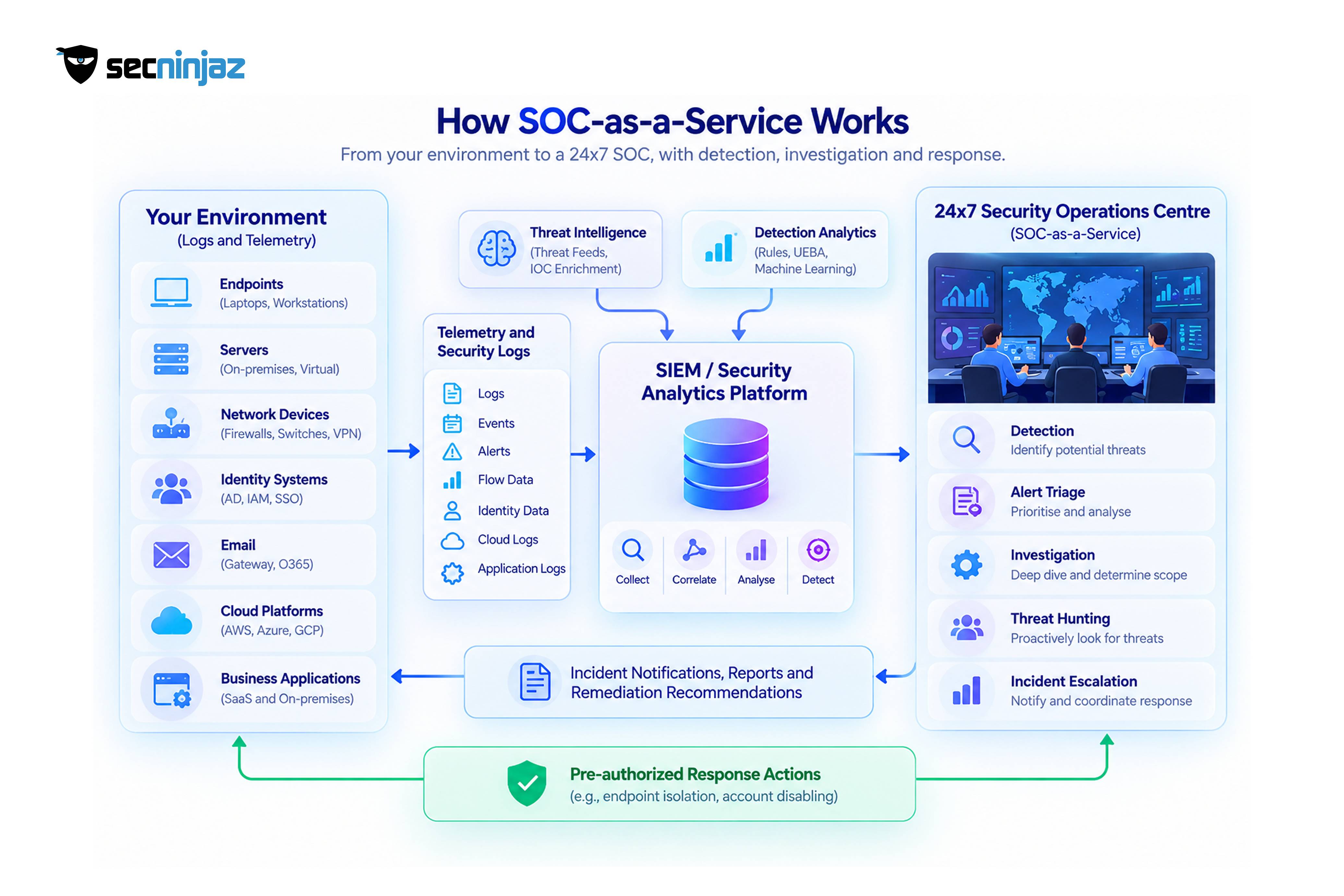
A Security Operations Centre (SOC) monitors an organization's technology environment for signs of malicious activity, investigates suspicious events, and coordinates incident response. SOC-as-a-Service (SOCaaS) delivers some or all of these capabilities through an external provider's people, processes, and technology, typically under a subscription or managed-service agreement. Depending on the agreed scope, the provider collects and analyses logs and telemetry, applies detection rules and analytics, enriches alerts with threat intelligence, investigates suspicious activity, and escalates confirmed or high-risk incidents. The service may also include threat hunting, incident-response support, detection engineering, reporting, and authorized containment actions. The contract should define exactly which capabilities are included, which response actions the provider can perform independently, and which require customer approval.
The core promise is coverage and skill without building them: analysts on duty at every hour, detection content maintained by specialists, and a team that sees patterns across many customers. The core risk is the reverse. A provider that does not understand an organization's business cannot judge which alert is serious, and a service that only forwards alerts has outsourced the noise, not the work.
How does SOCaaS differ from MDR, MSSP, and an in-house SOC?
The labels overlap in the market, and contracts should describe what is actually delivered. The distinctions below are the most useful ones.
| Model | Typical scope | Who holds the tooling | Response role | Best suited for |
|---|---|---|---|---|
| In-house SOC | Everything, built and run by the organization | The organization | Full control and full responsibility | Large organizations with the budget and talent to staff round the clock |
| SOC as a service | Log monitoring and detection across the estate, triage, escalation, reporting | Often the provider's platform, sometimes the customer's SIEM | Escalation, with containment where pre-agreed | Organizations that need broad monitoring without a full team |
| Managed detection and response | Detection and response focused on endpoints and key telemetry | The provider's chosen tools | Active response actions are central to the offer | Organizations that want hands-on containment more than broad log coverage |
| Traditional MSSP | Device management and alert forwarding | Varies | Often limited to notification | Organizations that mainly need device administration |
| Co-managed SOC | Shared work between internal and external teams | Shared | Split by agreement | Organizations with a small internal team that wants extra coverage |
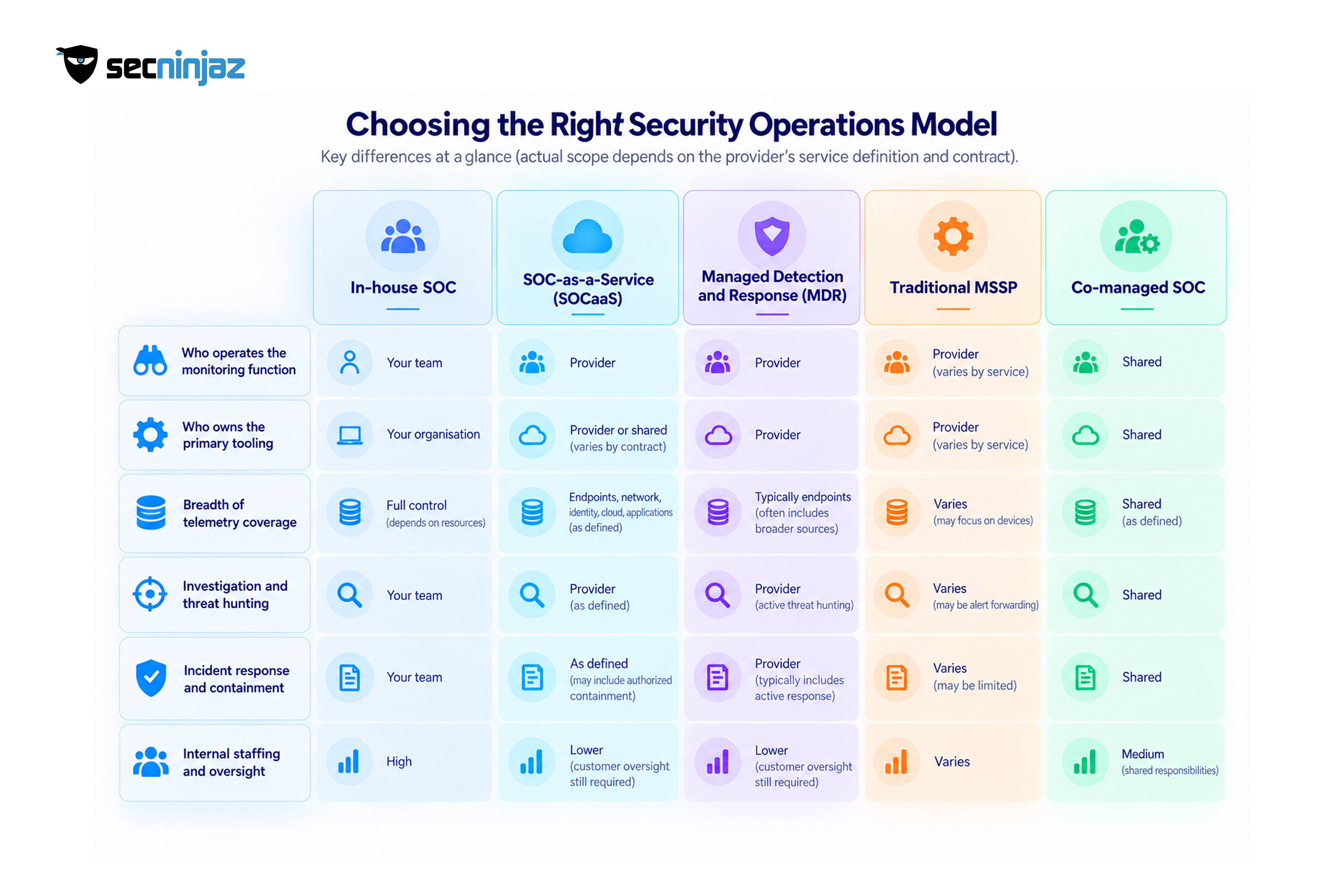
These categories are useful starting points, not rigid technical boundaries. Some SOCaaS providers include endpoint detection and response, threat hunting, and active containment, while some MDR providers ingest telemetry from identity systems, cloud platforms, networks, and applications in addition to endpoints. The distinction should therefore be established through the actual service scope: which assets are monitored, which detections are maintained, who investigates incidents, what containment actions are available, and which outcomes are contractually measured. Buyers should evaluate these capabilities rather than rely on the service label alone.
What does a SOC actually do around the clock?
A working SOC runs a continuous cycle. It collects logs and telemetry from endpoints, servers, networks, identity systems, cloud platforms, and applications. It detects suspicious activity using rules, analytics, and threat intelligence. Analysts triage each alert to separate real activity from noise, investigate the real ones by pulling related events together, and decide on escalation or containment. Findings are documented and reported, and the lessons feed back into better detection. The last step is the one that separates a mature SOC from a busy one, since a SOC that never improves its detections drowns in the same false alarms every week.
Is It the Right Fit?
When does an in-house SOC make sense, and when does SOCaaS?
IBM's data complicates the simple view that outsourcing is the faster route. Internal teams found more breaches than any other source and did so faster than the average, which suggests that a well-run internal capability is hard to beat. The same data shows breaches found by managed providers had the lowest average cost, so a provider is clearly not a second-best option either. The honest reading is that quality, context, and coverage matter more than who employs the analysts.
In practice, the choice turns on capacity and context. An organization with a mature security function, strong detection engineering, and the ability to retain analysts can reasonably build and run its own SOC. One without those, or one that cannot cover nights, weekends, and holidays, usually gets more from a managed or co-managed model. A hybrid is common: the internal team owns context, decisions, and remediation, while the provider supplies round-the-clock coverage and scale.
What does a 24x7 in-house SOC really take?
The arithmetic is worth doing before comparing quotes. Continuous coverage means 8,760 hours a year. A full-time analyst works roughly 1,800 to 2,000 productive hours once leave, training, and holidays are removed. One seat staffed at every hour therefore needs about five people, not one. These figures are illustrative arithmetic, not a quotation.
| Coverage level | Illustrative headcount | What it means |
|---|---|---|
| One analyst seat, 24x7 | About 5 people | Only triage is covered, with no depth behind it |
| Two tiers, 24x7 (triage plus investigation) | About 10 people | Enough for escalation inside the shift |
| Plus detection engineering, threat hunting, and management | More again | Needed to keep rules current and the team effective |
Add the SIEM and endpoint licences, the infrastructure, the training budget, and the cost of replacing analysts who leave, and the case for sharing that fixed cost across many customers becomes clear. The opposing case is control and context, which a provider can match only through disciplined onboarding.
Does SOCaaS replace an existing SIEM, EDR, or security team?
Usually not. Some providers bring their own SIEM and endpoint tooling, others operate the customer's. Either way, the organization still needs people who understand its systems and can approve actions, patch, rebuild, and decide what is acceptable risk. The provider detects and recommends. The organization decides and remediates. A contract that blurs this boundary leaves nobody accountable in the middle of an incident.
Who is responsible for what in a managed SOC arrangement?
A managed SOC works best when responsibilities are documented before the service goes live. The provider may operate the monitoring platform, investigate alerts, and perform pre-authorized containment, while the customer retains responsibility for business decisions, risk acceptance, remediation, and applicable regulatory obligations. Some activities are shared and require agreed escalation procedures.
| Activity | SOC provider | Customer organization |
|---|---|---|
| Log collection and monitoring | Operates the agreed monitoring capability | Ensures agreed sources are accessible and appropriately configured |
| Alert investigation | Investigates and documents findings | Supplies business context and access when required |
| Incident classification | Assesses technical severity and potential impact | Participates in business-impact and reportability decisions |
| Containment | Performs pre-authorized actions and recommends others | Approves actions outside delegated authority |
| Remediation and recovery | Advises or assists within the agreed scope | Owns remediation decisions and business recovery |
| Regulatory reporting | Supplies evidence and supports reporting | Ensures applicable obligations are met and filings are made by the responsible party |
| Service assurance | Reports metrics and supports validation | Reviews outcomes, challenges gaps, and verifies service effectiveness |
The final allocation must reflect the contract, the organization's governance model, and the applicable legal and regulatory requirements. A responsibility matrix should identify an accountable owner, an operational executor, and the escalation path for every critical activity.
What the Service Covers
Which log sources and environments should be monitored?
Coverage is the first thing to pin down in writing, because a SOC can only detect what it can see.
| Source category | Why it matters |
|---|---|
| Identity and access (directory, single sign-on, multi-factor logs) | Valid-account abuse and credential theft are central to many intrusions |
| Endpoints and servers | Where malware, lateral movement, and persistence show up |
| Network and perimeter (firewalls, VPN, DNS, proxies) | Visibility into movement and external contact |
| Email and collaboration | A frequent entry route, covering phishing and account takeover |
| Cloud platforms and SaaS | Misconfiguration, risky sign-ins, and data access in environments the organization may not fully control |
| Applications and databases | Where sensitive data lives and where web attacks land |
| Operational technology and IoT | Needs specialist monitoring where it exists |
Under CERT-In's Directions of 28 April 2022, covered entities must enable ICT-system logs and maintain them securely for a rolling period of 180 days within Indian jurisdiction. Separately, Rule 6 of the Digital Personal Data Protection Rules, 2025 provides for retaining the specified logs and personal data for one year for the purposes described in that rule, subject to its terms and applicable law. These requirements should not be treated as interchangeable. Organizations should map the retention periods applicable to their systems and data, confirm the relevant commencement dates, and configure their logging and storage arrangements accordingly. A SOC contract should explicitly address retention, storage location, retrieval, access controls, and the return or deletion of data at the end of the engagement.
How the Service Operates
How does onboarding work?
Onboarding is where many services are won or lost. A sensible sequence has distinct phases, and the duration of each depends mainly on how many sources are connected and how much custom parsing is needed.
| Phase | What happens | What to confirm |
|---|---|---|
| Discovery | Map assets, data flows, critical systems, and existing tools | An accurate inventory the monitoring can be scoped against |
| Source onboarding | Connect log sources and verify that the data arrives complete and correctly time-stamped | Clock synchronization and log completeness |
| Baseline and tuning | Learn normal behavior and tune detections to the environment | Early false-positive rates and gaps |
| Playbooks and authority | Agree escalation paths, contacts, and what the provider may do without approval | A signed response authority matrix |
| Parallel run | The provider monitors while the organization still watches in the old way | Comparison of what each side caught |
| Go-live and review | Move to full service and schedule regular reviews | Reporting rhythm and named contacts |
What happens when an alert fires, and who contains the incident?
A good service is specific about the steps. An alert is raised, an analyst triages it within an agreed time, and a determination is made: benign, suspicious, or confirmed. For confirmed activity, the analyst investigates scope, writes up what is known, and notifies the named contact by the agreed channel. Containment follows the authority matrix. The provider may be allowed to isolate an endpoint, disable an account, or block an address immediately, while changes that could disrupt the business need customer approval.
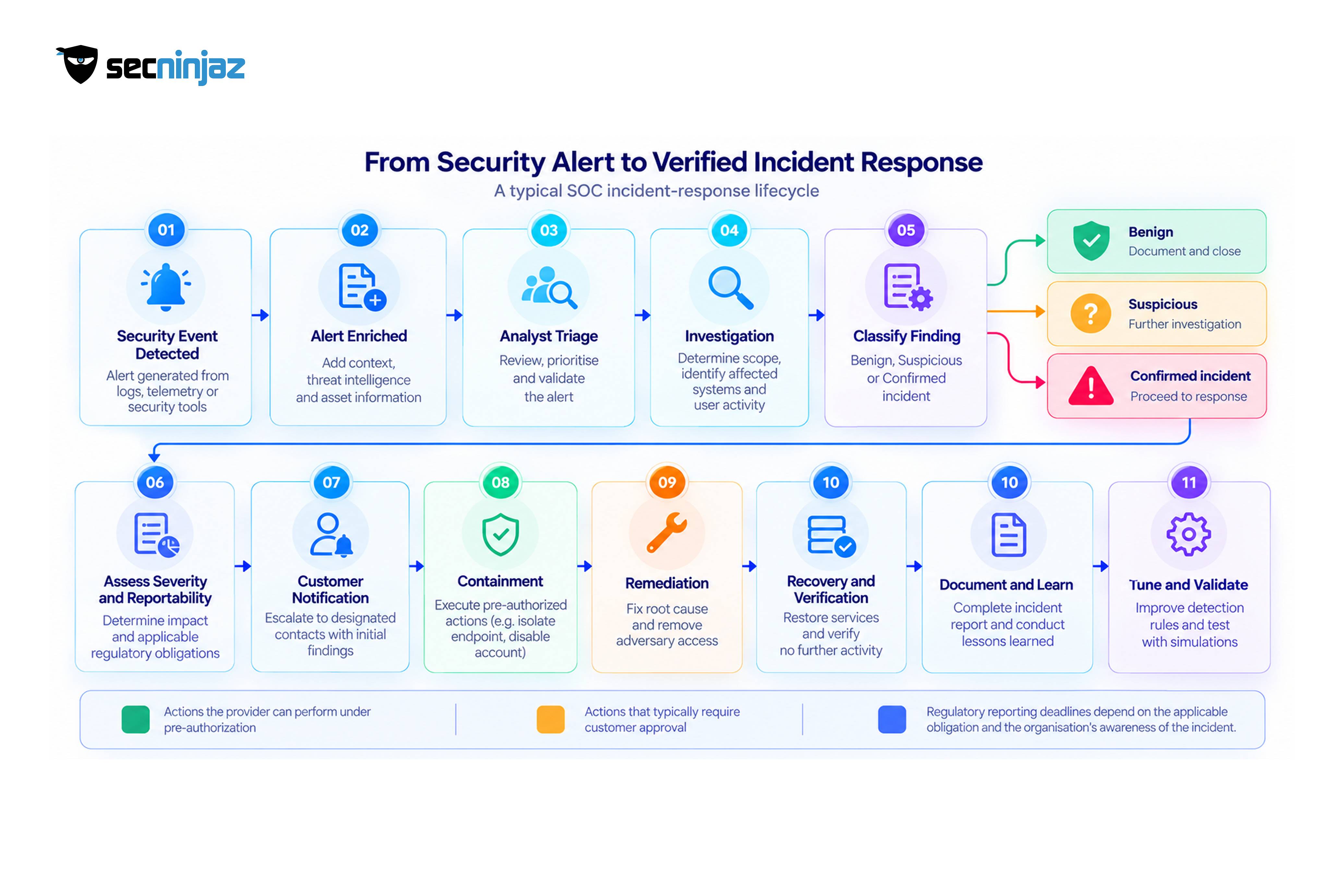
The most important column of that matrix is the one that says who can decide at three in the morning. A service that waits for a manager to wake up before isolating a compromised server has lost the benefit of round-the-clock monitoring.
What response actions should the provider be allowed to take?
| Authority level | Example actions | Typical arrangement |
|---|---|---|
| Observe and report | Raise alerts, write investigation notes | Always included |
| Recommend | Propose containment and remediation steps | Always included |
| Pre-approved containment | Isolate a single endpoint, disable a compromised account, block a malicious address | Agreed in advance, with logging and notification |
| Approval required | Shut down a production system, change firewall policy, take down a service | Needs a named approver, with a clear out-of-hours route |
What should the service levels and metrics look like?
Service levels should measure outcomes, not activity. A count of alerts processed says little. Useful measures include time to acknowledge an alert, time to triage it, time to escalate confirmed incidents, time to contain, the proportion of alerts that proved to be false positives, and detection coverage mapped to a framework such as MITRE ATT&CK. Quality matters as much as speed, so a periodic review of closed alerts by the customer is a worthwhile check. Metrics also need defined start and stop points, since a clock that begins when an analyst opens the alert, not when the alert fires, flatters the result.
| Metric | What should be measured | What the buyer should verify |
|---|---|---|
| Mean time to acknowledge (MTTA) | Time between alert generation and acknowledgement | Whether the clock starts at alert generation or analyst review |
| Mean time to triage | Time required to classify and prioritize an alert | Whether the target varies by severity |
| Mean time to escalate | Time between qualifying an incident and notifying the designated contact | Whether critical incidents have stricter targets |
| Mean time to contain | Time required to execute an authorized containment action | Whether customer approval delays are excluded or measured separately |
| Detection coverage | Coverage of agreed assets, log sources, and relevant attacker techniques | How coverage gaps are identified and reported |
| False-positive rate | Proportion of reviewed alerts classified as benign or non-actionable, using a defined calculation | Whether the denominator and classification rules are consistent |
| Detection validation | Results of purple-team exercises, attack simulations, and controlled test cases | Whether missed detections generate remediation actions and retesting |
| Reporting compliance | Timeliness and completeness of incident notifications and required reports | Whether contractual notification deadlines support applicable regulatory deadlines |
India-Specific Questions
Where must logs be stored, and what else does CERT-In require?
CERT-In's Directions of 28 April 2022 contain several points a SOC contract should address directly. Organizations must synchronize the clocks of all ICT systems to the NTP servers of the National Informatics Centre or the National Physical Laboratory, or servers traceable to them. They must enable logs of all ICT systems and maintain them securely for a rolling period of 180 days within the Indian jurisdiction, and provide them to CERT-In along with an incident report or when directed. They must designate a point of contact for CERT-In. And they must report the incident types listed in the Directions' annexure within six hours of noticing, a list of 20 categories that includes data breaches, data leaks, ransomware, phishing, and attacks on AI and machine learning systems.
For a provider relationship, this translates into questions with concrete answers. Where does the provider's platform store the customer's logs, and is that within India? Is retention of at least 180 days included? Can logs be produced quickly for CERT-In? Are clocks consistent across sources so events can be correlated and reported accurately? And who drafts and files the report?
Which clocks start when the SOC detects something?
A single incident may trigger several reporting obligations, each with its own scope, trigger, recipient, and deadline. The relevant clock depends on the applicable legal or regulatory requirement and the circumstances in which the organization becomes aware of the incident or detects it. A SOC should help identify potentially reportable incidents, escalate them promptly, preserve evidence, and provide the facts needed for reporting. The organization should have a documented process for determining reportability, identifying the applicable deadlines, and assigning responsibility for each filing. The service agreement must ensure that the provider's notification and evidence-delivery timelines leave sufficient time for the organization to meet its obligations.
| Obligation | Applies to | Clock |
|---|---|---|
| CERT-In Directions | Service providers, intermediaries, data centres, body corporates, and government organizations | Report listed incidents within six hours of noticing |
| RBI Directions, 2026 | Commercial banks | Report cyber incidents within six hours of detection on the DAKSH platform, and notify CERT-In |
| DPDP Rules 2025, Rule 7 (from May 2027) | Data fiduciaries | Tell affected individuals and give the Data Protection Board an initial intimation without delay, then a detailed report within 72 hours |
The deadlines and reporting triggers above should be checked against the current official text applicable to the organization. In particular, the CERT-In six-hour requirement, the RBI requirements for commercial banks, and the DPDP personal-data-breach notification process are distinct obligations. A SOC's internal alert or escalation SLA does not replace a statutory reporting deadline.
The practical consequence is that the SOC should triage not only for severity but for reportability. A contract should say who decides that an incident is reportable, how quickly the provider supplies the facts needed for each filing, and who submits. Accountability for the filing stays with the regulated organization even when a provider drafts the content.
What do SEBI and the RBI expect from a SOC?
SEBI's CSCRF requires regulated entities to establish security monitoring through a SOC, which may be the entity's own or a group SOC, a third-party managed SOC, or the Market SOC set up by NSE and BSE. Small-size and self-certification entities are directed toward the Market SOC. SOC effectiveness is to be reviewed half-yearly for Market Infrastructure Institutions and Qualified entities, and an efficacy report is obtained annually by other entities that rely on a third-party or Market SOC. A managed provider is therefore a recognized route, and it comes with an expectation of measuring whether the SOC works.
The RBI's Directions for commercial banks, issued on 31 July 2026, require a Cyber Security Operations Centre with continuous monitoring, log collection and correlation, threat intelligence, and incident response and forensic capability, and require cyber incidents to be reported to the RBI within six hours of detection. Commentary on the Directions describes a tiered structure beginning with round-the-clock first-level monitoring, and notes that third-party arrangements need contractual coverage of security, data protection, audit rights, incident reporting, and exit. Other categories of RBI-regulated entities have their own Directions, so the applicable text should be checked for each entity type.
How does the DPDP Act change what a SOC must do?
The Digital Personal Data Protection Act, 2023 and the Digital Personal Data Protection Rules, 2025 are relevant when a SOC monitors systems that process digital personal data. Rule 6 of the Rules addresses reasonable security safeguards, including appropriate security measures, access controls, visibility into access through logs and monitoring, investigation and remediation of unauthorized access, and retention of the specified logs and personal data for one year, subject to the rule's terms and applicable law. Rule 7 addresses intimation of personal-data breaches to affected individuals and the Data Protection Board of India. These substantive obligations have phased commencement provisions, so organizations should verify the applicable dates and any subsequent official amendments.
A SOC can support these obligations by monitoring relevant systems, detecting suspicious access, preserving evidence, escalating potential breaches, and supplying timely incident information. However, SOC monitoring alone does not establish compliance. The organization must define its incident-assessment and notification process, ensure that responsibilities are assigned, and confirm that the provider can supply the evidence needed within the applicable deadlines. Contracts with providers processing personal data should also address security safeguards, access restrictions, incident notification, evidence preservation, and cooperation during investigations.
Commercial Questions
How is SOC as a service priced?
Pricing models differ, and the model changes behavior and cost as the environment grows.
| Pricing driver | How it works | What to watch |
|---|---|---|
| Log volume (gigabytes per day or events per second) | Cost rises with data ingested | Overage charges, and pressure to collect less than needed |
| Per endpoint or per asset | A fixed fee per monitored device or system | Whether servers, cloud workloads, and network devices count |
| Per user | Common for identity and email-centred services | Whether service accounts and contractors are included |
| Tiered or flat packages | A set scope for a set fee | What falls outside the package, and how out-of-scope work is billed |
Questions that expose the real cost include how much log retention is included, whether the 180-day CERT-In period is covered at the quoted price, what incident response hours are included, how onboarding and tuning are charged, and what happens to the price when the environment grows. Contracts also need a clear exit route covering log and data return, since a provider that holds the only copy of years of security telemetry holds considerable leverage.
What should an organization ask any provider before signing?
| Area | Questions |
|---|---|
| Coverage | Which sources and environments are in scope, and how is gap detection handled? |
| Data | Where are logs stored, for how long, and who can access them? |
| People | Who are the analysts, what are their qualifications, and how is knowledge of the customer kept current? |
| Response | What can the provider contain without approval, and what is the out-of-hours route? |
| Measurement | Which metrics are reported, how are clocks defined, and can closed alerts be reviewed? |
| Regulation | How are CERT-In, sector regulator, and DPDP reporting supported? |
| Security | How is the provider's own access to the customer environment controlled and audited? |
| Exit | How are data and detection content returned at the end of the contract? |
Technology and Assurance Questions
Where does artificial intelligence fit in a SOC?
IBM's 2026 data reports that organizations using security AI and automation extensively identified and contained breaches in 215 days against 280 for those that did not, and averaged $1.93 million lower breach costs, though only 36% used these capabilities extensively across the security lifecycle. The 2026 Verizon DBIR offers a measured view of the attacker side, concluding that AI's primary impact so far is operational: it speeds up and scales techniques that defenders already know how to detect, so defenses do not need reinventing but do need to keep pace.
In a SOC, that points to a practical division of labor. Automation is well suited to enrichment, correlation, deduplication, and drafting investigation summaries, which relieves analysts of repetitive work. Judgment about whether an event is an attack, and decisions that affect the business, stay with people. A service worth buying can explain where automation acts on its own, where it recommends, and where a human always decides.
AI-assisted SOC operations should be evaluated on measurable improvements in detection quality, investigation time, analyst workload, and response consistency—not on the number of tasks automated. AI can help correlate events, summarize evidence, prioritize alerts, recommend investigation steps, and identify patterns across large volumes of telemetry. However, AI-generated conclusions can be incomplete or incorrect, and automated actions can create operational risk if they use excessive privileges or insufficient context.
Organizations should establish access controls for AI systems, validate important findings against underlying evidence, log AI-assisted decisions, and define which actions require human approval. Providers should also disclose where AI is used, what customer data is processed, how outputs are validated, and whether AI-assisted containment is permitted. The objective is not maximum automation at any cost; it is faster and more consistent security operations with measurable safeguards and accountable decision-making.
How can an organization tell whether the SOC actually works?
Trust in a SOC should rest on evidence. A provider's reports describe what was seen, not what was missed, so the organization needs a way to test the second question. Purple team exercises and breach and attack simulation run known attacker techniques against the monitored environment and check whether each one is detected, how quickly, and whether the right people are notified. Tabletop exercises test whether the escalation path and the regulatory clocks work under pressure. A periodic review of closed alerts tests the quality of triage. The CSCRF's expectation of a SOC efficacy review is a regulatory version of the same idea.
What if the provider itself is the weak link?
A SOC provider holds privileged visibility into a customer's environment, which makes it an attractive target and a third-party risk in its own right. The same DBIR reports third-party involvement in 48% of breaches, up 60% from the year before. Sensible safeguards include least-privilege and strongly authenticated access for provider staff, segregation between customers' data, audit rights, clear notification duties if the provider is itself compromised, and an information security management certification whose scope covers the SOC. Asking how the provider detects its own compromise is a fair question.
Before onboarding a provider, assess its security controls as carefully as those of any other privileged third party. Review how provider personnel authenticate to customer environments, how privileged sessions are controlled and recorded, how tenant data is segregated, how access is revoked when personnel leave, and how the provider detects and reports compromise of its own systems. Confirm that the contract provides appropriate audit rights, incident notification, evidence preservation, subcontractor transparency, and an orderly exit process. Any certification presented as evidence of assurance should be checked for validity, scope, and applicability to the actual service being delivered.
A Maturity Model for Security Monitoring
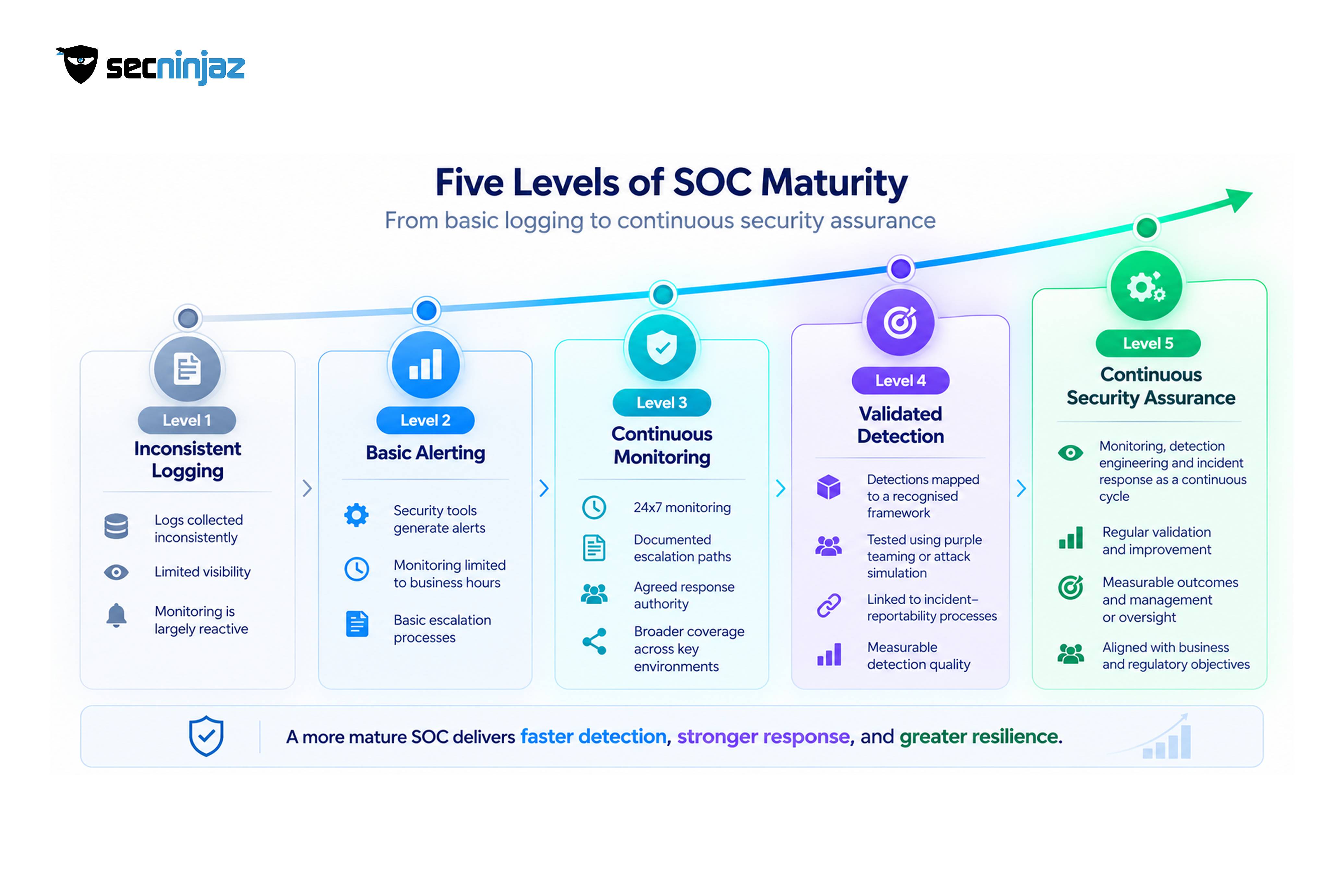
Level 1: Logs are collected inconsistently, nobody watches them outside business hours, and incidents are discovered by users or outsiders ↓ Level 2: A SIEM or endpoint tool raises alerts that are reviewed during working hours only ↓ Level 3: Round-the-clock monitoring exists, in-house or managed, with defined escalation paths and agreed response authority ↓ Level 4: Detections are mapped to a framework and validated through purple team exercises or simulation, and reportability is triaged with each incident ↓ Level 5: Monitoring, detection engineering, and validation run as one continuous cycle, with metrics reported to the board and mapped to regulatory duties
The step from Level 2 to Level 3 is the one that SOC as a service most often delivers, since it adds the hours and the discipline that a small internal team cannot cover alone.
A Readiness Playbook for Adopting SOC as a Service
- List the systems and data that matter most before talking to providers, so coverage is scoped to risk and not to a package.
- Decide what must stay in India for logs and personal data, and write the requirement into the contract.
- Map the regulatory clocks that apply and agree who decides reportability and who files.
- Define response authority in a matrix, including the out-of-hours approval route.
- Run a parallel period in which the provider's detections are compared with what the organization already catches.
- Set metrics with defined start and stop points, and review samples of closed alerts.
- Test the service with a purple team exercise or attack simulation within the first months, then on a schedule.
- Plan the exit at the start, including return of logs and detection content.
Common Mistakes and Edge Cases
Buying on price per endpoint without checking what is covered. A low rate that excludes cloud, identity, or email leaves the likeliest entry points unwatched.
Accepting alert forwarding as a SOC. If the service ends at an email, the hard work of investigation still falls to the customer.
Leaving response authority vague. Hours lost waiting for approval during an active incident are a cost no service level will recover.
Ignoring where logs are stored. Telemetry held outside India or retained for too short a period can put the organization at odds with the CERT-In Directions.
Assuming the provider files the regulatory report. Accountability stays with the regulated organization, and the contract should say who does the work.
Never testing detection. A quiet dashboard can mean no attacks, or it can mean no visibility.
Forgetting the exit. Years of security data and tuned detection content are valuable and need a defined route back.
How SecNinjaz Fits Into This
AI SOC Automation sits within SecNinjaz's Cybersecurity practice alongside Vulnerability Assessment, Penetration Testing, Red Teaming, Purple Teaming, Breach and Attack Simulation, and Social Engineering. That combination matters for the assurance questions above, because the same practice that supports monitoring can also test whether detections work, through purple team exercises and attack simulation. Current engagements in AI-supported security operations are AI-augmented, with automation assisting analysts and people making the decisions that count.
The regulatory side connects to SecNinjaz's GRC and DPDP practice, including Regulatory Compliance and Audit and Gap Assessment, which help map monitoring and incident reporting to the CERT-In Directions, sector regulator expectations, and DPDP safeguard duties. SecNinjaz holds ISO/IEC 27001:2022 for information security, ISO/IEC 20000-1:2018 for IT service management, and ISO/IEC 27701:2025 for privacy information management, relevant to the service discipline and data handling a monitoring relationship depends on. For organizations deciding how to cover the hours and skills a SOC demands, that pairing of monitoring support and independent validation is the one worth looking for, whether the organization works with SecNinjaz or anyone else.
Talk to Our Security Experts →
Frequently Asked Questions
What is the difference between a SOC and a NOC?
A network operations centre watches the availability and performance of networks and systems, while a security operations centre watches for malicious activity and coordinates the response. The two often share data, but their goals and skills differ.
Do smaller organizations need a SOC?
They need monitoring, and a managed service is often the practical way to get it. SEBI's framework, for instance, points small-size regulated entities to a shared Market SOC, and a third-party managed SOC is an accepted route for others.
What is a Market SOC?
A Market SOC is a shared security operations facility that SEBI's CSCRF directs NSE and BSE to set up, so smaller regulated entities can meet the continuous monitoring requirement without building their own SOC.
Is SIEM as a service the same as SOC as a service?
No. SIEM as a service provides the platform that collects and correlates logs. SOC as a service adds the people and processes that triage alerts, investigate, and escalate. A SIEM without analysts produces alerts that nobody may read.
Can a managed SOC work with the tools an organization already has?
Often yes. Some providers operate the customer's existing SIEM and endpoint tools, and others bring their own platform. Which approach fits depends on licence ownership, log residency needs, and how much tuning the existing tools already have.
How does SOC as a service support CERT-In compliance?
It can help with the log retention, time synchronization, detection, and fast reporting that the CERT-In Directions expect. The Directions require logs to be kept for a rolling 180 days within India and listed incidents to be reported within six hours of noticing, and the regulated organization remains accountable for the filing.
Does SOC as a service help with DPDP Act compliance?
It supports two duties that take effect in May 2027: the security safeguards in Rule 6, which include logs, monitoring, and review to detect unauthorized access, and the breach intimation duty in Rule 7, which depends on noticing a breach quickly. It does not by itself satisfy either obligation.
Where should an organization start?
Start by listing the systems and data that matter most and the regulatory clocks that apply. Then decide what must stay in India, define who can approve containment out of hours, and test any shortlisted provider with a parallel run before committing.