
India's cybersecurity workforce is expanding rapidly, but the challenge is increasingly about capability as well as headcount. Globally, SANS's 2026 Cybersecurity Workforce Research Report found that skills gaps had overtaken headcount shortages as the industry's primary workforce challenge, with 60% of organizations identifying skills as the larger problem versus 40% citing staffing shortages. That gap had been four points a year earlier. It is now twenty. Meanwhile, the average enterprise security operations centre processes more than 10,000 alerts a day, false positive rates commonly run between 50% and 80%, and up to 40% of alerts never get investigated at all.
Put those two facts together and the real problem an Indian SOC faces is not usually a headcount problem. It is that the analysts already on staff are drowning in noise and need to get sharper at recognizing a genuine attack pattern inside it, faster than the organization can realistically hire its way out of the gap. That is precisely the problem purple teaming exists to solve, and it solves it differently than either a standalone red team engagement or ordinary SOC operations can on their own.
Purple teaming is not a red team report handed to the blue team after the fact, and it is not the blue team quietly reviewing its own logs. It is red and blue working the same exercise together, in real time, technique by technique, with the blue team learning to detect something the moment the red team executes it rather than reading about it in a document weeks later. That distinction, real-time collaboration versus a report thrown over the wall, is the entire reason purple teaming produces a different outcome than the two disciplines it draws from.
This guide covers what purple teaming actually is, how a real exercise runs from scoping through to a closed detection gap, why this format solves a problem standalone red teaming cannot, what it measurably improves inside a SOC, and where it matters most for Indian security operations specifically. It is written for SOC leads, CISOs, and the security teams who have to make detection capability keep pace with a threat environment that is not waiting for the hiring pipeline to catch up.
What Purple Teaming Actually Is, and Is Not
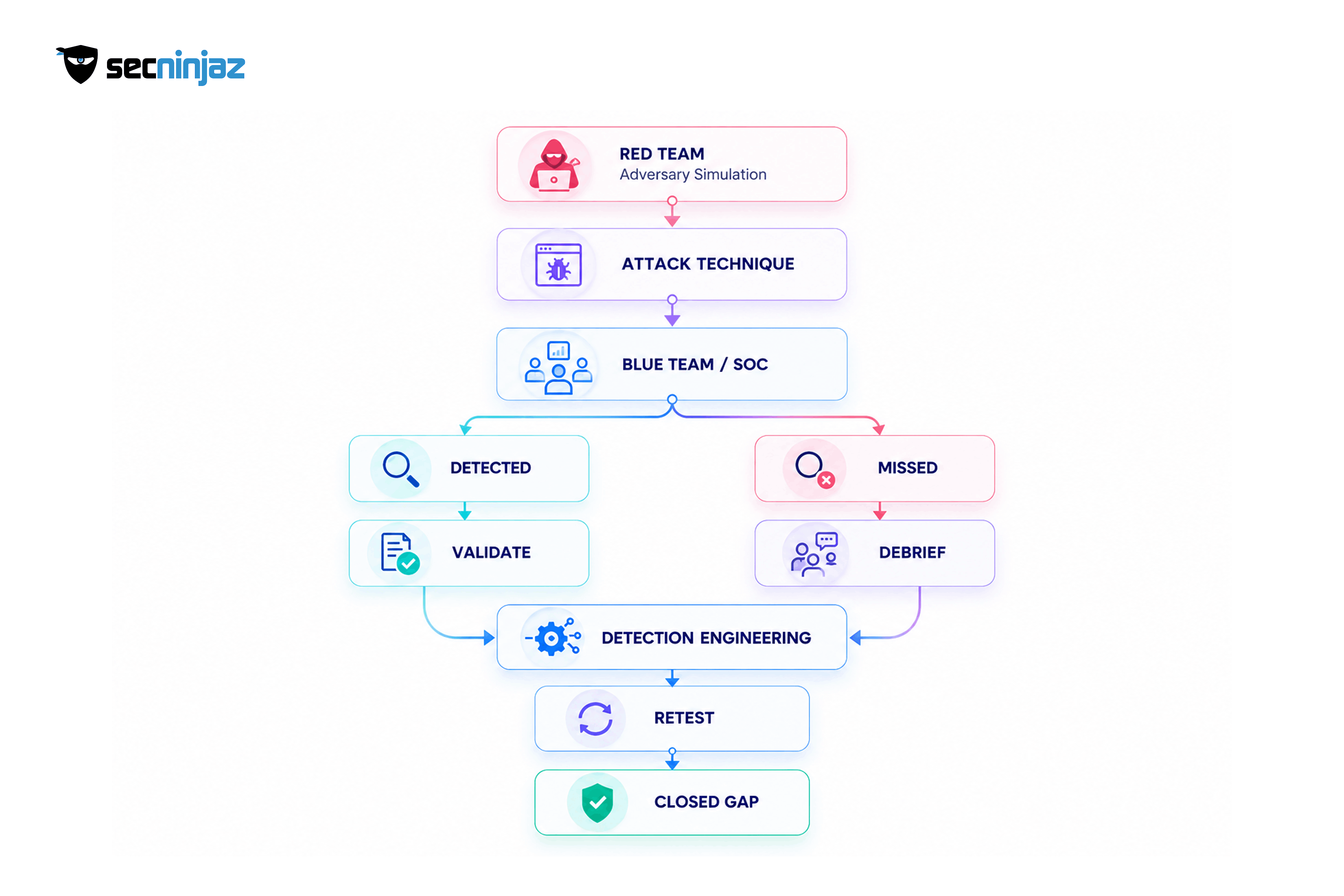
A standalone red team engagement tests whether a SOC would catch a real intrusion, and it usually does this stealthily, with the defending team learning what happened only at a debrief that may come weeks after the exercise started. Standalone blue team operations, the SOC's normal day-to-day work, respond to whatever comes in, real incidents rather than controlled ones, with no adversary simulation component at all. A penetration test, for its part, is coverage-based and largely unconcerned with detection capability; it is measuring whether vulnerabilities exist, not whether anyone would notice an attacker exploiting them.
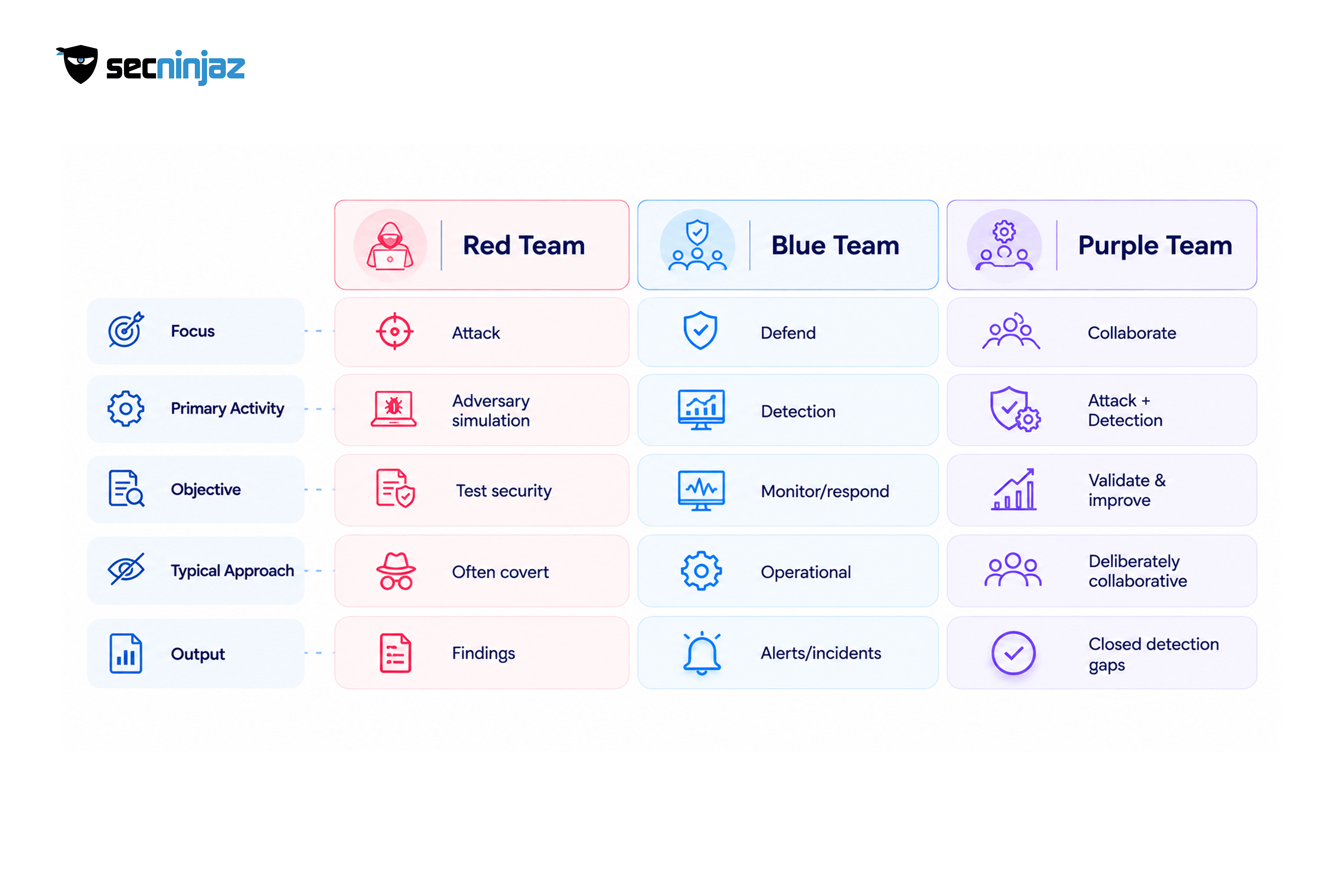
Purple teaming sits apart from all three. Purple teaming is a collaborative security-validation approach in which offensive activity and defensive detection engineering are deliberately connected. Red-team or adversary-emulation activity is used to test specific defensive hypotheses, while the blue team validates visibility, detection, investigation and response, with findings fed directly back into detection engineering and subsequent retesting. MITRE ATT&CK provides the shared vocabulary both sides work from, a common language for naming and organizing the specific techniques being tested, so the exercise produces a structured map of what is detected and what is not rather than an anecdotal list of findings.
Talk to Our Security Experts →
Purple Teaming and Its Neighboring Disciplines
| Discipline | What it does | How it differs from purple teaming |
|---|---|---|
| Standalone red team | Tests detection stealthily and reports findings afterward | No real-time feedback; the SOC often does not learn what happened until a debrief held well after the exercise |
| Standalone SOC operations | Monitors and responds to whatever activity actually occurs | No controlled adversary simulation; every incident is real, with no structured technique-by-technique coverage |
| Penetration testing | Finds and validates technical vulnerabilities within a defined scope | Coverage-based rather than detection-focused, and generally unconcerned with whether the SOC would notice exploitation |
| Purple teaming | Red executes one technique at a time, blue attempts live detection, both debrief immediately | Real-time, collaborative, technique-by-technique, with detection engineering built directly into the exercise |
Anatomy of a Purple Team Exercise
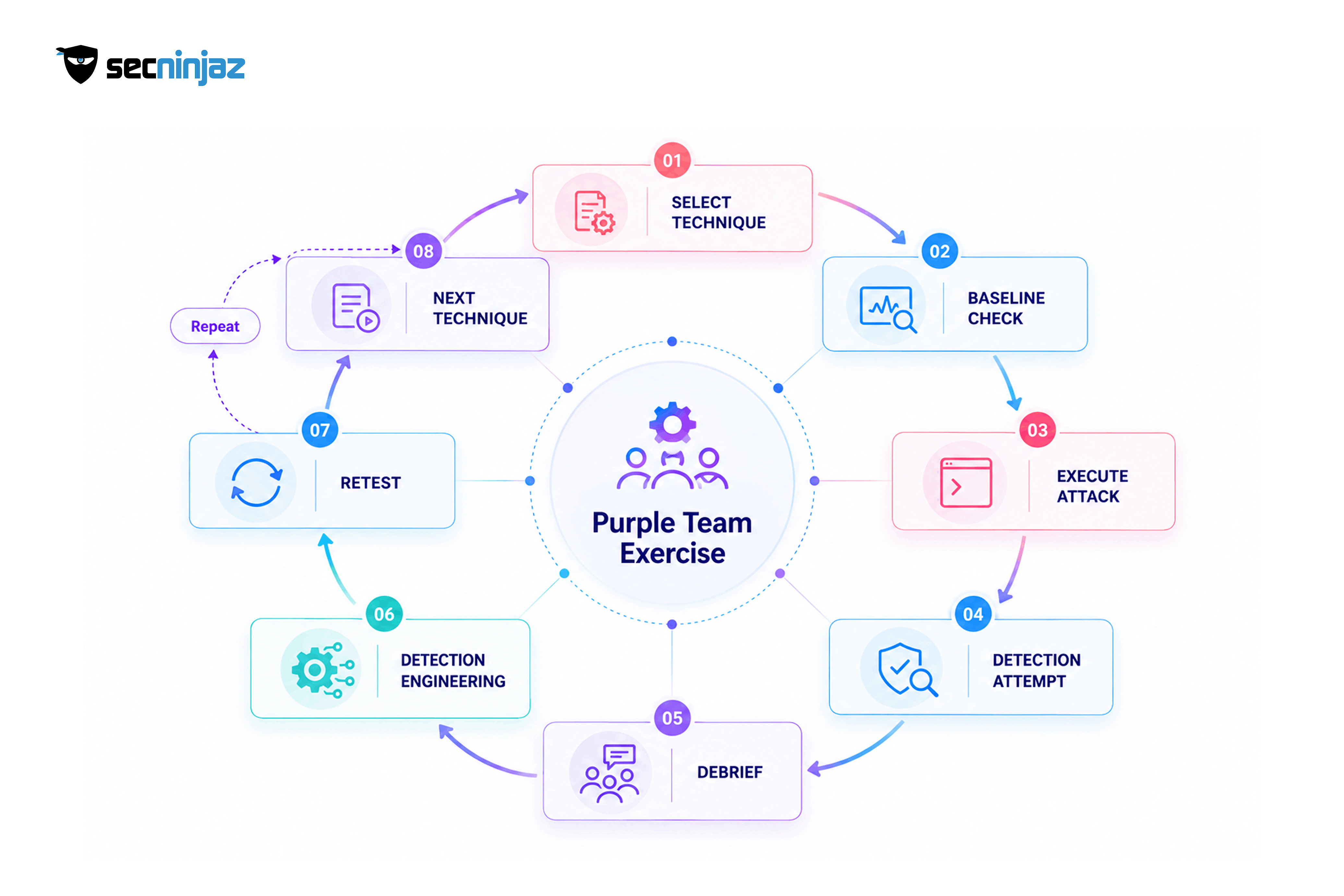
A well-run exercise moves through a consistent sequence, and skipping any step tends to weaken what the exercise actually delivers.
| Step | What happens |
|---|---|
| 1. Scoping and technique selection | Red and blue agree in advance on a list of MITRE ATT&CK-mapped techniques relevant to the organization's actual sector and threat profile |
| 2. Baseline detection check | The team confirms what existing tooling and rules currently detect, before any new activity runs, so later improvement can be measured against a real starting point |
| 3. Live technique execution | The red team executes one technique in a controlled, observed setting |
| 4. Real-time detection attempt | The blue team tries to spot the activity using its existing tools and rules, while the red team confirms whether, and when, detection actually occurred |
| 5. Immediate debrief | Both sides discuss why the technique was caught or missed, whether the gap was visibility, a rule that needed tuning, alert routing, or analyst training |
| 6. Detection engineering | A new or tuned detection rule gets built, addressing specifically what the debrief just uncovered |
| 7. Retest | The same or a closely related technique runs again to confirm the new detection genuinely works, not just in theory |
| 8. Move to the next technique | The cycle repeats across the agreed technique list |
Why This Format Solves a Problem Standalone Red Teaming Cannot
A standalone red team report documents a detection gap. It does not, on its own, transfer the tradecraft knowledge behind that gap into the analysts who will actually be staffing the SOC next month. Purple teaming does that transfer directly, in the room, at the moment a technique executes, which matters far more given SANS's finding that skills gaps, not headcount, are now the dominant workforce problem. A SOC that cannot hire its way to full staffing quickly still has a real path to getting measurably better at recognizing genuine attack behavior, and that path runs through exercises where analysts watch a technique happen and learn, immediately, what it actually looked like in their own tooling.
The same logic applies to the alert fatigue numbers cited earlier. Detection engineering that comes directly out of a purple team debrief is aimed at a specific, just-observed technique, which tends to produce a rule that fires on genuine attacker behavior rather than one more generic signature adding to an already overwhelming volume of low-fidelity alerts. Purple-team-driven detection engineering can help reduce false positives when tuning is based on observed attacker behavior, environmental context and validated telemetry rather than broad signatures.
What a Purple Team Exercise Measurably Improves
| Metric | What it measures | How purple teaming moves it |
|---|---|---|
| Mean time to detect | Time from technique execution to the SOC noticing it | Directly tested and improved technique by technique during the exercise itself |
| Mean time to respond | Time from detection to containment | Improved through the response half of each debrief, not just the detection half |
| Detection coverage against MITRE ATT&CK | The share of relevant techniques the SOC can actually detect | Grows exercise by exercise as each identified gap gets closed and retested |
| Analyst confidence and skill | The ability to recognize a real technique inside routine alert noise | Built directly through live, hands-on exposure rather than reading a report afterward |
Where This Matters Specifically for Indian SOCs
The workforce numbers at the start of this guide are not an abstract industry statistic; they describe the operating reality most Indian security teams are already working inside. A capability-building exercise that gets more out of an existing, understaffed team matters more in that environment than it would in a market with an easier hiring pipeline, and purple teaming is built specifically for that kind of leverage rather than only for organizations large enough to run parallel red and blue functions.
Regulatory direction reinforces the same priority. SEBI's Cybersecurity and Cyber Resilience Framework (CSCRF) requires Market Infrastructure Institutions (MIIs) and Qualified Regulated Entities to conduct red-team exercises, while also establishing requirements around SOC monitoring and functional efficacy. AI-driven SOC automation is a genuine complement here rather than a competing approach: Gartner's 2026 research suggests that effective AI deployment in SOCs could reduce human-touch incidents by 30% by 2028, increasing the importance of validating automated detection and response workflows against realistic adversary behavior.
What a Weak or Absent Purple Team Programme Costs
| Gap | Consequence |
|---|---|
| Red team findings delivered only as a report | Detection gaps get documented but rarely closed, since the SOC never learns live why the activity was missed |
| No baseline detection check before the exercise | No way to tell whether a later improvement is genuine progress or was already working before the exercise began |
| No retest after tuning a detection rule | The apparent fix is never actually confirmed to work against a live repeat of the technique |
| Treating one exercise as sufficient indefinitely | Attacker techniques evolve, and a detection tuned for last year's variant can miss this year's |
| Unaddressed alert volume and false positives | Analysts burn out on noise, worsening exactly the capacity problem purple teaming's detection engineering is meant to relieve |
A Maturity Model for Purple Teaming in a SOC
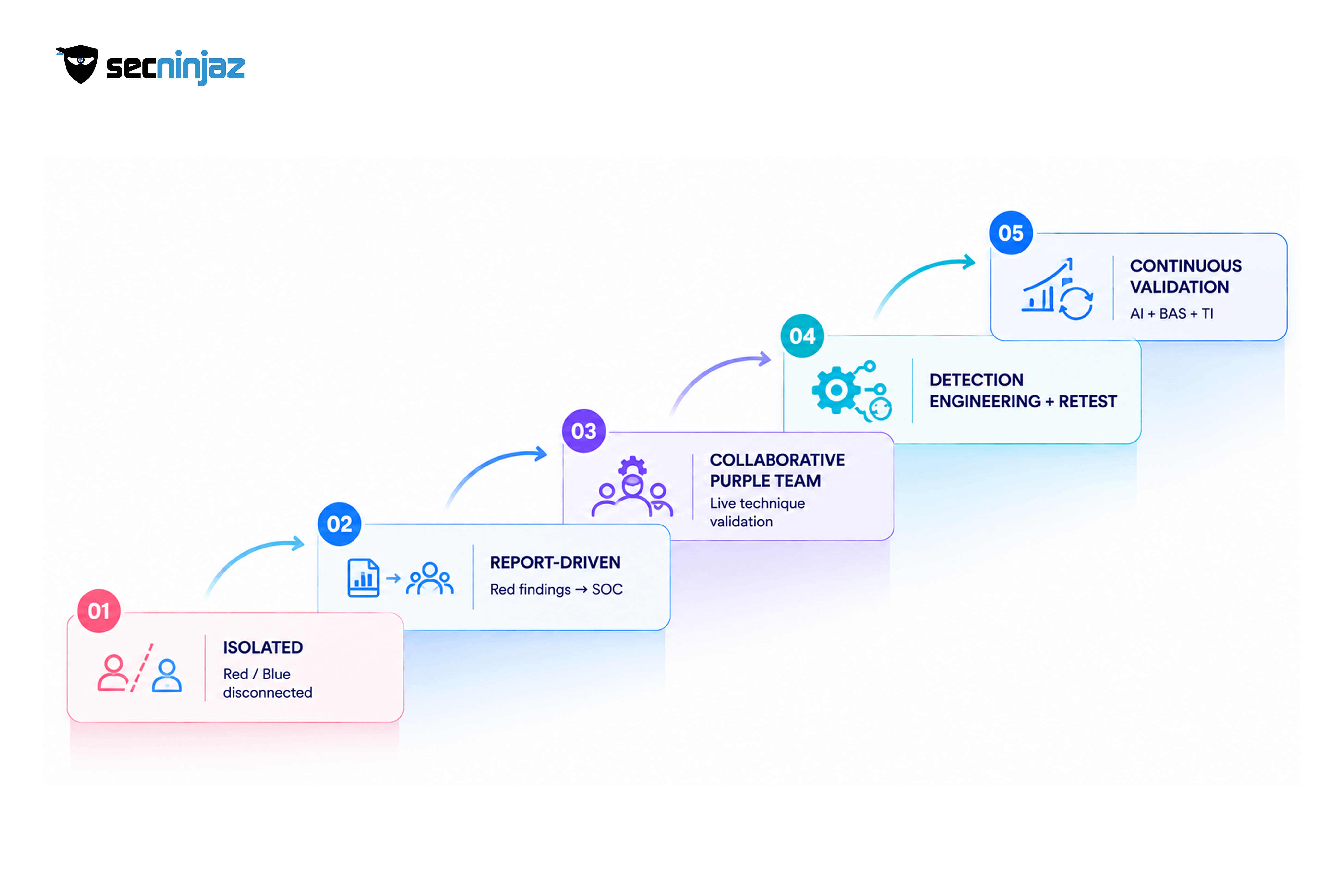
Most SOCs sit somewhere on a five-level path between total isolation and a continuously running purple team programme.
Level 1: Red team and blue team operate in complete isolation, with findings never reaching detection engineering at all ↓ Level 2: A red team report gets handed to the SOC after the engagement, with no live collaboration involved ↓ Level 3: Scheduled purple team exercises run technique by technique with an immediate, structured debrief ↓ Level 4: Detection engineering is built directly into the exercise cadence, with retesting confirming each fix actually closes the gap ↓ Level 5: Continuous purple teaming runs alongside AI-assisted detection tooling, informed by current threat intelligence, with MITRE ATT&CK coverage tracked and reported over time
The jump from Level 2 to Level 3, moving from a one-directional report to genuine live collaboration, is where most of the skill-transfer value this guide describes actually begins.
A Readiness Playbook for Building a Purple Team Programme
- Baseline current detection coverage against a MITRE ATT&CK-mapped technique list before scheduling anything, so later progress can be measured against a real starting point.
- Select techniques relevant to the organization's actual sector and threat profile, rather than working from a generic, one-size-fits-all list.
- Run the exercise live, with red and blue in the same room or on the same call, not as two teams working on separate timelines.
- Debrief immediately after each technique, rather than saving discussion for the end of the whole engagement.
- Turn every debrief finding into a specific detection engineering task, not a general recommendation left for someone to interpret later.
- Retest the new or tuned detection against the same technique before moving on to the next one on the list.
- Track MITRE ATT&CK coverage across exercises over time, rather than treating each session as a standalone pass-or-fail event.
- Repeat on a fixed cadence, since both attacker techniques and the SOC's own tooling keep changing after any single exercise ends.
Common Mistakes and Edge Cases
Treating purple teaming as a slower, more expensive red team engagement. Without genuine, live collaboration between both sides, it is just a red team exercise with extra steps, not the distinct discipline this guide describes.
Skipping the baseline check. Without knowing what was already detectable before the exercise, nobody can honestly say what actually improved afterward.
Ending at the debrief without turning findings into detection engineering work. A documented gap that never becomes a tuned rule is functionally the same outcome as a standalone red team report.
Skipping the retest. A detection rule believed to be fixed but never confirmed against a live repeat of the technique is still an open question, not a closed one.
Choosing techniques disconnected from the organization's real threat profile. Testing detection against attack patterns irrelevant to the sector wastes the exercise's most valuable resource, time with both teams engaged together.
Running one exercise and considering the SOC tested indefinitely afterward. Attacker techniques evolve continuously, and a single exercise is a snapshot, not a permanent certification.
When to Use What: A Few Decision Points
Purple teaming versus standalone red teaming. If the goal is purely testing whether detection works without alerting the defending team, a standalone, unannounced red team exercise is the right tool. If the goal is improving detection collaboratively and building analyst skill in the process, purple teaming is the better fit.
In-house facilitation versus external support. A SOC with existing red-team expertise in-house can run purple team exercises internally. One without that depth typically gets more value from an external provider who brings both the offensive technique library and the facilitation experience needed to run a genuinely productive live exercise.
A collaborative, announced format versus a more adversarial one. A SOC new to this kind of exercise benefits from a fully collaborative format focused on learning. A more mature SOC, already comfortable with the basics, can introduce more adversarial elements to test realistic pressure without losing the core value of immediate, structured feedback.
How SecNinjaz Fits Into This
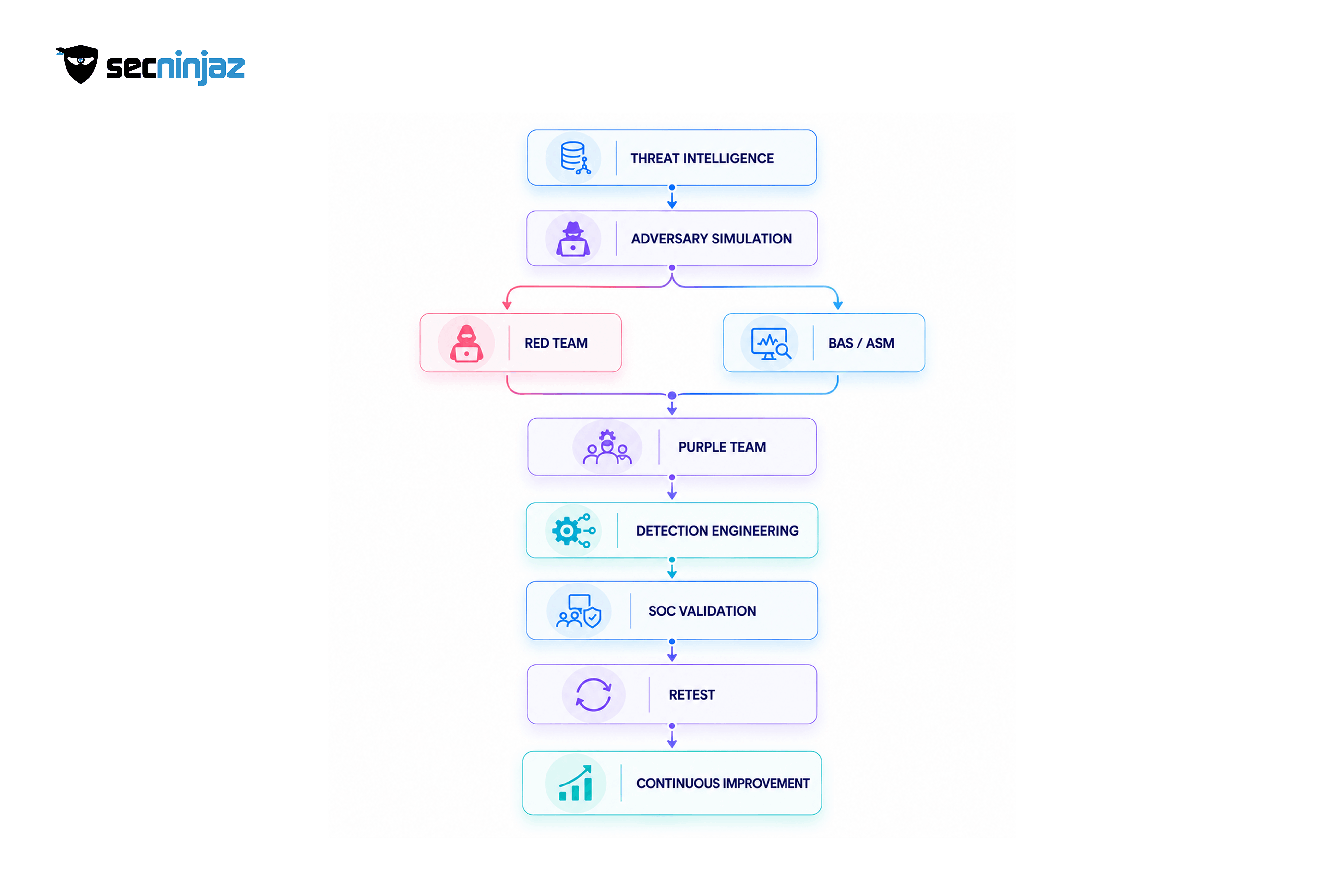
Purple Teaming sits within SecNinjaz's Cybersecurity practice alongside Red Teaming, Penetration Testing, Breach and Attack Simulation, and AI SOC Automation, the last of which extends directly into the continuous detection layer a purple team exercise is built to validate and improve. SecNinjaz approaches purple teaming as an integrated validation cycle spanning adversary simulation, detection engineering, SOC validation and retesting. This allows organizations to connect offensive findings directly to defensive improvements rather than treating the red-team report as the endpoint of the exercise.
SecNinjaz holds ISO/IEC 27001:2022 certification, relevant here because the detection rules, exercise findings, and SOC tooling configuration a purple team engagement touches are among the more sensitive operational material a security team holds, and handling that material under the same access control and confidentiality discipline the standard requires elsewhere matters as much as the exercise itself. For Indian SOCs trying to get more capability out of the analysts they already have, rather than waiting on a hiring pipeline that is not moving fast enough on its own, that combination of offensive technique depth and detection engineering discipline is the pairing worth looking for, whether the organization works with SecNinjaz or anyone else.
Talk to Our Security Experts →
Frequently Asked Questions
What is purple teaming?
Purple teaming is a collaborative security exercise where a red team executes attack techniques one at a time in a controlled setting while a blue team attempts to detect them live, with both sides debriefing immediately after each technique. It differs from a standalone red team engagement by removing the delay between the activity and the defending team learning from it.
What is the difference between red teaming, blue teaming, and purple teaming?
Red teaming tests detection stealthily and reports findings afterward, often with the defending team unaware an exercise is underway. Blue teaming refers to a SOC's normal defensive operations, monitoring and responding to real activity. Purple teaming combines both in real time: the red team executes a technique, the blue team tries to detect it live, and the two sides work together on the spot to close whatever gap the exercise reveals.
Why does purple teaming matter more given the current cybersecurity skills shortage?
SANS's 2026 workforce report found that skills gaps have overtaken headcount shortages as the industry's top workforce challenge, and India's own cybersecurity workforce gap exceeds one million vacancies. Purple teaming transfers offensive tradecraft knowledge directly into a SOC's existing analysts through live, hands-on exposure, which builds capability faster than hiring alone can close the gap.
What role does MITRE ATT&CK play in a purple team exercise?
MITRE ATT&CK provides the shared vocabulary both the red and blue teams use to name and organize the specific techniques being tested. Structuring an exercise around ATT&CK-mapped techniques produces a clear map of detection coverage and gaps, rather than an informal, anecdotal list of what worked and what did not.
How does purple teaming help with SOC alert fatigue?
Detection engineering built out of a purple team debrief is targeted at a specific, just-observed technique, which tends to produce precise rules that fire on genuine attacker behavior rather than broad signatures that add to an already high volume of low-fidelity alerts. With false positive rates commonly running between 50% and 80% across enterprise SOCs, this kind of targeted tuning is a more direct route to reducing noise than adding generic detection rules.
How often should a purple team exercise be run?
A single exercise is a snapshot rather than a permanent result, since attacker techniques and an organization's own tooling both keep changing afterward. Running exercises on a fixed, recurring cadence, informed by current threat intelligence, is what allows MITRE ATT&CK coverage to be tracked and genuinely improved over time rather than assessed once and assumed to hold indefinitely.
Does AI-driven SOC automation replace the need for purple teaming?
No. Gartner projects that more than half of Tier 1 SOC analyst work will be handled by AI by 2028, but that automation still needs to be validated against real technique execution rather than taken on a vendor's claims alone. A purple team exercise is exactly the mechanism that confirms whether an automated detection layer is actually catching what it is meant to.
Where should a SOC start if it has never run a purple team exercise before?
Start by baselining current detection coverage against a MITRE ATT&CK-mapped technique list relevant to the organization's actual threat profile, before scheduling any live exercise. Running the first session as a fully collaborative, learning-focused exercise, with an immediate debrief and a specific detection engineering task assigned to each finding, tends to produce more durable improvement than a more adversarial format attempted before the SOC has built up basic exercise experience.