
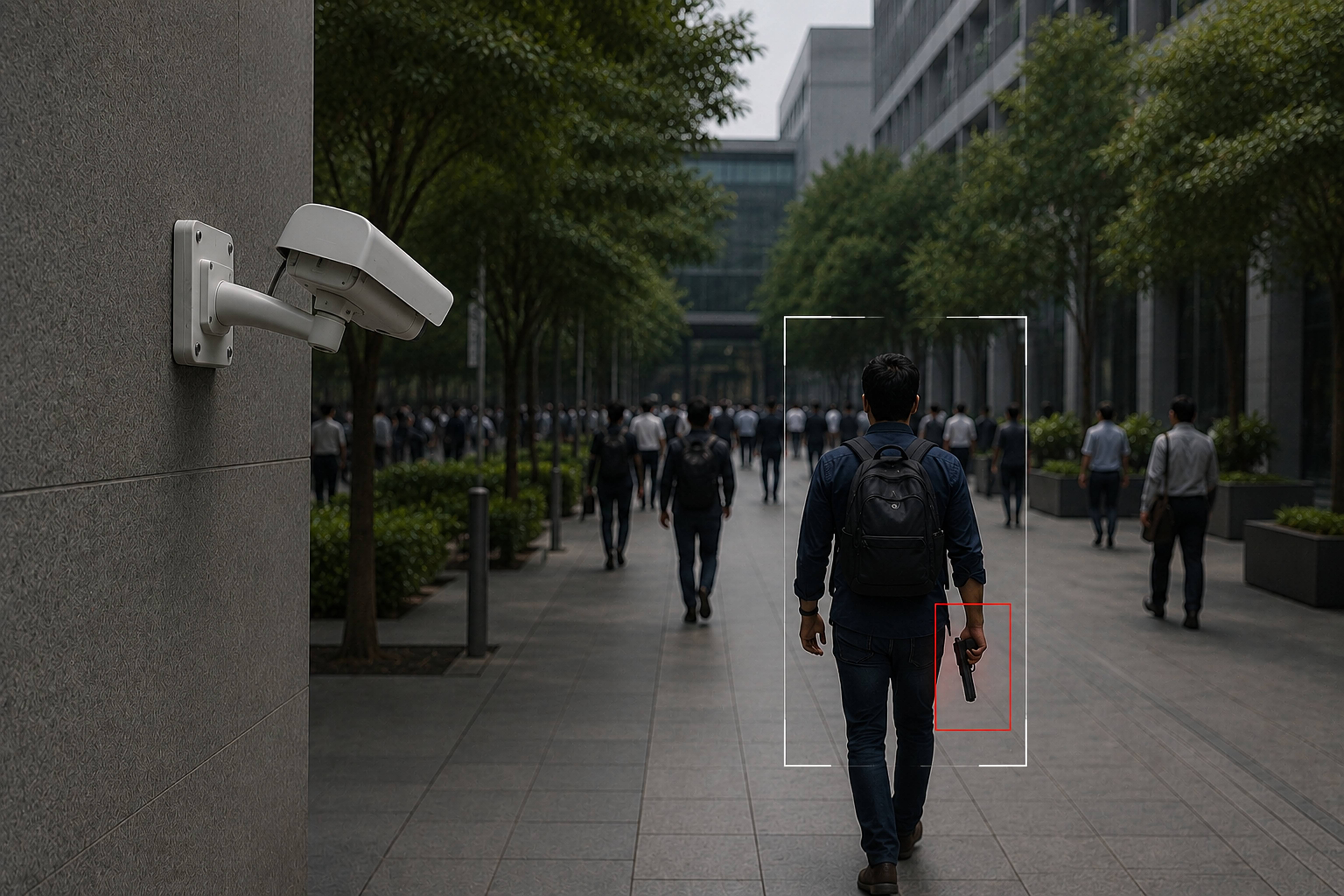
A camera that records and a camera that understands are two different products. Most Indian sites, whether that is a metro station, a factory gate, or a district control room, are stuck with the first kind. Footage piles up. Somebody reviews it after the incident. By then the window that mattered has shut.
That gap is the whole reason an AI video surveillance platform exists: not to add more cameras, but to make the ones already bolted to the wall pay attention. This piece walks through how that works in practice, what "real-time weapon detection" means once you strip out the marketing, and where SecNinjaz Naina sits in the picture for smart cities, critical infrastructure, and enterprises operating in India.
One note before we start. Published benchmarks for weapon detection under Indian conditions are thin, so the numbers and thresholds below come from engineering practice and public technical literature. Where a figure is a design target rather than something measured, I say so.
Talk to SecNinjaz about a Naina pilot →
Why Ordinary CCTV Stopped Being Enough
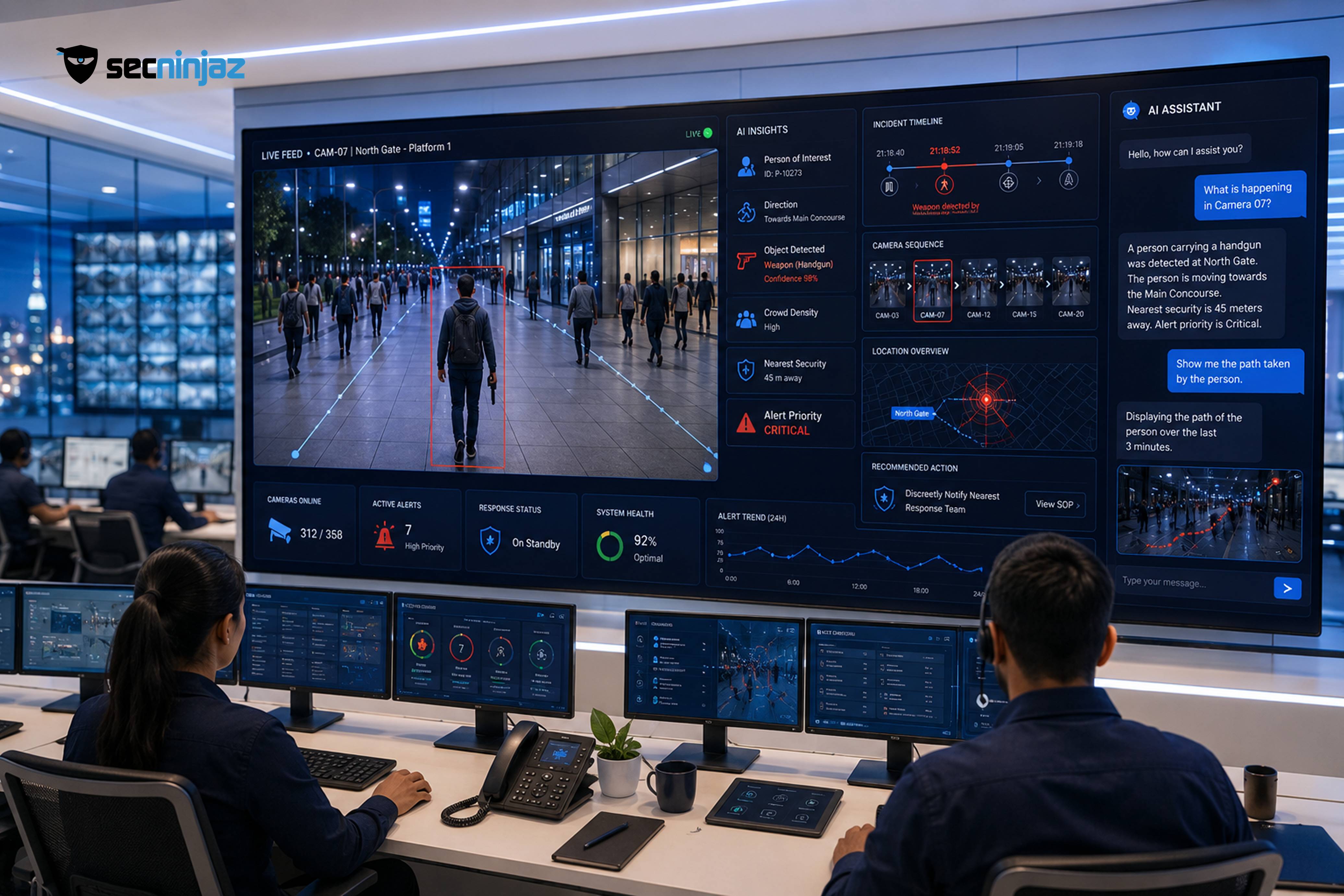
Walk into any large operations centre in India and count the monitors. Then count the people watching them. The ratio is brutal. One operator might be nominally responsible for forty feeds, sometimes eighty, and human attention on static video degrades sharply after about twenty minutes. Control-room ergonomics work has documented this for years, and it is not a discipline problem. Nobody can stare at eighty near-identical frames and reliably catch the one that matters.
So what happens instead? The recording keeps rolling. An incident occurs. Somebody scrubs back through six hours of footage the next morning to reconstruct it. Useful for the investigation, useless for prevention.
India adds its own texture here. Camera estates are wildly mixed: a few new IP cameras bolted up next to a decade of analogue installs, different resolutions, different frame rates, some feeds squeezed hard to save bandwidth on a rural link. Lighting swings from harsh midday glare to sodium-vapour orange at night. And crowd density on a railway platform, or at a temple festival, looks nothing like the tidy scenes most off-the-shelf models were trained on. An AI video surveillance platform that ignores all this looks great in a demo and falls apart in Ambala.
The shift that matters is from passive recording to active reasoning. Rather than storing everything and hoping, the system watches every frame, works out what normal looks like, and raises a hand only when something crosses a line you drew. That is the difference between video analytics and a hard drive full of regret.
What an AI Video Surveillance Platform Actually Does
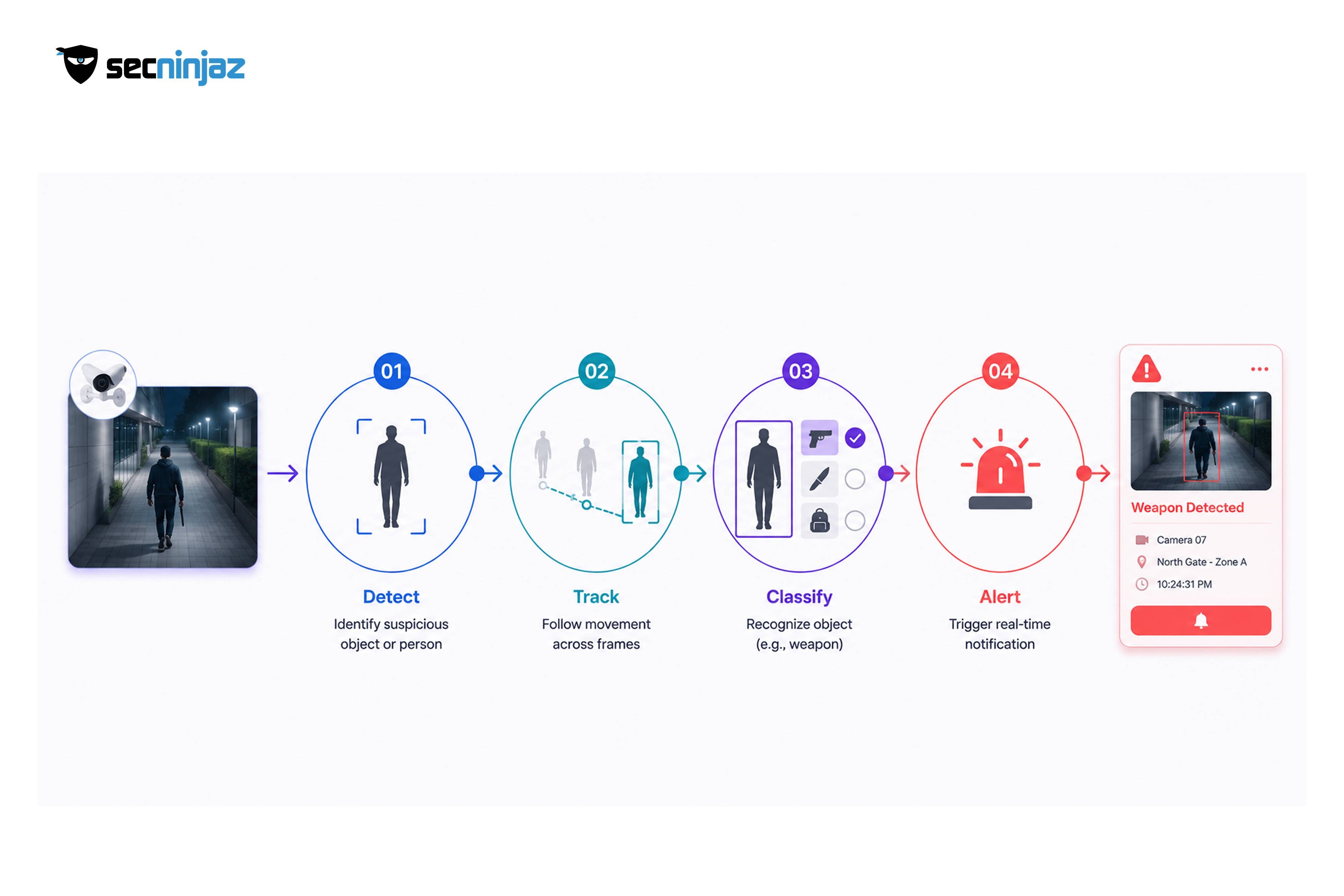
Strip away the brochure language and a modern platform is doing four jobs at once, continuously, across many streams.
From Pixels to Objects
First, detection. Every frame goes through a computer-vision model that finds objects and draws boxes around them: a person here, a vehicle there, a bag left on a bench, and in the case we care about most, a firearm or a blade. Models in this space are usually single-stage architectures from the YOLO family, picked because they keep up with live video instead of batch-processing last night's recordings.
Second, tracking. One box on one frame does not get you far. The platform stitches boxes across frames, so it knows the person who walked in at 09:14 is the same person now standing near the server room. That is what lets you ask how long a vehicle has been sitting at the gate, rather than merely whether a vehicle is there.
From Objects to Meaning
Third, classification and context. A raised arm is not a threat. A raised arm holding a rectangular metal object, in a zone where no tool should be, at an hour the site is shut, is a different story. The platform layers rules and learned behaviour over raw detection so it can tell the two apart. Loitering, someone crossing a virtual tripwire, a crowd forming where crowds should not, a person walking against the normal flow: these are behavioural signals, not object labels.
Fourth, alerting and search. When something crosses a threshold, the system pushes an alert to an operator, a mobile app, or a SOC queue, with the clip attached and the object highlighted. Just as important, it indexes everything, so an analyst can search "red backpack, north gate, between 2 and 4 PM" later and get answers in seconds rather than an afternoon.
Put the four together and you have moved from a wall of screens to a shortlist of moments worth a human's attention. That is the actual product. The rest is plumbing.
Real-Time Weapon Detection, Without the Hype
This is the capability that gets people to sit up in the meeting, and it is also the one most oversold. So let me be precise about what it can and cannot do.
How a Gun Becomes an Alert
The pipeline runs roughly like this. A frame arrives. The model scans it for objects matching learned "firearm" and "sharp weapon" patterns. Find a candidate, assign a confidence score, check that score against a threshold. If it clears the bar, the object gets tracked across the next several frames to confirm it was not a one-frame fluke. Only then does an alert fire, ideally with the weapon boxed in red and a few seconds of clip attached.
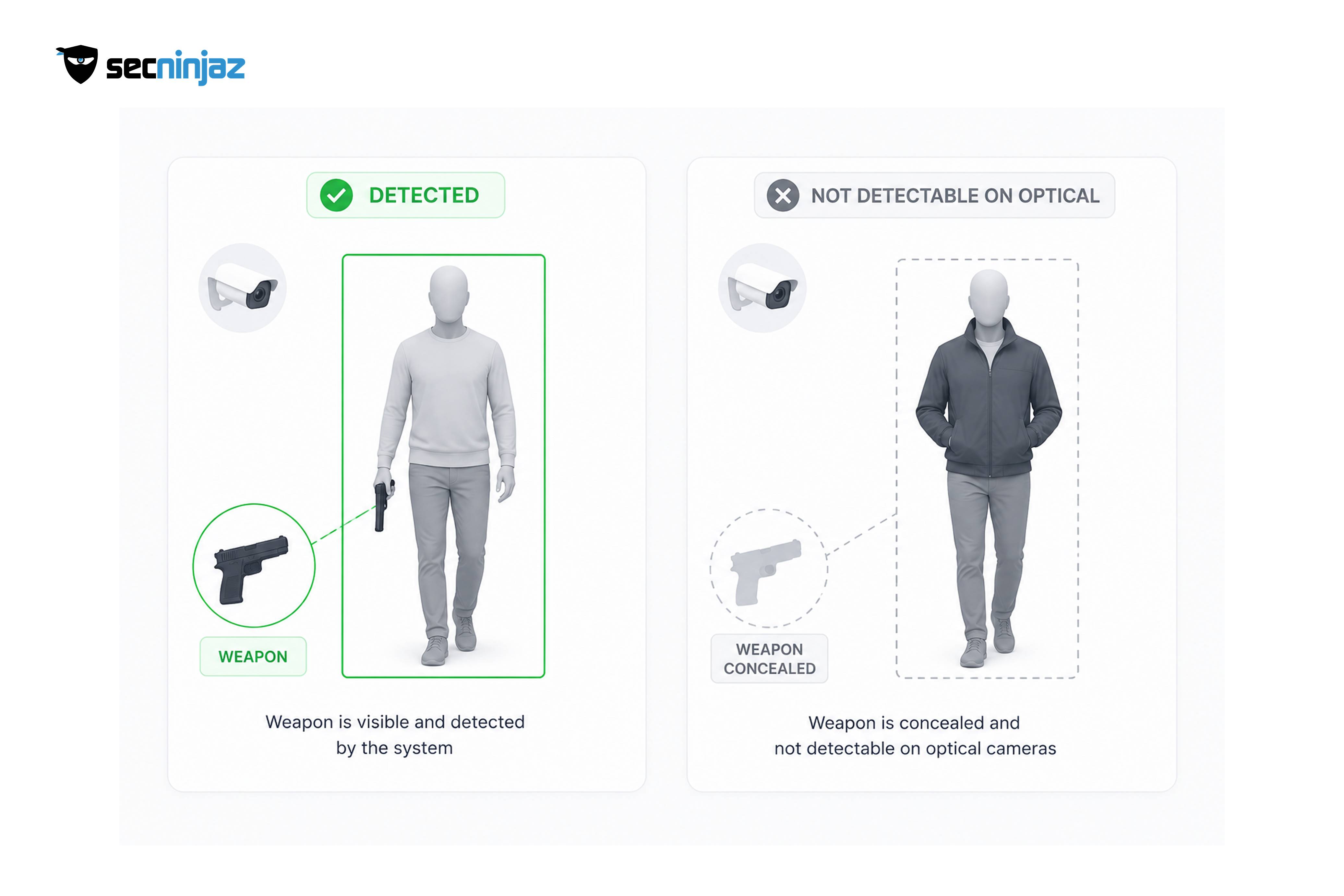
Two things are worth being honest about. A visible weapon is far easier to detect than a concealed one. Optical cameras see what is in view, so a pistol tucked into a waistband under a jacket is simply not something video analytics will find, and any vendor claiming otherwise is selling you a story. Concealed-weapon detection is a different stack altogether, millimetre-wave for instance, and a different conversation. What an AI CCTV platform reliably addresses is the brandished-weapon case: a firearm or knife drawn and in view, which happens to be the moment when a few seconds of early warning changes the outcome.
The Latency Budget, Worked Through
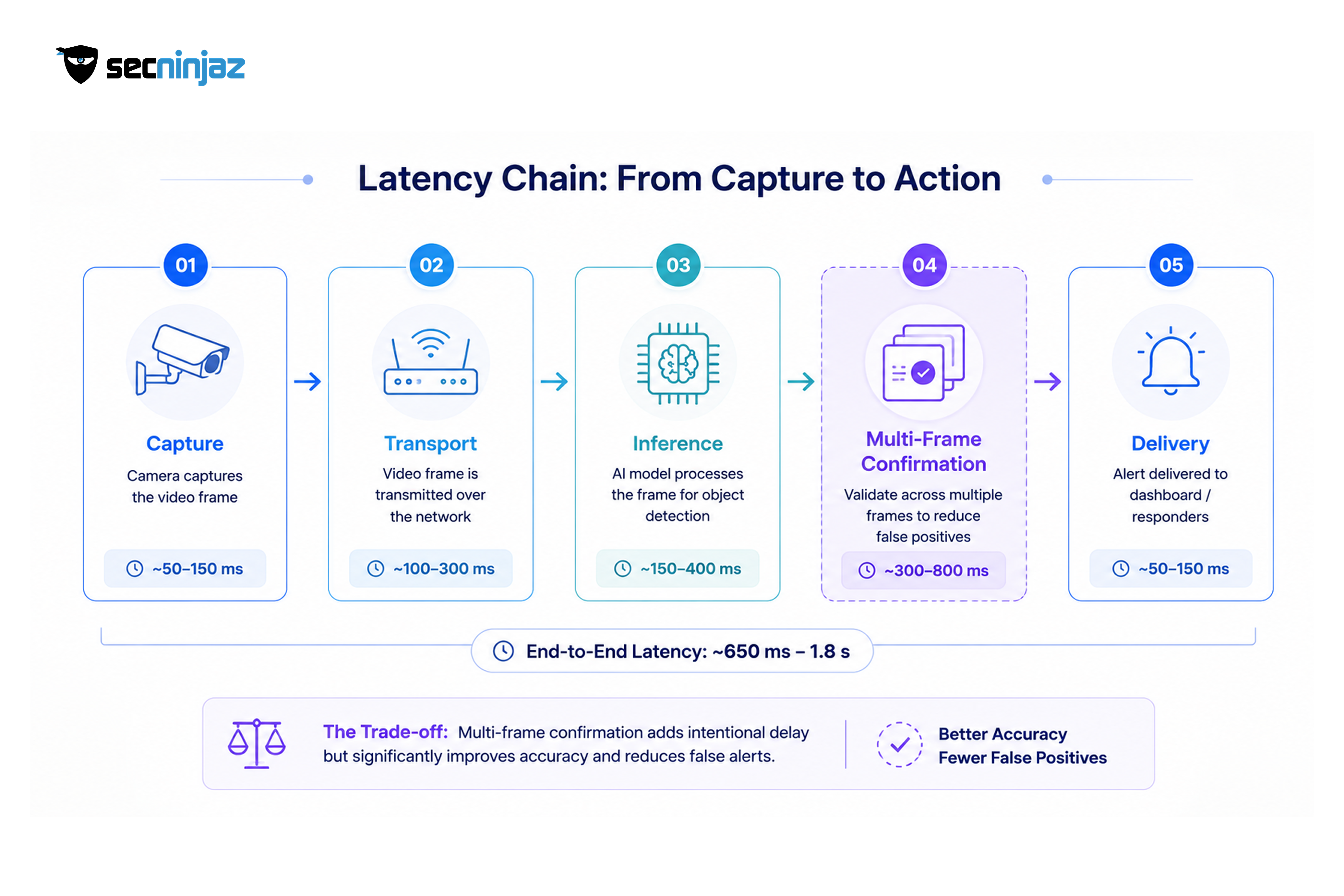
"Real-time" only means something once you put a number on it. Here is the chain an alert has to travel, with realistic design targets rather than promises:
- Capture and encode on the camera: tens of milliseconds.
- Transport to wherever inference runs. Near zero at the edge; a full network round trip if you have sent it to the cloud.
- Inference on the frame: again, often tens of milliseconds on a decent GPU or edge accelerator.
- Multi-frame confirmation before firing. This one deliberately costs you time, because you are trading a fraction of a second for far fewer false alarms.
- Delivery to the operator: one more network hop.
Add it up and a well-built system aims to turn a visible weapon into an operator alert within a small number of seconds, end to end. Not instant. But set that against today's baseline, where "detection" means a phone call after shots are heard, and the value is obvious enough. You are compressing the gap between event and response. Nobody is doing magic.
False Positives Are the Real Enemy
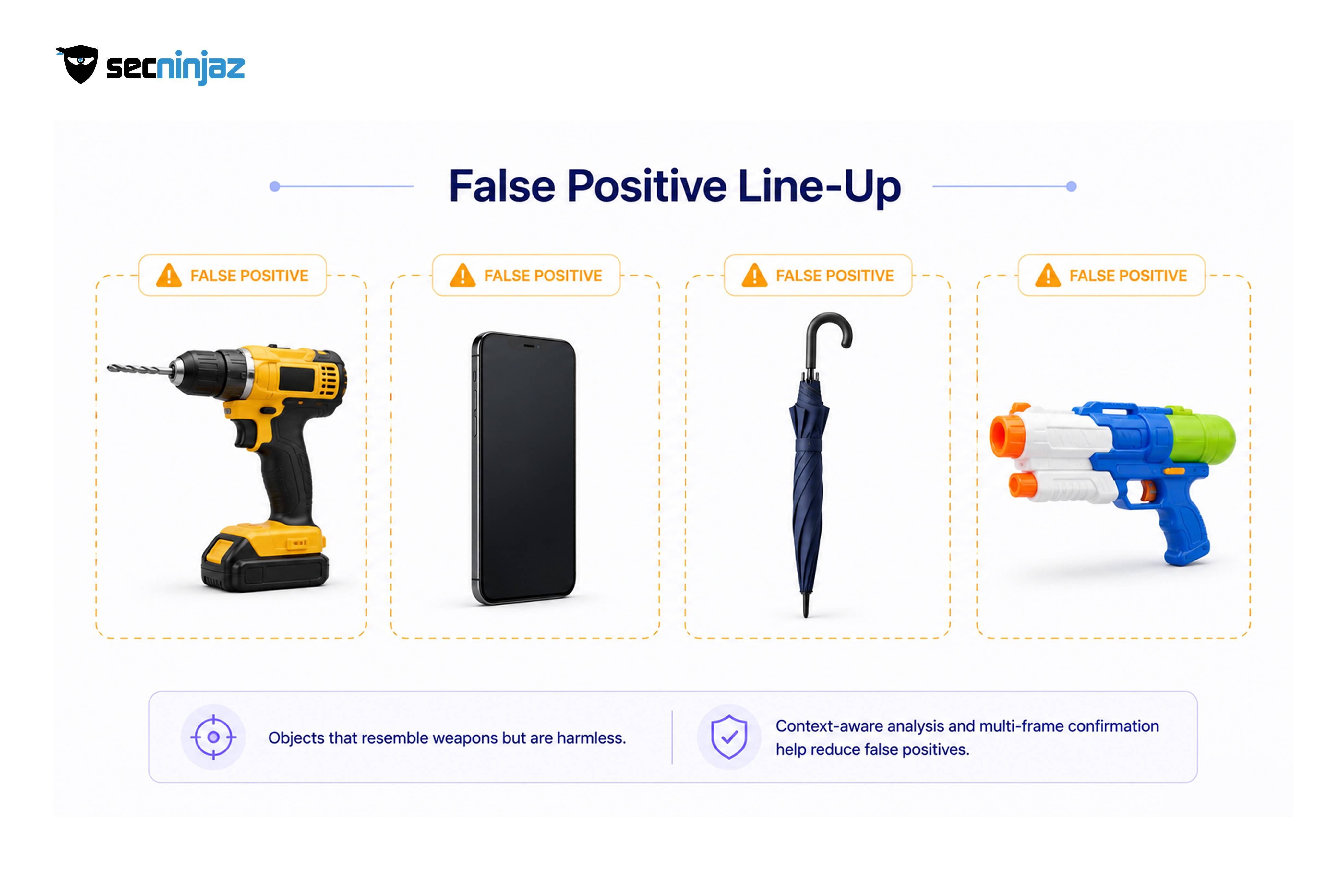
Here is the uncomfortable truth about weapon detection. The failure mode that kills a deployment is not the missed gun. It is the flood of false alarms. A power drill, a smartphone held at a certain angle, an umbrella, a child's toy: all of these have fooled detection models. Give your operators twenty false weapon alerts a shift and they will have stopped trusting the system by Wednesday. That is the death of a surveillance platform, and no accuracy percentage on a slide will save it.
Taming false positives is mostly unglamorous engineering work:
- Tune confidence thresholds per site. A warehouse and a school lobby have different backgrounds and very different tolerances.
- Require multi-frame persistence, so one noisy frame cannot trigger anything.
- Use zone logic. A knife in a kitchen is not a knife in a corridor.
- Feed confirmed false positives back into retraining so the model stops repeating the mistake.
- Keep a human in the loop for the alerts that matter. The platform shortlists; a person decides.
Anyone promising zero false positives and zero missed detections in the same breath is describing a system that does not exist. The honest target is a threshold tuned so operators trust the alerts they get, calibrated against how costly a miss would be at that particular site.
Inside SecNinjaz Naina
Naina is SecNinjaz's product for this problem: an AI-based imagery narrative analytics platform built for autonomous visual event detection and investigation. Two words in that sentence are doing most of the work, so let me unpack them.
"Narrative," Not Just "Alert"
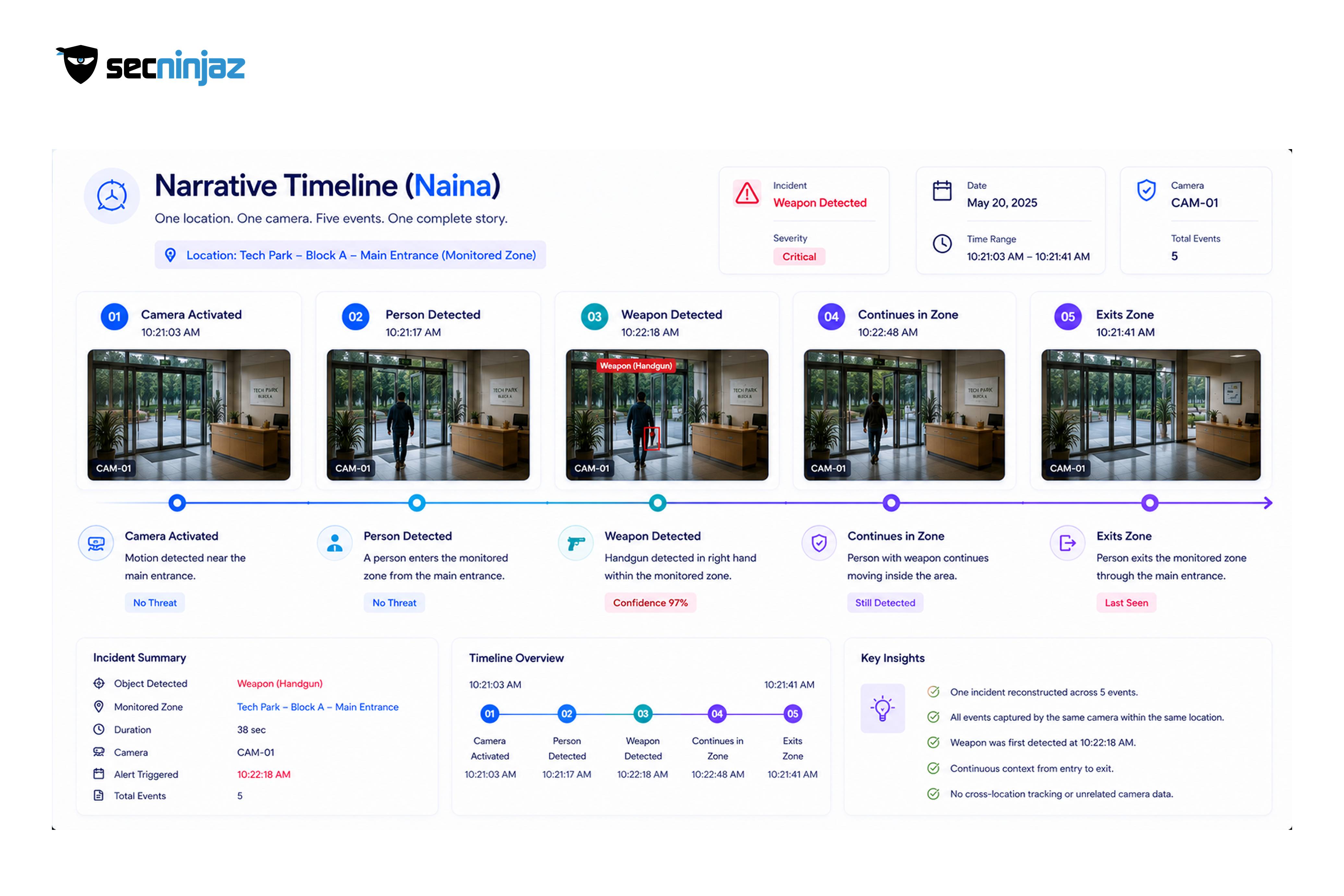
Most video analytics tools output events. A box, a label, a timestamp. Naina's framing is that operators do not think in boxes; they think in stories. Who did what, where, in what order, and what happened next. Imagery narrative analytics means the platform assembles individual detections into a coherent account of an incident, so an investigator follows a thread instead of reassembling one by hand from forty separate clips.
For weapon detection, that matters as much after the alert as during it. The moment a firearm is spotted, the questions come fast. Where did this person come in? What route did they take? Are they still on site? Which cameras still have eyes on them? A platform designed around narrative is designed to answer that sequence.
"Autonomous," With Guardrails
Autonomous here means detection and triage run without a human babysitting every frame. It does not mean the system acts on its own authority. That lines up with how SecNinjaz positions its work generally: AI accelerates the analysis, and approval and response stay with a named human. In surveillance, the principle is not optional. It is the line between a decision-support tool and an accountability nightmare.
Where Naina Fits With What You Already Own
You rarely get to rip out an existing camera estate, and you should not have to. The sensible model is an analytics layer that ingests feeds from the cameras and video management systems you already run, over standard streaming protocols, and adds detection on top. That protects money already spent on cameras and cabling. It also means a rollout can begin with the twenty cameras covering your highest-risk zones instead of the whole estate at once.
Naina sits alongside the rest of the SecNinjaz stack too. SecNinjaz runs SOC-as-a-Service, MDR/XDR, and 24/7 active monitoring, which matters more than it sounds: a weapon alert at 2 AM is worthless if nobody is watching the queue.
A useful rule of thumb: the analytics platform is only as valuable as the response process behind it. Buy the detection and the monitoring together, or the detection sits idle.
Edge or Cloud: Where Should the Inference Run?
This is the single biggest architecture decision, and there is no universally right answer. It turns on your bandwidth, your latency needs, your data-sensitivity constraints, and your budget. Here is how to reason about it.
| Factor | Run inference at the edge | Run inference in the cloud |
|---|---|---|
| Latency | Lowest, no network round trip | Higher, depends on the link |
| Bandwidth need | Low, only alerts leave the site | High, video streams uploaded continuously |
| Works if the link drops | Yes, keeps detecting offline | No, detection stops |
| Data residency | Stays on-premise, easier for sensitive sites | Video leaves the premises |
| Hardware cost per site | Higher upfront, an accelerator per location | Lower per site, centralised GPUs |
| Model updates | Push to many devices | Update once, centrally |
| Best for | Prisons, defence sites, remote infrastructure, poor connectivity | Multi-site retail, dense metro networks with good fibre |
When to Choose Edge
Choose edge when the link is unreliable, or when the data cannot leave. A border installation on a patchy connection cannot depend on the cloud, because the moment the link drops, so does your protection. Defence and law-enforcement facilities often cannot let raw video off the premises at all. And anywhere a two-second delay is unacceptable, weapon detection being the obvious case, benefits from inference running metres from the camera instead of in a data centre three states away.
When to Choose Cloud
Choose cloud when you have many sites, decent connectivity, and a real reason to centralise. A retail chain with two hundred stores does not want to maintain an accelerator in every stockroom. Centralised inference gives you one place to update models, one place to tune thresholds, one place to audit.
Plenty of serious Indian deployments end up hybrid, and there is nothing wrong with that. Time-critical detections such as weapons and intrusion run at the edge for speed and resilience, while heavier forensic search, long-term storage, and cross-site analytics live centrally. Fast local alerts, rich central investigation, no single compromise forced on either.
Rolling It Out: A Practical Sequence
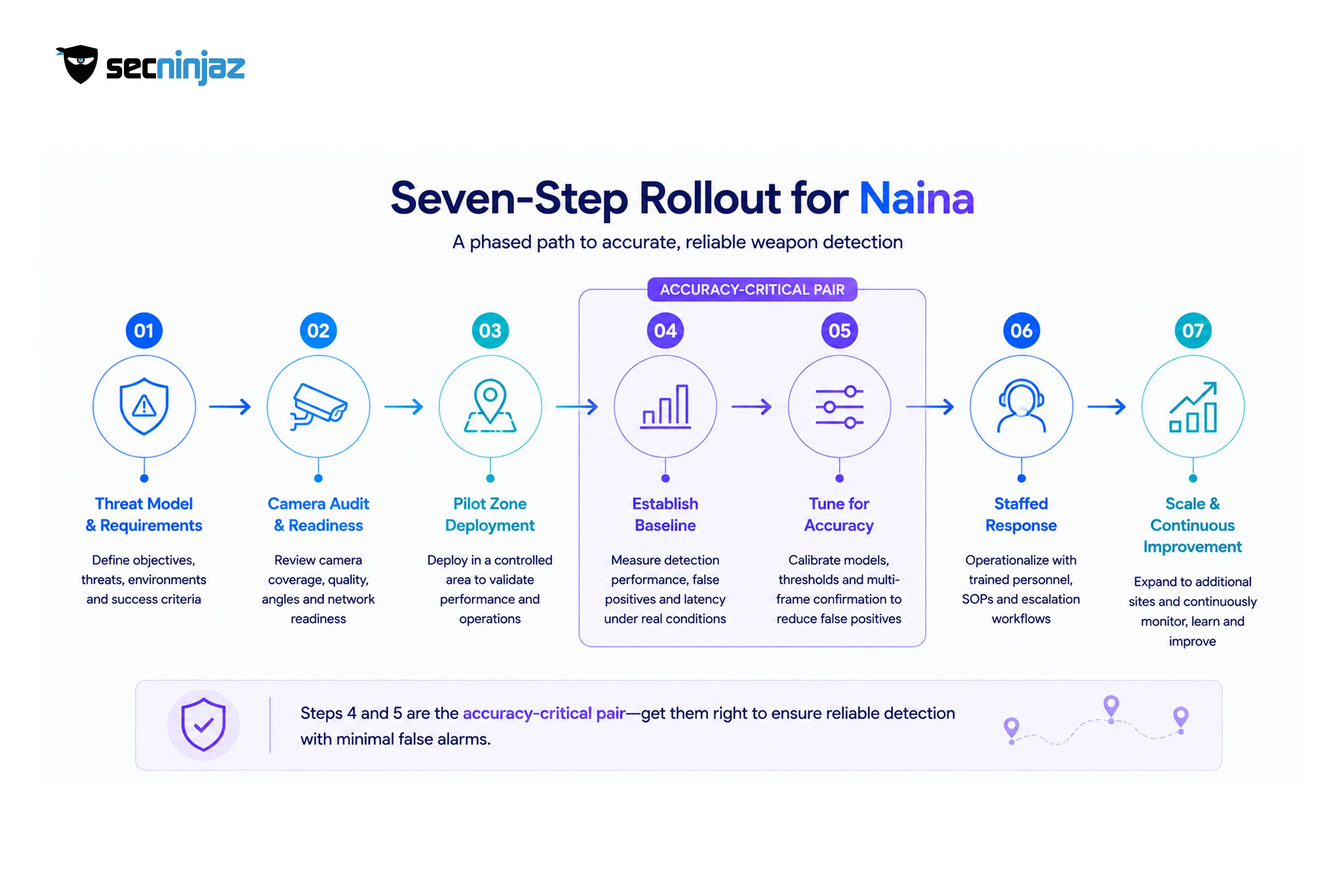
These projects fail on process more often than on technology. Here is a sequence that tends to hold up, whether you are a municipal smart-city cell or a plant security head.
- Define the threat model first. Weapon detection, intrusion, loitering, ANPR (automatic number-plate recognition), crowd density: different problems, different cameras, different thresholds. Pick the two or three that match your actual risk.
- Audit the camera estate. Resolution, placement, lighting, frame rate, night performance. A weapon at fifteen metres on a grainy 2 MP camera pointed into the sun is not a fair test for any model, so fix the worst blind spots before you blame the software.
- Start with a pilot zone, the ten to twenty highest-risk cameras. Entry points, cash areas, perimeter. Prove value there first.
- Baseline for two to four weeks. Let the system learn what normal looks like at your site, and log its detections without acting on all of them. This is where you find the drill that reads as a pistol at one specific camera angle.
- Tune thresholds against real footage, using the false positives the baseline handed you. Most of your eventual accuracy comes from this step, not from the model you picked.
- Wire alerts into a staffed response. Who receives a weapon alert, on what device, and what do they do in the next sixty seconds? Write that runbook before go-live, not after the first incident.
- Scale in waves, and review as you go. Add cameras in batches and revisit thresholds each time, because every new zone brings new backgrounds and new edge cases.
An Illustrative Rollout: A Mid-Size Manufacturing Campus
To make that concrete, here is a hypothetical walkthrough. Illustrative, not a specific SecNinjaz client, and the figures are planning assumptions rather than measured results.
Picture a manufacturing campus: 180 cameras, three shifts, a perimeter fence, a main gate, two high-value zones. The security head cares about two things above all, an intruder scaling the fence at night, and any weapon appearing near the gate or the admin block.
The team does not switch on all 180. They start with 20: the fence line, both gates, the admin entrance. Edge inference goes in near the gatehouse, because the campus sits on a semi-rural link that browns out through the monsoon and cannot be trusted for cloud-only detection. For a fortnight the system baselines. It flags forklifts as vehicles. It catches a night guard's torch as a moving light source. Once, it flags a pneumatic tool as a possible weapon at one low-angle camera.
Each of those becomes a tuning input. The forklift route gets marked normal. The tool false positive is fixed by adjusting the angle and threshold at that single camera. By the time intrusion and weapon rules go live for real, alert volume is low enough that the two-person night shift takes every one seriously. That is the whole game. Not the highest raw accuracy on a datasheet, but an alert stream a tired human at 3 AM still believes.
Common Mistakes When Buying an AI Surveillance Platform
Watch enough of these projects and the same handful of errors shows up again and again.
- Buying the model and ignoring the pipeline. The detection network is maybe a fifth of the problem. Ingestion, tracking, threshold tuning, alert routing, response: that is the rest of it. A brilliant model with no staffed queue behind it protects nobody.
- Trusting demo accuracy. Vendor demos run on clean footage in good light. Insist on a pilot against your own worst cameras, at night, in the rain, with your real crowd density.
- Forgetting the response side. An alert landing in an unwatched inbox is not detection, it is documentation. Decide who acts, and how quickly, before you sign anything.
- Treating concealed and visible weapons as one problem. Optical AI finds brandished weapons. Concealed detection is separate technology. Conflate them and you have set an expectation the system cannot meet.
- Underestimating data governance. Surveillance of identifiable people is personal-data processing in India, and the moment facial recognition or ANPR enters the picture you are squarely in DPDP territory. Bolting compliance on later is expensive, and occasionally impossible.
- Switching everything on. Weapons, faces, plates, crowds, PPE, fire, fall detection, all at once, will bury your operators. Enable what the threat model needs and leave the rest until you need it.
Compliance: DPDP, Consent, and Responsible Surveillance
You cannot deploy surveillance in India in 2026 and treat privacy as an afterthought. Video of identifiable individuals is personal data. Once your analytics start attaching identity, behaviour, or movement to a person, the Digital Personal Data Protection Act, 2023 applies, and consent, notice, purpose limitation, and retention all come into scope.
A few practical principles keep a deployment defensible:
- Be clear about purpose. Detecting a brandished weapon to protect people is defensible and proportionate. Silently profiling everyone who walks past is not. Write the purpose down and hold the system to it.
- Signpost the surveillance. Visible notice at monitored premises is good practice, and for many use cases a legal expectation.
- Minimise, and set retention. Keep footage only as long as the purpose needs it. Indefinite storage of everybody is a liability dressed up as an asset.
- Separate detection from identity. Weapon and intrusion detection do not require knowing who anyone is. Treat identity features (face, plate) as a deliberate, separately governed layer rather than an always-on default.
- Log access: who watched what, and when. An audit trail protects the public and the operator both.
This is one area where SecNinjaz's own posture helps rather than hurts. The organisation holds ISO/IEC 27701:2025 for privacy information management and ISO/IEC 42001:2023 for AI management systems, alongside ISO 27001, and offers GRC and DPDP advisory as a service. Governance built into a platform costs a great deal less than governance retrofitted after a regulator's notice. If a deployment touches identifiable personal data, settle the consent and DPDP question before the cameras go live.
Measuring Whether It Actually Works
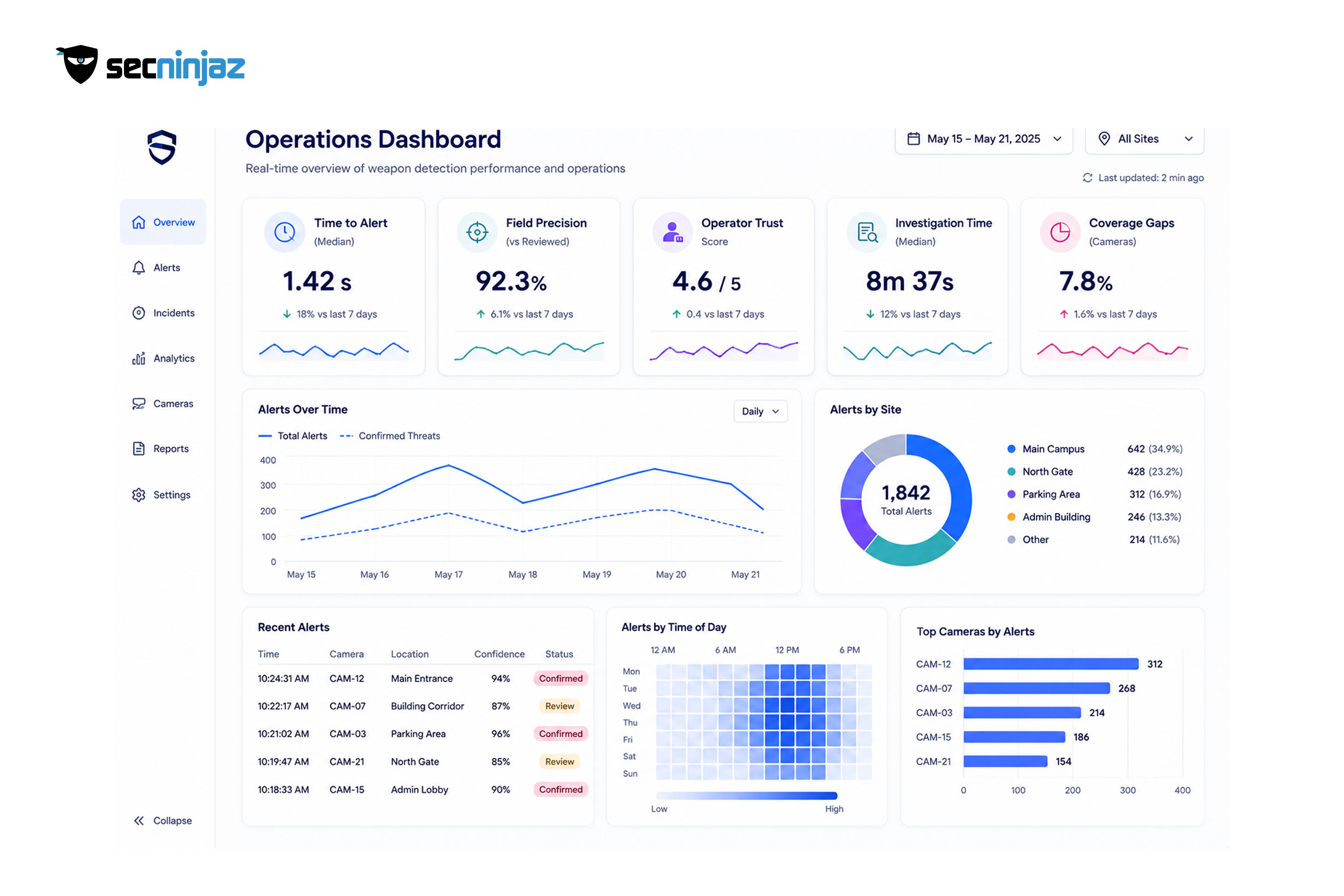
Once it is running, how do you know the platform earns its keep? Not from the accuracy number in the original proposal. From operational metrics you can watch every week:
- Time from event to operator alert. Your core "real-time" measure. Track the outliers, not just the average.
- Alert precision in the field. Of the weapon alerts fired, how many were genuine? If operators dismiss most of them, either your thresholds are wrong or your cameras are.
- Operator trust. Softer, but real. Are your people acting on alerts or ignoring them? Ignored alerts mean the system has already failed, whatever the dashboard says.
- Investigation time, meaning how long it takes to reconstruct an incident after the fact. A good narrative-analytics layer should turn hours into minutes here.
- Coverage honesty. Which zones and hours are genuinely protected, and which are blind. Know the gaps instead of assuming there are none.
Review these monthly with the people who use the system, not only the people who bought it. The cameras that matter change as the site changes, and thresholds drift as seasons and crowds shift.
Where This Leaves You
An AI video surveillance platform is not a magic eye that stops every threat. What it does is narrower and more useful. It makes an existing camera estate pay attention. It shrinks the gap between a dangerous event and a human response. And it turns a wall of forgotten footage into something you can search. Real-time weapon detection, done honestly, means fast and reliable warning on visible threats, with a false-positive rate low enough that operators keep trusting it. That is a genuine win, and an achievable one. It is also a rather different claim from the ones on most vendor slides.
For Indian smart cities, critical infrastructure, and enterprises, the decision usually comes down to three things, and none of them is the model. An architecture (edge, cloud, or hybrid) that matches your connectivity and your data rules. A response process staffed well enough to act on what the platform finds. And a governance posture that satisfies DPDP before go-live rather than after. Naina is SecNinjaz's answer on the detection and investigation side, built to sit on top of what you already own, backed by the monitoring and compliance capability that makes detection worth having.
If you are scoping a deployment, the most useful next step is a short pilot on your own highest-risk cameras. That one test will tell you more than any datasheet.
Talk to SecNinjaz about a Naina pilot →
Frequently Asked Questions
What is an AI video surveillance platform?
Think of it as software that watches, rather than software that stores. An AI video surveillance platform analyses live camera feeds as they arrive, spotting objects and behaviours (a weapon, an intruder, a vehicle, someone loitering longer than they should) and alerting an operator only when something crosses a threshold you have set. Ordinary CCTV records for later review; this shortlists the moments that need a human, frame by frame. It normally layers on top of the cameras and video management system you already own.
Can AI cameras really detect weapons in real time?
Short answer: yes, if the weapon is visible. A firearm or knife that has been drawn and is in view can be detected and turned into an operator alert within a small number of seconds. Concealed is where the claims get shaky. A pistol under a jacket is not something an optical camera can find, and that job needs a different sensor technology altogether, so treat any concealed-weapon claim made about ordinary video with suspicion.
How accurate is AI weapon detection?
Accuracy is mostly a property of your site, not of the model. Cameras, lighting, and threshold tuning move the number far more than the choice of detection network does. What actually decides success is the false-positive rate in the field: operators who get frequent false weapon alerts stop trusting the system, and a system nobody trusts has already failed, whatever the benchmark said. A well-tuned deployment gives up a little speed for multi-frame confirmation and site-specific thresholds. Be wary of anyone promising zero misses and zero false alarms in the same breath.
Should inference run at the edge or in the cloud?
Edge suits sites with unreliable connectivity, strict data-residency rules, or a need for the lowest possible latency: defence facilities, prisons, remote infrastructure. Cloud suits multi-site operations with good bandwidth that want centralised model updates and analytics. Many Indian deployments land in the middle and go hybrid, running time-critical detections such as weapons at the edge while forensic search and long-term storage sit centrally.
Does AI surveillance comply with India's DPDP Act?
It can, but not by accident. Governance has to be built in from the start. Video of identifiable people is personal data, and adding facial recognition or number-plate reading brings the Digital Personal Data Protection Act, 2023 into scope, with obligations around consent, notice, purpose limitation, and retention. Keeping detection separate from identity, setting retention limits, posting notice, and logging access all help. SecNinjaz holds ISO/IEC 27701 and ISO/IEC 42001 and offers DPDP advisory, so compliance can be scoped before deployment instead of retrofitted afterwards.
Can Naina work with our existing cameras?
Yes, that is the design intent. Naina is an analytics layer built to ingest feeds from cameras and video management systems already in place, over standard streaming protocols, so prior investment in cameras and cabling is protected. A rollout can start with your highest-risk cameras rather than the whole estate, which keeps the pilot focused and measurable.
How long does an AI surveillance rollout take?
Longer than a demo, shorter than a construction project, and phased rather than a single switch-on. The usual sequence runs: a camera audit, a pilot on ten to twenty high-risk cameras, two to four weeks of baselining to learn normal behaviour and surface false positives, threshold tuning against real footage, then scaling in waves. Most of the real-world accuracy comes out of the baseline and tuning steps, so they are worth not rushing.