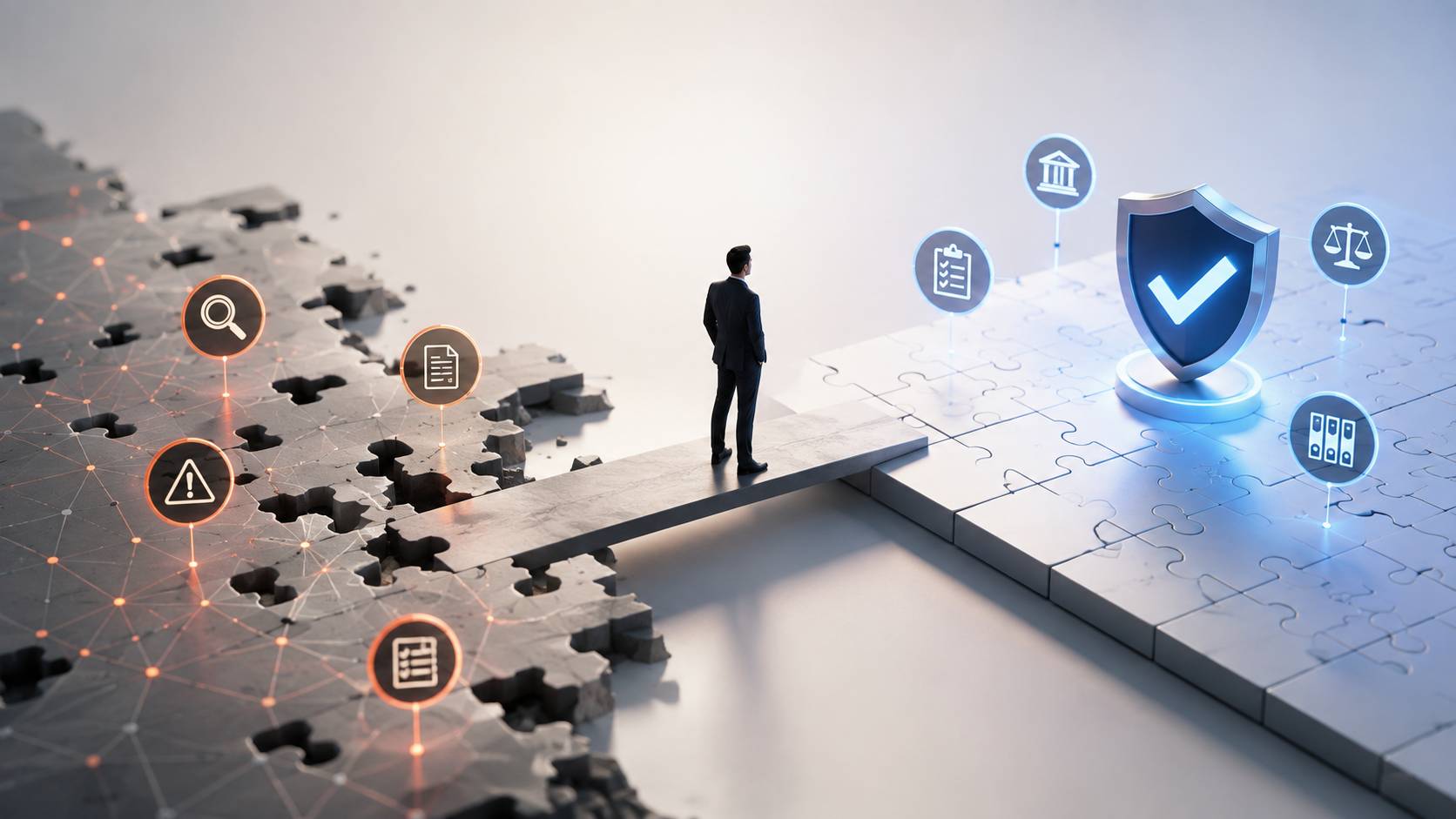
Hyperproof's 2026 IT Risk and Compliance Benchmark Report found that 97% of GRC teams already use AI for internal productivity, drafting policies, summarizing documentation, normalizing evidence. Only 27% have operationalized AI for external assurance, the work that actually has to hold up when an auditor or regulator looks at it. That seventy-point gap is a more accurate picture of where GRC actually stands in 2026 than any adoption headline. Separately, RegScale's second annual State of Continuous Controls Monitoring report, drawing on more than 250 InfoSec leaders, found that most organizations are still burning upward of 2,000 person-hours a year on annual evidence collection alone, a workload AI is supposed to be solving and, for the vast majority of teams, has not yet actually touched.
The future of GRC is not really a question of whether AI gets used. It already is, almost everywhere, for the easy parts. The real question is whether that usage matures into something that survives outside scrutiny, and that maturity gap is exactly where continuous assurance comes in. Continuous assurance replaces the old model, a point-in-time snapshot produced once a year or once a quarter, with ongoing, real-time visibility into whether controls are actually working right now. AI is the mechanism that makes that shift practical at scale, but only where it is deployed with the same governance discipline GRC teams already demand of everyone else in the organization.
This guide covers what is genuinely changing in how GRC operates, where AI is already adding real value versus where it still needs a human checkpoint, why the adoption-to-maturity gap exists and what closes it, how India's own regulatory direction already assumes something close to continuous assurance, what happens when the governance layer around AI-assisted GRC itself is missing, and a practical path toward building this without becoming another disconnected pilot. It is written for GRC leaders, risk officers, and the security and compliance teams who have to make continuous assurance work in practice rather than just in a vendor's product pitch.
From Point-in-Time to Continuous: What Is Actually Changing
Traditional GRC runs on snapshots. An annual audit tests a control once and assumes it kept working the same way for the following twelve months. A quarterly risk report reflects conditions as they stood on the day someone compiled it, not as they stand today. Evidence collection means chasing control owners for screenshots and exports each cycle, the same conversation repeated every year regardless of whether anything actually changed. Continuous assurance replaces each of these with something that runs constantly: controls monitored in near real time, evidence collected as a byproduct of normal operations rather than a special annual exercise, and risk registers that update as conditions change rather than waiting for the next scheduled review.
| Dimension | Traditional GRC | Continuous assurance |
|---|---|---|
| Evidence collection | Manual, chased once per audit cycle | Automated, pulled continuously from the systems that generate it |
| Control testing | Point-in-time, once or twice a year | Ongoing, with drift flagged as it happens |
| Risk register | Updated at scheduled review intervals | Updated as conditions change |
| Regulatory change tracking | Manual review of new circulars and guidance | Assisted by automated monitoring and framework mapping |
| Audit readiness | A scramble in the weeks before the audit | A continuous, always-current state |
Where AI Actually Fits Into This Shift
It is worth being specific about what AI is genuinely doing inside GRC functions today, rather than describing it in the abstract. According to Hyperproof's research, the largest single use case is documentation-heavy work: parsing, normalizing, and drafting, accounting for roughly 41% of how GRC teams apply AI in practice. Beyond that, current tools are being used to flag control drift, cross-map requirements across multiple frameworks so the same evidence can satisfy more than one obligation, summarize audit evidence, identify duplicate controls, support regulatory change monitoring through natural language processing, and generate predictive risk scores based on historical control performance.
What AI is not yet reliably doing, and what the 27% figure reflects, is standing in for the judgment an external assurance process actually requires: materiality decisions, the final interpretation a regulator or auditor will hold the organization accountable for, and sign-off on anything consequential enough to carry legal or reputational weight. That is not a temporary gap waiting for a better model. It reflects a genuine, durable distinction between work that benefits from acceleration and work that requires accountability a machine cannot carry on its own.
The Adoption-Maturity Gap, and Why It Exists
ISACA's 2026 AI Pulse Poll captured the same pattern from a different angle: AI use inside organizations is accelerating, while governance, risk management, workforce skills, security readiness, and measurable return on investment are all lagging behind that acceleration. McKinsey's most recent Global GRC Benchmarking Survey found that 42% of respondents describe their IT and GRC systems as needing improvement, with a further 15% describing them as absent or badly lagging. None of this suggests the technology itself is the bottleneck. It suggests that internal-productivity use of AI, low-stakes, easily reversible, requiring no audit trail, has spread far faster than the governed, accountable use that external assurance actually demands.
That asymmetry makes sense once the two use cases are separated. Drafting a first pass of a policy document carries little risk if a human reviews it before anything happens. Feeding AI-generated evidence directly into a regulatory submission without an equivalent review step is a different category of risk entirely, and building the audit trail, access controls, and sign-off process that second category needs takes real, deliberate work rather than simply switching on a feature.
Where India's Regulatory Direction Already Points Toward Continuous Assurance
Continuous assurance is not only a technology trend; it is already showing up directly inside Indian regulatory expectations, whether or not the regulations use that specific term. SEBI's Cybersecurity and Cyber Resilience Framework sets a defined remediation clock rather than a once-a-year checkbox: high-severity findings tied to unpatched systems must close within a week, all findings within three months, and revalidation follows within five, a cadence that functions much closer to continuous monitoring than to an annual audit. The RBI's 2026 restructuring into six entity-specific Directions carries a similar six-monthly vulnerability assessment expectation for the institutions it covers. The DPDP Act's Section 8(5) duty to maintain reasonable security safeguards is, by its own wording, an ongoing obligation rather than a one-time certification event, and ISO/IEC 42001's Plan-Do-Check-Act structure builds continual operation into an AI management system by design rather than treating certification as a finish line.
The practical implication is that a GRC function still running a purely annual assessment model is not simply behind the technology curve. In several regulated sectors, it is already behind what the regulation itself expects.
What Continuous, AI-Assisted Assurance Actually Requires
| Building block | What it does |
|---|---|
| Automated evidence collection | Pulls evidence continuously from the systems that already generate it, rather than requesting a fresh export from control owners each cycle |
| Continuous controls monitoring | Tests controls against a defined framework on an ongoing basis, flagging drift as it happens rather than at the next scheduled review |
| AI-assisted framework mapping | Cross-maps a single control against multiple applicable frameworks, so one piece of evidence can satisfy more than one obligation |
| Predictive, risk-prioritized dashboards | Surfaces what genuinely needs attention now, rather than presenting an undifferentiated list of everything being monitored |
| A human-in-the-loop sign-off layer | Preserves the accountability and materiality judgment external assurance still requires, the work behind the 27% figure |
None of these five pieces substitutes for the others. Automated evidence collection without a sign-off layer just produces unreviewed evidence faster. A human sign-off layer without automated collection leaves the underlying 2,000-hour workload untouched.
What Skipping the Governance Layer Costs
There is a genuine irony worth naming directly: a GRC function is exactly the part of an organization that should be least likely to deploy an ungoverned AI tool, and yet IBM's 2025 Cost of a Data Breach Report found that 63% of organizations studied had no AI governance policy at all. A compliance function using AI to draft evidence without a review step, or without an audit trail showing what the AI touched versus what a human verified, has quietly become its own shadow-AI risk, the same failure pattern it exists to catch elsewhere in the business.
| Gap | Consequence |
|---|---|
| AI-drafted evidence submitted without human review | An auditor discovers fabricated or misattributed material, damaging credibility across the entire audit, not just the flawed item |
| No audit trail distinguishing AI output from human-verified work | No way to demonstrate the procedural safeguards a regulator or a framework like ISO/IEC 42001 expects to see |
| Internal-productivity AI use mistaken for external-assurance readiness | The organization stays permanently inside the 97%-versus-27% gap, running AI-assisted busywork that never actually reduces audit burden |
| Continuous monitoring tooling deployed without mapping to applicable frameworks | Dashboards that look active but do not answer the specific question a regulator will actually ask |
| No governance policy covering the GRC team's own AI tools | The compliance function becomes the shadow-AI risk it is meant to be identifying in every other department |
A Maturity Model for Continuous, AI-Assisted GRC
Most organizations sit somewhere on a five-level path between a purely manual, annual model and continuous assurance running as the default state.
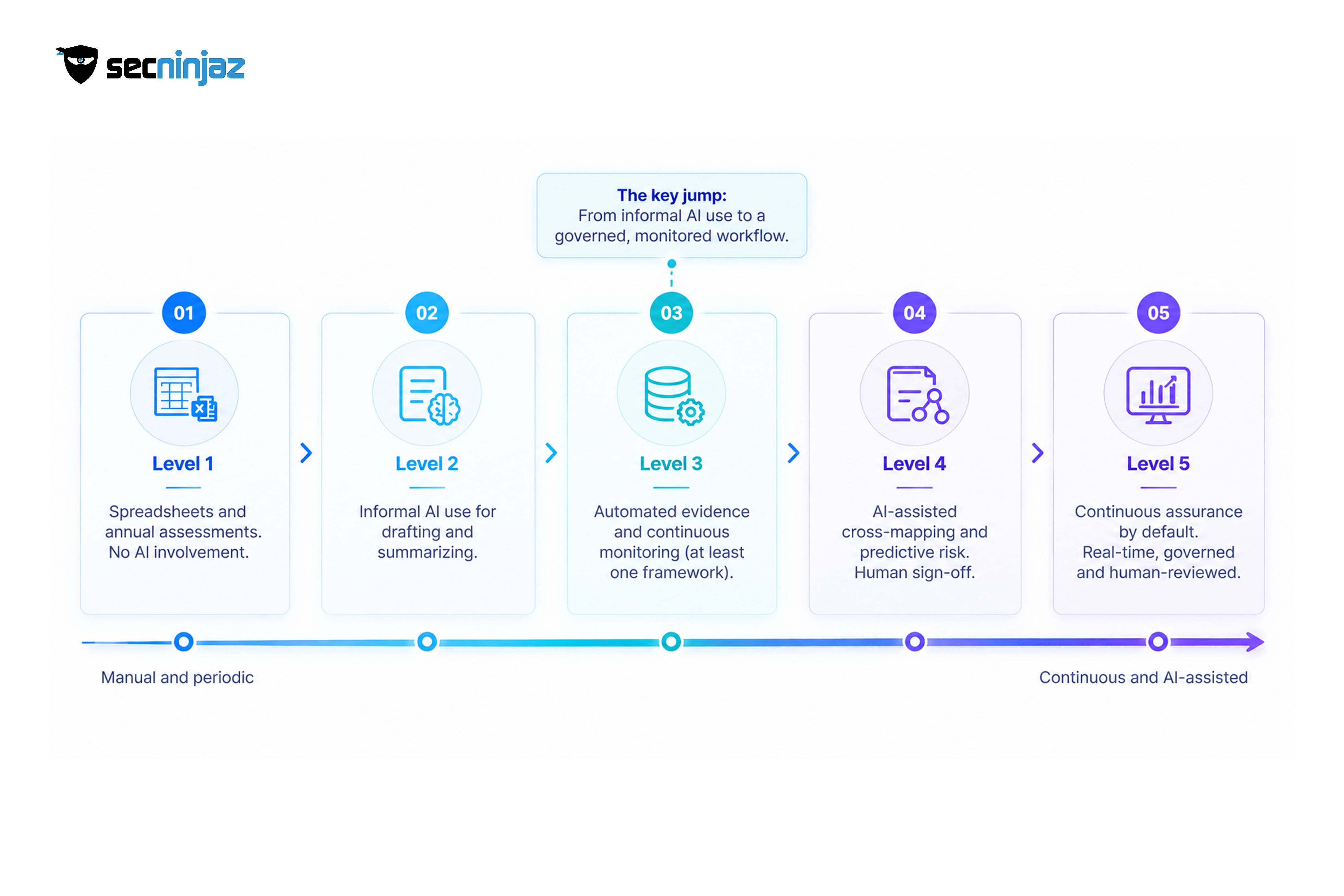
The jump from Level 2 to Level 3, moving AI from informal internal use into a governed, monitored workflow tied to a specific framework, is where the 97%-versus-27% gap this guide opened with actually starts to close.
A Readiness Playbook for Continuous, AI-Assisted GRC
- Inventory where AI is already being used informally inside the GRC function itself, before building anything new on top of an ungoverned foundation.
- Separate internal-productivity AI use from external-assurance-facing use, and apply meaningfully tighter governance to the second category.
- Start continuous controls monitoring with one framework already in scope, rather than attempting every applicable framework at once.
- Build automated evidence collection into the systems that already generate the evidence, rather than running it as a parallel manual process alongside the old one.
- Cross-map controls across every applicable framework, so a single piece of evidence can satisfy more than one compliance obligation at once.
- Keep a human sign-off checkpoint on anything that will face an external auditor or regulator, regardless of how confident the underlying automation appears.
- Track the adoption-to-maturity gap explicitly, measuring how much AI use has actually reduced audit burden rather than simply how much AI is in use.
- Revisit tooling and scope on a fixed schedule, since both the applicable frameworks and the underlying AI capability keep changing after initial deployment.
Common Mistakes and Edge Cases
Treating AI adoption inside GRC as equivalent to GRC maturity. The 97%-versus-27% gap exists precisely because these are different things, and conflating them produces false confidence going into an actual audit.
Deploying continuous monitoring tooling without mapping it to a specific framework's requirements. A dashboard that looks comprehensive but was never tied to an applicable regulation answers a question nobody is actually asking.
Leaving the GRC team's own AI tool use ungoverned. The compliance function cannot credibly demand governance elsewhere in the organization while running its own shadow-AI risk internally.
Automating evidence collection without automating, or at least structuring, the review step. Evidence still gets bottlenecked before submission if the human review process was never redesigned alongside the collection process.
Assuming continuous assurance removes the need for external audits entirely. It changes what those audits look like, faster, evidence-backed, less disruptive, rather than eliminating the need for independent verification.
Chasing every new AI-GRC tool rather than building depth on one properly integrated platform. Fragmented tooling tends to recreate the same silos continuous assurance is meant to remove.
When to Use What: A Few Decision Points
Building continuous monitoring on an existing GRC platform versus adopting a dedicated tool. An organization with a small number of frameworks in scope and reasonably mature existing tooling can often extend what it already has. One managing several overlapping frameworks at real scale tends to get more value from a dedicated continuous controls monitoring platform built for that specific complexity.
AI for internal productivity only versus pursuing external-assurance-grade AI use. An organization early in its AI-GRC journey reasonably starts with the lower-risk, internal-productivity use case. One looking to meaningfully reduce audit burden, not just accelerate document drafting, needs to invest in the governance layer that makes external-assurance-grade use defensible.
A single-framework pilot versus a multi-framework rollout. Proving continuous assurance against one framework first, then extending the same infrastructure to additional frameworks, tends to surface integration and governance gaps while they are still cheap to fix, rather than discovering them at scale.
How SecNinjaz Fits Into This
The pattern running through this guide, AI accelerating GRC work while a governance layer keeps that acceleration accountable, is the same sequencing SecNinjaz's GRC and DPDP practice follows: Regulatory Compliance, Audit and Gap Assessment, Risk Management, ISO Certification and Compliance, and AI Governance working together rather than as disconnected service lines. Where continuous assurance requires actual workflow automation rather than only policy design, that connects to SecNinjaz's Artificial Intelligence practice, specifically Agentic Workflow Automation, built for exactly the kind of structured, auditable process this guide describes.
SecNinjaz holds ISO/IEC 42001:2023 certification, the standard most directly relevant to governing the AI layer inside a continuous assurance programme rather than only advising on it from the outside. For organizations trying to close their own version of the adoption-to-maturity gap, using AI extensively but not yet in a way that survives external scrutiny, that combination of automation capability and certified AI governance practice is the pairing worth looking for, whether the organization works with SecNinjaz or anyone else.
Frequently Asked Questions
What is continuous assurance in GRC?
Continuous assurance replaces point-in-time audits and quarterly risk reviews with ongoing, real-time visibility into whether controls are actually working. Evidence is collected continuously from the systems that generate it, control drift is flagged as it happens, and risk registers update as conditions change, rather than everything being reassessed only at scheduled intervals.
What is the gap between AI adoption and AI maturity in GRC?
Hyperproof's 2026 IT Risk and Compliance Benchmark Report found that 97% of GRC teams use AI for internal productivity, such as drafting and summarizing, but only 27% have operationalized AI for external assurance, the work that has to hold up to an outside auditor or regulator. The gap reflects a genuine difference in risk and accountability between the two use cases, not simply slower rollout of the same capability.
What tasks can AI reliably handle in a GRC programme today?
Documentation parsing, normalizing, and drafting account for the largest share of current use, alongside flagging control drift, cross-mapping requirements across multiple frameworks, summarizing audit evidence, identifying duplicate controls, monitoring regulatory change, and generating predictive risk scores. Materiality judgment and final sign-off on anything facing external scrutiny still require a human.
Does Indian regulation already expect continuous compliance monitoring?
Several frameworks function close to a continuous model already, even without using that exact term. SEBI's Cybersecurity and Cyber Resilience Framework sets fixed remediation windows rather than an annual checkbox, the RBI's 2026 Directions set a six-monthly vulnerability assessment cadence for covered institutions, and the DPDP Act's security-safeguard duty is an ongoing obligation rather than a one-time certification event.
What is continuous controls monitoring?
Continuous controls monitoring, often abbreviated CCM, is an automated approach that tests controls against a defined framework on an ongoing basis rather than at scheduled intervals, flagging exceptions and drift as they occur. It replaces the point-in-time snapshot a traditional annual audit provides with real-time visibility into control effectiveness.
Why does a GRC team need to govern its own use of AI?
IBM's 2025 Cost of a Data Breach Report found that 63% of organizations had no AI governance policy at all, and a GRC function using AI to draft evidence without a review step or audit trail has effectively become the same kind of shadow-AI risk it is responsible for catching elsewhere in the business. Governing the compliance function's own AI use is a precondition for the function's credibility, not an optional extra.
Will continuous assurance eliminate the need for external audits?
No. Continuous assurance changes what an external audit looks like, faster, backed by continuously collected evidence, and less disruptive to the business, rather than removing the need for independent verification. A human sign-off and materiality judgment layer remains necessary regardless of how automated the underlying evidence collection becomes.
Where should a GRC team start if it wants to move toward continuous, AI-assisted assurance?
Start by inventorying where AI is already being used informally inside the GRC function itself, then separate internal-productivity use from anything that will face external assurance, applying tighter governance to the latter. Piloting continuous controls monitoring against a single framework first, rather than every applicable framework at once, tends to surface integration and governance gaps while they are still inexpensive to fix.