

On 31 July 2026, the RBI repealed its 2016 Cyber Security Framework and replaced it with six entity-specific Directions, one each for commercial banks, small finance banks, payments banks, urban co-operative banks, non-banking financial companies, and credit information companies. They share a common drafting template, but they are not interchangeable. Two of the six contain no red-teaming paragraph at all. One drafts its vulnerability assessment and penetration testing requirements differently from every other sibling in the set. For an Indian financial institution asking whether it needs red teaming or penetration testing this year, the honest answer as of a few weeks ago is that it depends on which of six new regulatory documents actually applies to it, and the six no longer agree with each other.
That regulatory split is a useful illustration of a confusion that goes well beyond banking. Red teaming and penetration testing get used almost interchangeably in vendor pitches and internal RFPs, and plenty of organizations that book one actually receive the other rebadged. The two exercises are not the same activity at different price points. They test different things, answer different questions, and satisfy different requirements, and picking the wrong one wastes budget without closing the gap the organization actually needed closed.
Here is the distinction that gets lost most often. A penetration test asks whether vulnerabilities exist and how severe they are. A red team exercise asks something closer to whether the organization's people, processes, and detection systems would actually catch and stop a real attacker pursuing a specific goal. An enterprise can pass every penetration test on its calendar and still have no idea whether its security operations centre would notice an intruder who got past the perimeter, because that is simply not what a standard pentest is built to measure.
This guide compares what each exercise actually tests, where purple teaming fits as a third option, how India's shifting regulatory requirements are now pointing different organizations toward different answers, what choosing the wrong one costs, and a decision framework for picking the right engagement. It is written for CISOs, security leads, and the compliance and risk owners who have to justify the budget for whichever one gets chosen.
Talk to Our Security Experts →
What Each Exercise Actually Tests
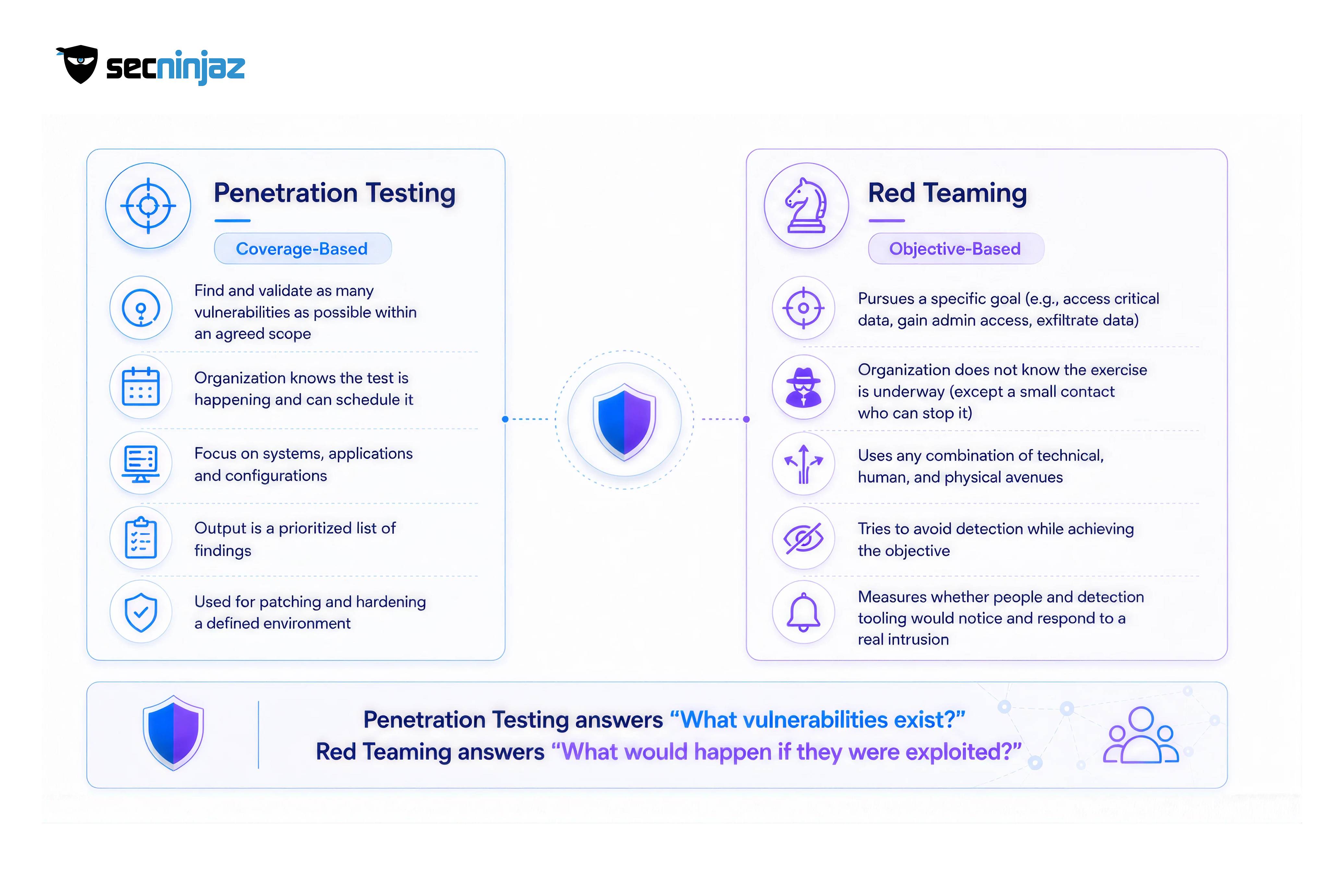 A penetration test is coverage-based. Within an agreed scope, a tester works to find and validate as many exploitable vulnerabilities as possible, and the organization being tested generally knows the exercise is happening, sometimes even scheduling it around business-critical hours. The output is a prioritized list of findings tied to specific systems, useful for patching and hardening a defined environment.
A red team exercise is objective-based. Rather than trying to find everything, a red team pursues a specific goal, reaching a crown-jewel database, exfiltrating a defined category of data, gaining administrative control of a critical system, using whatever combination of technical, human, and sometimes physical avenues would get there, while deliberately trying to avoid detection along the way. The defending team frequently does not know the exercise is underway at all, aside from a small, designated contact who can call it off if something goes wrong. What a red team measures is not primarily whether vulnerabilities exist; it is whether the organization's people and detection tooling would notice and respond to a real intrusion attempting to exploit them.
Red Teaming and Penetration Testing at a Glance
| Dimension | Penetration testing | Red teaming |
|---|---|---|
| Objective | Find and validate as many vulnerabilities as possible within scope | Achieve a specific goal while evading detection |
| Scope | Defined systems or applications, largely technical | Broader: cyber, cloud, social engineering, sometimes physical access |
| Awareness | The defending team generally knows testing is underway | Often unannounced, known only to a small white-cell contact |
| Typical duration | Days to around two weeks | Weeks to several months |
| What it measures | Presence and severity of vulnerabilities | Whether people, process, and detection systems actually catch and stop an intrusion |
| Typical output | A prioritized vulnerability list | An attack-path narrative alongside a detection and response scorecard |
| Common frameworks | PTES, OWASP Testing Guide, NIST SP 800-115 | MITRE ATT&CK-aligned, threat-led simulation modeled on frameworks like the European Central Bank's TIBER standard |
Purple Teaming: The Bridge Between the Two
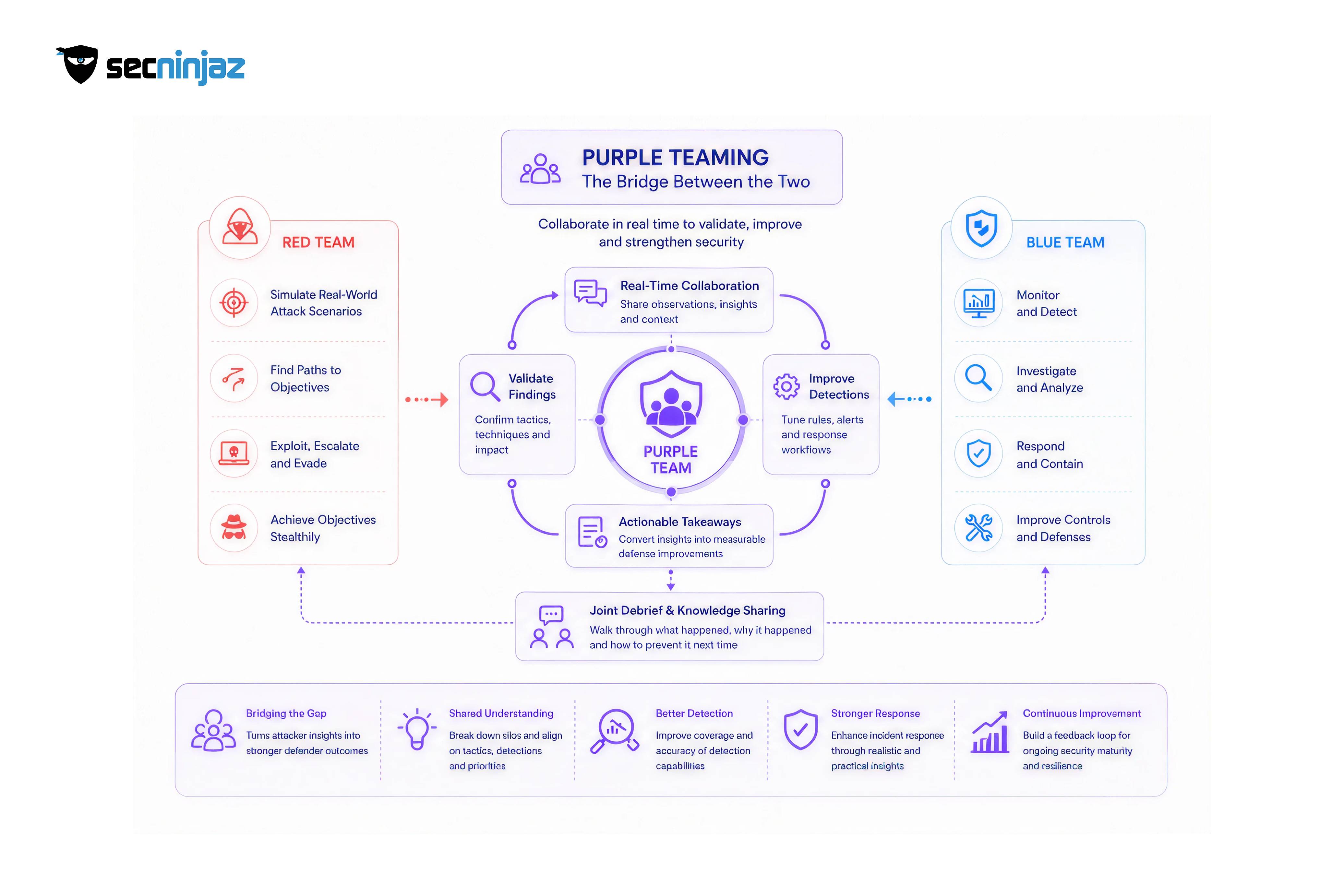 Purple teaming is neither of the above on its own. It is a collaborative exercise where the red team and the defending blue team work together in real time, rather than the red team operating in isolation and handing over a report weeks later. The point of a purple team engagement is to close the gap red teaming can otherwise leave open: a red team can spend two months proving a SOC missed a lateral-movement technique, but without a structured debrief walking the defending team through exactly what happened and why it was missed, that insight often does not translate into better detection rules. Purple teaming exists specifically to make sure it does.
Where India's Regulatory Map Now Points to One or the Other
The RBI's July 2026 restructuring is the clearest current example of how much this decision now depends on which specific regulatory instrument applies, but it is not the only one. SEBI's Cybersecurity and Cyber Resilience Framework requires adversary simulation specifically, not just standard VAPT, for its higher tiers, Market Infrastructure Institutions and Qualified Stock Brokers among them, while most other SEBI-regulated entities remain on an annual VAPT baseline without that additional requirement. The RBI framework banks operated under before July 2026 also ran incident reporting through its CSITE cell on a tight window, typically two to six hours from detection, a timeline that puts a premium on exactly the detection speed a red team exercise is built to test rather than the vulnerability coverage a pentest provides.
Internationally, the European Central Bank's TIBER framework, Threat Intelligence-Based Ethical Red Teaming, is the most widely referenced model for this kind of threat-led testing in the financial sector, and Indian institutions benchmarking their own red team programmes against global practice frequently use it as a reference point even without a formally adopted local equivalent.
Which Regulatory Signal Points Where
| Signal | What it suggests |
|---|---|
| The entity falls under an RBI Direction that includes a red-teaming paragraph | Genuine adversary simulation is likely required, not standard VAPT alone |
| The entity is a SEBI CSCRF Market Infrastructure Institution or Qualified Stock Broker | Adversary simulation is specifically mandated on top of annual VAPT |
| The entity is a smaller SEBI-regulated or self-certified entity | Annual VAPT is the likely baseline expectation, with red teaming optional rather than mandated |
| No sector regulator applies to the organization | The decision rests on internal risk appetite and SOC maturity rather than an external mandate |
A Decision Framework: Which Does an Organization Actually Need
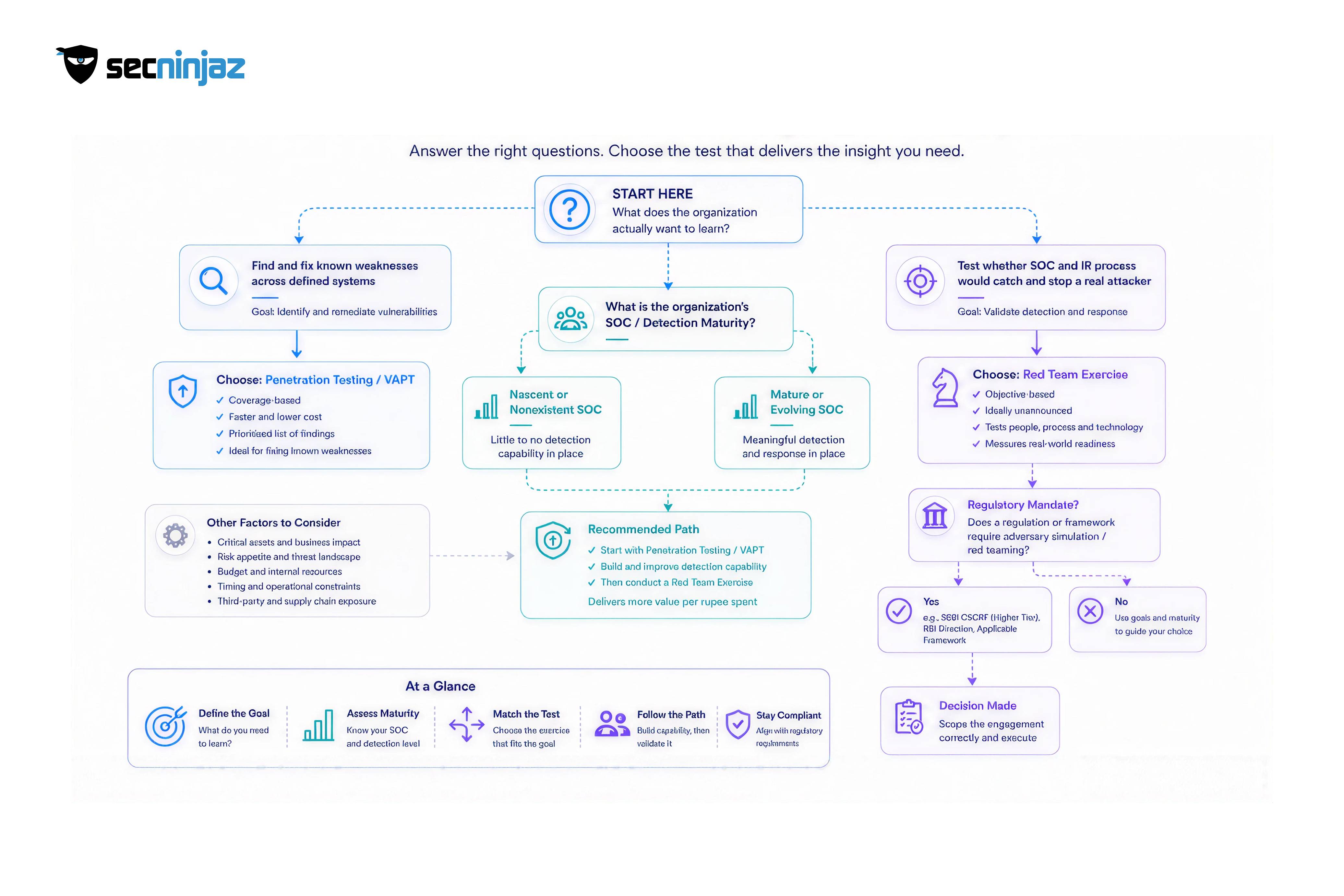 The starting question is not budget, it is what the organization actually wants to learn. If the goal is finding and fixing known weaknesses across a defined set of systems, a penetration test or a broader VAPT programme answers that directly and does so faster and at lower cost. If the goal is finding out whether the security operations centre and incident response process would actually catch and stop a real attacker, only a red team exercise, ideally unannounced, answers that question honestly.
Security operations maturity changes the calculus considerably. An organization with a nascent or nonexistent SOC gains relatively little from a red team engagement beyond confirming what was probably already suspected, that detection capability is weak. In that situation, a penetration test paired with building basic detection capability first, then a red team exercise once there is something meaningful to test, tends to deliver more value per rupee spent than jumping straight to adversary simulation. Where a regulatory mandate already specifies adversary simulation, as with SEBI's higher-tier CSCRF entities or an applicable RBI Direction that includes a red-teaming paragraph, that decision has effectively already been made, and the remaining work is scoping the engagement correctly rather than debating whether to run one.
What Choosing the Wrong One Costs
| Gap | Consequence |
|---|---|
| Buying red teaming that is actually a rebadged penetration test | No real signal on detection or response capability, and false confidence heading into a regulatory review that expects genuine adversary simulation |
| Running only VAPT where regulation requires adversary simulation | Non-compliance exposure and an audit finding, on top of the underlying capability gap never having been tested |
| Running a red team exercise before basic security hygiene is in place | An expensive exercise that mostly documents already-known weaknesses without adding new insight the organization did not already have reason to suspect |
| No purple team debrief following a red team engagement | Detection gaps get documented in a report but never actually closed, since the SOC never learns why the activity was missed |
| Announcing a red team exercise to the defending team in advance | The realism the exercise exists to test is removed, and the resulting detection and response findings cannot be trusted |
A Maturity Model for a Security Testing Programme
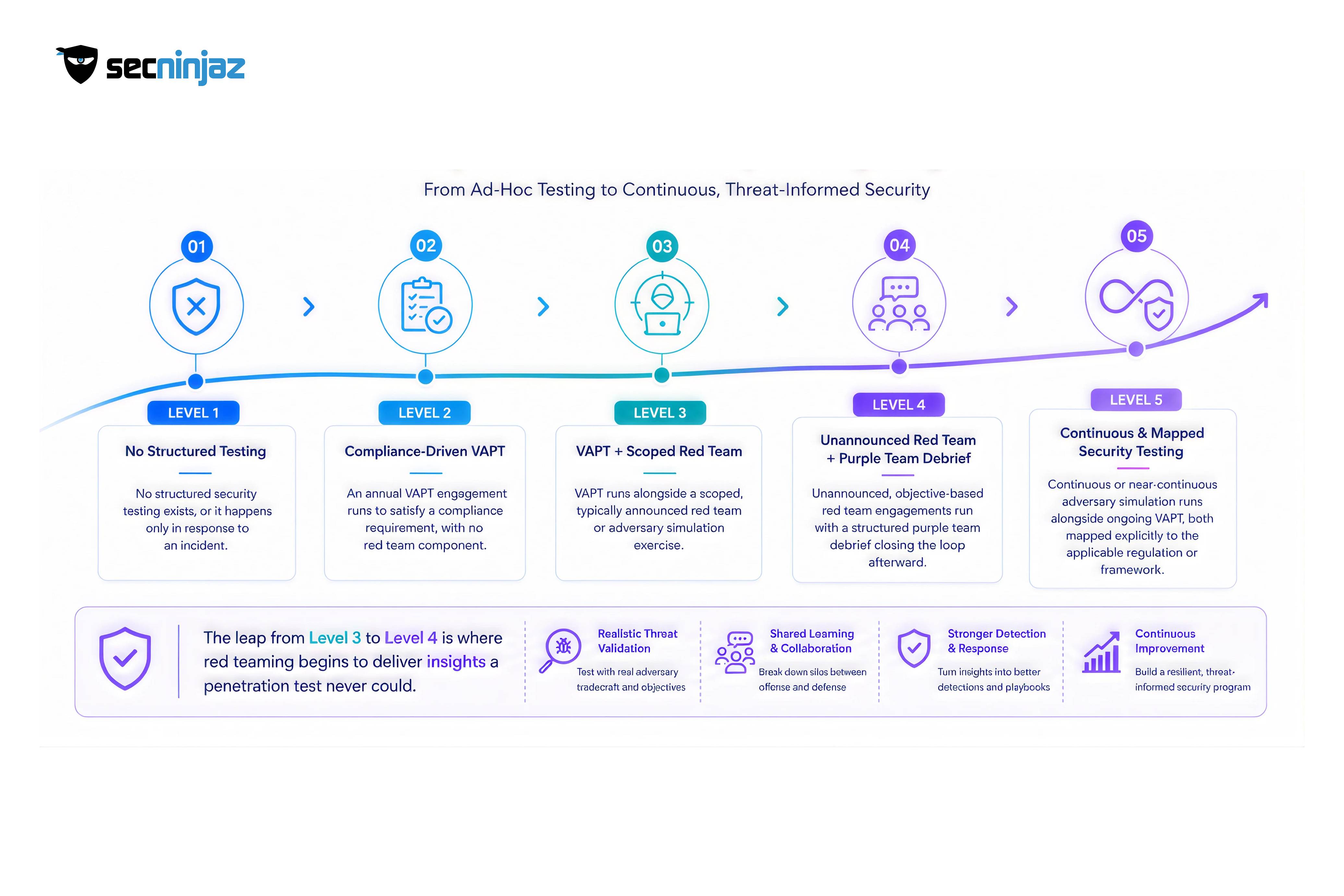 Most organizations sit somewhere on a five-level path between no structured testing and a genuinely continuous, threat-informed programme.
Level 1: No structured security testing exists, or it happens only in response to an incident ↓ Level 2: An annual VAPT engagement runs to satisfy a compliance requirement, with no red team component ↓ Level 3: VAPT runs alongside a scoped, typically announced red team or adversary simulation exercise ↓ Level 4: Unannounced, objective-based red team engagements run with a structured purple team debrief closing the loop afterward ↓ Level 5: Continuous or near-continuous adversary simulation runs alongside ongoing VAPT, both mapped explicitly to whichever regulatory Direction or framework actually applies
The jump from Level 3 to Level 4, moving from an announced exercise to a genuinely unannounced one with a purple team follow-up, is usually where a red team programme starts producing insight a penetration test could never have delivered.
A Readiness Playbook for Choosing and Commissioning the Right Engagement
- Confirm which regulatory Direction or framework actually applies, and read what it specifically requires rather than assuming last year's obligation still holds, given how quickly instruments like the RBI's July 2026 Directions have changed.
- Assess current SOC and detection maturity honestly before committing budget to a red team engagement that maturity is not yet ready to make full use of.
- Define a specific objective for any red team exercise, a named crown-jewel target or outcome, rather than a vague mandate to test security generally.
- Decide announced versus unannounced scope deliberately, keeping the number of people aware of an unannounced exercise to the smallest workable white-cell group.
- Book a purple team debrief as part of the engagement from the outset, not as an optional add-on considered only after the report is delivered.
- Use penetration testing and VAPT for coverage and patch prioritization on a shorter, more frequent cycle, reserving red team exercises for a slower, deeper cycle that reflects their higher cost and complexity.
- Match methodology and reporting format to the audience, a regulator, a board, or a SOC team, the same discipline any defensible security engagement needs regardless of which type is chosen.
- Revisit the choice as regulatory instruments and the organization's own risk profile change, rather than treating last year's decision as a permanent one.
Common Mistakes and Edge Cases
Treating red teaming as marketing language for a more expensive penetration test. If the engagement is announced in advance, scoped like a vulnerability sweep, and reported as a findings list, it is a penetration test regardless of what it is called on the invoice.
Announcing a red team exercise to the defending team. This removes the realism the exercise exists to measure and turns what should be a genuine test of detection capability into a cooperative walkthrough.
Skipping the purple team debrief. Detection gaps documented in a report but never explained to the SOC team rarely translate into better detection rules on their own.
Assuming red teaming is only relevant for banks and the largest enterprises. Smaller organizations holding sensitive data or connected to critical infrastructure can carry real exposure that a purely size-based assumption misses.
Running the same red team exercise annually with no change in objective. Repeating an identical scenario tends to find the same already-known gap every year rather than surfacing new insight.
Assuming a regulatory obligation exists, or does not, without checking the specific applicable instrument. As the RBI's 2026 restructuring shows, six entities that used to share one framework can now sit under six different sets of obligations, and assuming continuity from a repealed framework is no longer safe.
When to Use What: A Few Decision Points
Penetration testing versus red teaming versus purple teaming. Choose based on the actual question being asked: coverage of known weaknesses points to a penetration test, a genuine test of detection and response capability points to red teaming, and improving detection collaboratively in real time points to purple teaming.
Announced versus unannounced red team engagements. An announced exercise still tests technical depth and can be a reasonable first step for an organization new to red teaming. An unannounced exercise is what actually validates whether detection and response would hold up against a real, uncooperative attacker.
An in-house red team versus an external provider. Where a regulatory framework calls for independent, third-party validation, external engagement is effectively required. Outside that constraint, a mature internal red team can run more routine exercises, reserving external providers for the engagements that need demonstrable independence.
How SecNinjaz Fits Into This
Red Teaming and Purple Teaming sit within SecNinjaz's Cybersecurity practice alongside Penetration Testing, Vulnerability Assessment, Breach and Attack Simulation, Social Engineering, and AI SOC Automation, the last of which extends directly into the detection capability a red team exercise is built to test in the first place. That combination means an engagement can move from an initial VAPT baseline through to a genuine, objective-based red team exercise and a structured purple team debrief without switching providers partway through.
The regulatory mapping side, working out which RBI Direction, SEBI CSCRF tier, or other framework actually applies and what it specifically requires, runs through SecNinjaz's GRC and DPDP practice, including Audit and Gap Assessment. SecNinjaz holds ISO/IEC 27001:2022 certification, relevant here because a red team or purple team engagement handles some of the most sensitive material an organization has, its own detection blind spots, and needs the same access control and confidentiality discipline that standard requires elsewhere. For organizations trying to work out whether this year's obligation is a penetration test, a red team exercise, or both, that combination of testing depth and regulatory clarity is the pairing worth looking for, whether the organization works with SecNinjaz or anyone else.
Talk to Our Security Experts →
Frequently Asked Questions
What is the main difference between red teaming and penetration testing?
Penetration testing is coverage-based: it aims to find and validate as many vulnerabilities as possible within a defined, usually announced scope. Red teaming is objective-based: it pursues a specific goal while evading detection, testing whether an organization's people, processes, and detection systems would actually catch and stop a real intrusion, not just whether vulnerabilities exist.
Does every Indian enterprise need red teaming?
No. Whether red teaming is required or advisable depends heavily on the applicable regulatory framework and the organization's own risk profile. Following the RBI's July 2026 restructuring into six entity-specific Directions, some regulated entities have an explicit red-teaming obligation while others do not, and many organizations outside regulated sectors will get more immediate value from a solid VAPT programme before adding red teaming on top.
What is purple teaming and how is it different from red and blue teaming?
Purple teaming is a collaborative exercise where the red team, attackers, and blue team, defenders, work together in real time rather than the red team operating in isolation and delivering a report afterward. It exists to make sure detection gaps a red team finds actually translate into improved detection rules, closing a loop that a standalone red team exercise can otherwise leave open.
How has RBI's 2026 regulatory change affected red-teaming requirements for banks?
On 31 July 2026, the RBI repealed its 2016 Cyber Security Framework and replaced it with six entity-specific Directions covering commercial banks, small finance banks, payments banks, urban co-operative banks, NBFCs, and credit information companies. The six share a drafting template but are not identical: some include a red-teaming paragraph and others do not, meaning the obligation now depends on which specific Direction applies to a given entity rather than one uniform requirement across all RBI-regulated institutions.
Should a red team exercise be announced to the security team in advance?
Generally no, if the goal is to genuinely test detection and response capability. Announcing the exercise in advance removes the realism it is meant to measure. Most mature red team engagements keep awareness limited to a small white-cell contact who can intervene if something goes wrong, while the defending team operates without knowing the exercise is underway.
Is VAPT the same as penetration testing?
Not quite. VAPT bundles vulnerability assessment, systematic identification of weaknesses, with penetration testing, active attempts to exploit and demonstrate the impact of validated weaknesses. VAPT is broader than a standalone penetration test and is the term most Indian regulatory frameworks use when setting minimum testing requirements.
What does a red team engagement typically cost compared to a penetration test?
Red team engagements generally cost considerably more than penetration tests, reflecting their longer duration, weeks to several months against days to around two weeks for a typical pentest, and the broader range of technical, human, and sometimes physical avenues an objective-based exercise explores. Organizations with limited security testing budgets often get more immediate value from establishing a strong VAPT programme first and adding red teaming once basic detection capability exists to test.
Where should an organization start if it is unsure whether it needs red teaming or penetration testing?
Start by confirming which regulatory Direction or framework actually applies and what it specifically requires, since that alone may answer the question. Where no mandate applies, an honest assessment of current SOC and detection maturity should decide it: organizations without meaningful detection capability yet generally gain more from strengthening that foundation and running VAPT first, adding a red team exercise once there is something substantive for it to test.