

As of 19 August 2026, more than 53,800 new CVEs had already been published for the year, ahead of every full year on record, with four and a half months still left on the calendar. The Forum of Incident Response and Security Teams had forecast a median of roughly 59,400 new CVEs for 2026 back in February; by June it had revised that number upward, and the current pace works out to something close to one new disclosed vulnerability every six minutes. NIST responded to the same pressure in April by changing how the National Vulnerability Database operates: rather than trying to enrich every CVE with a severity score, NVD now prioritizes only the roughly 15 to 20% that appear in CISA's Known Exploited Vulnerabilities catalog, affect federal government software, or fall under Executive Order 14028's critical software list. Everything else gets logged and set aside as lower priority.
That shift matters for anyone running a vulnerability management programme, because it removes an assumption a lot of organizations were quietly relying on: that the CVE feed itself would tell them what to worry about. It no longer reliably does. An organization's own vulnerability assessment, discovering what it actually has, scanning it, confirming which findings are real, and rating them by more than a raw CVSS number, now has to do work that used to be partially outsourced to NVD's enrichment process.
Vulnerability assessment and penetration testing are often bundled together as VAPT, and the two get treated as roughly interchangeable in casual conversation. They are not. A penetration test attempts to exploit weaknesses and demonstrate real-world impact; a vulnerability assessment identifies and catalogs those weaknesses systematically without necessarily exploiting them, and it is usually the higher-frequency, broader-coverage half of a security programme. This guide looks specifically at that half: what a vulnerability assessment engagement actually involves, why the current volume of disclosed vulnerabilities has changed what a defensible assessment needs to do, and how each stage of the process, from asset discovery through to rescanning, fits together inside a working VA service. It is written for security leads, IT operations teams, and the compliance owners who have to show a regulator or an auditor that the organization's exposure is actually being tracked, not just scanned once a year and filed away.
What a Vulnerability Assessment Actually Is
A vulnerability assessment is a systematic process for identifying, classifying, and prioritizing security weaknesses across an organization's systems, applications, and infrastructure. It differs from a single vulnerability scan in the same way a full medical checkup differs from one blood test: a scan is a technical action a tool performs, while an assessment wraps that scan inside a broader process covering what gets scanned, how findings get validated, and how the results get turned into something an organization can actually act on.
It also differs in scope from network testing alone. Network vulnerability assessment looks at infrastructure, servers, firewalls, and network devices, typically through a mix of authenticated and unauthenticated scanning and service enumeration. Web application vulnerability assessment looks at a different attack surface entirely, applications and APIs, using OWASP-aligned test cases and authenticated, application-layer analysis that a network scanner was never built to perform. A cloud-focused assessment checks infrastructure configuration against provider-specific security benchmarks, catching misconfigurations that neither network nor web application tooling would necessarily surface. Treating these as one interchangeable activity, running the same scanning approach against all three, is one of the more common ways a VA programme leaves real gaps uncovered.
Talk to Our Security Experts →
Types of Vulnerability Assessment
| Type | What it covers | Typical approach |
|---|---|---|
| Network VA | Internal and external network infrastructure, servers, firewalls, network devices | Authenticated and unauthenticated scanning, port and service enumeration |
| Web application VA | Web applications and APIs | OWASP-aligned scanning combined with authenticated, application-layer testing |
| Cloud and configuration VA | Cloud infrastructure and platform configuration | Benchmark-based scanning against provider-specific security baselines |
| Host and endpoint VA | Operating system and endpoint patch and configuration state | Credentialed, agent-based or direct host scanning |
Why the Current Disclosure Rate Has Changed the Job
The numbers at the top of this guide are not a side note. They describe a genuine shift in what a vulnerability management function can rely on. CVE submissions grew 263% between 2020 and 2025, and 2026 is on pace to be the first year to cross 50,000 disclosures outright. Separately, exploitation timelines have compressed to the point that several major incident response firms now report vulnerabilities being exploited before, or within days of, public disclosure rather than the multi-week gap security teams used to plan around.
That combination means a raw CVSS score is no longer a reliable stand-alone signal for what to fix first, for two reasons. First, NVD's own triage change means a meaningful share of new CVEs will not receive a full score at all in the near term, so a prioritization approach that waits for NVD enrichment before acting is waiting on data that may never fully arrive. Second, even fully scored CVEs do not tell an assessor whether that specific vulnerability is being actively exploited in the wild right now, information the CVSS score was never designed to capture. Modern vulnerability assessment work has to layer additional signal on top of the base score to compensate for both gaps.
Signal Sources a Modern Assessment Has to Combine
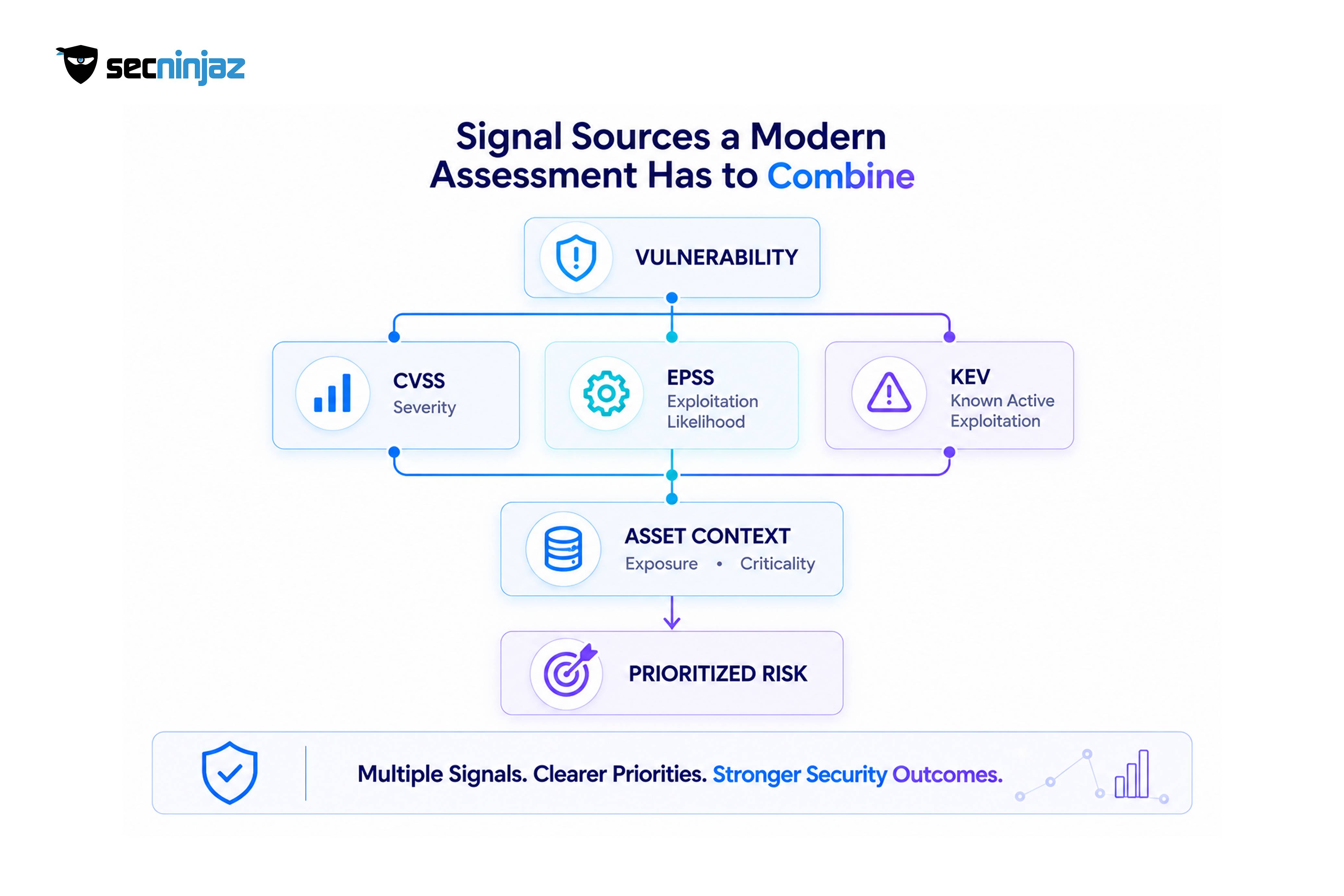 | Signal | What it tells an assessor | Its limitation on its own |
| --- | --- | --- |
| NVD and CVSS | A baseline technical severity rating | Since April 2026, only around 15 to 20% of new CVEs receive full NVD enrichment |
| CISA's Known Exploited Vulnerabilities catalog | Confirmed, real-world exploitation of a specific vulnerability | Does not cover every actively exploited flaw, and skews toward US federal relevance |
| EPSS, the Exploit Prediction Scoring System | A statistical estimate of the likelihood a vulnerability will be exploited soon | A probability, not a certainty, and it needs interpreting alongside asset context |
| Internal validation and business context | Whether the specific affected asset is genuinely exposed and how critical it is | Requires analyst time and does not scale to every disclosed CVE without prioritization first |
Inside a SecNinjaz VA Engagement: Six Stages
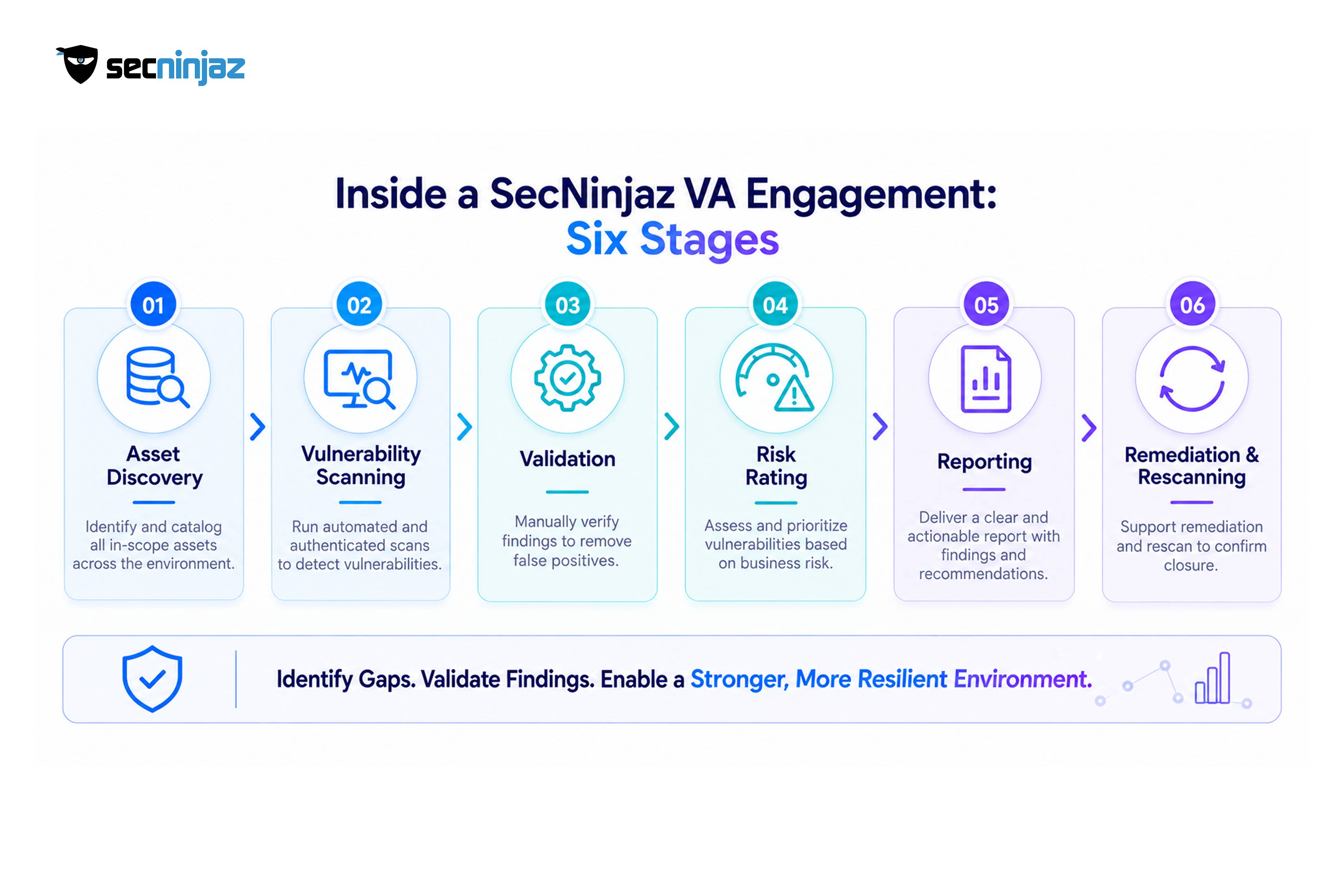 A properly run vulnerability assessment engagement moves through six stages, each producing something the next stage depends on.
| Stage | What happens | What it produces |
|---|---|---|
| 1. Asset discovery | Building a complete, current inventory of every in-scope system, including assets an existing CMDB may have missed | An accurate asset inventory the rest of the engagement can actually run against |
| 2. Vulnerability scanning | Automated, credentialed and uncredentialed scanning across every discovered asset | A raw list of potential vulnerabilities mapped to each asset |
| 3. Validation | Manually confirming which raw findings are genuine, removing false positives, and checking real-world exploitability against KEV and EPSS signals | A confirmed vulnerability list, not unvetted scanner output |
| 4. Risk rating | Scoring each validated finding on technical severity, exploitation likelihood, and business context together | A prioritized list showing what genuinely needs attention first |
| 5. Reporting | Structuring the prioritized findings into a report with reproduction detail and remediation guidance | An actionable deliverable for both engineering teams and leadership |
| 6. Remediation tracking and rescanning | Confirming that fixes were actually applied and validating closure | Closed-loop assurance rather than a one-time snapshot that goes stale |
Asset Discovery: The Stage Most Engagements Shortcut
Scanning cannot cover an asset nobody knew existed. An engagement scoped purely against an organization's documented CMDB routinely misses forgotten staging environments, unmanaged cloud resources spun up outside standard provisioning, and shadow IT that individual teams adopted without registering it anywhere central. Asset discovery exists specifically to close that gap before scanning begins, and it needs to be treated as an active step in its own right rather than an assumption that the existing inventory is already complete.
The same problem reappears between assessment cycles, not just at the start of one. New assets appear continuously, a new cloud instance, a new subdomain, a new third-party integration, and a discovery step run once a year cannot account for what gets added in month two. Organizations facing the current disclosure rate described earlier get considerably more value from asset discovery that runs on a rolling basis than from a single inventory snapshot refreshed annually alongside the rest of the assessment.
Scanning: Why Network and Web Application Testing Need Different Approaches
Credentialed scanning, run with legitimate access to the target system, surfaces considerably more detail than uncredentialed scanning, since it can inspect configuration and patch level directly rather than inferring weaknesses from what is visible externally. Uncredentialed scanning, by contrast, more closely approximates what an outside attacker with no internal access would actually see. Neither approach is strictly superior; a mature VA programme runs both, using uncredentialed results to understand external exposure and credentialed results to understand the deeper configuration risk a determined attacker with a foothold might eventually reach.
Web application scanning adds a layer network tooling was never designed to handle: authentication flows, session management, business logic, and API-specific weaknesses that only appear when a scanner interacts with the application the way a real user or attacker would. Running only network-style scanning against a web application, or the reverse, is a reliable way to miss an entire category of findings regardless of how thoroughly the covered category gets tested.
Validation: Why Raw Scanner Output Is Not a Finished Report
Automated scanning tools produce false positives at a rate well known across the industry, and forwarding raw output directly to an engineering team wastes their time chasing findings that are not actually exploitable in context. Validation is the manual step that separates a genuine vulnerability assessment service from a subscription to a scanning tool: Findings meeting defined severity, exploitability, exposure, or asset-criticality criteria undergo analyst validation and contextual prioritization, confirms it is real, and checks it against the KEV and EPSS signals described earlier rather than relying on the scanner's own severity label alone.
This step matters more now than it did even a few years ago, precisely because NVD's reduced enrichment coverage means fewer findings arrive with an authoritative severity score already attached. Validation increasingly has to supply the context NVD used to provide by default.
Risk Rating: Moving Past a Bare CVSS Number
CVSS measures technical severity in isolation: how bad a vulnerability would be if exploited, assuming it can be. It says nothing about whether that exploitation is actually happening anywhere, and nothing about whether the specific affected asset in a given environment is internet-facing, isolated, or business-critical. A CVSS 9.8 finding on a test server with no external exposure and no sensitive data can reasonably rank behind a CVSS 6.5 finding on an internet-facing production system that already appears in CISA's KEV catalog. Risk rating in a modern VA engagement combines the base CVSS score with KEV status, an EPSS probability, and the specific asset's exposure and business criticality into a single composite priority, rather than sorting a finding list by CVSS alone and working down it in order.
Reporting and Remediation Tracking
A vulnerability assessment report typically covers far more findings than a penetration test report, since it catalogs everything discovered across an entire asset base rather than a smaller number of exploited, chained weaknesses. That volume makes clear prioritization even more important: a report listing two hundred findings in no particular order is far less useful than one showing which handful actually demand attention this week. Each finding still needs enough reproduction and remediation detail for an engineering team to act without needing the original assessor re-engaged for every question, and the engagement is not complete once the report is delivered. Rescanning after a remediation cycle is what confirms a finding marked resolved was actually closed rather than only appearing to be, closing the loop the same way a retest closes one after a penetration test.
What You Receive from a SecNinjaz Vulnerability Assessment
A vulnerability assessment should leave an organization with more than a scanner export and a list of CVE identifiers. The purpose of the engagement is to establish a usable picture of exposure, give the teams responsible for remediation enough context to act, and provide management with a clear view of what requires attention first.
Depending on the agreed scope, a SecNinjaz vulnerability assessment engagement can include:
A defined assessment scope and asset inventory. The engagement begins with a clear understanding of what is being assessed, supplemented where necessary by asset discovery to identify systems, services, cloud resources, and other in-scope assets that may not appear in an existing inventory.
A validated vulnerability register. Potential findings identified during automated and manual assessment are reviewed to distinguish confirmed issues from false positives and other results that do not represent actionable risk in the environment.
Risk-based prioritization. Findings are not simply sorted from the highest CVSS score downward. Prioritization considers technical severity alongside exploitability signals such as CISA's Known Exploited Vulnerabilities catalog and EPSS, as well as the affected asset's exposure, business criticality, and role within the environment.
Technical findings with actionable remediation guidance. Each significant finding is documented with sufficient technical context for the responsible team to understand the issue, assess the affected asset, and plan remediation without having to interpret raw scanner output.
An executive-level view of risk. Technical detail alone is not sufficient for security leadership or management. The assessment provides a clearer view of the overall exposure, the vulnerabilities that represent the greatest current risk, recurring patterns across the environment, and the areas where remediation should be prioritized.
A remediation and tracking view. Vulnerability management does not end when the report is delivered. Findings can be tracked through remediation so that ownership, risk priority, and closure status remain visible rather than disappearing into a static PDF.
Rescanning and closure validation. Where included in the engagement, remediated findings are reassessed to confirm that the underlying issue has actually been addressed. A vulnerability should not be considered closed simply because a ticket was marked resolved.
The exact deliverables will vary with the scope of the engagement. An assessment covering external infrastructure, internal networks, web applications, APIs, cloud environments, or endpoints will naturally require different testing approaches and produce different technical evidence. The underlying objective, however, remains the same: to turn a broad set of potential weaknesses into a validated, prioritized, and actionable view of organizational risk.
Why Vulnerability Assessment Looks Different in the Indian Context
For organizations operating in India, vulnerability assessment is increasingly shaped by more than internal security policy. The required scope, frequency, evidence, and reporting expectations can vary according to sector, regulator, customer requirements, and whether the organization operates systems that fall within government, financial, critical infrastructure, or other regulated environments.
CERT-In plays a central role in India's cybersecurity ecosystem, issuing directions, guidelines, advisories, and vulnerability information intended to strengthen cybersecurity practices across Indian cyberspace. Its cybersecurity audit guidance applies to auditing organizations and auditees across public and private sectors seeking to evaluate cybersecurity posture, identify vulnerabilities, assess risks, and meet applicable regulatory and industry requirements.
This creates an important distinction between simply running a vulnerability scanner and operating a defensible vulnerability assessment programme. In the Indian context, organizations may need to demonstrate not only that testing occurred, but also what was in scope, what methodology was used, how findings were validated, who owns remediation, and whether identified weaknesses were subsequently addressed. CERT-In guidance for cybersecurity auditing also emphasizes comprehensive vulnerability discovery, executive-level reporting, relevant evidence, and alignment with applicable standards and regulatory requirements rather than limiting an assessment to a narrow "Top 10" style checklist.
The importance of this approach becomes particularly clear in sectors with specific cybersecurity obligations. Financial institutions, payment ecosystem participants, securities market entities, government organizations, and organizations operating critical or high-impact digital services may all face different requirements around security assessments, vulnerability management, audit evidence, and testing frequency. The correct assessment cadence should therefore not be chosen simply because an annual scan is convenient; it should reflect the applicable regulatory environment, the rate at which the organization's attack surface changes, and the criticality of the systems involved.
India's rapidly expanding digital infrastructure also creates a practical asset-management challenge. Enterprise environments increasingly span on-premises infrastructure, public cloud, SaaS platforms, APIs, mobile applications, third-party integrations, and externally exposed digital services. An asset inventory that was accurate six months ago may no longer represent what is actually exposed today. This makes asset discovery and continuous visibility particularly important for organizations operating at scale or undergoing rapid cloud and application expansion.
For organizations providing digital services to government entities, the assessment requirements can be even more explicit. Government guidance for websites, web applications, portals, and mobile applications includes security audit expectations before production hosting and references current security risks and practices such as OWASP ASVS and MASVS.
The practical implication is straightforward: there is no single "Indian vulnerability assessment frequency" that applies to every organization. A defensible programme starts by identifying the organization's applicable regulatory and contractual requirements, then combines those minimum obligations with the actual rate of asset change, exposure, and emerging vulnerability risk.
For some organizations, a periodic assessment may be sufficient. For others—particularly those operating regulated financial services, high-value digital platforms, critical systems, or rapidly changing cloud environments—vulnerability assessment increasingly needs to function as a recurring or near-continuous process rather than an annual compliance exercise.
Where Indian Regulation Sets the Cadence
Regulatory cadence has become a significant driver of how often vulnerability assessment actually happens rather than how often an organization would ideally choose to run it. The RBI's Directions, 2026 set a six-monthly vulnerability assessment requirement specifically for banks, non-banking financial companies, and payment aggregators, independent of the separate penetration testing expectations layered on top for the same entities. SEBI's Cybersecurity and Cyber Resilience Framework sets an annual VAPT minimum for most regulated entities, tightening to a six-monthly cycle for Market Infrastructure Institutions and Qualified Stock Brokers. For organizations regulated by both bodies, aligning the two cadences into a single testing calendar, rather than running overlapping but separately scheduled cycles, avoids duplicated scanning effort against the same systems.
What a Weak Vulnerability Assessment Programme Costs
| Gap | Consequence |
|---|---|
| No asset discovery, relying on an outdated inventory | Vulnerabilities on unknown or shadow assets never get scanned in the first place |
| No manual validation of scan output | Engineering time wasted on false positives, while unvalidated automated results miss real, context-dependent risk |
| Risk rating based on CVSS alone | Teams patch a high-CVSS but low-priority finding while a lower-scored, actively exploited, KEV-listed vulnerability goes unaddressed |
| No rescanning after remediation | Findings marked resolved are never actually confirmed closed |
| Point-in-time-only assessment | New assets and new CVEs appearing between cycles create blind spots at the current disclosure rate |
A Maturity Model for a Vulnerability Assessment Programme
Most organizations sit somewhere on a five-level path between reactive, incident-driven discovery and a genuinely continuous programme.
Level 1: No systematic scanning exists, and vulnerabilities are discovered only after an incident ↓ Level 2: Scheduled scanning runs, but the asset inventory is incomplete and raw output goes straight into a ticket queue unvalidated ↓ Level 3: Scanning is paired with manual validation and prioritization based on CVSS ↓ Level 4: Risk rating incorporates KEV and EPSS alongside CVSS, and rescanning confirms remediation actually closed each finding ↓ Level 5: Continuous asset discovery and scanning feed a living risk register that updates faster than the annual or quarterly cycle most compliance frameworks treat as a minimum
The jump from Level 3 to Level 4, adding KEV and EPSS on top of a CVSS-only prioritization model, is increasingly the difference between a programme that catches what is actually being exploited and one that only catches what looks severe on paper.
A Readiness Playbook for a Vulnerability Assessment Programme
- Build and maintain a live asset inventory before scheduling the first scan. A scan is only as complete as the list of things it was pointed at.
- Match scanning depth and credential level to each asset type, since network, web application, and cloud environments all need a different approach to surface their respective risks.
- Require manual validation for every finding above a defined severity threshold, rather than forwarding raw scanner output as though it were a finished deliverable.
- Layer KEV and EPSS signals on top of raw CVSS scores before finalizing risk ratings, since CVSS alone increasingly under-represents what is actually being exploited.
- Tie every finding to a business-context owner, not just a technical severity number, so prioritization reflects what the asset actually does for the organization.
- Set a remediation SLA by risk tier and track it, rather than treating a logged finding as equivalent to a scheduled fix.
- Rescan after every remediation cycle to confirm closure before marking a finding resolved in any tracker or report.
- Increase scanning frequency in step with both the organization's own asset churn and the broader CVE disclosure rate, rather than defaulting to a fixed annual cadence regardless of how fast either one is actually moving.
Common Mistakes and Edge Cases
Scoping an assessment against the CMDB alone. Shadow IT and forgotten environments live precisely in the gap between what is documented and what actually exists.
Forwarding raw scanner output as a finished report. Unvalidated findings waste engineering time on false positives and undermine confidence in every future report the programme produces.
Prioritizing strictly by CVSS score. A high technical severity score says nothing about whether an attacker is actually targeting that specific weakness right now.
Treating vulnerability assessment as a once-a-year exercise. At the current disclosure rate, a full year between assessments leaves enormous room for new exposure to accumulate unnoticed.
Skipping rescanning after remediation. A finding marked resolved in a ticketing system has not been confirmed closed until a rescan actually verifies it.
Using identical scanning techniques for network and web application layers. Each surface has failure modes the other approach was never built to detect.
When to Use What: A Few Decision Points
Credentialed versus uncredentialed scanning. Uncredentialed scanning approximates an outside attacker's view and is well suited to understanding external exposure. Credentialed scanning goes deeper into configuration and patch state, and a mature programme runs both rather than choosing one over the other.
A point-in-time engagement versus a continuous VA programme. An organization with a slow-changing environment and light regulatory obligations may reasonably run a periodic, scheduled assessment. One with a fast-changing asset footprint, or one regulated under a framework like SEBI CSCRF or the RBI's cybersecurity directions, benefits more from a continuous or near-continuous programme matched to that pace.
An internal scanning tool versus a managed VA service. An organization with the in-house capacity to validate findings, maintain scanning infrastructure, and stay current on signals like KEV and EPSS can run more of this work internally. One without that dedicated capacity typically gets a more reliable, consistently validated outcome from a managed service built around exactly that workflow.
How SecNinjaz Fits Into This
Vulnerability Assessment sits within SecNinjaz's Cybersecurity practice alongside Penetration Testing, Red Teaming, Purple Teaming, Breach and Attack Simulation, and AI SOC Automation, which extends the same discovery-and-monitoring discipline into continuous, automated detection between formal assessment cycles. The six-stage engagement structure described in this guide, asset discovery through validated, risk-rated reporting and rescanning, reflects how that practice runs a VA engagement in operation rather than a theoretical framework.
SecNinjaz holds ISO/IEC 27001:2022 certification, and the asset inventory and risk assessment discipline that standard requires internally overlaps directly with the asset discovery and risk-rating stages this guide describes, meaning the underlying process is one the organization applies to its own environment as well as its clients'. For organizations trying to move from a once-a-year scan toward a genuinely current picture of their exposure, in a year already on pace to set a new record for disclosed vulnerabilities, that combination of structured methodology and validated, business-context-aware risk rating is the pairing worth looking for, whether the organization works with SecNinjaz or anyone else.
Talk to Our Security Experts →
Frequently Asked Questions
What is the difference between vulnerability assessment and penetration testing?
A vulnerability assessment systematically identifies, validates, and prioritizes security weaknesses across an organization's systems without necessarily exploiting them. A penetration test goes further, with a qualified tester actually attempting to exploit validated weaknesses to demonstrate real business impact. VA typically runs more frequently and covers broader ground, while penetration testing goes deeper on a narrower set of confirmed issues.
What is the difference between a vulnerability scan and a vulnerability assessment?
A scan is a technical action performed by a tool, producing a raw list of potential findings. A vulnerability assessment is the broader process wrapped around that scan: asset discovery beforehand, manual validation of the results, risk rating that accounts for more than a raw severity score, and a structured report that engineering and leadership can actually act on.
Why can organizations no longer rely on CVSS scores alone to prioritize vulnerabilities?
Since April 2026, NIST's National Vulnerability Database only fully enriches around 15 to 20% of new CVEs, those appearing in CISA's Known Exploited Vulnerabilities catalog, affecting federal government software, or falling under Executive Order 14028's critical software list. A large share of newly disclosed vulnerabilities may not receive a complete CVSS score in a timely way, and even scored CVEs do not indicate whether exploitation is actually happening in the wild, which is why signals like KEV and EPSS need to be layered on top.
What is asset discovery and why is it the first stage of a VA engagement?
Asset discovery builds a complete, current inventory of every system in scope, including assets an existing CMDB may have missed, such as shadow IT or forgotten staging environments. Scanning cannot cover an asset nobody knew existed, so discovery has to happen before scanning for the rest of the engagement to produce a genuinely complete picture.
How often should a vulnerability assessment be run?
Regulatory frameworks set minimums: the RBI's Directions, 2026 require six-monthly vulnerability assessment for banks and NBFCs, and SEBI's CSCRF requires annual VAPT for most regulated entities, tightening to six-monthly for Market Infrastructure Institutions and Qualified Stock Brokers. Organizations with fast-changing asset footprints, or operating in a year with record-high CVE disclosure volume, generally benefit from a cadence closer to continuous than the regulatory minimum alone would require.
What is the difference between network and web application vulnerability assessment?
Network vulnerability assessment covers infrastructure such as servers, firewalls, and network devices, using port and service enumeration alongside authenticated and unauthenticated scanning. Web application vulnerability assessment targets applications and APIs, using OWASP-aligned test cases and authenticated, application-layer analysis to catch authentication, session management, and business-logic flaws that network tooling is not built to detect.
Why does a vulnerability assessment need manual validation instead of just automated scanning?
Automated scanning tools produce a well-documented rate of false positives, and forwarding raw output directly to an engineering team wastes time chasing findings that are not genuinely exploitable in context. Manual validation confirms each significant finding is real and checks it against exploitation signals like KEV and EPSS, work that matters even more now that NVD enriches a smaller share of new CVEs than it used to.
Where should an organization start if it has never run a formal vulnerability assessment before?
Start with asset discovery to establish an accurate inventory, since scanning cannot cover systems nobody knew existed. From there, matching scanning depth to each asset type, requiring manual validation of findings, and layering KEV and EPSS signals onto raw CVSS scores prevents the two most common early failures: missed shadow IT and misplaced remediation priority.