

Web application security testing in India has moved from a nice-to-have to a basic operating requirement. CERT-In, the country's national incident response agency, handled more than 29 lakh security incidents in 2025, a 44 percent jump over the previous year. The striking part is what those incidents were: over 80 percent were scanning and probing. Attackers are not leading with ransomware; the bulk of reported activity is quiet reconnaissance, mapping Indian websites, APIs and admin panels for one weak entry point.
This post is the checklist we use to close those entry points. It walks through the OWASP Top 10 (2025 edition), explains what a tester actually checks for each risk, and covers what to expect from a professional assessment.
Explore Application Security Testing →
Why Indian web applications are getting probed
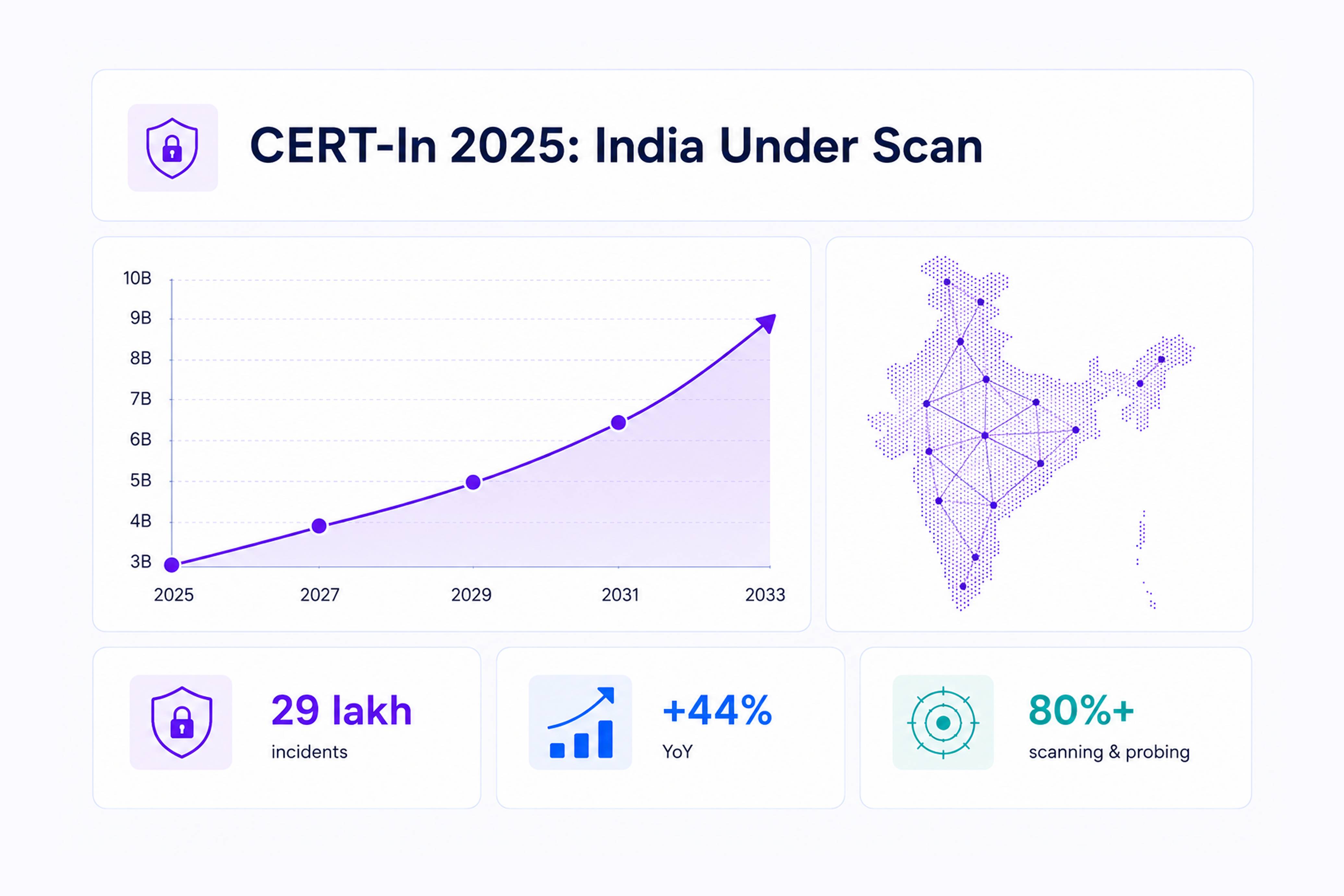
Three forces are converging on Indian businesses at once.
First, exposure. Every new customer portal, payment flow and mobile API widens the attack surface, and the CERT-In numbers above show attackers are systematically scanning it. Second, compliance requirements have real teeth now. CERT-In's directions, in force since 2022, require organisations to report security incidents within six hours of noticing them. The DPDP Rules notified in November 2025 go further: a detailed breach report to the Data Protection Board within 72 hours, penalties of up to ₹200 crore for failing to notify, and full compliance due by May 2027. Third, the cost asymmetry: an attacker needs one overlooked flaw, while your team has to get everything right.
Security issues in web applications are rarely exotic. Most breaches trace back to well-understood, preventable weaknesses. That is exactly why structured testing works.
Vulnerability assessment vs web application penetration testing
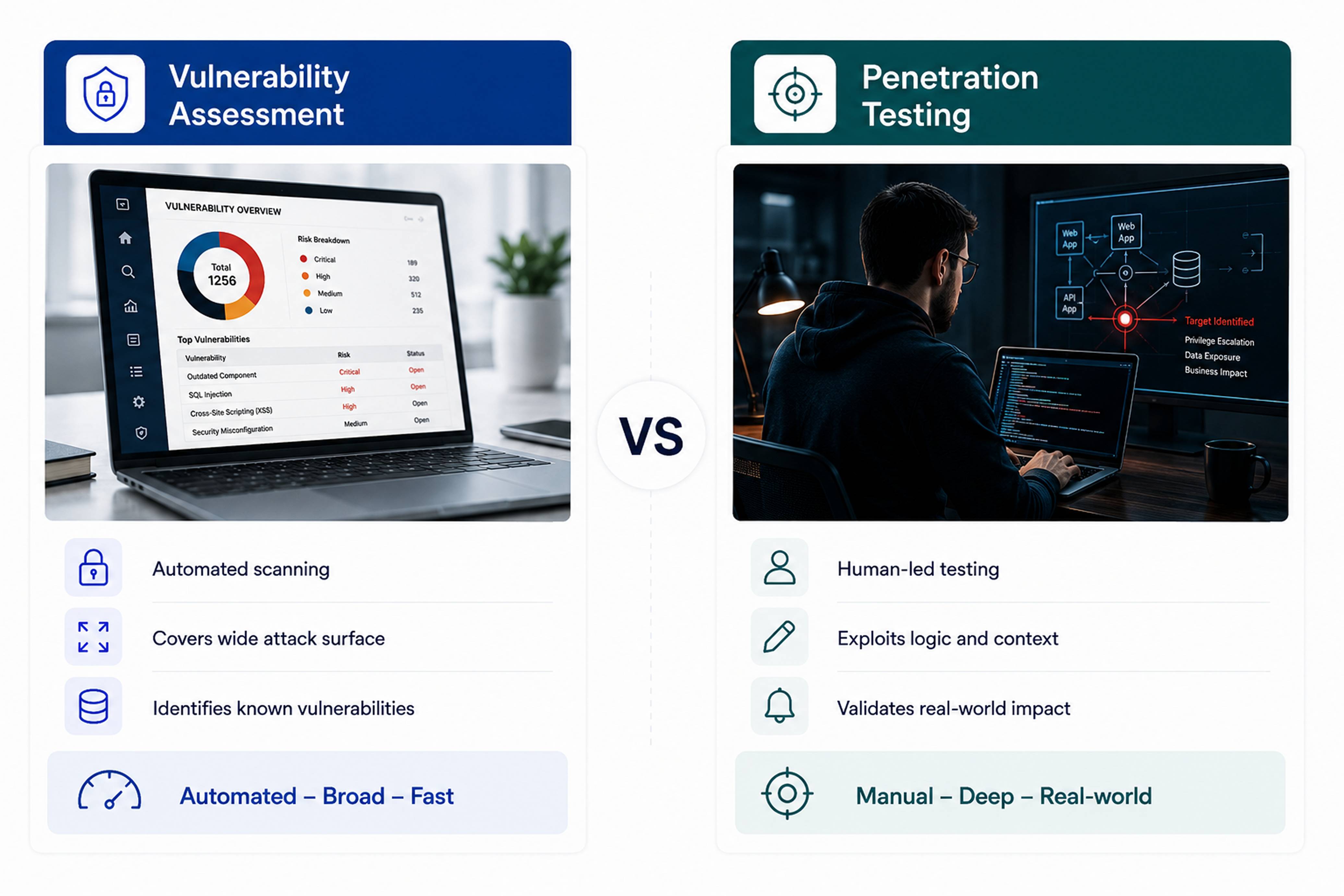
These two terms get used interchangeably, and they should not be.
A vulnerability assessment is a broad, largely automated sweep. Scanners check your applications and web services against databases of known security vulnerabilities and produce a prioritised list. It is fast, repeatable and good at catching the obvious.
Web application penetration testing is narrower and deeper. Human penetration testers behave like a real attacker: chaining minor weaknesses together, abusing business logic, and proving what an actual breach would look like. A scanner can tell you a door is unlocked. A penetration tester walks through it and shows you what was reachable inside.
Mature testing services combine both. Automation for coverage, manual testing for depth. Anyone selling you one as a substitute for the other is selling you a blind spot.
The OWASP Top 10 (2025) checklist: the vulnerabilities a tester looks for
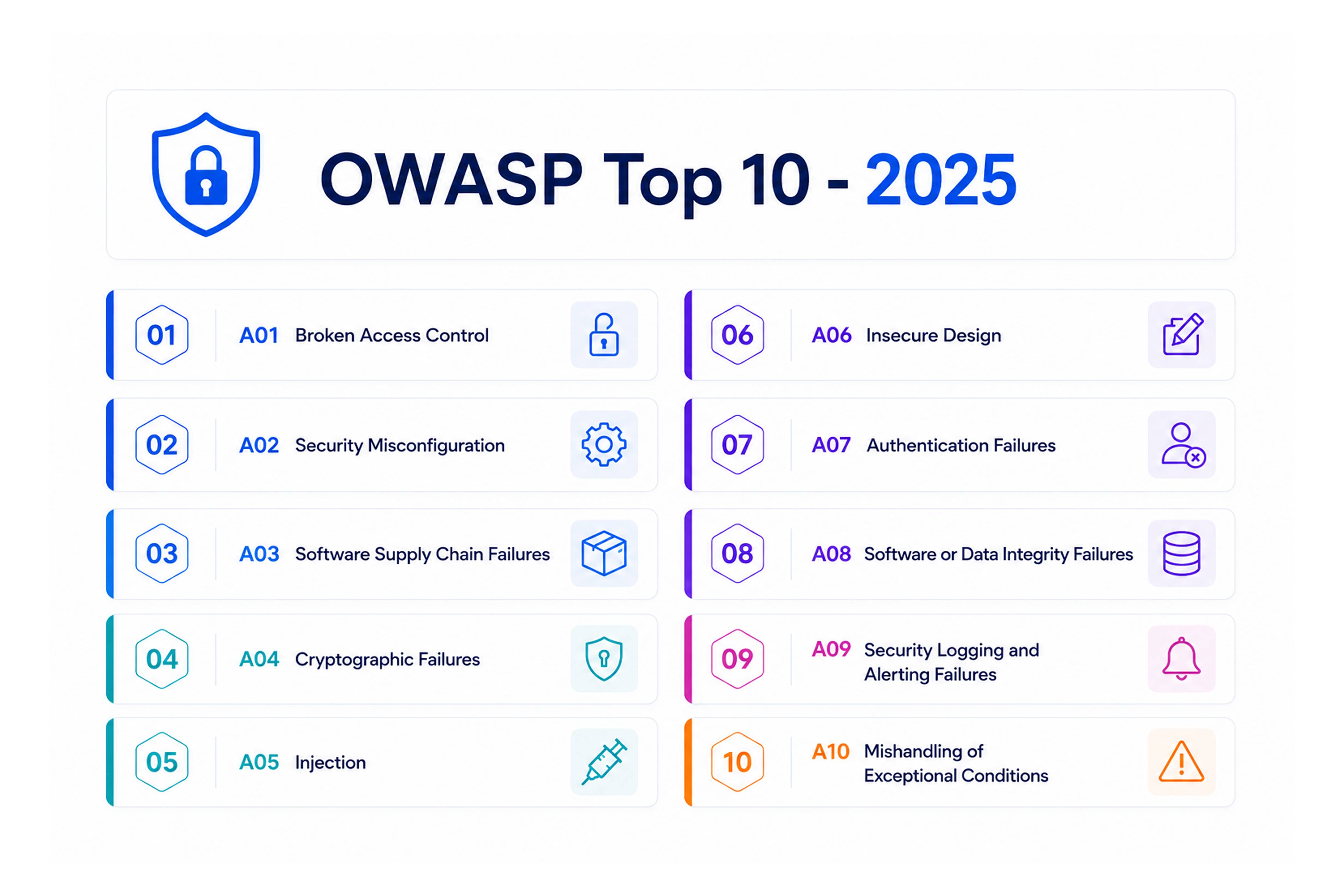
The OWASP Top 10 is the most widely used ranking of critical web application risks, and its 2025 edition, the current version, reshuffled the list based on contributed testing data and a global practitioner survey. Alongside it, the OWASP Web Security Testing Guide (WSTG) defines how to test for each risk in practice. Here is the current list, and what we check for each item.
A01: Broken access control
Still the number one risk in OWASP's data. Testers check whether user A can read user B's data by changing an ID in the URL (IDOR), whether low-privilege accounts can reach admin functions, and whether the server actually enforces permissions or just hides buttons. Server-side request forgery (SSRF) now lives in this category too.
A02: Security misconfiguration
Up from fifth place to second. Default credentials, directory listings, verbose error messages, missing security headers, and cloud storage buckets left open to the internet. In our experience this category produces some of the fastest wins for an attacker because misconfigurations require no skill to exploit.
A03: Software supply chain failures
Expanded in 2025 from the older Vulnerable and Outdated Components category, in direct response to how modern applications are built. Testers inventory your dependencies, check for known-vulnerable packages, and examine whether your build and deployment pipeline could be tampered with.
A04: Cryptographic failures
Sensitive data travelling over plain HTTP, passwords hashed with obsolete algorithms, hardcoded keys in source code, and TLS configurations that accept broken ciphers. The test is simple to state: could intercepted or stolen data actually be read?
A05: Injection
The classic family: SQL injection, command injection, and cross-site scripting (XSS). Testers probe every input that touches a database, an OS command or a rendered page. The fixes are equally classic: parameterised queries, strict input validation and output encoding.
A06: Insecure design
Some flaws are not bugs in code but gaps in the design itself. Can a discount code be applied twice? Can an OTP be brute-forced because there is no rate limit? Business logic testing is where manual testers earn their keep, because no scanner understands your workflows.
A07: Authentication failures
Credential stuffing against login endpoints, weak password policies, session tokens that survive logout, and missing multi-factor authentication on sensitive actions. Testers attack the login, the session and the recovery flow, because attackers do.
A08: Software or data integrity failures
Insecure deserialisation, auto-update mechanisms that do not verify signatures, and CI/CD pipelines that trust unsigned artefacts. The question here: can attacker-controlled data or code be smuggled into something your application trusts?
A09: Security logging and alerting failures
If a penetration test runs for two weeks and nobody on your side notices, that is itself a finding. Testers verify that authentication failures, access control violations and input attacks are logged, and that the logs reach someone who can act.
A10: Mishandling of exceptional conditions
Also new in 2025. What happens when things go wrong? Applications that fail open, leak stack traces, or enter inconsistent states under unexpected input give attackers both information and opportunity.
How SecNinjaz tests web applications

SecNinjaz is a Delhi-based offensive security company serving clients across India, from startups in Bangalore to enterprises in the NCR. Web application security testing is core work for us, and our approach is deliberately simple to explain.
We test manually first, guided extensively by the OWASP WSTG, with automated scanning for baseline coverage. On top of that, we use AI-assisted tooling and agents to surface issues that traditional fuzzers and scanners sometimes miss, especially in complex, stateful application flows. Every engagement is scoped with you up front, and every finding ships with a proof of concept, a severity rating grounded in business impact, and concrete remediation guidance your web developers can act on directly. When the fixes are in, we retest and verify them. A report that says "vulnerable" without showing how, or a test that ends before remediation is confirmed, is half a job.
An engagement follows a defined arc: scoping and reconnaissance first, then mapping the application, then controlled exploitation of what we find, and finally reporting and retest. The toolkit is what you would expect: Burp Suite Professional, Nmap, and purpose-built scripts. But tools only find what the tester knows to ask. The interesting findings usually come from a human noticing that two minor issues, chained together, become a critical one.
The team behind this holds certifications including OSCP+, CEH, CRTP, CRTE, CISSP, SSCP, and ISO 27001 Lead Auditor and Lead Implementer credentials. More importantly, they are practising security experts who break real applications every working day. The exams formalised what years of engagements had already taught.
What you receive when the test ends
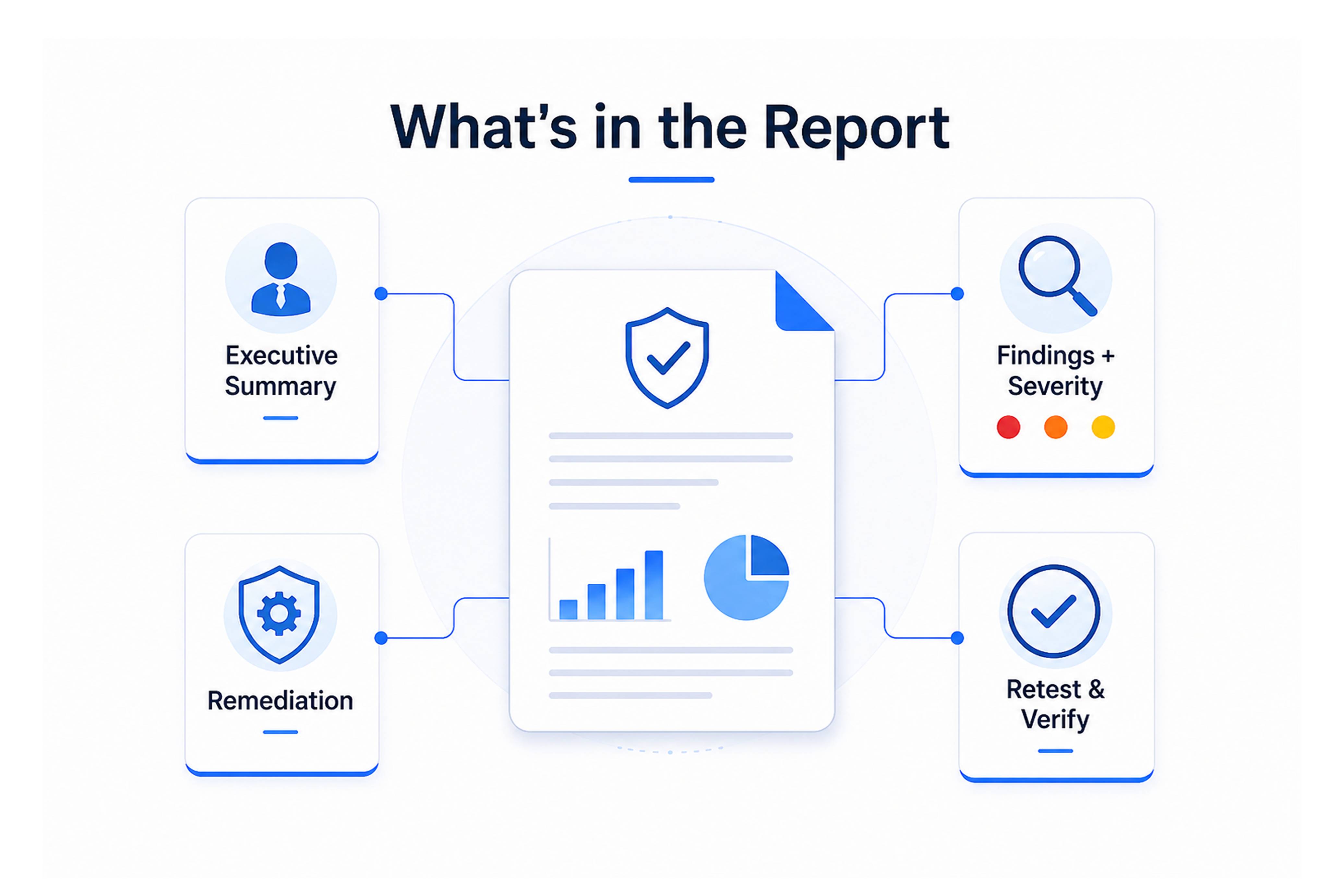
The deliverable matters as much as the testing, because the report is what your team actually works from. A good web application security test produces three things.
First, an executive summary in plain language, so leadership understands the risk position without translating jargon. Second, technical findings where every issue carries a severity rating, exact reproduction steps and a working proof of concept. If your engineers cannot reproduce a finding from the report alone, the report has failed. Third, remediation guidance written for your stack, specific enough that a developer can pick it up and start fixing the same day.
We rank findings by exploitability and business impact together, not by scanner score. A medium-severity flaw on a payment flow can matter far more than a high-severity one on a static brochure page. And once your fixes land, the retest closes the loop: each finding is verified and the updated report becomes evidence you can hand to customers, auditors or partners who ask how your applications are tested.
Choosing a security testing partner in India
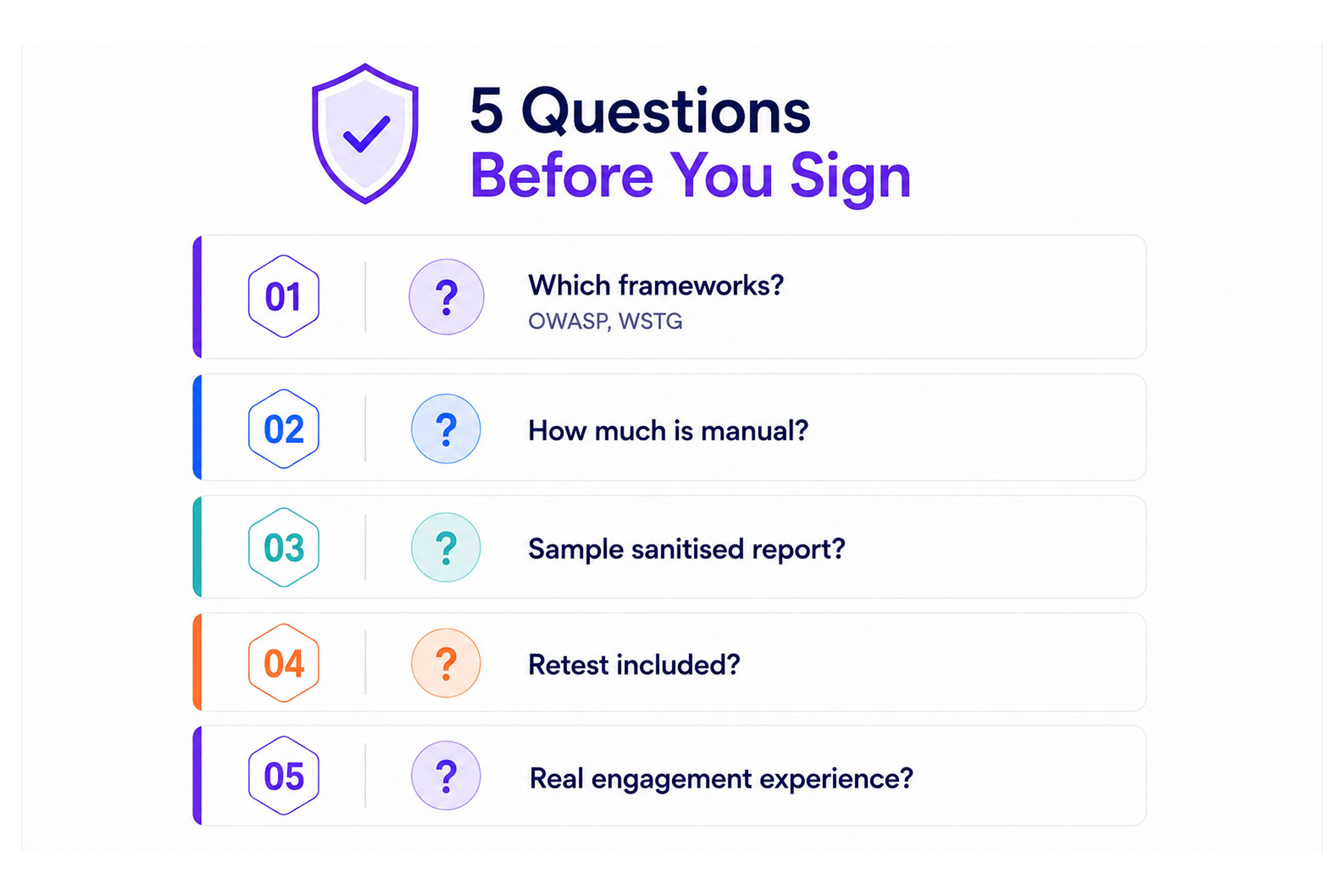
Whoever you engage, ask these questions before signing.
Ask about methodology: a credible security consultant should name the frameworks they test against (OWASP Top 10, WSTG) without hesitation. Ask how much of the work is manual, because a rebadged scanner report is not a penetration test. Ask to see a sanitised sample report and judge whether your engineers could fix issues from it. Ask whether retesting after remediation is included. And weigh training and credentials sensibly: a certificate from a training institute proves foundational knowledge, but it is engagement experience that finds the flaws scanners miss. Cybersecurity professionals worth hiring will happily answer all of this.
Explore Application Security Testing →
Frequently Asked Questions
How often should web applications be tested?
Web applications should be tested at least once a year and after any significant changes, such as introducing new features, APIs, framework upgrades, or infrastructure migrations. Applications that process payments or personal data should undergo security testing more frequently to reduce risk and support regulatory compliance.
What does web application security testing cost in India?
The cost depends on the application's size, complexity, number of assets being tested, and the depth of the assessment. A scoped security engagement provides a more accurate estimate than a fixed-price quote and ensures testing aligns with your business requirements.
Do we need a vulnerability assessment or a penetration test?
Most organizations benefit from both. A vulnerability assessment identifies known security weaknesses across an application, while a penetration test uses manual techniques to validate exploitable vulnerabilities, uncover business logic flaws, and demonstrate the real-world impact of security issues.