
India has quietly become one of the busiest places on the planet for putting AI to work. It isn't only the big software exporters anymore. Mid-sized firms in Delhi, Pune, Bengaluru, Gurugram and Ahmedabad are handing their most repetitive work to AI systems and freeing their people for the tasks that actually need a human. What used to be a pilot project in an innovation lab is now a line item in the operating budget.
That's the real story behind AI virtual teams. They aren't a gadget or a passing trend. They're a shift in how a business gets its routine work done, sitting somewhere between hiring more staff and buying another piece of software. Used well, they cut the drudgery and keep your best people focused on judgement calls. So here's the question worth sitting with: if a large slice of your team's day is spent on work that never really needed a person, what exactly are you paying a salary for?
Key Takeaways
Not just automation. AI virtual teams go further than fixed automation scripts, handling variable, multi-step work while a human stays in charge of the decisions that matter.
Real cost movement. Once set up, an AI workforce absorbs routine volume without the recruitment, attrition and per-seat overhead of adding headcount for the same tasks.
India's advantage. A deep technical talent pool, mature IT infrastructure and supportive policy make India a practical, cost-sensible base for building these teams.
Department-wide reach. Customer service, sales and marketing, finance, HR and operations all have repetitive work that AI can take over, freeing staff for higher-value effort.
Human oversight stays. These systems augment your people rather than replace their judgement; the sensible model keeps a named human accountable for every output.
Reframing the Concept of AI Virtual Assistants. What It Means for Your Business

Most business owners hear AI assistant and picture a chatbot that answers a few FAQs. That picture is a decade out of date. The gap between a scripted bot and a modern AI agent is the difference between a vending machine and a capable junior colleague who can actually work through a task.
The reason this matters for your business is simple. As you try to grow without your cost base growing at the same rate, routine work becomes the bottleneck. AI virtual assistants sit right on that bottleneck.
Understanding the Reality Behind AI Virtual Teams
An AI virtual team is a set of AI agents configured around your actual business functions rather than around generic use cases. Instead of one tool doing one trick, you get several agents that can take a task from start to finish, pass work between each other and flag anything unusual to a person.
What makes them useful is consistency. An AI agent doesn't get tired at 4pm, doesn't lose focus on the hundredth ticket of the day, and applies the same standard to the first task and the thousandth. That reliability is where the value sits, not in any single clever feature.
To be clear about what they are and aren't: these agents handle defined work extremely well, but they don't run your company. They work inside the boundaries you set, and a person reviews the outcomes that carry real risk.
Why Indian SMEs Are Turning to AI Virtual Assistants
For a lot of Indian SMEs, the appeal starts with cost, but it doesn't end there. Yes, handing routine volume to an AI system is cheaper than adding seats for the same work. The bigger draw is being able to scale up when demand spikes without a frantic hiring round, then scale back down without difficult conversations.
There's also the speed of adapting to the market. When a festive-season rush hits or a new product launches, an AI-supported team can pick up the extra load in days, not months. Cloud delivery means most of this runs without you buying and babysitting your own servers.
Virtual Employees vs Automated Processes. What's the Difference?
This distinction trips a lot of people up, so it's worth getting right. Traditional automation, including RPA, is brilliant at fixed, repetitive steps: if X happens, do Y, every single time, no deviation. The moment something falls outside the rule, it breaks and waits for a human.
An AI virtual employee is more flexible. It can weigh a bit of context, handle a task that doesn't follow an identical pattern each time, and make a reasonable call within its remit. Think of automation as the rails and AI agents as something closer to a colleague who can read the situation.
Neither removes the human. The point of both is to take routine load off your team, and in every serious setup a person still owns the outcome and steps in on the exceptions.
Real-life Examples. Tasks That AI Virtual Assistants Can Replace
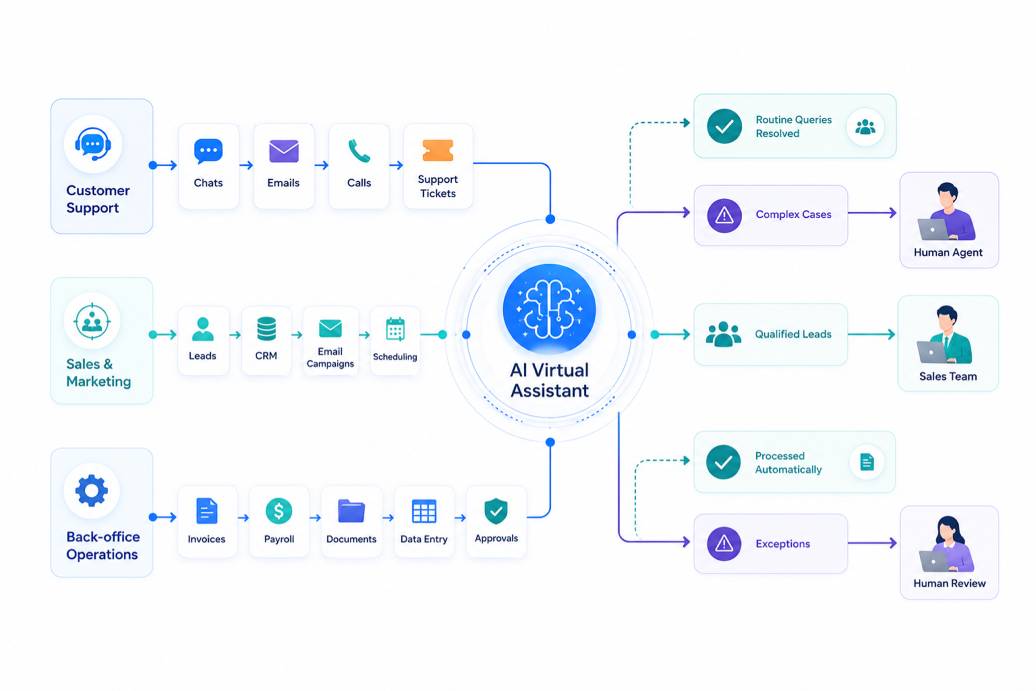
The clearest way to understand the value is to look at the specific work these agents take off your team's plate. Across most businesses, the same categories of repetitive effort show up again and again.
Task Replacement in Customer Service and Support
Picture your support desk running through the night without a single person on shift, and customers still getting sensible answers. AI agents handle a large volume of routine queries at once and resolve the common ones on the spot, which pulls a big chunk of load off your contact centre.
That leaves your human agents free for the calls that genuinely need a person, the frustrated customer or the unusual complaint. Customers get faster answers on the simple things, and your team spends its time where it counts. The AI handles first-line volume; anything sensitive or complex still lands with a human.
AI-driven Efficiency in Sales and Marketing
In sales and marketing, AI agents earn their keep on the grind work. They sift through lead data, score and prioritise prospects, draft first-pass follow-ups and keep the CRM tidy so nothing slips through the cracks. Your sales team walks into the day with a ranked list instead of a cold spreadsheet.
On the marketing side, agents can help personalise outreach at a scale a small team couldn't manage by hand, and schedule content across channels. The creative and strategic calls stay with your marketers; the AI just clears the repetitive setup so they have time to make them.
Streamlining Admin and Back-office Tasks with AI
Back-office work is the quiet drain on most businesses. Scheduling, data entry, document sorting, basic reconciliation, chasing missing information. It rarely needs deep thought, but it eats hours and it's where tired people make small, costly mistakes.
AI agents handle this steadily and accurately, so finance and payroll cycles run more smoothly and records stay clean. The result is a leaner back office where your admin staff spend their time on exceptions and judgement calls rather than repetitive keying.
How Much Does It Cost to Build an AI Virtual Employee Team?
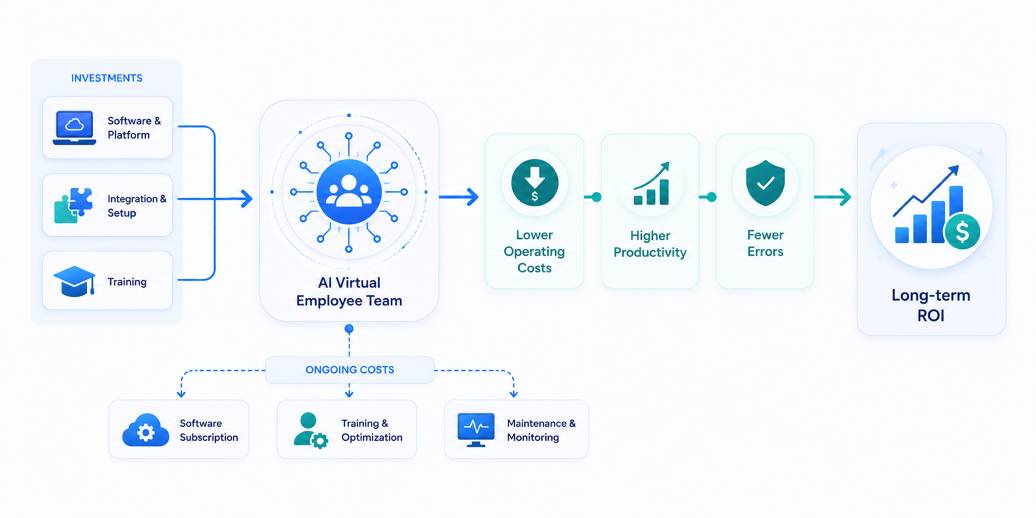
Cost is usually the first real question, and it deserves a straight answer. The honest version is that there's an upfront investment, and for most businesses the running economics work out well over a year or two, provided you pick the right tasks to start with.
Evaluating the Initial Investment for AI Virtual Teams
The initial spend covers a few things: the software and agent platform, the work of integrating it with the systems you already run, and the setup time to configure agents around your specific processes. Occasionally there's a hardware or upgrade cost, though cloud delivery keeps that low for most SMEs.
Training is part of this too, both the AI and your people. Your team needs to know how to work alongside the agents and when to step in. Set up sensibly, this investment tends to pay itself back through the volume it absorbs and the errors it prevents.
Understanding Long-term Cost Benefits of AI over Manual Labour
Over the long run, the maths shifts in AI's favour. Routine tasks that once needed several people to keep up with volume can be handled by a smaller team supported by AI agents. That trims the recurring cost of doing repetitive work, and it's steadier because you're not exposed to the same attrition and rehiring churn.
The gain isn't only salary saved. It's the extra output your existing people produce when they're no longer buried in routine work, and the cost of mistakes you avoid by keeping quality consistent.
Breaking Down Costs. Software, Training, Maintenance
Think of the ongoing cost in three buckets. First, software: usually a predictable annual or monthly subscription. Second, training: some continuing effort to keep the agents aligned as your processes change. Third, maintenance: monitoring, tuning and the occasional fix to keep everything running cleanly.
None of these is a one-off. As your setup matures and the agents are tuned to your work, the cost-per-task usually drops and the value becomes easier to see on paper.
A Step-by-step Guide to Building and Deploying an AI Digital Workforce
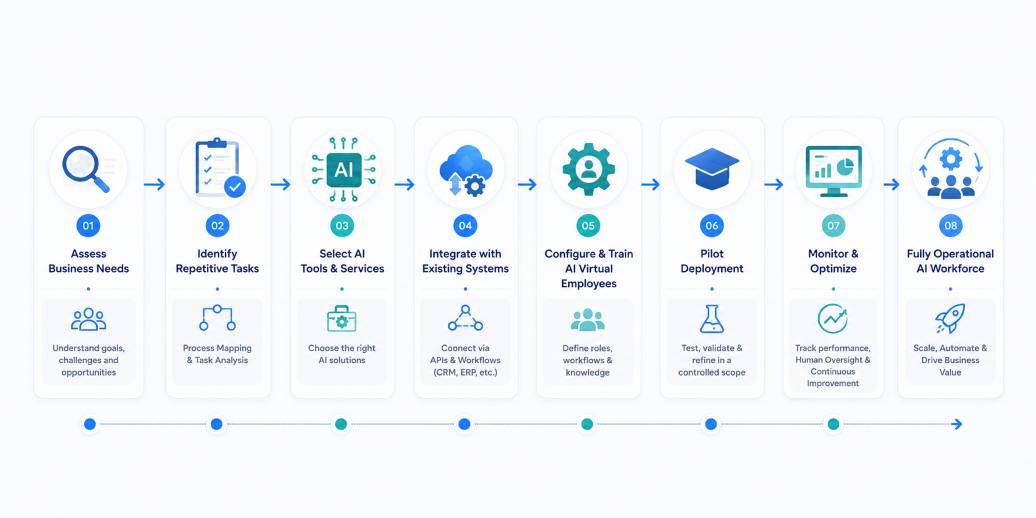
Building an AI workforce isn't a plug-and-play weekend job, but it isn't mysterious either. A steady, staged approach beats a big-bang rollout every time. Here's a sensible route.
Identifying Your Business Needs for AI Integration
Start by looking hard at where your team's hours actually go. List the tasks that are repetitive, high-volume and rule-bound, because those are the ripe candidates for AI. Map your existing processes so you can see which ones an agent could slot into cleanly.
This assessment stage is where the real value is decided. Pick the wrong first task and you'll fight the tooling; pick a well-defined, high-volume one and you'll see results quickly.
Selecting the Right AI Services and Tools
Once you know the target tasks, choose tools that fit both today's need and tomorrow's scale. Check how well each option plays with the systems you already run, since integration is where projects usually get stuck.
You'll also weigh off-the-shelf against custom. Off-the-shelf is faster and cheaper to start; custom fits your business more tightly. A good consulting partner will steer you towards whichever genuinely suits your situation rather than selling you the most expensive option.
Steps to Deploy and Train Your AI Virtual Employees
Deployment should include a proper onboarding phase for the agents, just as you'd train a new hire. Configure them to your processes, feed them the right context, and start on a limited scope before you widen it.
Then keep tuning. Continuous adjustment keeps the agents useful as your business changes, and human oversight during this period is what turns a rough first version into something you'd trust with real volume.
Transforming Business Operations. Human and AI Collaboration
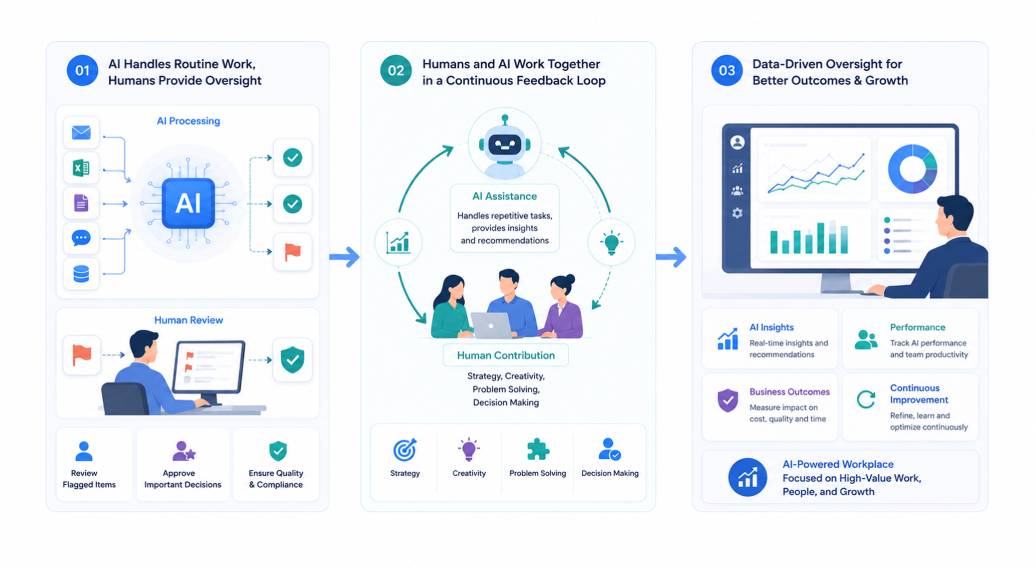
Adopting AI isn't only a technology decision. It changes how your team works day to day, and getting that human side right matters as much as the tooling.
The Role of Human Oversight in AI Operations
Human oversight is the backbone of a responsible AI setup. People review the outputs that carry risk, catch the edge cases the agents get wrong, and keep the whole thing accountable. This is exactly why the sensible model has a named human signing off on anything that matters, never the machine acting entirely on its own.
Good oversight also builds trust. When your team can see that a person is checking the important outcomes, they're far more willing to lean on the AI for the routine ones.
Building a Collaborative Culture Between Human and AI Teams
The businesses that get the most out of this treat AI agents as tools that support their people, not as a threat to them. That framing has to be deliberate. If staff think the AI is there to replace them, they'll quietly work around it.
Encourage your team to share what's working, flag where the agents fall short, and shape how the tools are used. The people doing the work usually have the best ideas for where AI helps and where it gets in the way.
Adapting Management Practices for an AI-powered Workplace
Managers need to adjust too. When agents handle the routine volume, the old measures of productivity stop making sense, and you'll want to judge people on the higher-value work they're now free to do. Performance metrics should reflect that shift.
It also means keeping an eye on how roles change, having honest conversations about it, and helping people move towards the parts of the job that machines can't do.
Key Differences Between AI Virtual Teams and Traditional Outsourcing
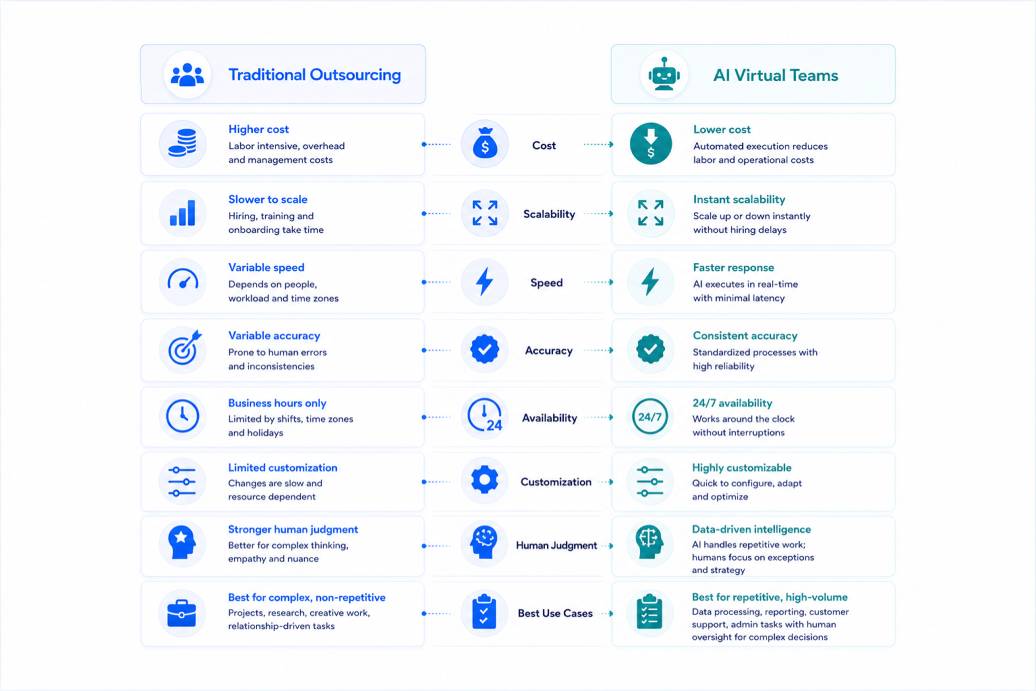
Plenty of businesses already outsource routine work, so it's fair to ask how an AI virtual team compares. The two solve a similar problem in quite different ways.
Comparing Cost Efficiency and Scalability
Traditional outsourcing has real recurring costs that rise as you add work: more people, more management, more coordination across time zones. An AI virtual team scales differently. Once it's set up, taking on more volume is far cheaper at the margin, and you can flex capacity up and down without renegotiating contracts.
For work that swings with the season, that flexibility alone can justify the move.
Evaluating Speed and Accuracy. AI vs Human Outsourcing
On turnaround and consistency, AI agents have a clear edge for routine work. They respond instantly, apply the same standard every time, and don't suffer the variable quality that comes with large outsourced teams and staff churn.
That said, outsourced human teams still win where work needs cultural nuance, difficult judgement or a genuinely human touch. The smart approach uses AI for the high-volume, rule-bound work and keeps people for the rest.
Measuring Flexibility and Customisation in AI Services
AI systems can be shaped tightly around how your business actually works, and reconfigured as your needs change, often faster than you could retrain an outsourced team. Whether you have a niche requirement or broad operational needs, that adaptability is hard to match with a fixed outsourcing contract.
Services to Consider When You Hire AI Virtual Assistants in India
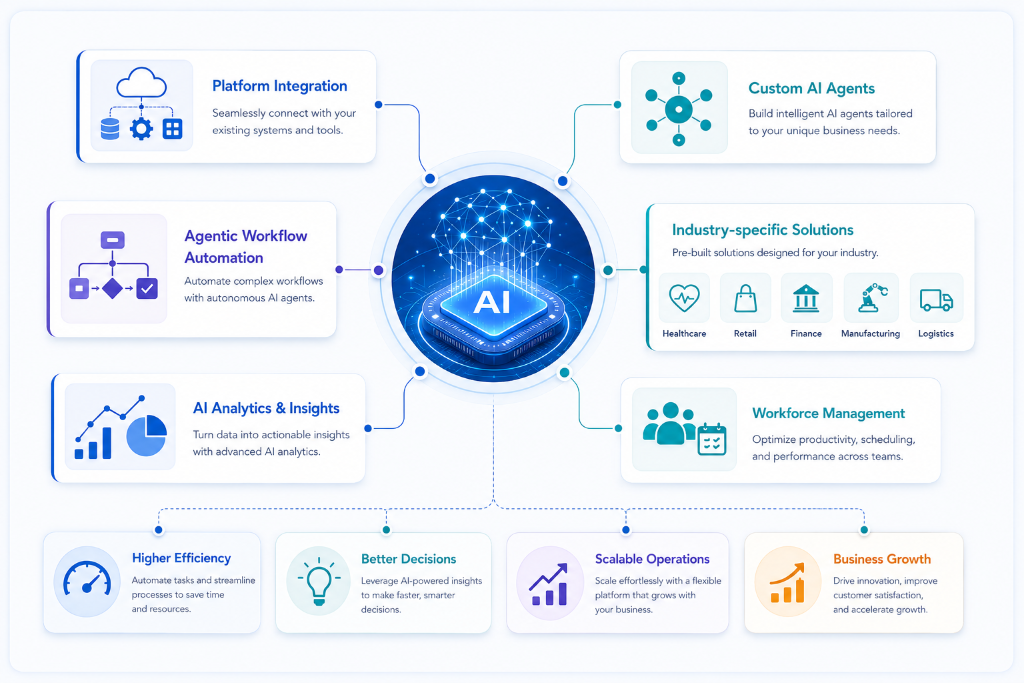
If you're ready to build an AI team, it helps to know what's actually on offer so you can match services to your needs rather than buying blind.
Top AI Services for Effective Virtual Team Operations
Look for providers who offer proper integration with the platforms you already use, since disconnected tools create more work than they save. The strongest offerings combine ready-made agents with the ability to customise, so you get a quick start without being boxed in later. Agentic workflow automation, which chains multiple agents across a full process, is usually where the biggest gains sit.
Industry-specific AI Solutions for Indian SMEs
Generic AI rarely fits perfectly. Sector-specific solutions, built with an understanding of how a particular industry works, tend to deliver far more value. For Indian SMEs, that means agents tuned to the workflows, compliance needs and customer expectations of your market segment rather than a one-size-fits-all template.
Investing in AI for Better Management and Efficiency
Beyond doing the work, AI tools can sharpen how you manage it. Data-driven insights help you allocate resources better, standardise how things get done and plan your workforce more accurately. Used this way, AI becomes a management aid, not just a task-doer, giving you a clearer view of where your operation runs well and where it doesn't.
Task Replacement by Department. A Practical Table for Management
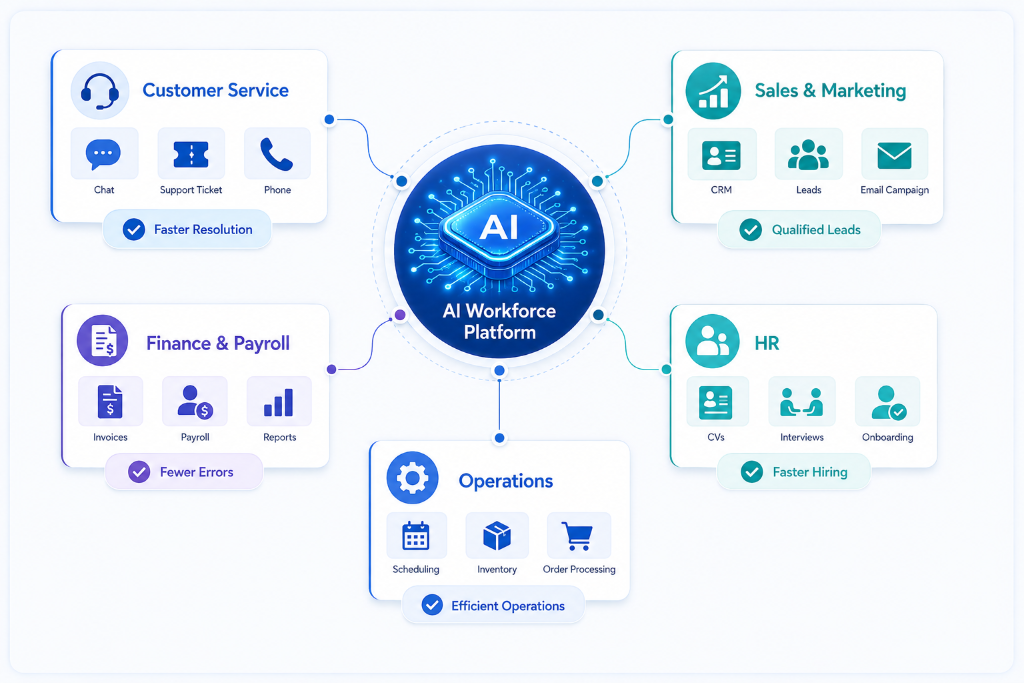
For a management team weighing this up, it helps to see the opportunity department by department. The table below maps common routine tasks that AI agents can take over, and the practical benefit for each function. In every case, a person still owns the exceptions and the decisions that carry risk.
| Department | Tasks AI Can Take Over | Business Benefit |
|---|---|---|
| Customer Service | First-line query handling, ticket triage and routing, order and status updates, after-hours responses | Faster resolutions, round-the-clock cover without extra shifts, human agents freed for complex cases |
| Sales & Marketing | Lead scoring and qualification, CRM updates, first-draft follow-ups, content scheduling, campaign reporting | A cleaner pipeline, quicker follow-up, sales staff spending more time actually selling |
| Finance & Payroll | Invoice data entry, basic reconciliation, expense checks, payroll data preparation, routine reporting | Fewer keying errors, smoother monthly cycles, finance staff focused on analysis over admin |
| HR | CV screening and shortlisting, interview scheduling, onboarding paperwork, routine policy queries | Faster hiring, consistent candidate handling, HR time redirected to people and culture |
| Operations | Scheduling, inventory tracking, order processing, status monitoring, standard documentation | Leaner day-to-day running, fewer bottlenecks, managers working on improvement rather than firefighting |
Is SecNinjaz the Right Choice for Your AI Virtual Employee Needs?
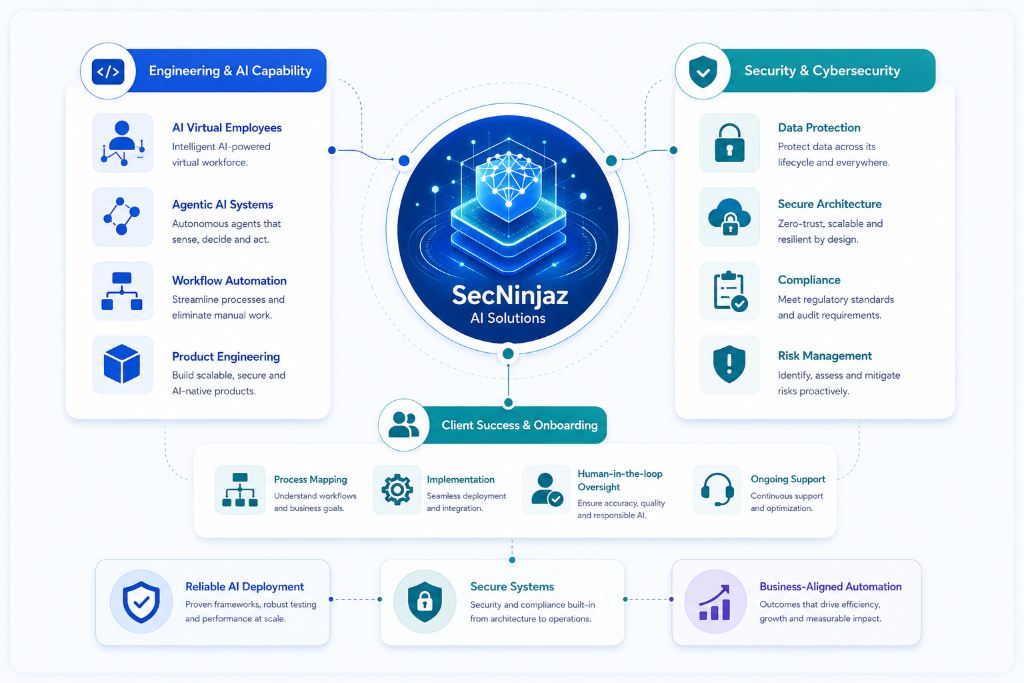
Choosing who builds your AI workforce matters as much as the decision to build one. The wrong partner leaves you with tools nobody uses; the right one leaves you with a working part of your operation. Here's an honest look at where SecNinjaz fits.
SecNinjaz vs Competitors. Why Choose Them for AI Services
SecNinjaz is an India-headquartered, architecture-led firm that brings together cybersecurity, IT engineering, AI and product engineering under one roof. Its AI Virtual Team offering sits alongside agentic workflow automation and agentic AI development, so the work is designed to fit your existing business systems rather than bolted on as an afterthought.
The difference many clients point to is the focus on solutions built around their actual processes, backed by a security-first mindset that comes from the company's core work. When AI agents are touching your customer data and internal systems, having that security discipline built in from the start is worth a great deal.
How SecNinjaz Approaches Client Success
SecNinjaz's approach is grounded in a plain principle the company sums up as measured, not claimed. In practice that means AI engagements today are AI-augmented, with human oversight built in, rather than being sold as a machine that runs on its own. It's a more honest framing, and a more reliable one for a business owner who has to answer for the outcomes.
The emphasis is on clear documentation, accountability and outcomes you can actually see, rather than a black box you're asked to trust on faith.
Navigating the Onboarding Process with SecNinjaz
Onboarding is structured to get you working without a long, painful setup. Expect a proper assessment of your processes, a clear implementation plan, and training resources so your team knows how to work with the agents from day one.
The relationship is built to last beyond go-live, with ongoing support as your needs change, because an AI workforce is something you tune over time, not a one-off install.
Join the AI Revolution. Practical Steps to Get Started Today
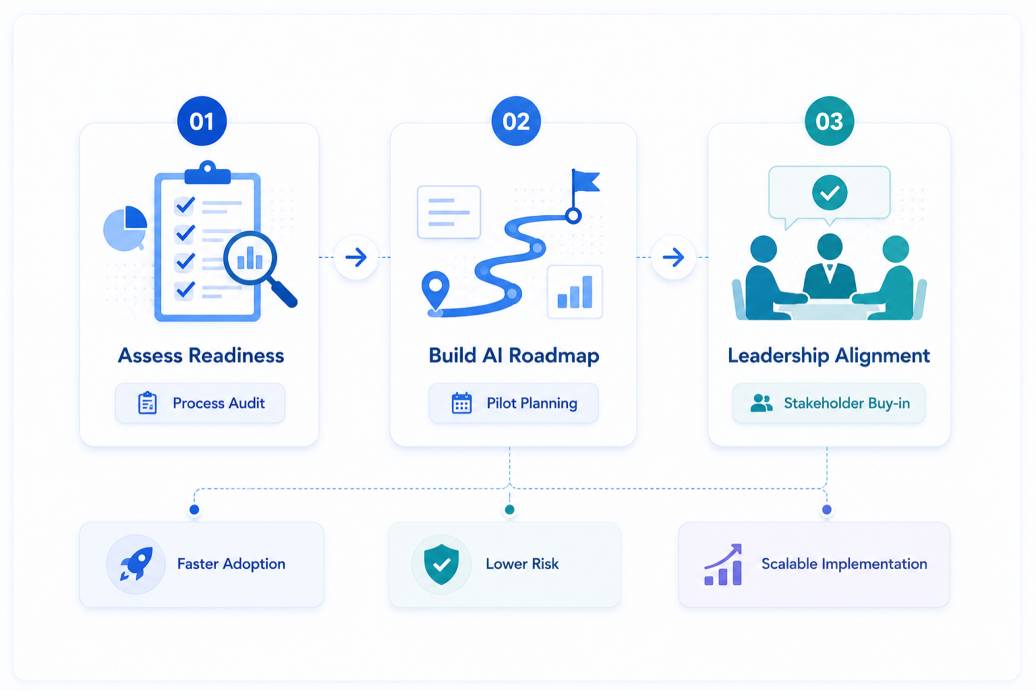
The path to putting AI to work is more straightforward than most owners expect, as long as you plan properly and bring your people with you. Here's how to begin.
Evaluating Your Readiness to Shift to AI Virtual Teams
Start with an honest audit. Look at your current processes, the systems you run, and where your team's hours actually go. Being ready isn't about having the fanciest tech; it's about knowing which routine work is dragging on your people and being willing to change how it gets done.
Developing a Strategic Roadmap for AI Implementation
Don't try to do everything at once. Build a roadmap that lines up AI adoption with your business goals, starts with one or two well-chosen tasks, and expands in phases as you learn what works. A staged rollout keeps the risk low and the wins visible, which makes the next phase easier to fund and easier to sell internally.
Engaging Leadership and Stakeholders in the AI Transition
None of this sticks without leadership behind it. Bring stakeholders in early, be transparent about what's changing and why, and be honest about how roles will shift. When people can see the plan and trust that it's been thought through, they back it rather than resist it. A shared view of where you're heading is what keeps the whole effort moving.
So here's the question to take into your next leadership meeting: which routine task, if it disappeared from your team's day tomorrow, would free your best people to do the work you actually hired them for?
Frequently Asked Questions
What is an AI virtual team?
An AI virtual team is a group of AI agents configured to handle work that's usually done by people, such as answering routine queries, sorting data and preparing reports. The agents can take a task from start to finish and pass work between each other, all within limits you set. A human stays in charge of the outcomes that carry real risk. The point is to take routine load off your staff so they can focus on higher-value work.
How do AI workforce solutions replace routine tasks?
They take over repetitive, rule-bound and high-volume work such as data entry, first-line customer support and basic reconciliation. Because the agents apply the same standard every time and don't tire, they keep quality consistent across large volumes. This frees your people to spend their time on judgement calls and complex problems. It's worth being clear that these solutions augment your team rather than removing the need for human judgement.
Why consider building an AI virtual team in India?
India offers a deep pool of technical talent, mature IT infrastructure and a policy environment that supports AI adoption, which makes it a practical and cost-sensible base. Indian firms also have real experience integrating AI into day-to-day operations. For a business, that combination means you can build and run an AI workforce without the premium costs you'd face in many other markets. It's one of the reasons India has become such an active hub for this kind of work.
Are AI virtual teams cost-effective?
For most businesses, yes, provided you start with the right tasks. There's an upfront investment in software, integration and training, but once it's running an AI team absorbs routine volume far more cheaply than adding headcount for the same work. You also avoid the recurring costs of attrition and rehiring. Over a year or two, the combination of lower cost-per-task and fewer errors usually makes the economics clear.
How does AI integration impact business growth?
Done well, it lets you grow without your cost base growing at the same rate. As AI agents take over routine work, your people are freed for strategic and revenue-generating tasks, and your operation can flex with demand rather than scrambling to hire. Faster turnaround and more consistent quality tend to improve customer satisfaction too. Together, that added agility gives you a real edge over competitors still doing everything by hand.