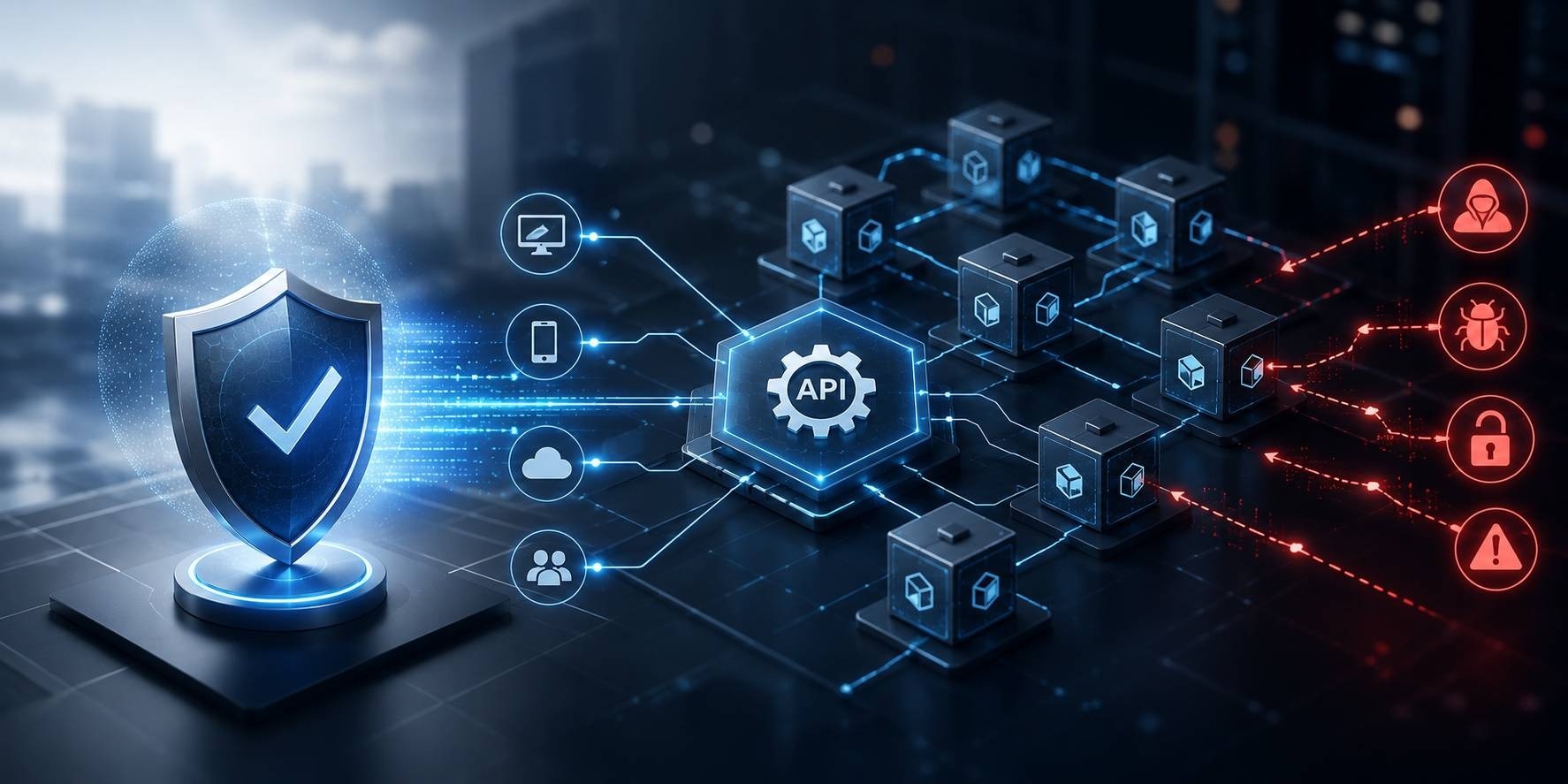

As Indian businesses use cloud platforms and mobile applications more and more APIs are becoming an important part of software. APIs help different applications talk to each other they make business processes automatic. They allow systems to share data in a safe way.. When you make an API available on the internet you are also making your organization more vulnerable to attacks.
APIs are different from web applications because they talk directly to the services that are running in the background. If APIs are not made and tested with security in mind bad people can take advantage of security measures, like poor authentication or authorization and get access, to sensitive information that they should not have.
At SecNinjaz we help organizations find and fix these security problems by testing their APIs thoroughly. We use computers to scan the APIs. We also have people test them to see if they can be hacked. We test REST and GraphQL APIs to make sure they can withstand real-world attacks. This helps the development teams make their APIs more secure before any problems can happen.
Quick Answer
When we talk about API security testing we are basically looking at how to check APIs for weaknesses that could let sensitive information get out allow people to access things they should not or even stop business from working
To really check everything we need to do a things.
We use automated scanning to find problems
We do manual penetration testing to see if we can break in
We check the business logic to make sure it is valid
We give advice, on how to fix the problems we find
All of this helps to make the API security of our application better. API security testing is important because it helps us find weaknesses in our APIs. API security is what we are trying to improve when we do API security testing.
Key Takeaways
Why API security is critical for modern applications
The difference between REST and GraphQL security testing
Common API vulnerabilities that attackers actively exploit
How SecNinjaz performs API penetration testing
Best practices for securing APIs throughout the development lifecycle
Understanding API Security and Its Importance

APIs drive customer portals, mobile applications, payment platforms, health-care platforms, and software-as-a-service (SaaS). Each request sent through the API carries valuable business or customer data that makes APIs one of the top targets in any modern-day application.
Contrary to the attack against a website's UI, an attack on APIs involves exploiting the functionality behind the application. Attackers can automate requests, manipulate the API parameters, or exploit the authorization checks to access unauthorized data. Some of the biggest application security incidents in recent times were due to the insecurity of APIs and not any vulnerability in the web application itself.
A good API security will make sure there are no data breaches, maintain customer confidence, and meet regulatory requirements like the Indian DPDP Act, 2023. More importantly, API security will help in detecting vulnerabilities before they become business-critical incidents.
Explore Application Security Testing →
What Is API Security?
API Security can be defined as the processes and mechanisms which provide security against any attacks or misuse of APIs.
A secure API ensures authentication of each request, permission checks for users, validation of inputs, encryption of sensitive data during transport, restriction of malicious behavior, and maintains adequate logs for monitoring and forensic purposes.
API Security does not mean an implementation once and forget kind of process. With the evolution of applications and addition of new endpoints to the application, security reviews need to be performed to identify new threats to the API Security.
Is API Security Vital for Organisations?
Yes, indeed. With each new API endpoint created, there is yet another avenue for attacks. Most companies create APIs in order to use them in their mobile applications and cloud services. Lack of security testing in such cases can cause leaks of sensitive data or key functionalities of businesses.
Consequences of the attack will not only be technical but also include financial, reputational, regulatory problems, as well as losses of customers' trust. Proper API pen-testing can help mitigate all of these risks and avoid any incidents.
Key Concepts in API Security
Effective API security starts with robust authentication and authorization. Whereas authentication is about knowing who makes a particular request, authorization deals with what the particular user or application can do or have access to. Poor authorization is still one of the main factors behind API security breaches.
Encryption helps secure sensitive data on its way between sender and receiver, thus, making sure that no one will be able to intercept it or tamper with the process. Input validation, in turn, ensures that APIs only work with correct and expected data.
Security testing, as the final piece in the puzzle, provides an opportunity to assess any possible new vulnerabilities in ever-evolving APIs.
Key Features of API Security Testing
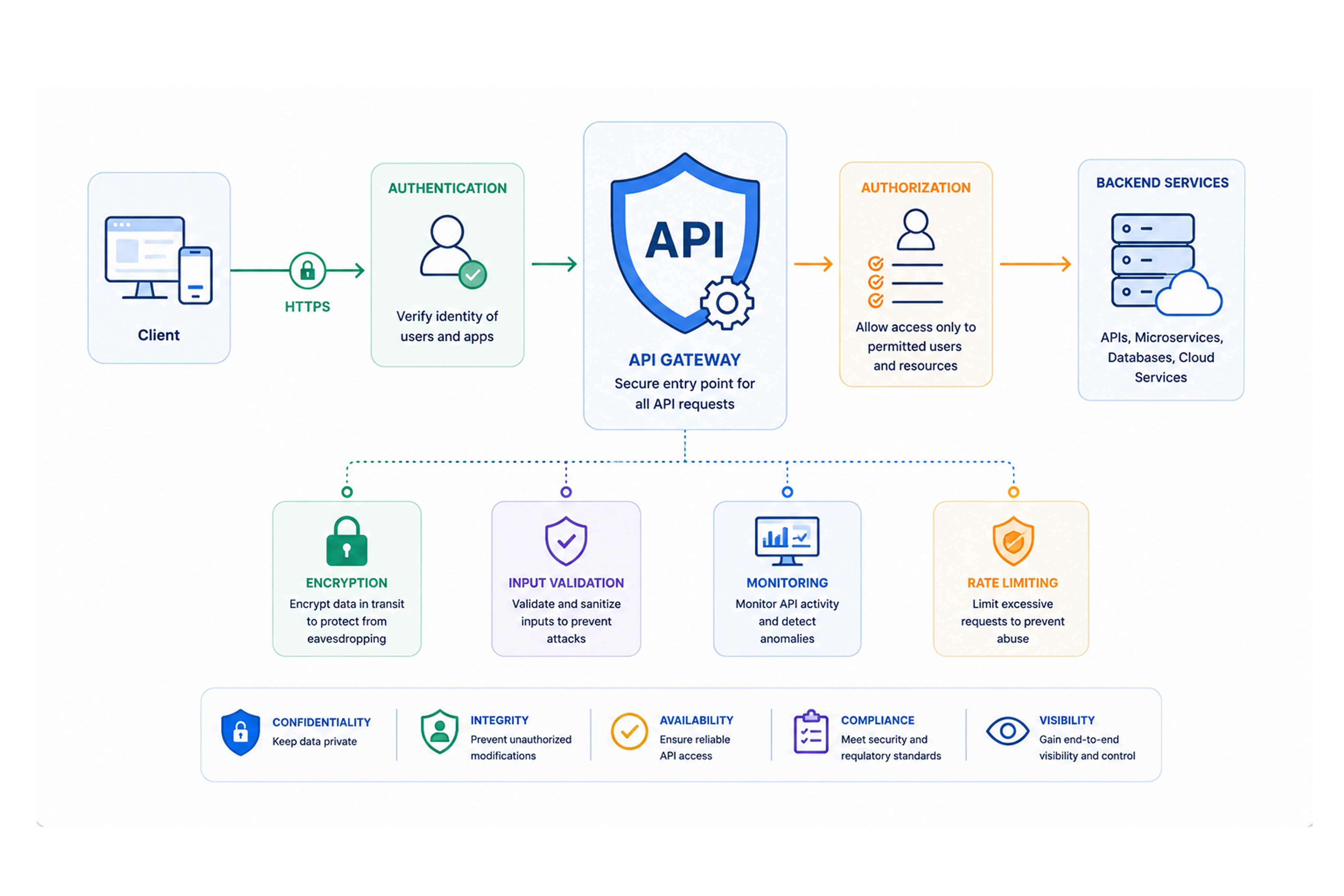
In order for the API security assessment process to be complete, it is not just about finding out the vulnerabilities that exist within it. It needs to test the behavior of the API in case of an attack, confirm the enforcement of the security measures, and check if the attacks can leverage any business logic.
Comprehensive Vulnerability Assessment
Every engagement starts by understanding the application's architecture and mapping its API attack surface. We identify exposed endpoints, authentication methods, user roles, and third-party integrations before beginning security testing.
Our assessments are aligned with the OWASP API Security Top 10 and cover vulnerabilities such as
Broken Object Level Authorization (BOLA)
Broken Authentication
Broken Function Level Authorization
Excessive Data Exposure
Mass Assignment
Security Misconfiguration
Injection attacks
Server-Side Request Forgery (SSRF).
Beyond identifying individual issues, we also evaluate whether multiple weaknesses can be combined to create a larger attack path.
Authentication and Authorisation Checks
Authentication and authorization are commonly mistaken as being one thing. However, they resolve different challenges: authentication identifies the user/application whereas authorization defines what rights a certain identity has.
While testing, we check if the authentication mechanisms (e.g. OAuth, JWT, API keys, session management) allow to bypass and reuse credentials. Then we validate whether only proper resources and functions are available for a certain user. This implies privilege escalation testing, insecure direct object references, tenant isolation and exposed administrative functions.
A lot of the most risky API vulnerabilities happen due to the inconsistent implementation of authorization rather than due to poor authentication.
Data Protection and Privacy Evaluation
Sensitive data, such as customer information, financial transactions, medical information, among others, is regularly processed using APIs. It is not just sufficient to rely on encryption methods to protect sensitive data.
Our assessment includes checking whether sensitive information has been inadvertently exposed via the API response, ensuring that encryption has been used properly to secure the data being transported through the API, and that error messages and logs do not divulge sensitive information about the inner workings of the application. We will further check whether data handling practices are compliant with regulations such as DPDP (Digital Personal Data Protection Act), India.
The Unique Challenges of REST and GraphQL API Security
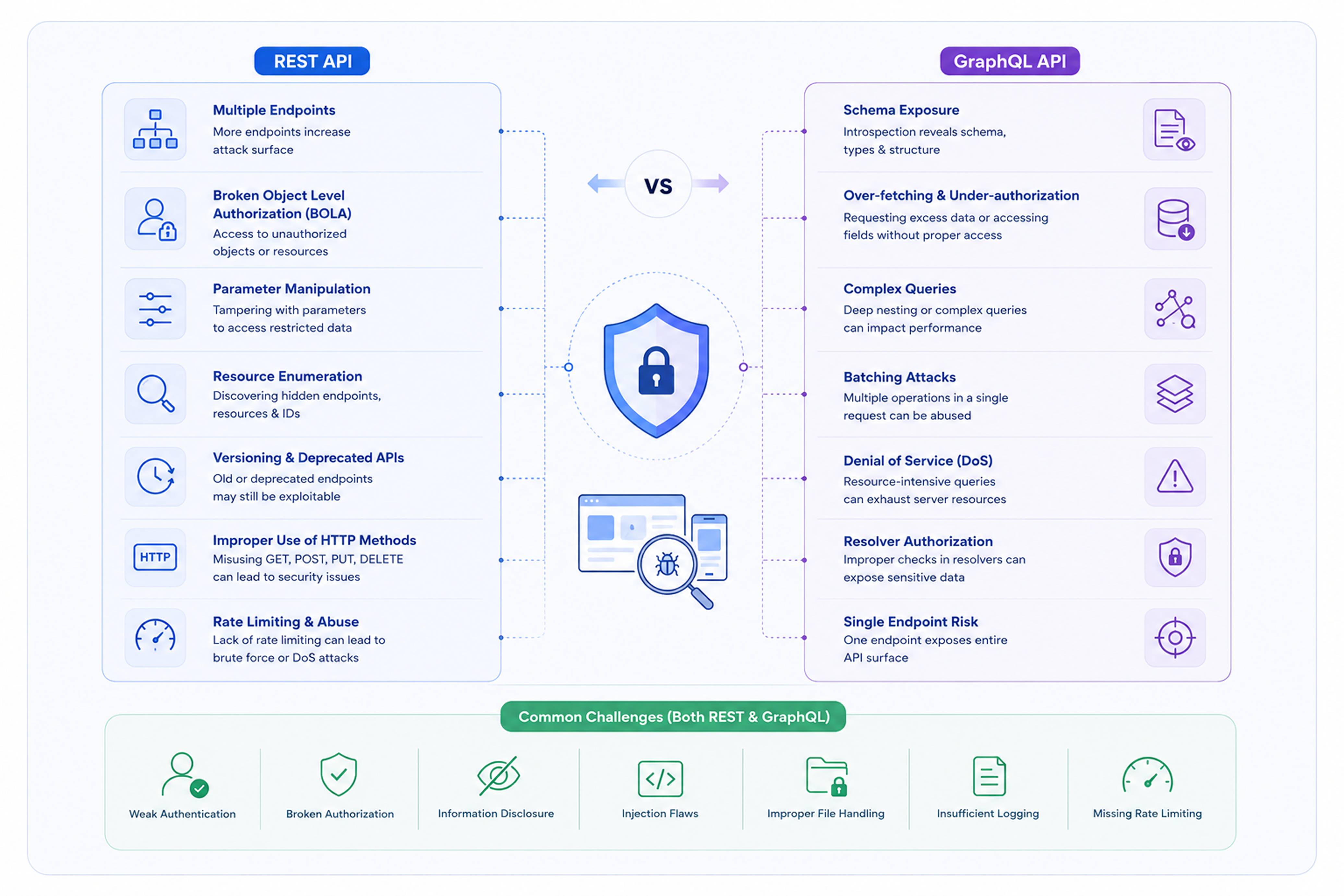
Although REST and GraphQL both enable applications to exchange data, they present different security challenges. Understanding these differences allows testing to focus on the risks that matter most.
Distinct Features of REST APIs
Each REST API provides several endpoints that are intended for particular resources or actions. Although this approach is rather simple, each new endpoint presents an additional chance for a hacker to exploit authentication, manipulate parameters, or bypass authorization mechanisms.
In the course of REST API testing, we perform testing of access controls on endpoint, HTTP methods, input validation, rate limiting, resource enumeration, versions management, deprecated APIs that can be still publicly available. Especially we focus on Broken Object Level Authorization that is considered to be one of the most frequent API vulnerabilities today.
Complexities of GraphQL APIs
It makes development easy by letting clients fetch only the necessary data, but this added functionality brings about more security concerns as well.
The tests we conduct include schema exposure, introspection configuration, resolver authorization, query complexity, batching capabilities, nesting, and denial-of-service protection. The fact that usually the entire API surface is exposed through one endpoint means that any small issues with authorization may impact a bigger part of the system than expected.
Challenges Common to REST and GraphQL APIs
In spite of architectural styles, many problems with APIs’ security are global ones. Lack of proper authentication mechanisms, absence of correct authorization processes, unnecessary information disclosure, injection flaws, improper management of file systems, lack of logging, and missing rate limiting features often occur in modern software.
Automatic scanners help in finding typical weaknesses in applications, but these tools never consider business logic and application environment. This is why we use both approaches in all our assessments – automated scanning and penetration testing.
SecNinjaz: Your Trusted Partner for API Security Testing Services in India

Selecting the right partner for your API security needs is not just about finding out where vulnerabilities lie. You need a team that not only knows how to build applications but also how hackers operate, as well as how to turn their findings into useful feedback for developers.
When it comes to API security assessment at SecNinjaz, we aim to find real business risks rather than create long-winded reports with little actionable information. We use a blend of industry standards, manual penetration testing, and automated analysis to enhance your API security without hindering development.
The SecNinjaz Security Testing Process
Every engagement follows a structured methodology that delivers consistent and actionable results.
1. Scoping and Discovery
We begin by understanding your application architecture, API inventory, authentication methods, user roles, and business workflows. This helps define the testing scope and ensures critical APIs receive the attention they deserve.
2. API Penetration Testing
Our consultants perform both automated and manual testing to identify security weaknesses. The assessment covers authentication, authorization, input validation, business logic, rate limiting, session management, API configurations, and vulnerabilities aligned with the OWASP API Security Top 10.
3. Reporting and Remediation
Every finding is documented with its technical details, business impact, proof of concept, risk rating, and practical remediation guidance. Once fixes are implemented, we perform validation testing to confirm that the identified vulnerabilities have been resolved.
Tools and Techniques for Effective API Penetration Testing
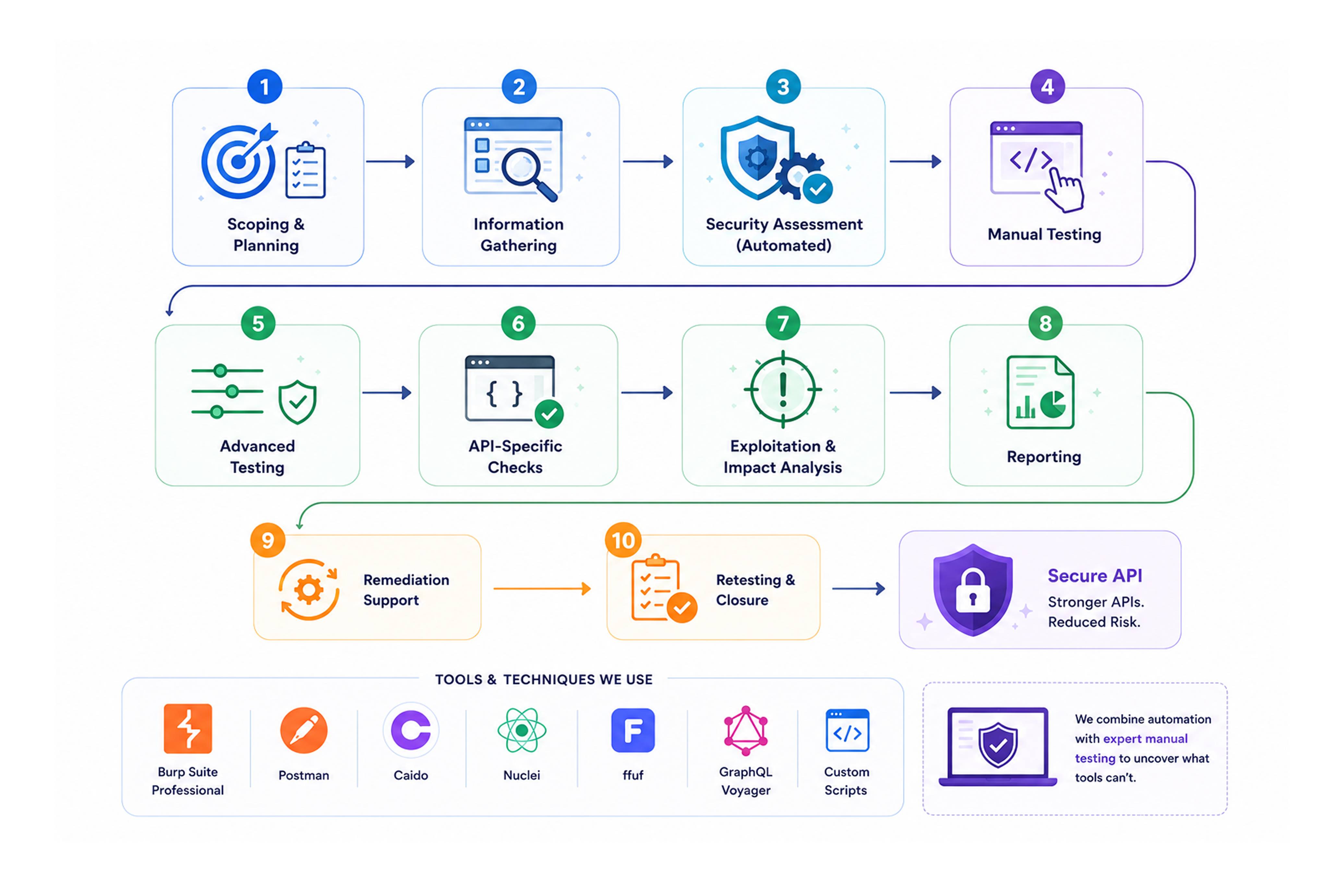
Efficient API Security Testing involves the speed of automation and the precision of manual testing.
Our team uses proven tools like Burp Suite Professional, Postman, Caido, Nuclei, ffuf, GraphQL Voyager, and customized test scripts when necessary. This allows discovering exposed endpoints, automating routine tasks, and efficiently validating vulnerabilities.
Just technology does not protect APIs. Most valuable insights are provided by manual testing, during which experts analyse application behavior and business logic of the application and explore cases unknown to automated scanners.
Common API Vulnerabilities We Address
API vulnerabilities vary between applications, but several issues appear consistently across assessments.
Broken Object Level Authorization (BOLA): Users can access resources belonging to other users by manipulating object identifiers.
Broken Authentication: Weak session management, insecure token validation, or poorly implemented authentication workflows increase the risk of account compromise.
Broken Function Level Authorization: Administrative or privileged API functions are accessible to users without appropriate permissions.
Excessive Data Exposure: APIs return more information than necessary, unintentionally exposing sensitive customer or application data.
Injection Vulnerabilities: Improper input validation can allow SQL Injection, NoSQL Injection, command injection, or other attacks against backend systems.
Identifying these weaknesses early enables development teams to remediate issues before they can be exploited in production.
Why Choose SecNinjaz for Your API Security Needs?
We at SecNinjaz understand that companies require solutions that will protect their organization from threats, not just automated reports about vulnerabilities. Every assessment is customized to fit your application's architecture, tech stack, and business goals.
Our consultants interact with development and security teams to analyze results, prioritize mitigation steps, and confirm that all fixes were done properly. We offer solutions regardless of what type of app you are working on.
Secure Your APIs Before Attackers Find the Weaknesses
In today’s day and age, modern applications rely heavily on APIs; therefore, it is essential to ensure that your API security is in place to protect your sensitive customer data, processes, and even your brand identity. Even a single vulnerability could lead to any of these being exposed to anyone who can get past your defenses.
With the assistance from SecNinjaz, you will be able to detect any vulnerabilities through our extensive API Security testing process that is focused specifically on modern REST and GraphQL applications.
If you need reliable and professional API Security Testing Services in India, feel free to reach out to us.
Talk to Our API Security Experts →
Frequently Asked Questions
How often should APIs be security tested?
API security testing should be performed before major production releases, after significant code changes, and at regular intervals as part of an ongoing application security program.
Can automated scanners replace manual API penetration testing?
No. Automated tools are effective for identifying common vulnerabilities, but they cannot reliably detect business logic flaws, authorization weaknesses, or complex attack paths. Manual testing remains essential for a comprehensive assessment.
Does SecNinjaz test both REST and GraphQL APIs?
Yes. Our consultants assess REST, GraphQL, SOAP, and microservices-based APIs using methodologies tailored to each architecture.
What deliverables will we receive?
Every engagement includes a detailed technical report, an executive summary, proof-of-concept evidence, remediation recommendations, and optional revalidation testing after fixes are implemented.