

Most enterprises have stopped asking whether to adopt AI. The harder question is who, or what, actually does the work once the tools are in place. Buying licences is easy. Turning them into delivery, without adding headcount for every gap, is the part that takes real work.
That is what the SecNinjaz AI Virtual Team is built for. Instead of putting more people in seats, we put customizable AI agents to work in the roles you need covered. They do real, role-shaped work, they run independently or under your team's direction, and they are shaped around how your organisation already operates. Upskilling your people plays a supporting role here, and an important one, but the agent workforce is the engine. This post covers both, in that order.
Key takeaways
- The AI Virtual Team is agents, not remote staff. Customizable agents do role-shaped work, run independently or under your team's direction, and scale without a hiring cycle.
- Agents are built around your processes, tools, and data, not a generic template. Two different jobs get two different agents with two different sets of guardrails.
- You control where the line sits between independent and human-in-the-loop, and you move it as trust builds.
- The work runs at 24×7 and scales the moment you need more, then steps back when you do not.
- Training has a role: your people learn to configure, direct, and oversee the agents. Trained staff are what make an agent workforce safe and useful rather than a black box.
- You can start with a scoped pilot on one workflow, prove it, then expand.
Why this matters now
AI has moved from pilot projects to production. The organisations getting value are not the ones with the flashiest model; they are the ones who have handed real, repeatable work to AI and freed their people for the parts that need judgement. A capable model doing nothing but answering questions in a chat window is a demo. The same capability wired into a workflow, doing the job every day, is a result.
That shift, from AI you talk to toward AI that does the work, is exactly what an agent workforce delivers. And for regulated or security-conscious sectors, it has to happen without losing control of your data. SecNinjaz holds ISO/IEC 42001:2023, the international standard for AI management systems, alongside ISO/IEC 27001 and ISO/IEC 27701. Governance is built into how the agents are deployed, not bolted on afterwards.
The AI Virtual Team: agents, not headcount
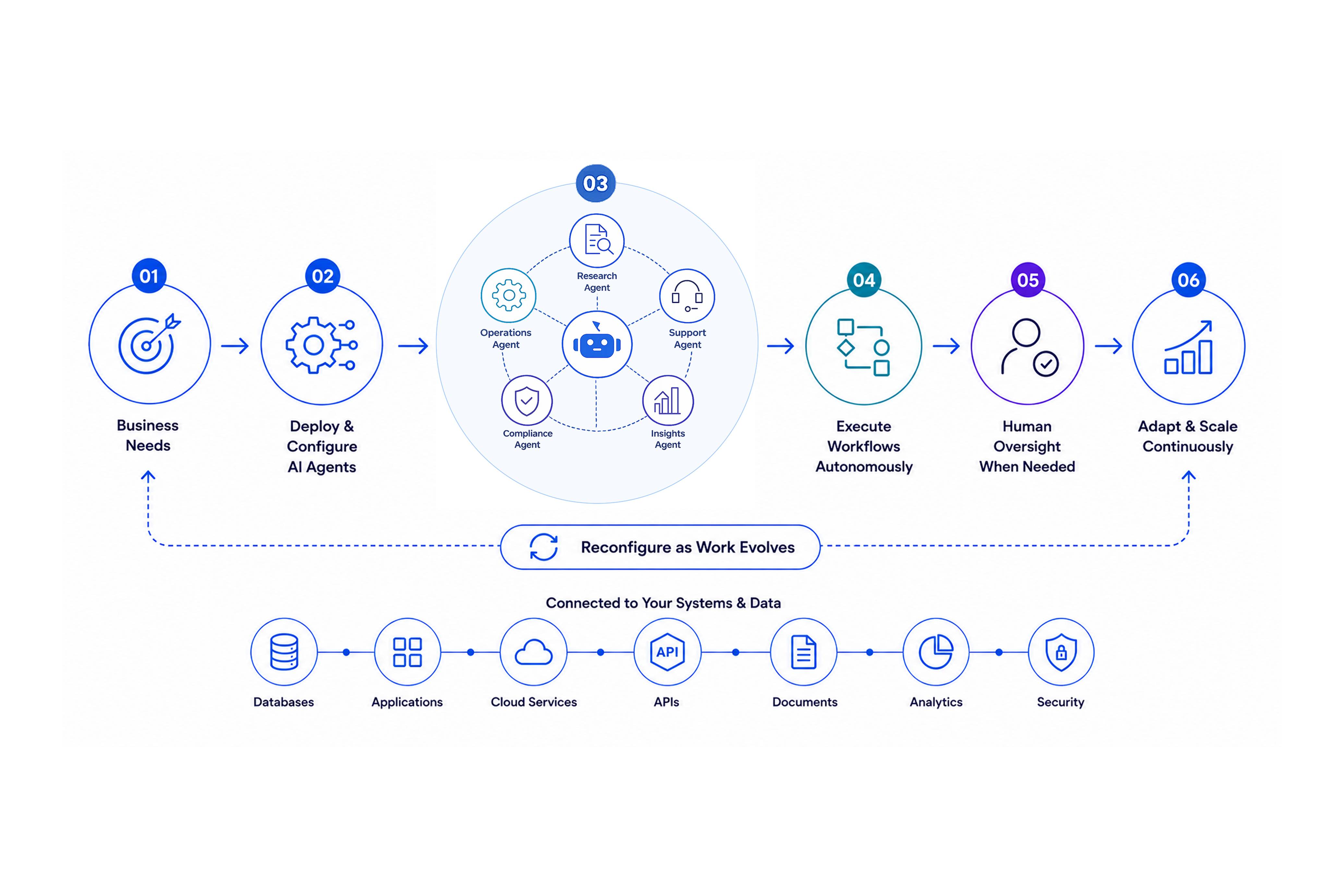
Here is where we differ from most providers. Our AI Virtual Team is not people logging in remotely, and it is not a chatbot bolted onto the side of the business. It is a set of AI agents deployed in place of, or alongside, the roles you need filled. Each agent is configured to do the work a given role would do. Depending on the task, it runs under a person's direction or handles well-defined work on its own.
Think of it as staffing a function with agents rather than adding headcount. Where you would once have hired, trained, and scheduled people for a repeatable job, you deploy an agent built for it. The agent does not call in sick, does not need a fresh hiring cycle when volume spikes, and does not leave with the knowledge in its head. When the work changes, you reconfigure it.
This is the practical face of the agentic capabilities SecNinjaz already builds: agentic AI development to create the agents, agentic workflow automation to give them real jobs, and AI integration to connect them to the systems you run. The AI Virtual Team is those pieces assembled into something that behaves like part of your team.
What the agents actually do
The point of an agent is a job, not a conversation. Depending on the function, an agent on your virtual team might:
- Triage and summarise a queue. Cluster incoming alerts, tickets, or messages, surface the few that need a human, and draft a first response to the rest.
- Handle first-pass review. Read long documents, extract what matters, and flag anything unusual for a person to confirm.
- Keep a process moving. Reconcile records, route work to the right place, and carry a workflow through its routine steps without waiting on someone's inbox.
- Run overnight. Pick up repetitive processing after hours so the backlog is cleared, not created, by the time your team logs in.
In our own field, security operations, the pattern is easy to picture: an agent works the alert queue around the clock, collapses the noise, and hands an analyst the handful of things that genuinely need a human. The analyst does the judgement. The agent does the volume.
Customizable, and built around you
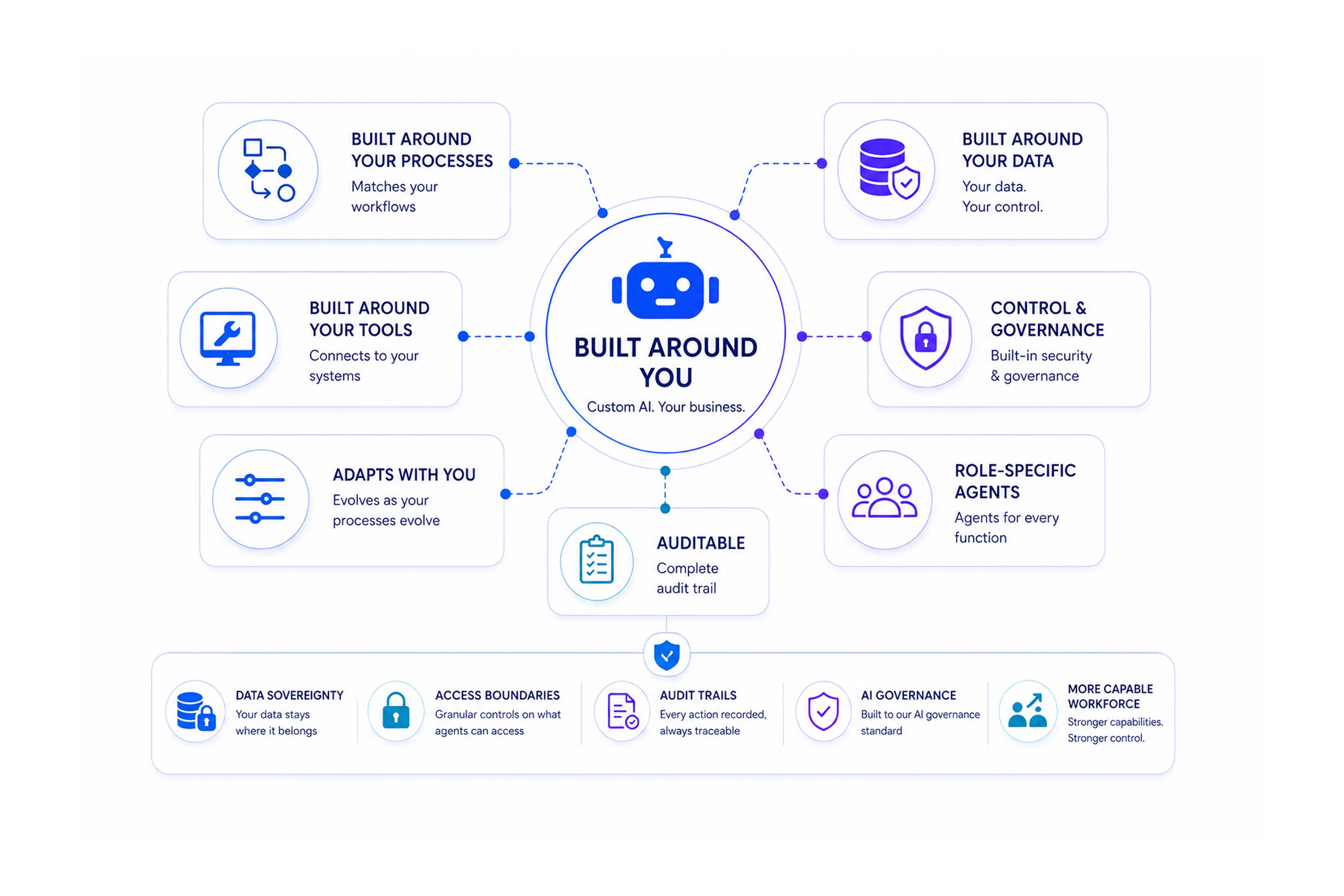
An off-the-shelf agent solves an off-the-shelf problem, which is rarely the one you have. Agents on the SecNinjaz AI Virtual Team are built around your processes, your tools, and your data.
That customisation is the difference between a demo and a deployment. A workflow in your finance function and one in your security operations are different jobs, so they get different agents, connected to different systems, with different rules about what they can touch and what they must escalate. As your processes change, the agents change with them. You are not locked into someone else's idea of how the work should run.
Because the agents sit on top of your own systems and data, sovereignty stays where it belongs. Data handling, access boundaries, and audit trails are part of the build, in line with the AI governance standard we hold, so a more capable workforce does not mean a looser grip on your information.
Independent, or in the loop, on your terms
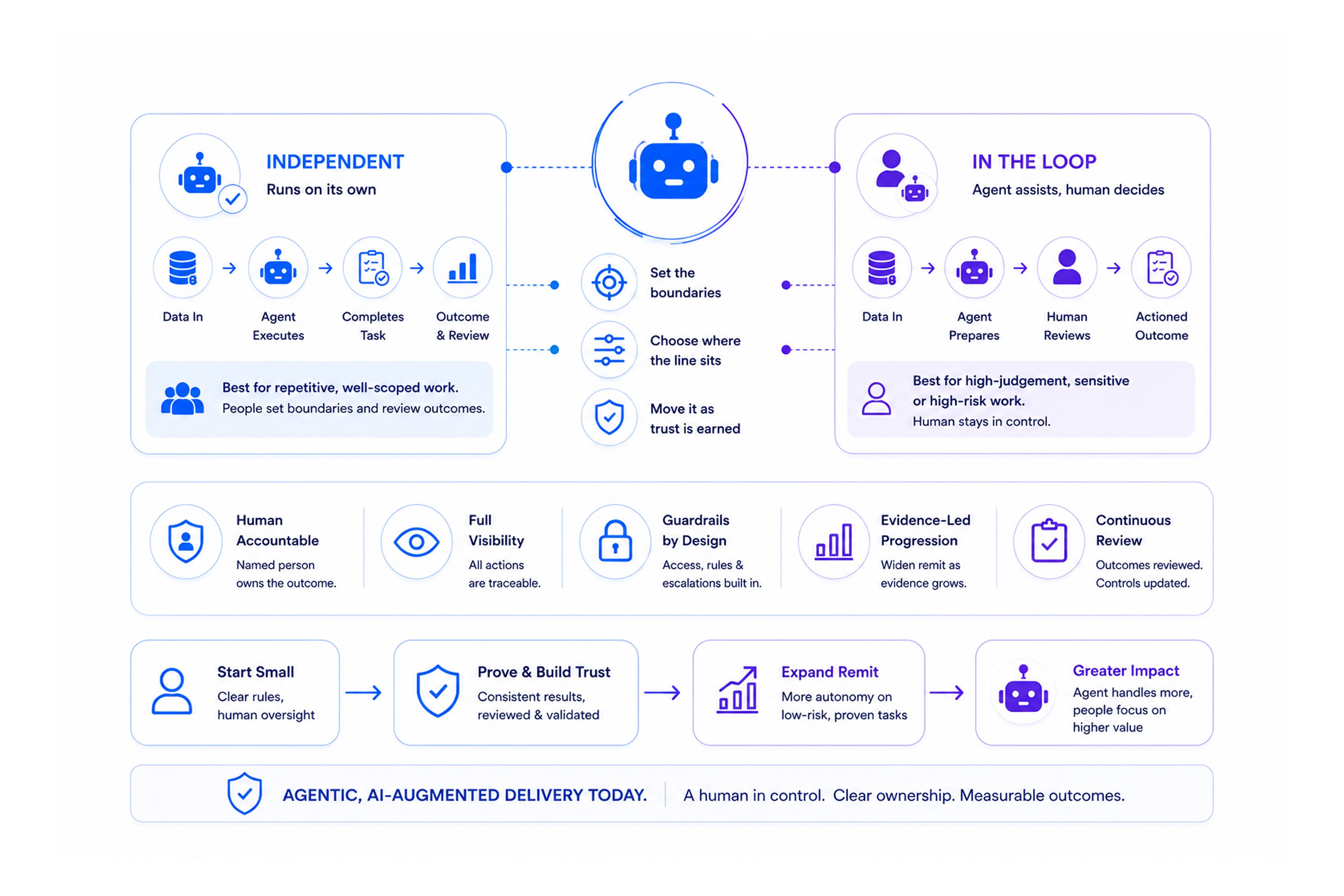
Not every task deserves the same level of autonomy, and we do not pretend otherwise.
For well-scoped, repetitive work, an agent can run on its own, with your people setting the boundaries and reviewing outcomes rather than doing each step. For work that needs judgement, the agent runs in the loop: it does the heavy lifting while a person stays in control of the decision. You decide where that line sits for each job, and you move it as the agent earns trust on the easy cases before taking on the harder ones.
This is deliberate. An agent workforce is only worth having if you trust it, and trust is built by keeping a human accountable at every step and widening the agent's remit as the evidence supports it. To be plain about it, in line with how we describe our own roadmap: this is agentic, AI-augmented delivery today, with a named person owning the outcome, not a hands-off system running the business on its own.
Scale, availability, and cost
The economics follow from the model. An agent workforce scales the moment you need more of it and steps back when you do not, with no recruitment lag and no idle headcount between peaks. It runs at 24×7, so a process that used to wait for morning is moving overnight. And it lets a lean team cover far more ground than its size would suggest, because the repetitive volume is handled and the people are pointed at the work that actually needs them.
None of this is about cutting people for its own sake. It is about aiming your people at the work worth their time and letting agents carry the rest.
Generative and agentic AI, in plain terms
It is worth being clear about the anxiety around all this. Generative AI changed a lot of everyday work. Agentic AI, systems that plan and carry out multi-step tasks rather than answering a single prompt, is changing it again, and that is the technology the AI Virtual Team runs on.
The realistic picture is augmentation, not replacement. Agents take over the repetitive parts of a function and hand people more time for the parts that need judgement. That only works when the people around the agents know how to direct them, review what they produce, and catch the failures. Which brings us to the part training plays.
Where training fits
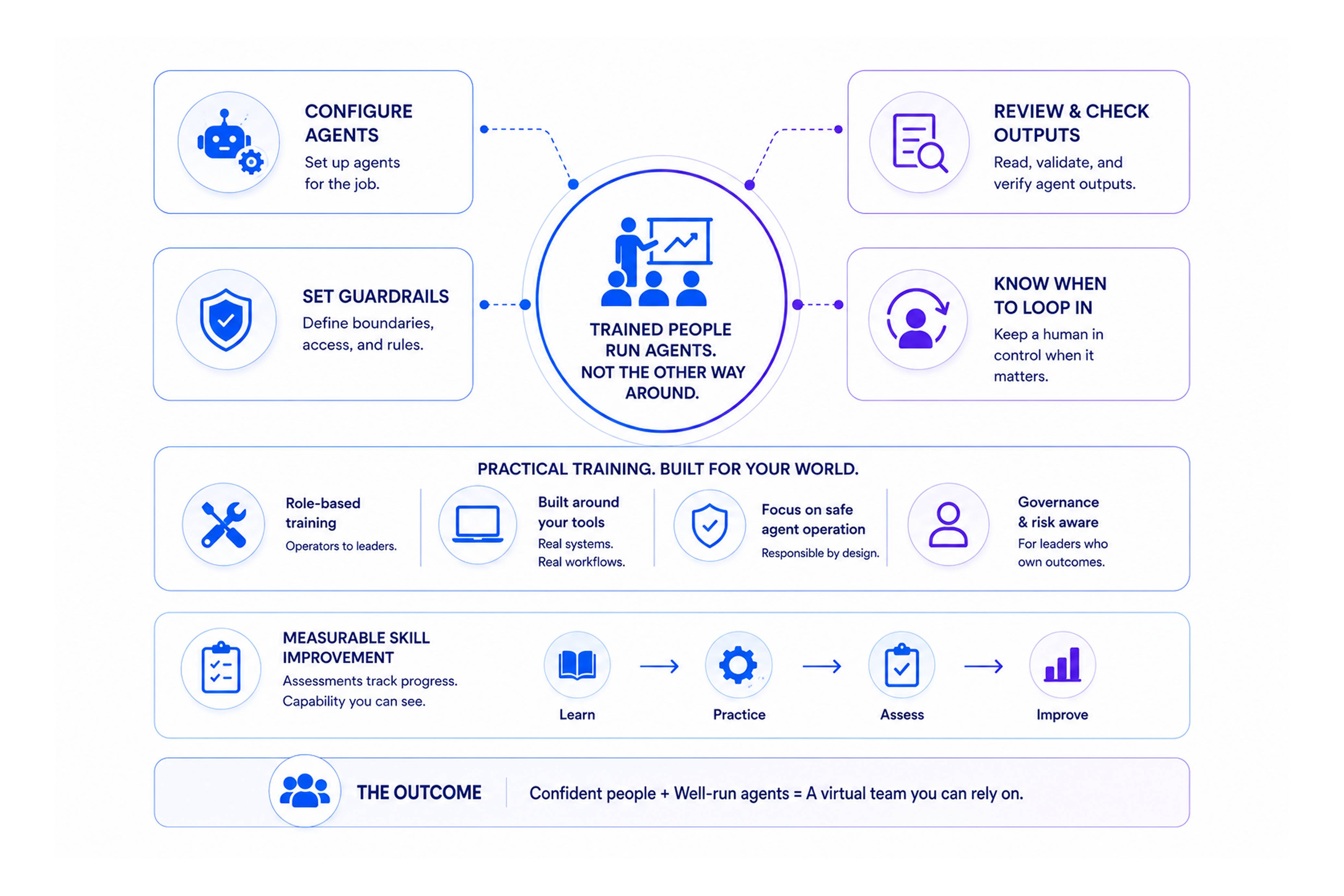 An agent workforce needs people who can run it. That is the smaller, but essential, half of the picture, and it is where upskilling comes in.
Through AI Mastery Labs, we train your teams to do exactly that: configure agents for a job, set sensible guardrails, read and check what an agent produces, and know when to keep a human in the loop. This is not a generic AI course. It is practical training aimed at the specific skill of running an agent workforce safely, built around your tools and scoped to each level, from hands-on operators to the leaders responsible for governance and risk.
We also keep it honest and measurable. Skill assessments run through the programme so you can see capability improve rather than take it on faith. The result you are aiming for is simple: staff who treat the agents as a team they direct with confidence, not a black box they are nervous to touch. Trained people are what turn a set of agents into a virtual team you can rely on.
Getting started
You do not have to reorganise around agents on day one. The sensible first step is a scoped pilot: pick one repetitive, well-understood workflow, put an agent on it, keep your people in the loop, and measure the result. Once it proves itself, you widen the remit and add the next workflow.
A short scoping session with our team is usually where that starts. It maps which of your workflows are the best early candidates, what the agents would need to connect to, and what training your people need to run them. From there you expand as the work earns it.
SecNinjaz Technologies - Where Cybersecurity Meets Intelligence.
Frequently Asked Questions
What is the SecNinjaz AI Virtual Team?
The SecNinjaz AI Virtual Team is a workforce of customizable AI agents that perform real business roles instead of acting as chatbots. Each agent is configured around your organization's processes, tools, and data, operating independently for routine tasks or under human supervision for work that requires judgment.
How is an AI Virtual Team different from a chatbot?
A chatbot primarily responds to user prompts, while an AI Virtual Team executes business workflows. AI agents can triage requests, process documents, route work, automate repetitive tasks, and integrate directly with enterprise systems to deliver operational outcomes.
Can AI agents work independently?
Yes. AI agents can autonomously perform well-defined, repetitive tasks within approved guardrails. For activities that require human judgment, they operate in a human-in-the-loop model, ensuring people remain accountable for important business decisions.
Can AI Virtual Teams be customized for different business functions?
Yes. Every AI agent is designed around an organization's specific workflows, systems, and governance requirements. Different departments such as finance, cybersecurity, operations, or customer support receive purpose-built agents with role-specific permissions and guardrails.
Why is workforce upskilling important for AI adoption?
Successful AI adoption requires employees who can configure, supervise, and evaluate AI agents effectively. Training helps teams understand how to use AI responsibly, establish appropriate guardrails, interpret outputs, and maintain human oversight while maximizing business value.
How can organizations start implementing AI Virtual Teams?
A practical approach is to begin with a pilot project focused on a repetitive, well-defined workflow. After validating performance, organizations can gradually expand AI agents to additional business processes while strengthening governance, integrations, and employee capabilities.