

Most Indian enterprises have already run the off-the-shelf experiment. Someone bought seats to a popular AI copilot, a few teams tried it, and the results split down the middle: genuinely useful for drafting and summarising, oddly useless the moment the work touched an internal system, a compliance rule, or data that can't leave the building.
That gap is the whole conversation. The question was never "should we use AI agents?" It's narrower and harder: do we buy a generic tool that works everywhere but fits nowhere in particular, or do we build an agent that actually knows our workflows, our data, and our security posture?
For a business handling regulated data under the DPDP Act, running mission-critical operations, or answerable to CERT-In-style scrutiny, that choice carries more weight than a per-seat licence. It decides where your data goes, who can see it, and whether an AI decision can be audited when someone asks.
Key Takeaways
- Off-the-shelf wins on speed and cost — up to a point. For general drafting, search, and summarisation with no sensitive data, a subscription tool is the right call. Building custom for that would be wasteful.
- Custom agents win when the work touches your systems. Real value shows up when an agent reads your internal data, calls your APIs, and follows rules that only exist inside your organisation.
- Sovereignty is the deciding factor for many Indian firms. Data residency, DPDP consent, and air-gapped or on-prem deployment are hard limits, not preferences — and generic SaaS tools rarely clear them.
- Governance is not optional. An AI decision you can't explain is a liability. SecNinjaz builds to the ISO/IEC 42001:2023 AI management standard, so agent behaviour is documented and reviewable.
- A hybrid usually beats a purist stance. Buy the commodity layer, build the parts that carry your competitive edge and your risk. Most enterprises land here.
What "off-the-shelf" and "custom" actually mean
The two words get thrown around loosely, so it's worth being precise.
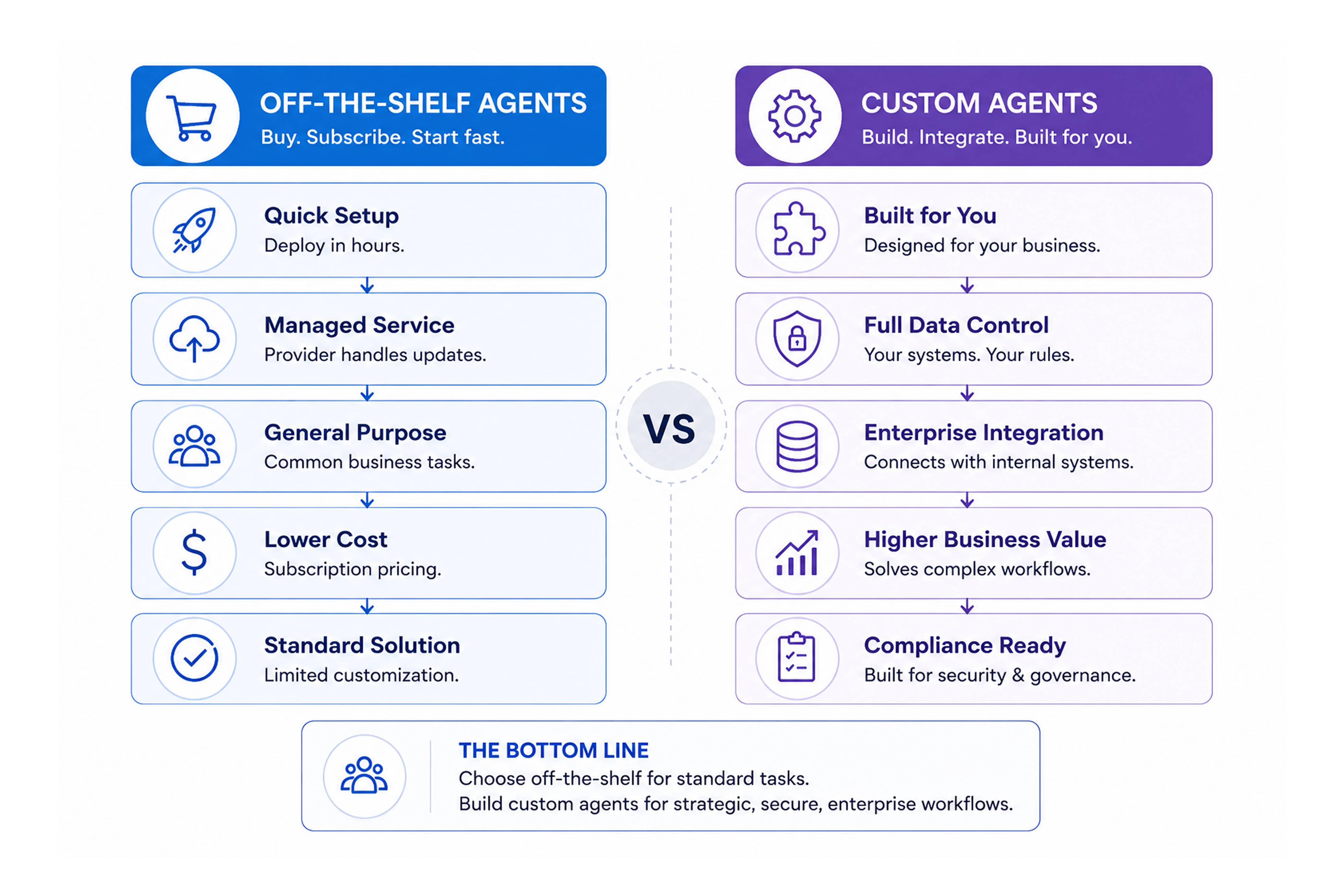
Off-the-shelf covers the tools you subscribe to and switch on: hosted AI assistants, no-code agent builders, and the AI features bolted onto software you already run. You don't own the model, the pipeline, or usually the data path. You rent capability and accept the vendor's defaults.
Custom sits at the other end. An agent is designed around a specific job — triaging support tickets against your knowledge base, drafting a first-pass VAPT report from scan output, watching a data feed and flagging what matters. It connects to your systems, follows your rules, and runs where you decide it runs. You own the logic and the data path.
Between them sits a middle band that catches most real projects: a foundation model you didn't train, wired into your data and tools through a layer you did build. That middle band is where SecNinjaz does most of its agent work, and it's usually the sensible place to be.
Where off-the-shelf tools genuinely win
Let's not pretend building is always the answer. It isn't.
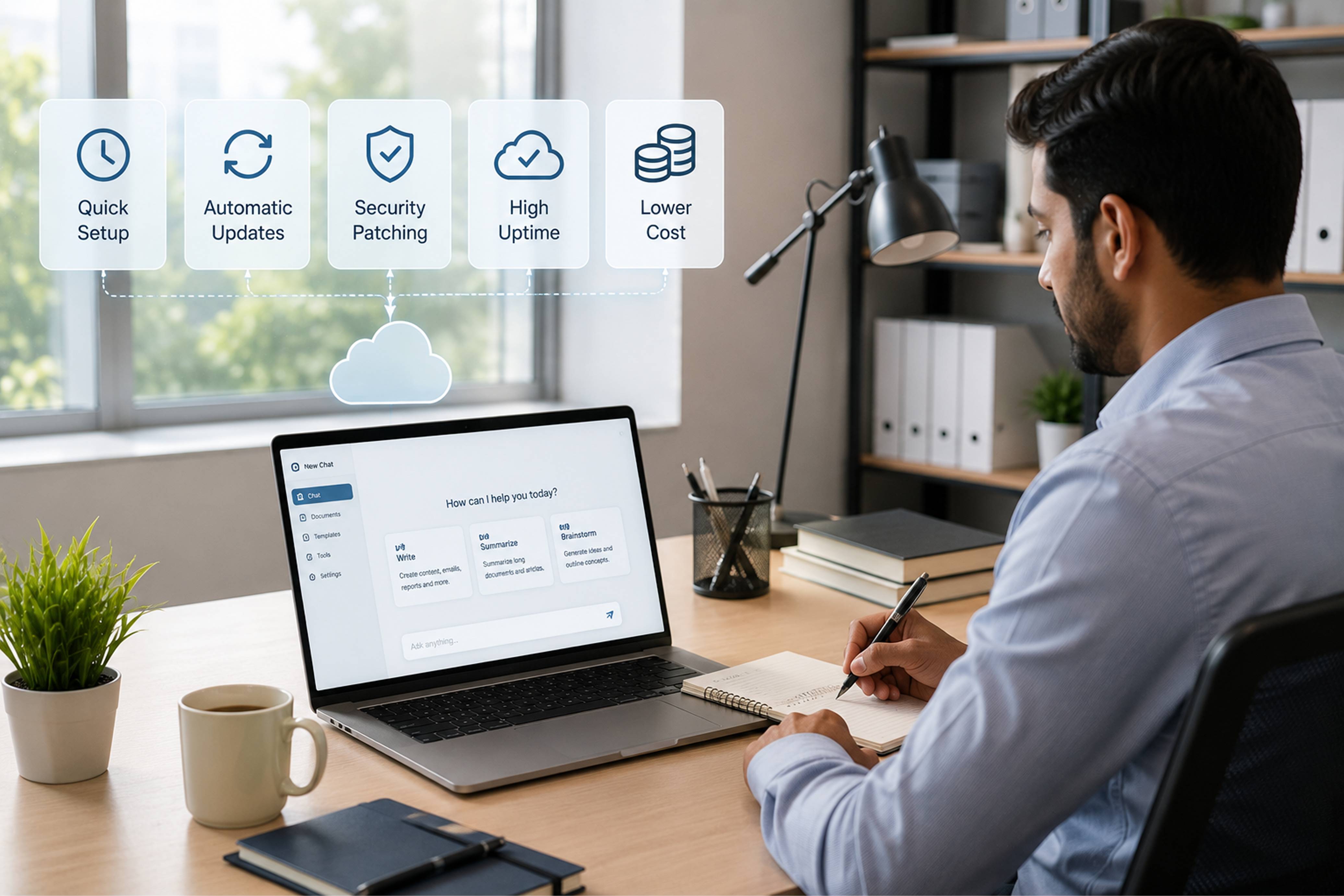
If the task is general-purpose — writing, brainstorming, cleaning up notes, answering questions from public knowledge — a subscription tool will beat anything custom on time-to-value and cost. You're live the same afternoon. Someone else handles the model updates, the uptime, and the security patching. For a small team that just needs a capable assistant, spinning up a bespoke agent would be an expensive way to solve a solved problem.
Off-the-shelf also makes sense when the workflow is genuinely standard across the industry and you have no edge to protect. If your process looks like everyone else's, a tool built for everyone else will fit fine.
The honest rule: if the work involves no sensitive data, no internal systems, and no rule unique to your business, buy it. Building custom there is effort spent for no return.
Where custom agents pull ahead
The picture flips the moment the agent needs to do real work inside your organisation.
Off-the-shelf tools hit a wall when they meet your internal systems, because they were never built to reach them. A generic assistant can summarise a document you paste in. It cannot log into your ticketing system, cross-check a claim against your asset inventory, and act on the result — unless someone builds that path, and building it is exactly the custom work vendors don't do for you.
Custom agents also carry context that generic tools flatten. Your escalation rules, your naming conventions, the difference between a routine alert and a real one — that knowledge lives inside your walls. An agent that encodes it behaves like a trained team member. A generic one behaves like a bright outsider who's never read your runbook.
And when the process is your differentiator, handing it to a shared tool means handing your edge to a vendor's roadmap. Custom keeps the logic — and the advantage — yours.
The India-specific factors that change the maths
This is where the decision stops being a generic build-vs-buy exercise and starts being an Indian-enterprise decision.
Data residency and sovereignty. A lot of generic AI tools route data through infrastructure outside your control, often outside the country. For a government body, a bank, or any firm bound by data-localisation expectations, that's a non-starter before the feature list even matters. SecNinjaz builds sovereign by default — you decide where the agent runs and where the data sits, including fully on-prem or air-gapped when the mandate demands it.
DPDP Act 2023 consent. The moment an agent processes identifiable personal data of Indian individuals, consent and purpose limitation are legal obligations, not nice-to-haves. A custom pipeline can enforce those constraints in the plumbing. A generic tool leaves you to hope its terms of service line up with the Act.
Auditability. Indian regulators are moving toward AI accountability, and "the model decided" won't survive an audit. Custom agents can log their reasoning, their inputs, and their actions in a form a compliance officer can actually read.
These aren't reasons custom is nicer. For many Indian enterprises they're the reasons off-the-shelf is simply off the table.
Security and governance: the part most vendors skip
An AI agent with access to your systems is a new attack surface and a new source of decisions you're accountable for. Bolting security on afterwards doesn't work; it has to be designed in.
SecNinjaz comes at agent development from the security side first — the company's whole reason for existing is cybersecurity, and that shows up in how agents get built. Prompt-injection resistance, least-privilege access to tools and data, and testing the agent the way an attacker would (AI red teaming is a standard part of the practice) are baked into the build, not offered as an upsell.
On the governance side, the company holds ISO/IEC 42001:2023 — the international standard for AI management systems — alongside ISO/IEC 27001:2022 for information security and ISO/IEC 27701:2025 for privacy. In plain terms: the way agents are designed, documented, and reviewed follows a certified process, so when someone asks how a decision was made, there's an answer on record.
The cost conversation, told straight
Off-the-shelf looks cheaper because the sticker price is a monthly subscription. Custom looks expensive because it starts with a build.
That comparison misleads. Subscription costs scale with seats and usage, and they keep climbing as adoption spreads — while the tool still can't touch your core systems. A custom agent carries a higher upfront cost and a lower marginal one, and it does work a subscription never could. The right way to compare isn't sticker price against sticker price; it's total cost of ownership against the value each option actually delivers.
The trap in both directions is real. Buy generic for a job that needed custom, and you pay in workarounds and unrealised value. Build custom for a job a tool would have done, and you've burned budget on a solved problem. Getting this right is mostly about being honest which job you actually have.
Off-the-shelf vs custom: how they compare
| Dimension | Off-the-Shelf Tools | Custom AI Agents (SecNinjaz) |
|---|---|---|
| Time to value | Live in hours; strong for general tasks | Longer to build; delivers on tasks tools can't reach |
| Fit to your workflow | Generic defaults; you adapt to the tool | Shaped to your process; the tool adapts to you |
| Access to internal systems | Limited or none | Connects to your data, APIs, and tools |
| Data residency & sovereignty | Often routed off-shore; little control | On-prem, air-gapped, or in-country by design |
| DPDP & auditability | Depends on vendor terms | Consent and audit logging built into the pipeline |
| Security posture | Vendor-managed; opaque to you | Secure-by-design, red-teamed, least-privilege access |
| Cost shape | Low upfront, rising per-seat over time | Higher upfront, lower marginal, higher ceiling on value |
| Ownership of logic | Vendor's roadmap | Yours to keep and change |
Read the table as a decision aid, not a verdict. If your rows all sit on the left, buy a tool and move on. If the sovereignty, systems-access, and governance rows matter to you, that's the signal to build.
How SecNinjaz builds agents
Engagements are AI-augmented today; the product roadmap is where AI-native lives — and SecNinjaz keeps the two honest rather than blurring them. On the delivery side, agentic AI development is a standing service line, drawing on the same practitioners who run the company's cybersecurity, AI, and product engineering work day to day. The same team that stress-tests other people's AI for weaknesses builds yours to survive that treatment.
The house style is "measured, not claimed." An engagement starts by pinning down which parts of your work genuinely warrant a custom agent and which are better served by something you can just buy — because recommending a build you don't need would undercut the point. From there it's scoped, built against your systems, tested adversarially, and documented to a standard you can put in front of an auditor.
The hybrid path most enterprises actually take
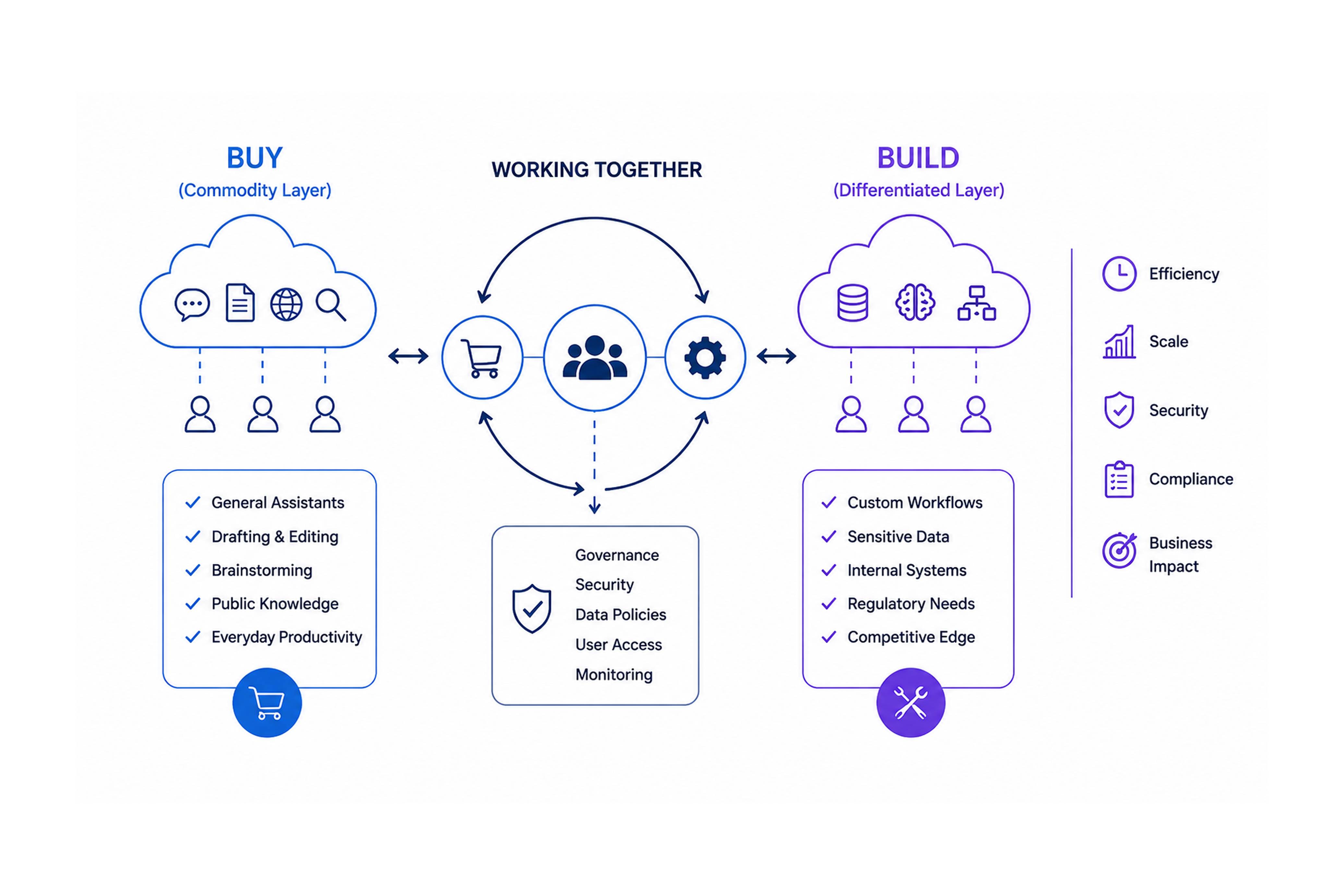
For all the framing of it as a binary, most organisations shouldn't pick a side. They should split the estate.
Buy the commodity layer — general assistants for drafting and everyday knowledge work, where a subscription is the efficient answer. Build custom for the handful of workflows that carry your competitive edge, touch sensitive data, or sit under regulatory scrutiny. The generic tools handle the volume; the custom agents handle the parts that actually matter.
The judgement is knowing which is which, and that's the conversation worth having before any budget is committed.
Talk to us before you commit
Working with SecNinjaz starts with a straight conversation, not a pitch. An initial consultation puts you in front of the people who build these systems, so you can pressure-test your own build-vs-buy call against how it would actually play out.
A brochure with the full agent-development approach is available on request — useful when you're making the internal case. To start, reach out at sales@secninjaz.com or +91-9289962965, or through www.secninjaz.com.
Conclusion
Off-the-shelf AI tools are good at being everything to everyone, which is exactly why they struggle to be much to you specifically. Custom agents cost more to start and pay back where it counts — inside your systems, under your rules, on your infrastructure. For Indian enterprises weighing sovereignty, DPDP obligations, and audit-readiness, that's often less a preference than a requirement.
A year from now, do you want a workforce renting generic AI that stops at the edge of your systems — or agents that work inside them, on your terms?
Frequently Asked Questions
What's the difference between a custom AI agent and an off-the-shelf AI tool?
An off-the-shelf AI tool is a ready-to-use subscription service designed for general tasks such as content creation, summarization, and research. A custom AI agent is built specifically for your organization, integrating with your internal systems, business processes, and security policies to automate specialized workflows.
When should an organization build a custom AI agent instead of buying a tool?
Custom AI agents are the better choice when workflows involve internal systems, proprietary data, regulatory requirements, or unique business processes. Off-the-shelf tools are ideal for general-purpose productivity tasks that do not require access to sensitive data or enterprise applications.
How does SecNinjaz address data sovereignty and DPDP compliance?
SecNinjaz designs AI agents with data sovereignty in mind, supporting on-premises, private cloud, or air-gapped deployments where required. Solutions can be built to support DPDP Act requirements, including consent management, purpose limitation, secure data processing, and comprehensive audit logging.
Are custom AI agents more secure than off-the-shelf AI tools?
Custom AI agents can provide stronger security because they are designed around an organization's security architecture. SecNinjaz incorporates secure-by-design principles, least-privilege access, AI red teaming, prompt injection testing, and governance practices aligned with standards such as ISO/IEC 42001, ISO/IEC 27001, and ISO/IEC 27701.
Should enterprises choose custom AI agents or off-the-shelf AI tools?
For most organizations, a hybrid approach delivers the greatest value. Off-the-shelf AI tools handle general productivity tasks, while custom AI agents automate business-critical workflows, integrate with enterprise systems, protect sensitive data, and address compliance and governance requirements.