A procurement officer in Delhi forwards a draft tender to two colleagues over a popular chat app. There is a little lock icon on the screen, so it feels safe. It probably is not, at least not in the way that matters for a government project. The message very likely crossed servers sitting in another country. The metadata around it (who spoke to whom, at what time, from which cell tower) was logged somewhere outside Indian jurisdiction. And the maths protecting the actual words was designed for a world where large quantum computers do not exist yet.
That last point is the one people keep waving away. It is also the one that will age the worst.
For Indian government departments, PSUs, defence and law enforcement units, and the regulated banks and utilities around them, "we use an encrypted messaging app" has stopped being an answer. It is the beginning of a much harder set of questions. Which app. Whose servers. Who holds the keys. What happens to the ciphertext a foreign intelligence service copies today and quietly decrypts in 2032, once the hardware catches up.
This guide is written for the people who have to answer those questions: security architects, GRC leads, and the officers who sign off on a communication tool for a sensitive project. We will get concrete about what "secure encrypted messaging" really requires, why post-quantum readiness moved from a research curiosity to a line item in serious tenders, and how to evaluate a sovereign messenger without being fooled by a lock icon that means far less than it suggests.
Why consumer messaging apps fall short for government work
Signal, WhatsApp, and Telegram are not bad software. Signal in particular has excellent cryptography, and for an ordinary citizen it is a genuinely strong choice. The problem is not the encryption on the wire. It is everything around it, and the assumptions baked into who runs the service.
Start with jurisdiction. A consumer app decides where its servers live, and that decision is rarely India. Under the Digital Personal Data Protection Act, 2023, and the sector rules that sit above it (RBI's localisation direction for payment data being the sharpest example), a government or regulated body cannot simply shrug about where citizen data and official communications come to rest. If the routing and the metadata sit in a US or EU data center, you have exported a category of information you were supposed to keep at home.
Then there is metadata, which most buyers underrate. End-to-end encryption hides the contents of a message. It usually does nothing to hide the pattern of communication. A foreign platform that cannot read your text can still see that a particular official device exchanged 40 messages with a specific number the night before a policy announcement. For intelligence work, that traffic-analysis picture is often more valuable than the words.
There are three more practical gaps worth naming:
- No administrative control. You cannot enforce your own retention policy, your own key rotation, or your own device-loss procedure. You get the vendor's global defaults.
- Opaque supply chain. You are trusting a build pipeline and an update mechanism you do not audit. A single pushed update reaches every device.
- Account model built for consumers. Phone-number identity, cloud backups that quietly weaken the encryption guarantee, and social features (contact discovery, read receipts) that leak more than a sensitive workflow should.
None of this makes these apps useless. It makes them wrong for a project where the threat model includes a well-funded nation-state adversary and a legal obligation to keep data on Indian soil.
Talk about sovereign messaging →
What "secure encrypted messaging" actually means
The phrase gets thrown around until it means almost nothing. Break it into the properties that a real evaluation should test, because a vendor can honestly claim "encrypted" while still failing most of them.
End-to-end encryption versus transport encryption
Transport encryption (TLS) protects a message between your device and the server. The server then decrypts it, does whatever it does, and re-encrypts it for the next hop. That means the operator can read everything. Plenty of "secure" enterprise chat tools work exactly this way, and they are fine for internal chatter that you would not mind the vendor reading.
End-to-end encryption (E2EE) is a different guarantee. The message is encrypted on the sender's device with a key the server never sees, and only the recipient's device can decrypt it. The operator, even under legal compulsion, can hand over ciphertext and nothing more. For a government project, E2EE is the floor, not a feature.
The test question to ask any vendor is blunt: if a court orders you to produce the plaintext of a specific conversation, can you technically comply? If the answer is yes, it is not end-to-end encrypted, whatever the marketing says.
The metadata problem
This is where most systems quietly leak. Even with perfect E2EE on message bodies, the server often knows the social graph. Good systems fight this deliberately. Signal's "sealed sender" hides who sent a message from the server. Some architectures go further and route through relays so that no single node sees both ends of a conversation.
For sensitive work, treat metadata minimisation as a first-class requirement, not a nice-to-have. Ask specifically: what does the server log, for how long, and can that logging be turned off or kept inside your own infrastructure?
Forward secrecy and post-compromise security
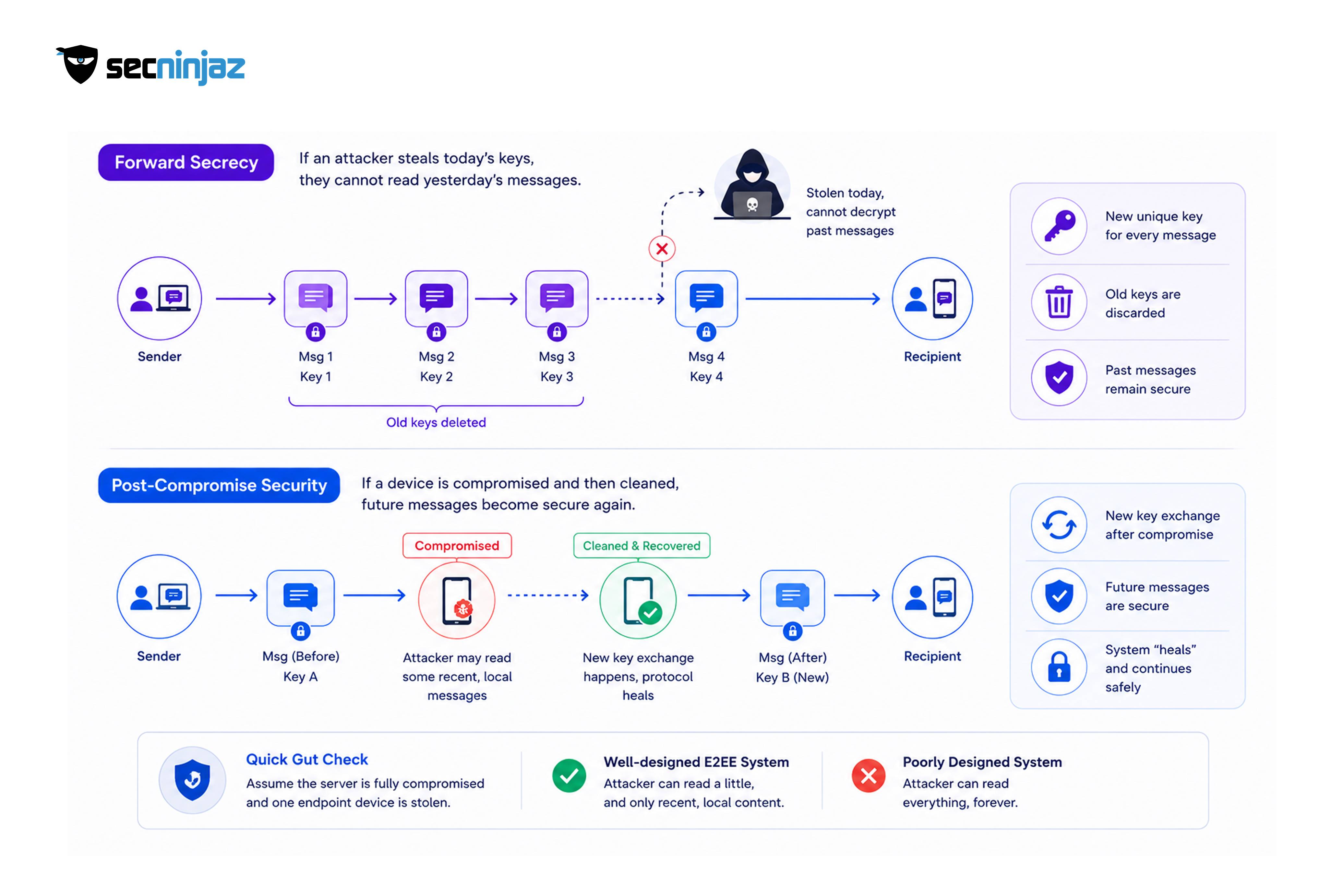 Two properties, closely related, and both underappreciated.
Forward secrecy means that if an attacker steals today's keys, they still cannot read yesterday's messages, because the keys used for old messages have already been thrown away. Post-compromise security is the mirror image: if a device is compromised and then cleaned, future messages become safe again as the protocol "heals" through new key exchanges.
The Signal Protocol achieves both through its Double Ratchet, which derives a fresh key for essentially every message. Any serious messenger should be doing something equivalent. If a system uses one long-lived key for a whole conversation, a single breach exposes the entire history. That is a design you should reject outright.
> A quick gut check for any messaging tool: assume the server is fully compromised and one endpoint device is stolen. How much can the attacker read? In a well-designed E2EE system with forward secrecy, the honest answer is "a little, and only recent, local content." If the answer is "everything, forever," walk away.
Why post-quantum readiness matters now, not in 2030
Here is the uncomfortable part, and the reason this article pairs encrypted messaging with post-quantum cryptography rather than treating them as separate topics.
Almost every messaging app in use today protects its key exchange with elliptic-curve cryptography, usually a variant of Diffie-Hellman on Curve25519. That maths is secure against classical computers. It is not secure against a large, fault-tolerant quantum computer running Shor's algorithm, which would break it comprehensively. The machine capable of that does not exist in public today. The consensus among serious cryptographers is that it is a question of when, not if, and the honest range on "when" is wide, somewhere from the early 2030s to later, depending on who you ask and how the hardware progresses.
Harvest now, decrypt later
You do not need the quantum computer to exist yet for the threat to be live. This is the part buyers miss.
A capable adversary can record encrypted traffic today, store it cheaply, and simply wait. The day a working cryptanalytically relevant quantum computer arrives, every conversation they archived becomes readable in retrospect. Cryptographers call this "harvest now, decrypt later," and for anything with a long secrecy lifetime it is already a real problem in 2026.
Think about what that means for government data. A citizen's health record, a defence procurement negotiation, an intelligence source's identity, a diplomatic cable: these need to stay secret for 20, 30, sometimes 50 years. If the secrecy requirement outlives the arrival of quantum computers, then classical-only encryption already fails the requirement today. You are shipping data with an expiry date on its confidentiality, and you do not control the clock.
The standards are done, so the excuse is gone
For a long time the answer to post-quantum was "wait for the standards." That wait is over. In August 2024, the US National Institute of Standards and Technology finalised its first three post-quantum standards:
- FIPS 203 (ML-KEM), the key-encapsulation mechanism derived from the algorithm formerly known as Kyber.
- FIPS 204 (ML-DSA), a lattice-based digital signature scheme derived from Dilithium.
- FIPS 205 (SLH-DSA), a hash-based signature scheme derived from SPHINCS+.
These are not drafts. They are published, vetted algorithms that vendors can and do implement. The messaging industry has already moved. Signal deployed its PQXDH key agreement in 2023, layering ML-KEM on top of its existing X25519 exchange. Apple shipped PQ3 for iMessage in early 2024. The leading edge is no longer asking whether to do this.
Why hybrid, and why it is the sane default
Notice what Signal and Apple both did: they did not rip out the old cryptography. They ran the classical algorithm and the post-quantum one together, and combined both outputs so that the session key is safe as long as either one holds.
That hybrid approach is the pragmatic choice for a reason. The post-quantum algorithms are new, and new cryptography sometimes has flaws that take years to surface. If a weakness turns up in ML-KEM, the classical layer still protects you. If a quantum computer breaks the classical layer, the post-quantum layer holds. You get the union of two safety nets rather than betting everything on one.
Conceptually the key derivation looks like this:
# Hybrid key derivation: safe if EITHER exchange holds
classical_secret = x25519(our_priv, their_pub)      # classical ECDH
pq_secret        = ml_kem_decapsulate(ciphertext, sk) # NIST FIPS 203

# Combine both so the session key needs both to be broken
session_key = hkdf(
    salt=transcript_hash,
    ikm = classical_secret + pq_secret,
    info=b"messaging-session-key",
    length=32,
)
A messenger that markets itself as "post-quantum ready" but has thrown away the classical layer entirely is being braver than it should be. Ask which construction they use. Hybrid is the answer you want in 2026.
Sovereignty: where your keys and servers live is a security property
Cryptography protects the contents. Sovereignty decides who is even in a position to try. For an Indian government project these are separate questions, and both have to be answered well.
A sovereign messenger, in the sense that matters here, means three things working together. The infrastructure runs where you control it, ideally on Indian soil or inside your own data center. The cryptographic keys are generated and held by you or your users, never escrowed with a foreign vendor. And the operator has no technical ability to read, hand over, or silently alter your communications, regardless of which government leans on them.
That last clause is the one that separates a genuinely sovereign product from a rebranded consumer app. Plenty of tools localise a copy of the data while still holding the keys centrally. If the vendor can be compelled by any authority to produce plaintext, your sovereignty is on paper only.
Decentralised versus centralised architecture
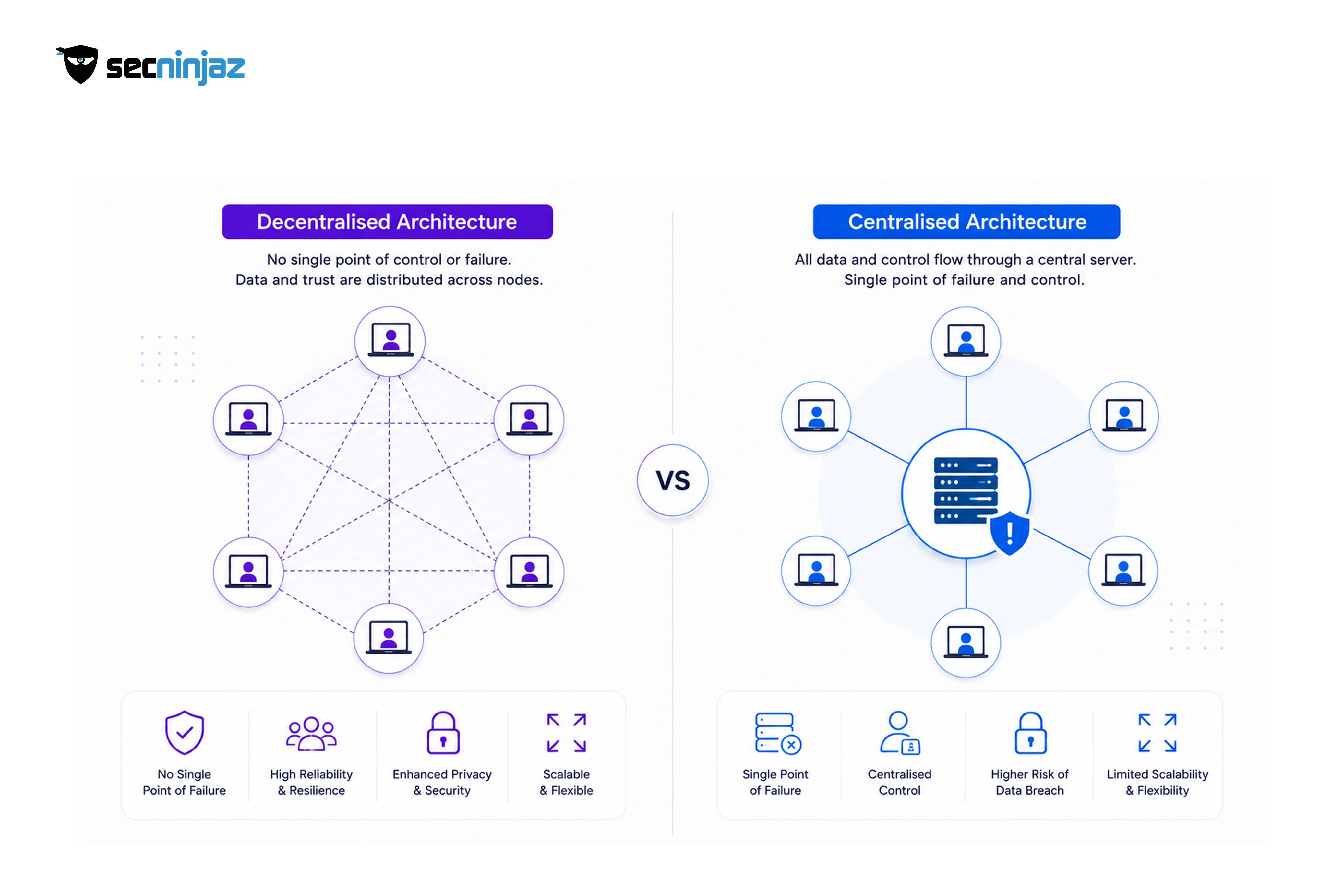 Most messaging you have used is centralised. There is a company, it runs the servers, and if that company disappears or is compromised the service disappears or leaks with it. Centralisation is simple to operate and simple to attack: one target, one legal jurisdiction, one point of failure.
A decentralised architecture spreads the routing across nodes that no single party fully controls. No one node sees the whole picture, there is no single server whose seizure unlocks everything, and the system keeps working even if part of it goes dark. For a high-trust environment this maps neatly onto the actual threat model, because it removes the single chokepoint that a nation-state adversary or a legal order would go after first.
The trade-off is real and worth stating plainly. Decentralised systems are harder to operate, harder to update in lockstep, and can be trickier to monitor for abuse. They are not automatically better for a small internal team that just wants a private group chat. They are better when the cost of a single centralised breach is measured in national-security or regulatory terms. That is exactly the situation this article is about.
This is where SecNinjaz's own product, textr, is built for the case. textr is an encrypted, decentralised sovereign messenger with post-quantum cryptography, engineered in India for precisely the environments where the three sovereignty conditions above are non-negotiable. We will come back to how it fits into a deployment, without pretending it is the answer to every messaging need.
A procurement checklist for government and regulated buyers
If you are evaluating a secure encrypted messaging app in India, the marketing pages will not tell you what you need. Here is the shortlist of questions that actually separate a serious product from a repackaged consumer app. Score each one honestly.
| Requirement | What to demand | Red flag |
|---|---|---|
| End-to-end encryption | Server can never produce plaintext, even under court order | "We can decrypt if legally required" |
| Post-quantum readiness | Hybrid key exchange using a NIST PQC standard (ML-KEM) | "Quantum-safe" with no algorithm named |
| Metadata protection | Minimal server logs; social graph hidden from the operator | Full contact graph and timestamps retained |
| Forward secrecy | Per-message key ratcheting (Signal Protocol or equivalent) | One long-lived key per conversation |
| Data residency | Servers and keys on Indian soil or self-hosted | Routing through foreign data centers |
| Key custody | Keys held by you or your users, never vendor-escrowed | Vendor holds a master or recovery key |
| Deployment model | Self-hosted or on-premise option available | Cloud-only, vendor-managed only |
| Auditability | Open protocol, third-party cryptographic review | Proprietary "secret sauce" encryption |
| Compliance mapping | Documented alignment with DPDP Act 2023 and CERT-In directions | No India-specific compliance posture |
| Device and identity | Admin control over device loss, revocation, retention | Consumer phone-number identity only |
Two of these deserve emphasis because vendors love to fudge them.
"Quantum-safe" with no algorithm named is almost always a tell. A real answer sounds like "we use a hybrid of X25519 and ML-KEM-768." A vague one sounds like "our platform is quantum-resistant." Make them name the primitive.
And "proprietary encryption" is a warning, not a feature. Sound cryptography survives being public. If a vendor will not tell you what algorithms they use because it is a trade secret, they are describing security through obscurity, and that has failed every time it has been tested seriously.
Deploying a sovereign messenger: a rollout that survives contact with reality
Buying the right tool is half the job. Rolling it out across a department without either a security gap or a user revolt is the other half, and it is where most projects stumble. Here is a sequence that works.
- Classify what you are protecting. Not every conversation needs the same treatment. Map your communication flows and mark which ones carry data with a long secrecy lifetime or a regulatory obligation. Those go on the sovereign messenger first. General logistics chatter can wait.
- Define the threat model on paper. Write down who you are defending against and what they can do. A department facing a nation-state adversary makes different choices than one worried mainly about a lost phone. This document drives every later decision, and skipping it is why so many rollouts optimise for the wrong thing.
- Stand up the infrastructure on your terms. For a truly sovereign deployment this means self-hosted or on-premise nodes inside Indian jurisdiction, hardened and monitored. Integrate identity with your existing directory rather than creating a parallel account system nobody maintains.
- Pilot with a small, real group. Pick one team with genuinely sensitive workflows, not a group of volunteers who will be gentle with it. You want to find the friction where it hurts, early, when changing course is cheap.
- Train for the failure modes, not the happy path. Users do not lose data because encryption is hard. They lose it because they did not know what happens when they change phones, or they screenshotted a message into an unprotected gallery. Train the recovery and device-loss procedures explicitly.
- Wire it into your monitoring and incident response. A messenger is part of your attack surface. Feed the relevant operational logs (never message contents) into your SOC so a compromised device shows up the way any other endpoint anomaly would.
- Review and rotate on a schedule. Set key rotation policy, device re-attestation, and an access review cadence. Then actually run them. A control you configure once and never revisit is a control you have already lost.
The order matters. Teams that jump straight to step 3, standing up servers before they have classified data or written a threat model, almost always build the wrong thing and rebuild it a year later.
Common mistakes when rolling out secure messaging
A few failure patterns show up again and again. None of them are exotic. All of them are avoidable.
Treating the lock icon as the finish line. E2EE on the message body is necessary and nowhere near sufficient. If metadata leaks and keys live with a foreign vendor, the lock icon is theatre.
Enabling cloud backup without thinking it through. This one is quiet and lethal. A messenger can have flawless end-to-end encryption and then offer a "helpful" cloud backup that stores your entire history in a form the cloud provider can read. The backup silently undoes the guarantee. Decide your backup policy deliberately, and if you back up, back up encrypted with keys you hold.
Buying "post-quantum" as a checkbox. A vendor slaps the phrase on a datasheet, nobody asks which algorithm, and two years later you discover it was marketing. Name the primitive, confirm it is hybrid, confirm it is a NIST standard.
Ignoring the human layer. The strongest protocol in the world does not help if an officer forwards a sensitive thread to a personal account because the sovereign tool was annoying to use. Usability is a security property. A tool people route around is worse than no tool, because it creates a false sense of coverage.
Forgetting device loss and offboarding. Phones get lost, and staff move on. If you cannot remotely revoke a device and cut its access to future messages, every departure is a slow leak. Build revocation into day one, not into the post-incident review.
Skipping the compliance mapping. DPDP Act 2023, CERT-In's incident reporting directions, and sector rules from the RBI or others are not optional context. If your messenger choice has no documented compliance posture, you are inheriting risk you cannot see until an auditor finds it for you.
When to use what: matching the tool to the threat
Not every problem needs a sovereign, decentralised, post-quantum messenger. Over-engineering has its own costs. Here is a straight comparison to help place the options.
| Scenario | Sensible choice | Why |
|---|---|---|
| Ordinary citizen, personal privacy | Signal | Strong E2EE, free, well-audited, easy |
| Internal company chat, low sensitivity | Enterprise platform with admin controls | Compliance and management matter more than nation-state resistance |
| Regulated firm, customer data in scope | Self-hosted E2EE with data residency | DPDP and sector rules require control over location and custody |
| Government project, long secrecy lifetime | Sovereign, decentralised, post-quantum messenger | Harvest-now-decrypt-later and jurisdiction are live threats |
| Defence, intelligence, law enforcement | Sovereign messenger plus strict device and network controls | Threat model includes capable state adversaries |
Read the table as a spectrum, not a set of walls. The deciding factors are two questions asked honestly: how long does this data need to stay secret, and who is realistically trying to read it. When the honest answer to the first is "decades" and to the second is "a well-resourced state actor," you are in sovereign-messenger territory, and consumer apps are simply the wrong instrument.
There is also a cost dimension worth naming. A self-hosted, decentralised deployment carries real operational overhead: infrastructure, updates, monitoring, and the expertise to run it. For a project that genuinely faces the high end of the threat model, that overhead is cheap insurance. For a low-sensitivity internal chat, it is money and effort better spent elsewhere. Match the investment to the risk, and be willing to under-build where the risk is genuinely low.
Where SecNinjaz and textr fit
SecNinjaz builds secure, sovereign, and future-ready digital capabilities for enterprises, governments, and high-trust environments, and secure communication sits squarely inside that. textr, our sovereign messenger, is an encrypted and decentralised platform with post-quantum cryptography, made in India for exactly the projects described in this guide: the ones where jurisdiction, key custody, and long-horizon secrecy are not negotiable.
But a messenger is one component, not a whole security programme, and it would be dishonest to sell it as one. A sovereign messaging tool only delivers on its promise when the surrounding architecture holds up. That is where the rest of the work lives.
Identity and access is the usual weak point. A secure messenger wired into a loose identity system inherits every weakness of that system, which is why our IAM, Privileged Access Management, and Zero Trust Architecture work tends to sit alongside a messaging deployment rather than after it. On the governance side, our GRC and DPDP practice maps a deployment against the Digital Personal Data Protection Act, 2023 and CERT-In's directions, so the compliance posture is documented before an auditor asks rather than reconstructed afterward. For public-sector projects specifically, our STQC services cover the security and GIGW compliance testing that government platforms in India are expected to pass.
The honest framing is this: a post-quantum messenger closes one important gap. Closing it while leaving identity, monitoring, and governance open is a common and expensive mistake. The value is in the combination, and the combination is what an experienced security team should be evaluating.
SecNinjaz holds ISO/IEC 27001 and ISO/IEC 42001:2023 among its certifications, is CMMI Level 3 appraised, and the team holds credentials including CISSP, OSCP, and CISM. That is context for how we approach the work, not a substitute for the evaluation you should run on any vendor, including us. Ask us the same hard questions from the checklist above. A vendor worth trusting will welcome them.
Talk about sovereign messaging →
Frequently asked questions
What is the most secure encrypted messaging app for the Indian government?
There is no single answer that fits every department, because the right choice depends on your threat model and secrecy horizon. For projects facing capable state adversaries and long data-retention obligations, the requirements are clear: end-to-end encryption the operator cannot bypass, hybrid post-quantum key exchange, metadata protection, keys held by you rather than a foreign vendor, and infrastructure on Indian soil. A sovereign, decentralised messenger such as SecNinjaz textr is built for that profile. Consumer apps like Signal are excellent for personal use but were not designed for the jurisdiction and custody requirements a government project carries.
Is end-to-end encryption enough on its own?
No. End-to-end encryption protects the contents of a message, but it usually does nothing about metadata, which reveals who talked to whom and when. It also says nothing about where your servers and keys live, or whether the encryption will survive the arrival of quantum computers. Treat E2EE as the floor of a secure messaging evaluation, then check metadata protection, forward secrecy, data residency, and post-quantum readiness on top of it.
What does post-quantum ready actually mean for a messaging app?
It means the app protects its key exchange against future quantum computers, not just today's classical ones. In practice the credible approach is a hybrid one: combine a classical algorithm like X25519 with a NIST post-quantum standard such as ML-KEM (FIPS 203), so the session stays safe as long as either layer holds. Be wary of any product that claims to be "quantum-safe" but will not name the algorithm it uses. A real answer specifies the primitive; a marketing answer does not.
Why does harvest now, decrypt later matter if quantum computers don't exist yet?
Because an adversary can record your encrypted traffic today, store it cheaply, and decrypt it years later once the hardware exists. Any data with a long secrecy lifetime is already exposed to this. A defence negotiation, a health record, or an intelligence source's identity may need to stay secret for decades, which is well within the window where quantum computers are expected to arrive. If your secrecy requirement outlives that arrival, classical-only encryption already fails it now.
Does the DPDP Act 2023 require encrypted messaging?
The Digital Personal Data Protection Act, 2023 requires organisations to protect personal data with reasonable security safeguards, and encryption is a standard way to meet that obligation for data in transit and at rest. The Act, together with sector-specific rules and CERT-In's directions, also drives decisions about where data resides and how breaches are reported. It does not name a specific product, but for communications carrying personal or sensitive data, encryption with control over data residency and custody is the practical way to demonstrate compliance. Map your choice against the Act explicitly rather than assuming a tool is compliant by default.
What is the difference between a sovereign messenger and a normal secure chat app?
A normal secure chat app encrypts your messages but is usually run by a company on infrastructure it controls, often outside India, with keys it can influence. A sovereign messenger adds three conditions: the infrastructure runs where you control it, the keys are held by you or your users and never escrowed with the vendor, and the operator has no technical ability to read or hand over your communications under pressure from any government. The first protects the contents. The second decides who is even in a position to try to read them.
Is a decentralised messaging architecture always the better choice?
Not always. Decentralisation removes the single point of failure that a nation-state adversary or a legal order would target first, which is a genuine advantage for high-trust environments. But it is harder to operate, update, and monitor than a centralised system. For a small internal team that just wants a private group chat, that overhead may not be worth it. Decentralisation earns its cost when a single centralised breach would carry national-security or serious regulatory consequences.
How should we evaluate a secure messaging vendor?
Run the procurement checklist in this guide and score each item honestly. Confirm the server can never produce plaintext, make the vendor name their post-quantum algorithm, check what metadata the server retains, and verify data residency and key custody. Reject "proprietary encryption" as a selling point, since sound cryptography survives being public. Ask for evidence of third-party cryptographic review, and require a documented compliance mapping to the DPDP Act 2023 and CERT-In directions. A trustworthy vendor, SecNinjaz included, will welcome these questions rather than deflect them.