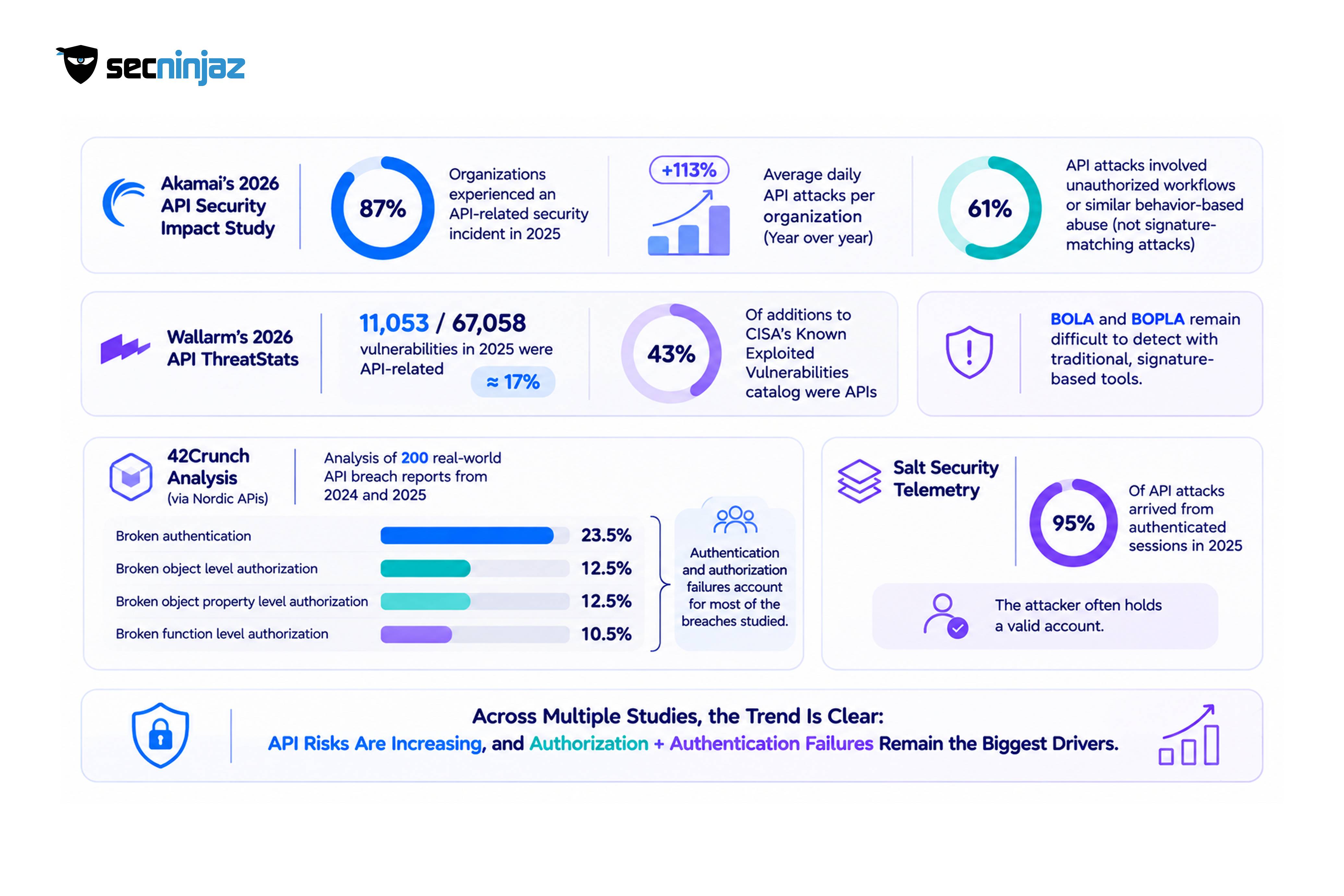
Akamai's 2026 API Security Impact Study found that 87% of surveyed organizations experienced an API-related security incident in 2025, and the average number of daily API attacks per organization rose by 113% year over year. About 61% of API attacks in 2025 involved unauthorized workflows or similar behavior-based abuse, not the signature-matching attacks that traditional tools are built to spot. The same report notes that vulnerabilities such as broken object level authorization and broken object property level authorization remain difficult to detect with traditional, signature-based tools. Wallarm's 2026 API ThreatStats report adds a vulnerability view: 11,053 of the 67,058 vulnerabilities published in 2025, about 17%, were API-related, and the company reports that APIs accounted for 43% of the additions to CISA's Known Exploited Vulnerabilities catalog that year. Both are vendor reports, so the exact percentages deserve caution, but the direction matches what independent breach analyses show.
Talk to Our Security Experts →
One such analysis comes from 42Crunch, which reviewed 200 real-world API breach reports from 2024 and 2025. As summarized by Nordic APIs, broken authentication led at 23.5% of reported cases, followed by broken object level authorization and broken object property level authorization at 12.5% each, and broken function level authorization at 10.5%. Taken together, authentication and authorization failures account for most of the breaches studied. A further data point comes from Salt Security's telemetry, reported at 95% of API attacks arriving from authenticated sessions in 2025, which means the attacker often holds a valid account.
Those findings explain the title of this guide. The OWASP API Security Top 10 is widely known, and the 2023 edition remains the current published edition at the time of writing, separate from the general OWASP Top 10:2025. Knowing the list is not the same as testing against it. The risks at the top of the list are logic flaws about who may do what to which object, and a scanner that sends a valid request and receives a valid response sees nothing wrong. Closing the gaps means turning each risk into specific tests, evidence, and fixes, and running those tests as authenticated users with different roles and tenants.
This guide covers what the Top 10 does and does not cover, why API testing differs from web application testing, the testing gap behind each risk, how to build a test plan, what evidence a finding needs, how testing fits into the delivery pipeline, what Indian regulators ask for, and where to start. It is written for security leads, API and platform engineers, product owners, and the compliance teams that have to show APIs were tested.
What the OWASP API Security Top 10 Covers
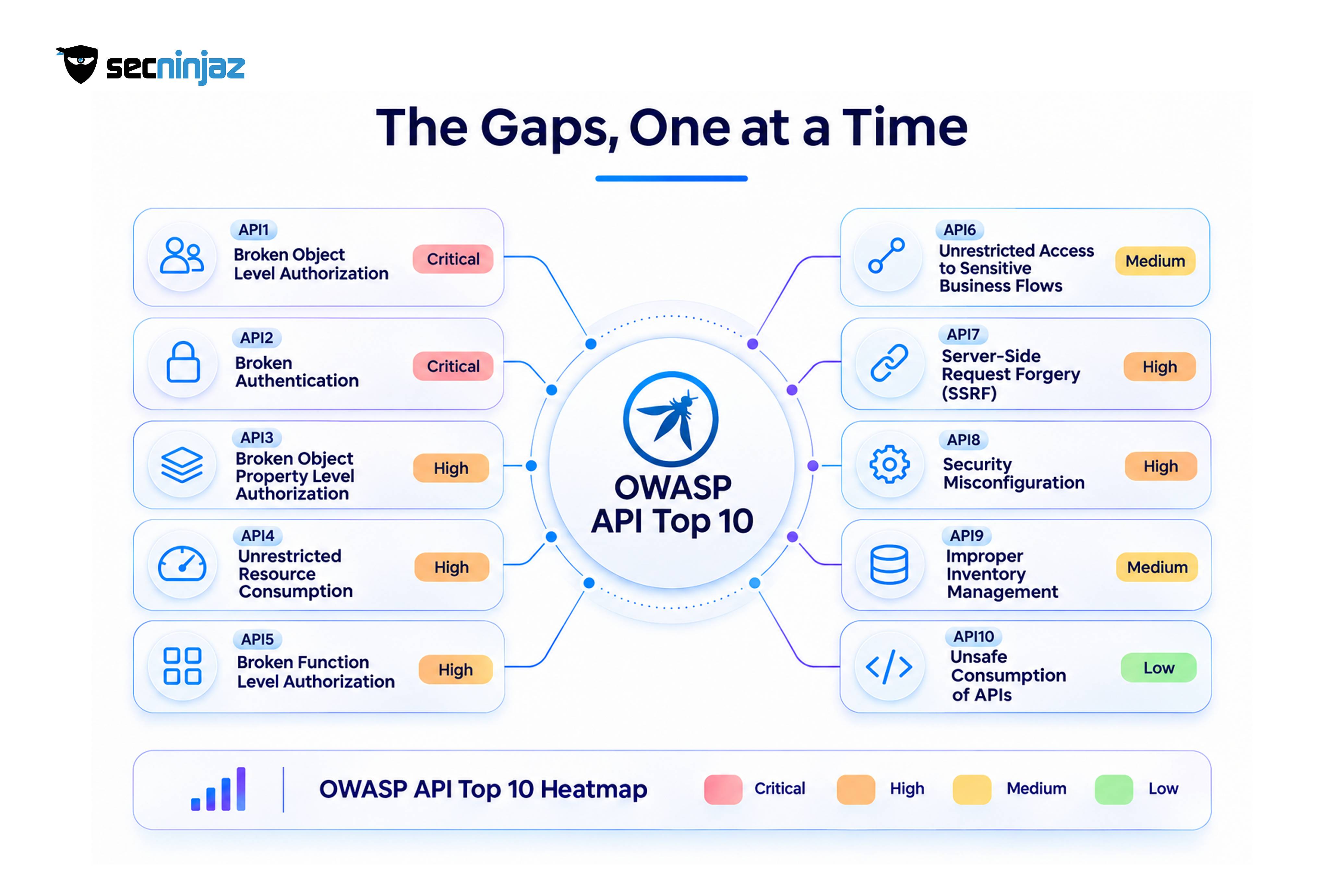
The OWASP API Security Top 10 is an awareness document that ranks the most critical risks specific to APIs. The 2023 edition changed the 2019 list in several ways. Excessive data exposure and mass assignment were merged into broken object property level authorization, resource limiting was reframed as unrestricted resource consumption, and three risks were added: unrestricted access to sensitive business flows, server-side request forgery, and unsafe consumption of APIs. It lists risks and does not prescribe tests, which is where the gap opens. Each entry needs translating into test cases for a specific API, and the table below shows what that translation looks like.
| Risk | What goes wrong | Why routine scanning misses it | What testing must do |
|---|---|---|---|
| API1 Broken Object Level Authorization | A caller reaches another user's or tenant's objects by changing an identifier | The request is valid and the response is a normal success | Replay requests across identities and compare what each can reach |
| API2 Broken Authentication | Weak tokens, flawed login, reset, or session handling let an attacker act as another user | Flaws sit in flow design and token lifecycle, not in a single request | Test token validation, lifetime, refresh, reset flows, and brute-force controls |
| API3 Broken Object Property Level Authorization | A caller reads or writes object properties they should not | Responses and accepted fields look legitimate | Compare returned and writable fields per role, and test unexpected fields |
| API4 Unrestricted Resource Consumption | Requests exhaust capacity or run up cost | Default scans do not stress limits | Test rate limits, quotas, payload size, pagination, and costly operations |
| API5 Broken Function Level Authorization | A lower-privileged caller invokes administrative or internal functions | The function works as designed for the right role | Test every function with every role, and test changed methods |
| API6 Unrestricted Access to Sensitive Business Flows | Automation abuses a legitimate flow, such as sign-up, booking, or purchase | Each request is individually valid | Model abuse of workflows at scale within agreed limits |
| API7 Server-Side Request Forgery | The API fetches attacker-chosen destinations | Needs knowledge of which parameters trigger fetches | Test every parameter, webhook, and import feature that accepts a destination |
| API8 Security Misconfiguration | Weak defaults, verbose errors, open cross-origin policy, or unneeded methods | Often found, but varies by environment | Review configuration across environments and layers |
| API9 Improper Inventory Management | Old, undocumented, or test API versions stay exposed | A scanner only tests what it is told about | Discover endpoints from several sources and compare with documentation |
| API10 Unsafe Consumption of APIs | The API trusts data from third-party services | Needs control of or visibility into the upstream response | Test how the API handles malformed or hostile upstream data |
Why API Testing Differs From Web Application Testing
| Aspect | Web application testing | API testing |
|---|---|---|
| Interface | A browser interface guides the tester | No interface, so documentation, specifications, and traffic define the surface |
| Clients | Humans through browsers | Mobile apps, partners, services, and increasingly AI agents |
| Authorization | Often visible in menus and pages | Enforced per request on identifiers, properties, and functions |
| State | Sessions tied to pages | Tokens, multi-step flows, and long-lived credentials |
| Surface growth | Pages added with releases | Versions, endpoints, and integrations multiply and linger |
| Protocols | HTTP and HTML | REST, GraphQL, gRPC, WebSocket, and webhooks, each with its own failure modes |
The Gaps, One at a Time
Gap 1: Authorization (API1, API3, API5)
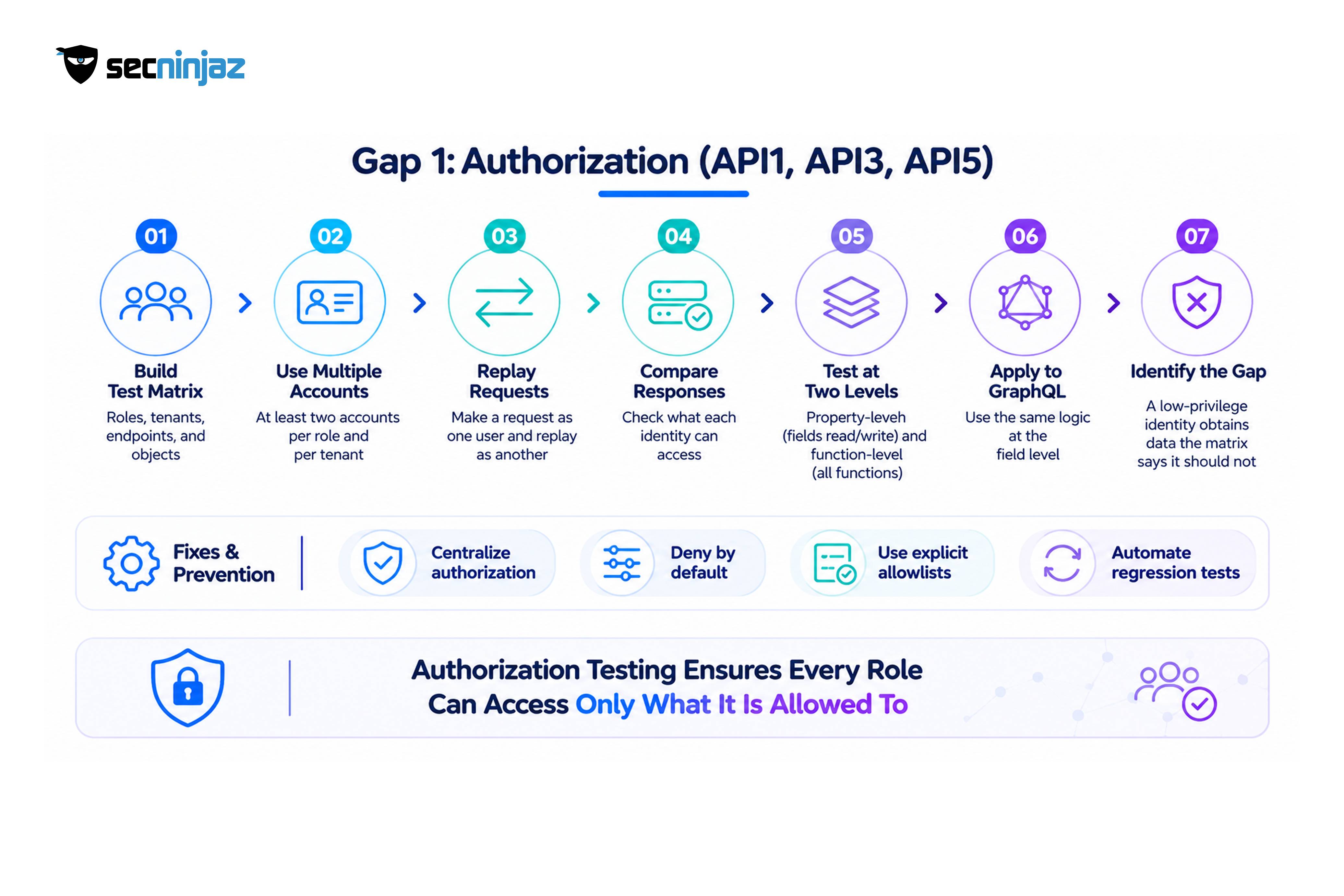
Three of the top five risks are authorization failures, and they share a testing method. The tester builds a matrix of roles, tenants, endpoints, and objects, and works with at least two accounts per role and per tenant so that one identity can be tried against another's data. Requests made as one user are replayed as another, and the responses are compared. Property-level testing compares the fields each role receives and the fields each role can write. Function-level testing tries every function, including administrative and internal ones, with every role and with alternative methods. For GraphQL, the same logic applies at field level. A finding is a low-privilege identity obtaining something the matrix says it should not.
Fixes belong in a central authorization layer, not in each endpoint. Deny by default, check ownership in the data access path, return only fields on an explicit allowlist, accept only fields on an explicit allowlist, and turn the matrix into automated regression tests so a later release cannot reopen the flaw.
Gap 2: Authentication (API2)
Authentication testing examines the token lifecycle and the flows around it: how tokens are issued, validated, refreshed, and revoked, how long they live, what happens at password reset and account recovery, and whether login and reset endpoints resist automated guessing. Static API keys embedded in clients, tokens that never expire, and validation that trusts the token without checking its signature and claims are recurring findings. The usual fixes are standard flows such as OAuth 2.0 and OpenID Connect, short-lived tokens, strong validation, throttling on authentication endpoints, and additional authentication for sensitive operations.
Gap 3: Resources and Business Flows (API4, API6)
Resource consumption testing measures what an API does under pressure: whether rate limits exist per identity as well as per address, whether pagination and payload sizes are bounded, whether expensive operations such as deep GraphQL queries or bulk exports can be abused, and whether actions that cost money, such as one-time passwords or calls to paid third-party services, are limited. Business flow testing goes further and asks whether a legitimate flow can be abused through automation, for example by mass account creation, repeated coupon or referral abuse, or scalping of limited inventory. These tests need agreed limits and a non-production environment, since they can disrupt service. Fixes combine per-identity and per-flow limits, anomaly detection, and step-up controls on high-value actions.
Gap 4: SSRF and Unsafe Consumption (API7, API10)
Server-side request forgery appears wherever an API accepts a destination: URL parameters, webhook registration, file import by link, and integrations. Testing identifies every such parameter and checks whether the server can be steered toward internal services or cloud metadata endpoints. Unsafe consumption is the mirror image: the API calls other services and trusts what returns. Testing checks how the API behaves with malformed, oversized, or hostile upstream responses. Fixes include allowlisting destinations, restricting outbound network access, validating upstream data as untrusted input, and applying timeouts and schema checks.
Gap 5: Misconfiguration and Inventory (API8, API9)
Misconfiguration testing reviews cross-origin policy, error verbosity, unneeded HTTP methods, default credentials, and differences between environments. Inventory testing is the one most often skipped, and it decides how much of everything else gets tested. Endpoints should be discovered from several sources: API gateway configuration, OpenAPI and GraphQL specifications, source repositories, cloud load balancers, traffic logs, mobile app packages, and DNS. The discovered set is then compared with the documented set, and the differences, such as old versions, debug endpoints, and undocumented partner routes, become test targets and cleanup items. Fixes make the inventory a living record, retire old versions, and block undocumented routes at the gateway.
Building the Test Plan
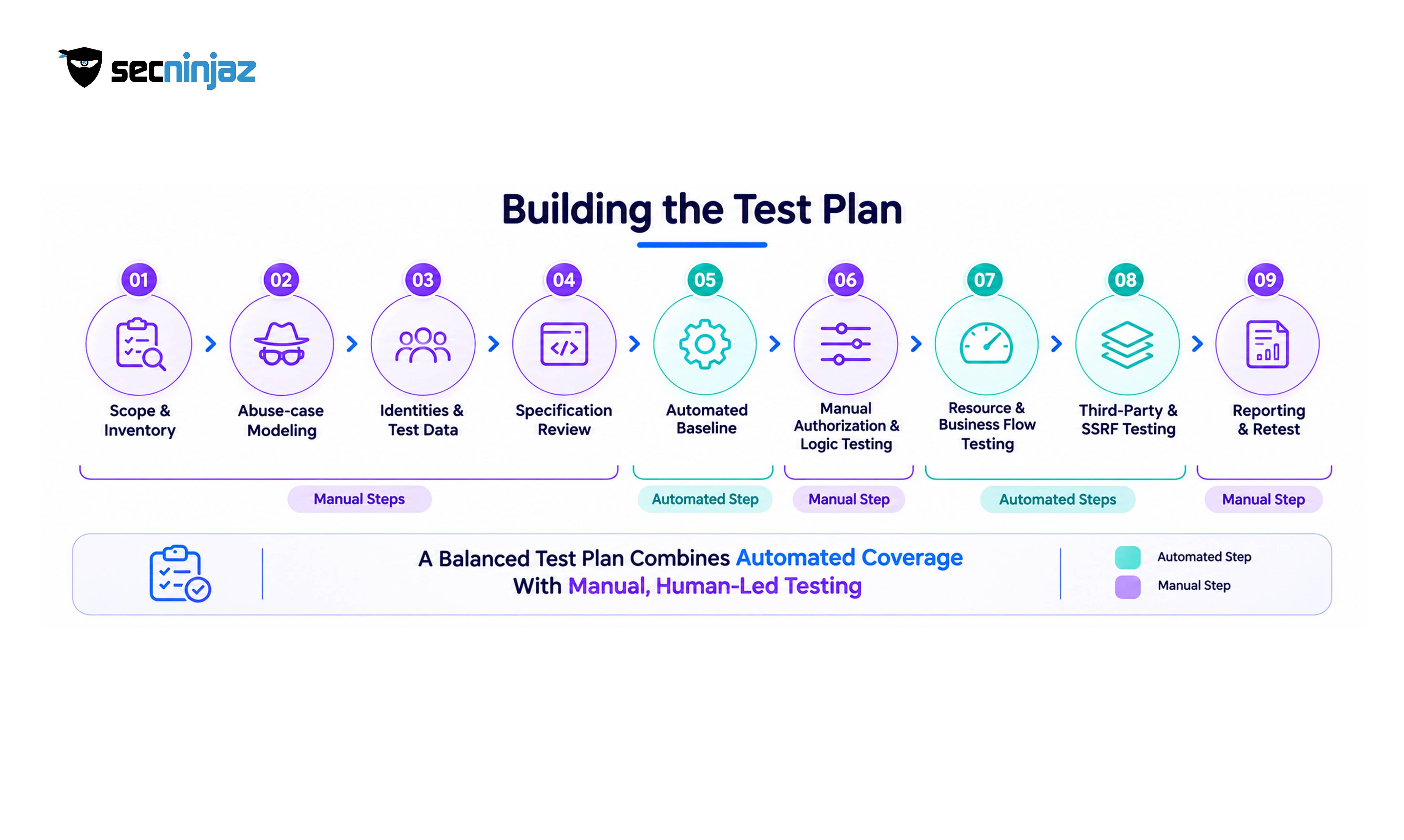
| Step | What happens | What it produces |
|---|---|---|
| 1. Scope and inventory | Define the APIs, versions, environments, and consumers, and discover endpoints from several sources | A scoped, complete target list |
| 2. Abuse-case modeling | Identify what an attacker with a valid account would try to reach or automate | A short list of priority scenarios |
| 3. Identities and test data | Create accounts for each role and tenant, with masked or synthetic data | The ability to test authorization across identities |
| 4. Specification review | Review OpenAPI, GraphQL schemas, and gateway policies for gaps and drift | Findings on documentation and policy mismatches |
| 5. Automated baseline | Run specification-driven scans and fuzzing for injection, misconfiguration, and malformed input | Broad coverage and candidate issues |
| 6. Manual authorization and logic testing | Work through the role, tenant, and object matrix and the multi-step flows | Findings that automation cannot reach |
| 7. Resource and business flow testing | Test limits and abuse of workflows within agreed bounds | Evidence on limits and abuse resistance |
| 8. Third-party and SSRF testing | Test destination-accepting features and upstream data handling | Findings on request forgery and unsafe consumption |
| 9. Reporting and retest | Document reproducible findings, map them to the Top 10, and verify fixes | A traceable report and confirmed remediation |
Common tool categories include intercepting proxies such as Burp Suite, scanners such as OWASP ZAP, API clients such as Postman for building and replaying requests, and specification-driven fuzzers. Tools surface candidates and give breadth. Authorization testing needs human-designed scenarios, because the question of who should see what lives in the business rules, not in the traffic.
The table below lists commonly used tools by testing area and maps each to the steps above. Tool choice depends on the API's protocols, the environment, and licensing, and no tool replaces the authorization matrix.
| Testing area | Example tools | Where they help |
|---|---|---|
| Interception and manual testing | Burp Suite, OWASP ZAP, mitmproxy | Capturing, modifying, and replaying requests across identities (Steps 6 to 8) |
| Request building and collections | Postman, Insomnia, Bruno | Building authenticated request collections for each role and tenant (Steps 3 and 6) |
| Endpoint and parameter discovery | Kiterunner, Arjun, OWASP Amass, ffuf | Finding undocumented routes, hidden parameters, and API hosts (Step 1) |
| Specification review and linting | Spectral, 42Crunch API Security Audit | Checking OpenAPI definitions for missing security requirements, weak schemas, and drift (Step 4) |
| Specification-driven fuzzing | Schemathesis, RESTler | Generating malformed, boundary, and stateful request sequences from API specifications (Step 5) |
| Template-based scanning | Nuclei | Checking known exposures and misconfigurations across many hosts (Step 5) |
| Authorization testing | Autorize and AuthMatrix (Burp Suite extensions) | Replaying each request as other roles and flagging responses that should have been denied (Step 6) |
| Token and authentication testing | jwt_tool | Testing JWT signature validation, algorithm handling, and claim tampering (Steps 5 and 6) |
| GraphQL testing | InQL, graphw00f, Clairvoyance | Mapping schemas, fingerprinting engines, and testing field-level authorization and query depth (Steps 4 and 6) |
| Resource and rate-limit testing | Turbo Intruder (Burp Suite extension), k6, Locust | Measuring rate limits, quotas, and costly operations within agreed ceilings (Step 7) |
| Out-of-band and SSRF detection | Burp Collaborator, interactsh | Confirming whether the server makes requests to tester-controlled destinations (Step 8) |
| AI-backend endpoint testing | garak, PyRIT, promptfoo | Running repeated prompt injection and data leakage probes against endpoints that pass input to a language model (see APIs and AI Agents) |
Two practical points apply. Written authorization is the foundation of the engagement, since Sections 43 and 66 of the Information Technology Act, 2000 treat unauthorized access to a computer system as a civil and, with dishonest intent, criminal matter. And test data should be masked or synthetic, since personal data in test environments is still personal data under the DPDP Act, whose safeguard duties take effect in May 2027.
What a Good API Finding Contains
| Element | Why it matters |
|---|---|
| Endpoint, method, and version | Lets engineers locate the flaw |
| Identity and role used | Shows which privilege boundary failed |
| Object or property reached | Shows what the attacker obtained |
| Redacted request and response pair | Makes the finding reproducible |
| Business impact | Connects the flaw to harm, such as exposed customer records or fraud |
| OWASP API Top 10 reference | Supports comparison and reporting |
| Severity by CVSS v4.0 and business impact | Prioritizes fixes sensibly |
| Fix at the right layer | Points to the authorization layer, gateway, or code, not a one-off patch |
| Retest evidence | Confirms the fix and stops regressions |
Making Testing Continuous
API surfaces change with every release, so one annual test ages quickly. A workable pattern keeps specification linting and contract tests in the build, turns the authorization matrix into automated regression tests that run on every change, runs spec-driven scans against staging, and reserves manual assessment for major releases and significant new functionality. SEBI's CSCRF, for example, expects VAPT after major releases for regulated entities. Production monitoring then watches for the behavior-based abuse that testing cannot fully predict, such as unusual sequences of calls from a valid account.
APIs and AI Agents
AI agents are becoming API consumers that act on behalf of users, and they inherit the authorization risks above. An agent that calls downstream APIs with a broad credential can skip object level checks entirely, and new agent-facing endpoints, including those built on the Model Context Protocol, can appear without entering the inventory. Wallarm's Q3 ThreatStats report cited a 270% rise in MCP-related vulnerabilities from the second quarter to the third. OWASP's 2026 LLM list places Excessive Agency third, for the same reason. APIs used by agents deserve the same authorization matrix, with the agent's credentials treated as a separate role.
Testing AI-Backed API Endpoints
A related and growing category is the API that sits in front of a language model: chat and assistant endpoints, search and summarization endpoints, document-processing services, and features that add generated content to an existing response. These endpoints accept ordinary parameters, but some of those parameters end up inside a prompt. That changes the threat model, because content the API treats as data can be read by the model as instructions. A request field that would be harmless in a conventional API can redirect the model, expose data held in its context, or trigger the tools it is allowed to call.
| Attack vector | How it reaches the model | What testing must check | Control being tested |
|---|---|---|---|
| Direct prompt injection through API parameters | Fields such as a message, query, title, comment, file name, or metadata value are inserted into the prompt | Whether input in each field can override the operator's instructions, change the task, or reveal the system prompt | Separation of instructions from user-supplied data |
| Indirect (stored) prompt injection | Instructions are planted in profile fields, uploaded documents, support tickets, reviews, or records that the model reads later | Whether content stored by one user can steer the model when another user, or an internal operator, triggers processing | Treatment of stored and retrieved content as untrusted |
| Client-controlled model parameters | The request body exposes fields such as system instructions, role, model name, tool list, or output limits | Whether the server accepts fields the client should not set, the same pattern as broken object property level authorization (API3) | Server-side allowlist of accepted fields |
| Tool and function-calling abuse | The model can call internal APIs or functions, often with a service credential | Whether injected instructions can make the model call functions or reach objects the requesting user is not authorized for, bypassing API1 and API5 checks | Authorization enforced inside each tool with the end user's identity |
| Retrieval and cross-tenant leakage | Retrieval-augmented endpoints pull documents or records into the prompt | Whether queries or injected instructions can retrieve another user's or tenant's content | Tenant-scoped retrieval and access checks before content reaches the model |
| Insecure output handling | Model output is rendered in a browser, stored, used in a query or command, or used to build a URL | Whether crafted input produces output that becomes script, query, command, or a server-side request destination (API7), or leaks data through rendered links and images | Validation and encoding of model output as untrusted data (API10) |
| Cost and capacity abuse | Long inputs, large output limits, repeated generation, and agent loops consume billed tokens and compute | Whether limits apply per identity to tokens, input size, and generation length, not only to request count (API4) | Token budgets, timeouts, and per-identity quotas |
| Business flow abuse | A free or trial AI feature can be scripted as a general-purpose model service | Whether the endpoint can be used at scale for tasks outside its intended purpose (API6) | Purpose restriction, abuse detection, and step-up controls |
| Streaming and multimodal channels | Responses are delivered over server-sent events or WebSocket, and inputs arrive as images, audio, or files | Whether filters apply to streamed partial output, and whether instructions carried in non-text inputs are handled as untrusted | Consistent controls across delivery channels and input types |
Testing these endpoints adds three habits to the plan above. First, every parameter that can reach a prompt is recorded during inventory, including fields that are stored and read later, since the injection point and the point where the model acts on it are often in different requests. Second, results are measured over repeated trials, because model output varies from run to run and one failed attempt proves little. Third, authorization is tested on every action the model can trigger, using the same role, tenant, and object matrix, with the model treated as an untrusted caller. Tools such as garak, PyRIT, and promptfoo can generate and score prompt injection and leakage probes at scale, while human testers design the application-specific chains that connect an injected instruction to data access or a tool call.
Fixes follow the same principle as the rest of this guide: place the control where the model cannot override it. System instructions stay on the server and client attempts to set them are rejected, only allowlisted parameters are accepted, retrieval is scoped to the requesting user's permissions before content enters the prompt, authorization is enforced inside every tool the model can call using the end user's identity rather than a broad service account, model output is validated and encoded before it reaches a browser, database, shell, or outbound request, and token and cost limits apply per identity. Prompt-level defenses and content filters can reduce risk, but no known filter reliably stops prompt injection, so they serve as one layer, not as the authorization boundary.
The Indian Requirements Layer
| Requirement | What it asks | Where it lands |
|---|---|---|
| SEBI CSCRF | The cyber audit terms of reference ask whether application security testing includes API security and API discovery, whether API security measures such as rate limiting are in place, and whether the OWASP Top 10 API risks are mitigated | Steps 1, 5, 6, and 7 |
| RBI Digital Payment Security Controls Directions, 2021 | Security testing of digital payment applications, including source code review, vulnerability assessment, and penetration testing | The APIs behind mobile and internet banking channels |
| RBI non-bank PSO Master Directions, 2024 | Cyber resilience and digital payment security controls, including application security, phased by PSO size | APIs of payment aggregators, wallets, and similar operators |
| DPDP Rules, 2025 | Reasonable security safeguards under Rule 6, including access control, logging, and monitoring, from May 2027 | Authorization, authentication, and logging tests |
| CERT-In Directions, 2022 | Reporting of listed incidents within six hours, and log retention for 180 days within India | Detection and logging around API abuse |
| STQC approval scheme | Application security testing for web, mobile, and API applications falls within the scope of approved test laboratories | Test scope for government and regulated projects |
Applicability varies by entity category and by the nature of the system. Where a framework requires an audit by a CERT-In empanelled auditor or testing by an STQC-approved laboratory, the status of the provider should be verified before engagement.
What Untested APIs Cost
| Gap | Consequence |
|---|---|
| Authorization never tested across roles and tenants | Customer data reachable by any authenticated user who changes an identifier |
| Inventory incomplete | Old and undocumented endpoints stay exposed and untested |
| Reliance on signature-based scanning | The authorization and workflow abuse that Akamai describes goes unseen |
| Anonymous-only testing | Misses the 95% of attacks that arrive through authenticated sessions, as Salt's data reports |
| No limits on cost-bearing operations | Fraud and runaway spend through paid services |
| Test data containing personal data | Exposure that the DPDP safeguards duty will cover from May 2027, where inadequate safeguards carry a penalty of up to ₹250 crore |
| No retest or regression suite | Fixed flaws return with later releases |
A Maturity Model for API Security Testing
Level 1: APIs are tested only through the application's user interface, and nobody holds a full list of them ↓ Level 2: A scanner runs against known APIs before release, with results reviewed informally ↓ Level 3: An inventory exists, and tests cover authentication and basic authorization, with findings mapped to the OWASP API Top 10 ↓ Level 4: The role, tenant, and object matrix is tested manually, business flows and resource limits are tested, and fixes are verified by retest ↓ Level 5: The authorization matrix runs as automated regression tests in the pipeline, inventory is continuously reconciled, and production monitoring feeds back into test design
The step from Level 2 to Level 4, adding authorization and business-flow testing by identity, is where most of the risk reduction sits.
A Readiness Plan
- Build the inventory first. Discover APIs from the gateway, specifications, repositories, cloud configuration, traffic, and mobile packages.
- Document the roles, tenants, and objects. The authorization matrix cannot be tested if nobody has written down who should reach what.
- Prepare identities and masked test data. Create at least two accounts per role and per tenant.
- Agree scope, limits, and authorization in writing. Include agreed ceilings for load and automation tests.
- Run an automated baseline. Use specifications to cover injection, misconfiguration, and malformed input broadly.
- Test authorization and business flows manually. Use the matrix, and model abuse of the highest-value workflows.
- Report with evidence and a fix at the right layer. Map findings to the Top 10 and rate them by business impact.
- Automate the regression suite and schedule reassessment. Re-run on every change, and repeat a full assessment after major releases.
Common Mistakes and Edge Cases
Testing only what the documentation lists. Undocumented and old endpoints are the ones least likely to have been secured.
Testing as an anonymous user only. Most meaningful API abuse needs a valid account, and many attacks use one.
Relying on a web application scanner for APIs. It does not understand identifiers, roles, or workflows.
Fixing one endpoint at a time. Authorization flaws recur until the check moves into a central layer.
Returning whole objects and filtering in the client. Anything sent to the client is exposed to the caller.
Ignoring webhooks and third-party callbacks. They are APIs too and are often left unauthenticated.
Treating GraphQL as a single endpoint. Authorization, depth, and cost limits must be tested at field and query level.
When to Use What: A Few Decision Points
Automated scanning versus manual testing. Automation gives breadth and fits every build. Manual testing finds authorization and business-logic flaws, and for any API holding sensitive data it is the larger share of the value.
Specification-driven versus traffic-driven discovery. Specifications are accurate for documented APIs and silent about shadow ones. Traffic and gateway logs reveal what actually runs, so both are needed.
Production versus staging. Staging is safer for load and abuse tests. Production confirms real configuration and needs the strictest agreed limits.
Internal versus external testing. Internal teams know the business rules behind authorization. An external assessment adds independence and fresh attack ideas, and it is often what auditors expect.
Gateway protections versus code fixes. A gateway can enforce authentication, limits, and schema validation, but object and property level authorization usually has to be fixed where the data is accessed.
How SecNinjaz Fits Into This
API security testing draws on two of SecNinjaz's practice areas. The Cybersecurity practice covers Penetration Testing and Vulnerability Assessment. The STQC Services practice lists application security testing for web, mobile, and API applications among its testing categories, aligned with the scope STQC describes for approved test laboratories. Approval of laboratories and the issue of STQC certificates are matters for STQC, so where a tender requires testing by STQC or an STQC-approved laboratory, the status of the agency should be verified before engagement.
The compliance side connects to SecNinjaz's GRC and DPDP practice, including Regulatory Compliance and Audit and Gap Assessment, which help map API test findings to DPDP safeguard duties and sector requirements. SecNinjaz holds ISO/IEC 27001:2022 for information security and ISO/IEC 27701:2025 for privacy information management, relevant to the handling of API specifications, test accounts, and findings. For teams that want API testing that goes beyond scanning to the authorization and workflow flaws that cause real breaches, that combination of application testing and compliance mapping is the pairing worth looking for, whether the organization works with SecNinjaz or anyone else.
Talk to Our Security Experts →
Frequently Asked Questions
What is API security testing?
API security testing is the assessment of an API's authentication, authorization, input handling, resource limits, business flows, and configuration to find weaknesses before attackers do. It combines automated scanning with manual testing across roles, tenants, and workflows.
What is the OWASP API Security Top 10?
It is OWASP's awareness list of the ten most critical API risks. The 2023 edition, which remains the current published edition, covers broken object level authorization, broken authentication, broken object property level authorization, unrestricted resource consumption, broken function level authorization, unrestricted access to sensitive business flows, server-side request forgery, security misconfiguration, improper inventory management, and unsafe consumption of APIs.
Why do scanners miss broken object level authorization?
The flawed request is a valid request that receives a valid response, so nothing looks abnormal. Detecting it requires knowing which user should reach which object, which is why testing needs multiple identities and a role, tenant, and object matrix. Akamai's 2026 report notes that this class of flaw remains difficult to detect with traditional, signature-based tools.
What is the difference between API security testing and API penetration testing?
API security testing is the broader activity and includes automated scanning, specification review, and configuration checks. API penetration testing is the manual, attacker-style part, in which a tester tries to chain weaknesses and demonstrate impact. Mature programmes use both.
Does SEBI's CSCRF cover API security?
The framework's cyber audit terms of reference ask whether application security testing includes API security and API discovery, whether measures such as rate limiting are in place, and whether the OWASP Top 10 API security risks are mitigated. Applicability depends on the entity's category.
How often should APIs be tested?
Automated checks should run with every build, authorization regression tests should run on every change, and a full manual assessment is appropriate after major releases and significant new functionality. SEBI's CSCRF, for example, expects VAPT after major releases for regulated entities.
Do AI agents change API security testing?
They add a new class of API consumer with its own credentials, and they can skip object level checks when given broad access. New agent-facing endpoints can also appear outside the inventory. The practical response is to treat the agent's credentials as a separate role in the authorization matrix and to include agent-facing endpoints in discovery.
Where should an organization start with API security testing?
Start with an inventory of APIs discovered from several sources, then write down the roles, tenants, and objects so an authorization matrix can be tested. Prepare identities and masked test data, agree scope and limits in writing, run an automated baseline, and test authorization and business flows manually.