
Introduction
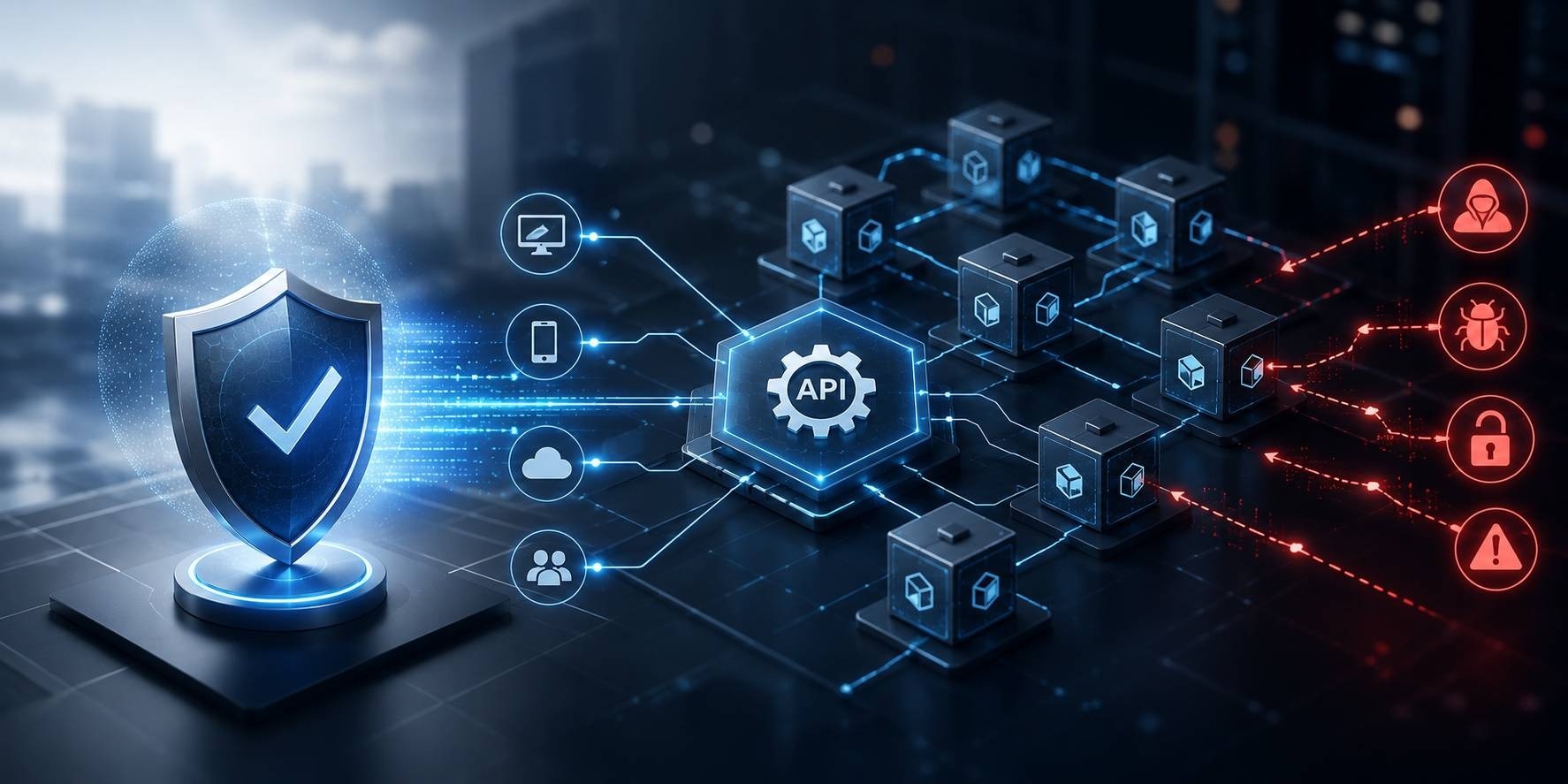
Application Programming Interfaces (APIs) are the backbone of modern digital ecosystems. They enable seamless communication between applications, cloud services, mobile platforms, and third-party integrations, making them indispensable for organizations embracing microservices architecture. While this modular approach improves scalability, agility, and faster deployment cycles, it also significantly expands the attack surface. Every exposed API endpoint becomes a potential target for cybercriminals seeking unauthorized access, sensitive data, or business-critical functionality.
According to the Open Web Application Security (OWASP) community, API attacks have become one of the fastest-growing cybersecurity concerns across industries. Unlike traditional web applications, APIs expose business logic directly to consumers and interconnected services, making vulnerabilities far more damaging when exploited. Attackers increasingly focus on weaknesses such as broken authentication, authorization failures, business logic abuse, and excessive data exposure because they often provide direct access to valuable organizational assets.
To address these evolving threats, the OWASP API Security Project introduced the OWASP API Top 10, a globally recognized framework that identifies the most critical API vulnerabilities affecting modern applications. Rather than serving as a simple compliance checklist, it provides security teams, developers, architects, and penetration testers with practical guidance to identify, prioritize, and remediate API vulnerabilities throughout the software development lifecycle.
Implementing OWASP API Top 10 security testing enables organizations to proactively identify weaknesses before they become exploitable. When combined with secure development practices, continuous monitoring, and DevSecOps automation, organizations can substantially reduce critical API security risks while maintaining the agility that microservices architecture offers.
This playbook outlines how SecNinjaz approaches API security testing in modern microservices environments. It explains the importance of understanding the OWASP framework, integrating security throughout the development lifecycle, and adopting a structured testing methodology that goes beyond automated vulnerability scanning. Whether you're building cloud-native applications, modernizing legacy systems, or securing enterprise APIs, this guide will help you establish a stronger and more resilient API security posture.
Key Takeaways
Understand why API security has become a critical component of modern microservices architecture.
Learn how the OWASP API Security Project helps organizations identify and mitigate API-specific vulnerabilities.
Explore the most critical API security risks affecting modern applications.
Discover how OWASP API Top 10 security testing supports proactive API security assessments.
Learn how the SecNinjaz testing methodology combines manual penetration testing, threat modelling, and automated security validation.
Understand how DevSecOps practices strengthen API security throughout the software development lifecycle
Talk to Our API Security Experts →
Why API Security Matters in Microservices
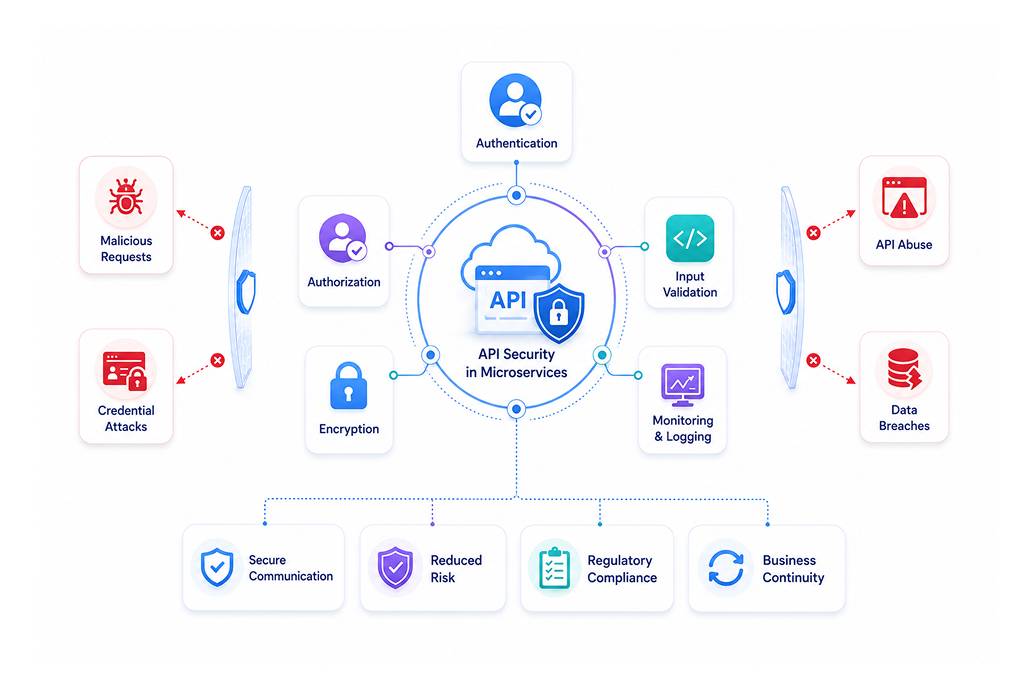 Microservices architecture has fundamentally transformed application development by breaking large monolithic applications into smaller, independently deployable services. These services communicate almost exclusively through APIs, allowing development teams to innovate rapidly while improving scalability and operational flexibility. However, this increased connectivity also creates a larger and more complex security landscape.
Unlike traditional monolithic applications, where most communication occurs internally, microservices expose numerous API endpoints for service-to-service communication, mobile applications, partner integrations, and customer-facing applications. Every API request represents an opportunity for attackers to exploit weaknesses in authentication, authorization, input validation, or business logic if security controls are not consistently implemented.
API attacks are particularly dangerous because they often bypass conventional perimeter defenses. Firewalls, endpoint protection, and traditional intrusion prevention systems cannot adequately protect poorly designed APIs that expose sensitive business functions. Instead, API security must be embedded directly into the application architecture, ensuring that every request is authenticated, authorized, validated, monitored, and logged.
Modern organizations also face increasing regulatory requirements regarding data privacy and cybersecurity. Industries such as financial services, healthcare, retail, manufacturing, and SaaS rely on APIs to exchange highly sensitive information. A single API vulnerability can result in customer data breaches, regulatory penalties, reputational damage, and significant financial losses. Protecting APIs is therefore no longer simply a technical requirement—it is a business imperative.
As organizations continue migrating toward cloud-native architectures, API security should become an integral part of software design rather than an afterthought. Continuous security testing, secure coding practices, runtime monitoring, and regular penetration testing collectively reduce organizational risk while enabling innovation.
What Is the OWASP API Security Project?
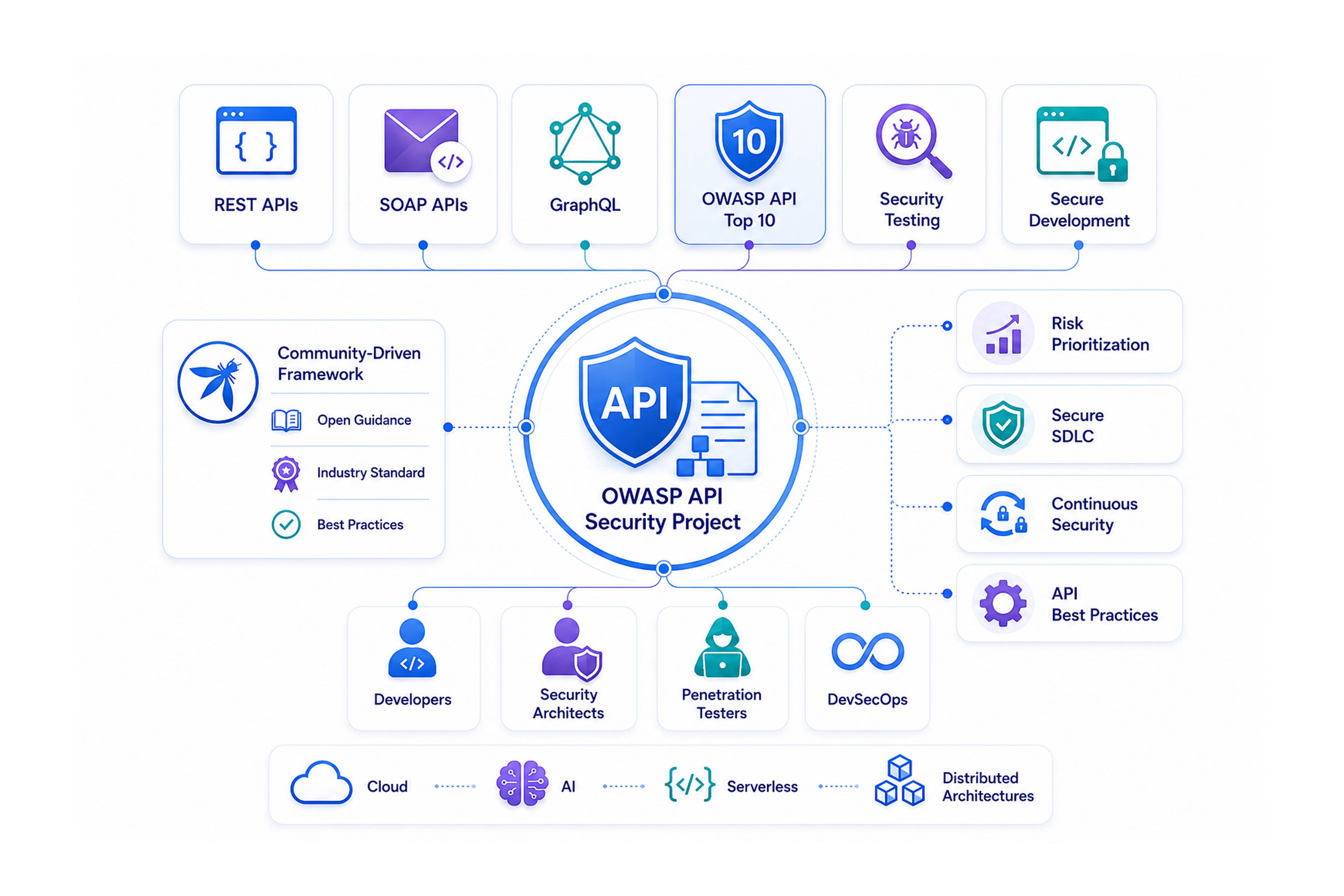 The OWASP API Security Project is a specialized initiative developed by the Open Web Application Security Project (OWASP) to address security challenges unique to Application Programming Interfaces. While the traditional OWASP Top 10 focuses primarily on web application vulnerabilities, APIs introduce additional risks that require dedicated testing methodologies and defensive controls.
The project provides developers, security architects, penetration testers, and DevSecOps teams with comprehensive guidance for securing REST, SOAP, GraphQL, and other API technologies. It highlights common attack vectors, secure development recommendations, testing methodologies, and best practices for integrating API security throughout the software development lifecycle.
One of the project's most influential contributions is the OWASP API Top 10, which identifies the most prevalent API vulnerabilities observed across industries. The framework helps organizations prioritize security investments based on real-world attack trends rather than theoretical risks. Security professionals worldwide use this framework during penetration testing, architecture reviews, security assessments, and secure application development.
As APIs continue evolving alongside cloud computing, artificial intelligence, serverless computing, and distributed architectures, the upcoming OWASP updates are expected to address emerging API security challenges, helping organizations remain resilient against evolving attack techniques.
Understanding the OWASP API Top 10
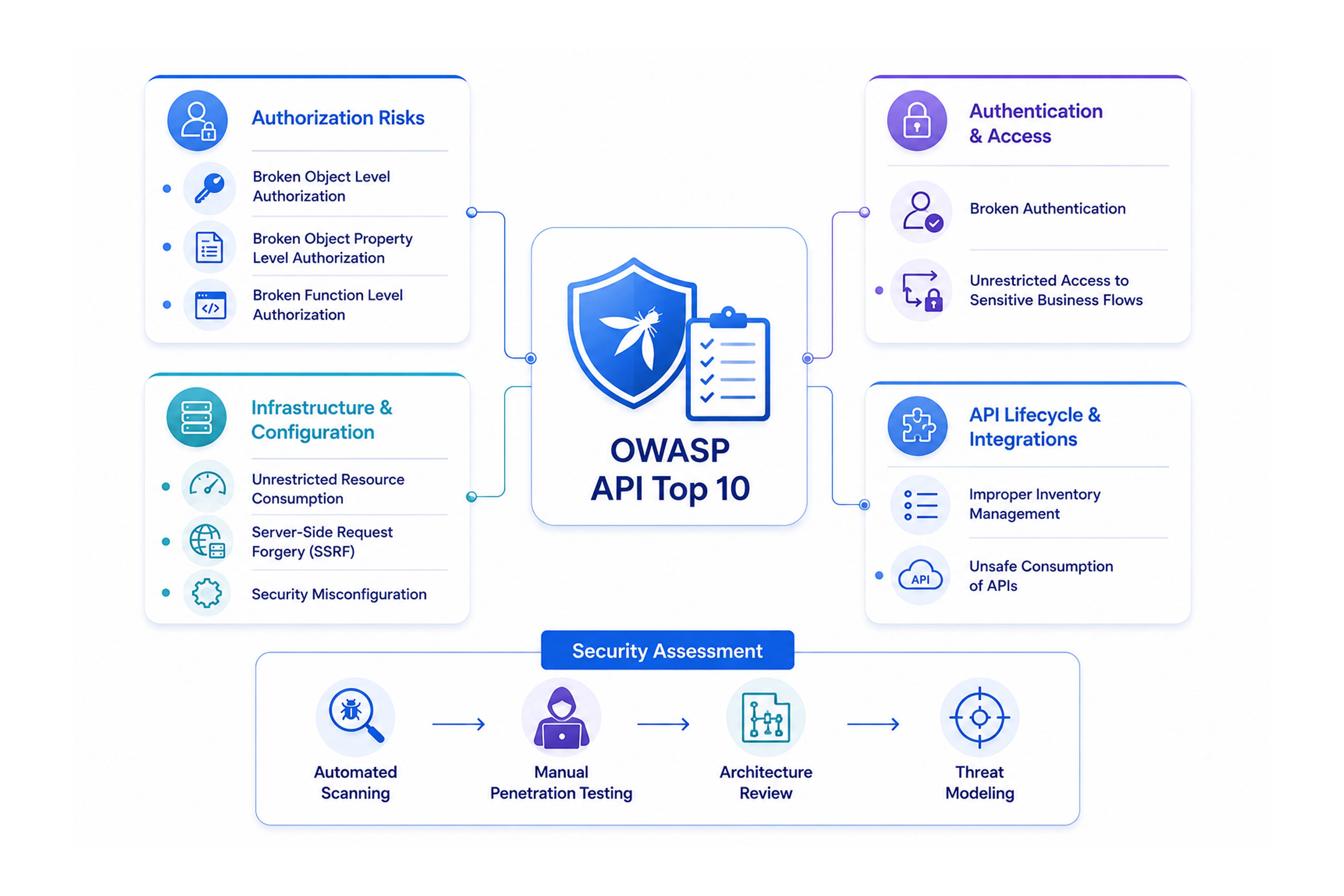 The OWASP API Top 10 represents the industry's most widely accepted framework for identifying and mitigating API-specific vulnerabilities. Rather than focusing solely on technical flaws, it addresses weaknesses that attackers routinely exploit to compromise business logic, access sensitive information, or disrupt application availability.
Organizations implementing OWASP API Top 10 security testing gain a structured methodology for evaluating authentication mechanisms, authorization controls, input validation, rate limiting, API inventory management, third-party integrations, and security configurations. This systematic approach enables security teams to identify vulnerabilities early, prioritize remediation activities, and continuously improve API security maturity.
OWASP API Top 10 Overview
| OWASP API Risk | Description | Recommended Security Testing |
|---|---|---|
| Broken Object Level Authorization (BOLA) | Unauthorized access to objects and records | Authorization testing |
| Broken Authentication | Weak identity verification mechanisms | Authentication testing |
| Broken Object Property Level Authorization | Unauthorized access to sensitive object properties | Response validation |
| Unrestricted Resource Consumption | Resource exhaustion leading to denial of service | Load and rate-limiting tests |
| Broken Function Level Authorization | Privilege escalation through exposed functions | Role-based authorization testing |
| Unrestricted Access to Sensitive Business Flows | Abuse of business processes | Business logic testing |
| Server-Side Request Forgery (SSRF) | Exploiting backend services through APIs | SSRF testing |
| Security Misconfiguration | Insecure API configurations and defaults | Configuration assessment |
| Improper Inventory Management | Forgotten or unmanaged APIs | API discovery and inventory assessment |
| Unsafe Consumption of APIs | Risks introduced through third-party APIs | Dependency and integration security review |
Rather than treating this framework as a compliance exercise, organizations should integrate it into continuous security assessments. Combining automated scanners with manual penetration testing, architecture reviews, and threat modeling provides significantly better visibility into API security than relying on automation alone.
Why OWASP API Top 10 Security Testing Is Essential
Cybercriminals increasingly target APIs because they expose valuable business functions and sensitive organizational data. Unlike traditional attacks that focus on infrastructure, API attacks often exploit weaknesses in application logic, authorization mechanisms, and data handling processes.
Implementing continuous OWASP API Top 10 security testing enables organizations to identify vulnerabilities before attackers can exploit them. Security assessments should evaluate not only technical flaws but also authorization controls, authentication workflows, business logic, rate limiting, error handling, and API inventory management.
For organizations adopting DevSecOps, integrating API security testing into CI/CD pipelines ensures vulnerabilities are identified early during development instead of after deployment. This "shift-left" approach reduces remediation costs, accelerates secure software delivery, and strengthens the organization's overall cybersecurity posture.
At SecNinjaz, our API security assessments combine automated testing with expert-led manual validation, ensuring organizations identify hidden vulnerabilities that automated tools frequently overlook. This methodology provides a comprehensive understanding of API security posture while enabling organizations to reduce critical API security risks before they impact business operations.
Critical API Security Risks in Modern Applications
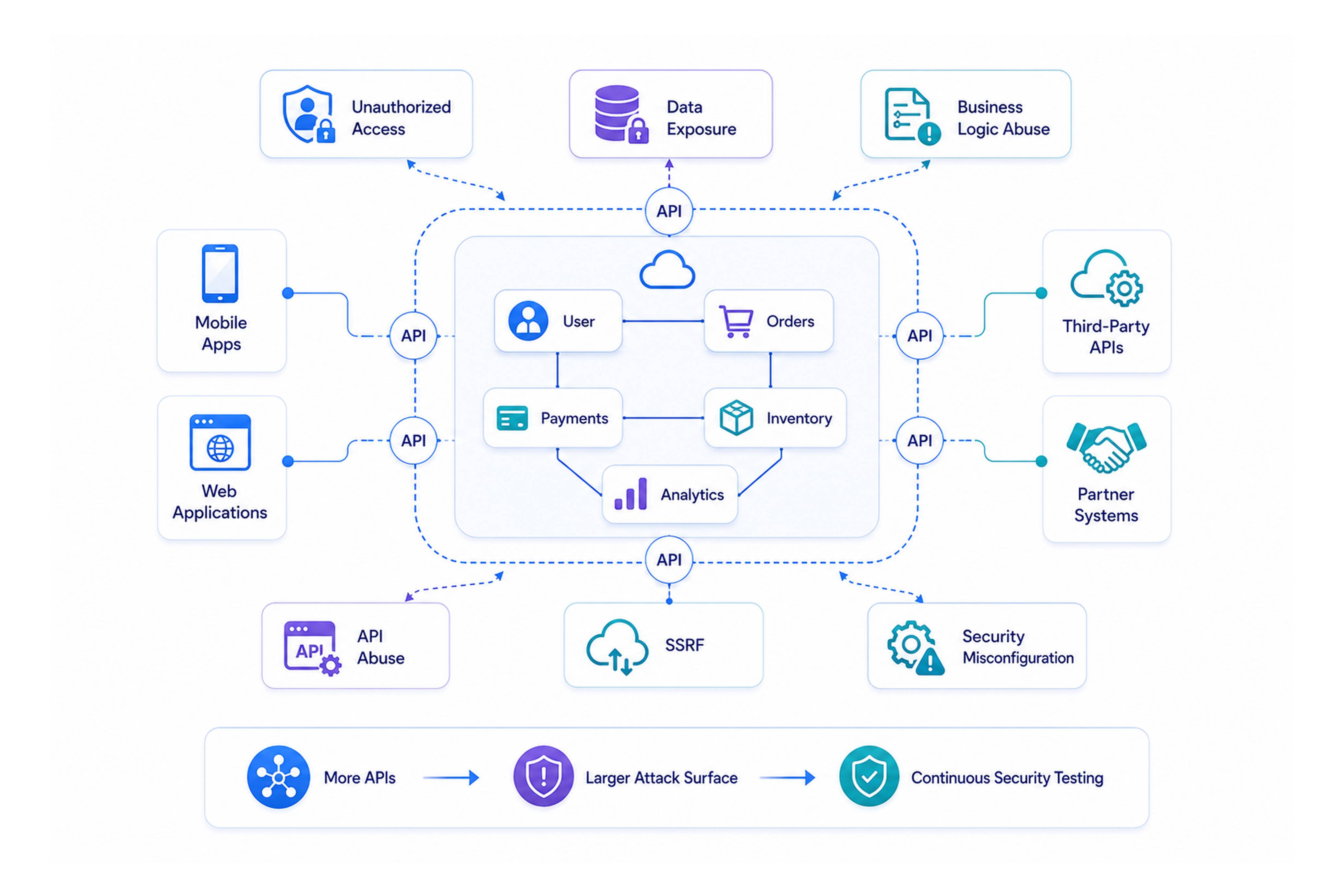 As organizations continue adopting cloud-native architectures and distributed applications, APIs have become the preferred communication channel between services, users, and third-party platforms. While APIs accelerate innovation and improve scalability, they also introduce numerous attack vectors that traditional web application security controls often fail to address. Understanding these vulnerabilities is the first step toward building resilient microservices capable of resisting sophisticated cyberattacks.
Unlike conventional web applications, APIs expose business logic directly through endpoints. Attackers no longer need to compromise an entire application—they only need to discover a poorly secured API to gain unauthorized access, manipulate transactions, or extract sensitive information. This shift has made API security one of the highest priorities for modern security teams.
The OWASP API Security Project categorizes these vulnerabilities based on real-world attack patterns observed across industries. Organizations implementing OWASP API Top 10 security testing can identify these weaknesses before they evolve into costly security incidents. The following sections explore the most common critical API security risks affecting microservices today.
Broken Authentication and Authorization
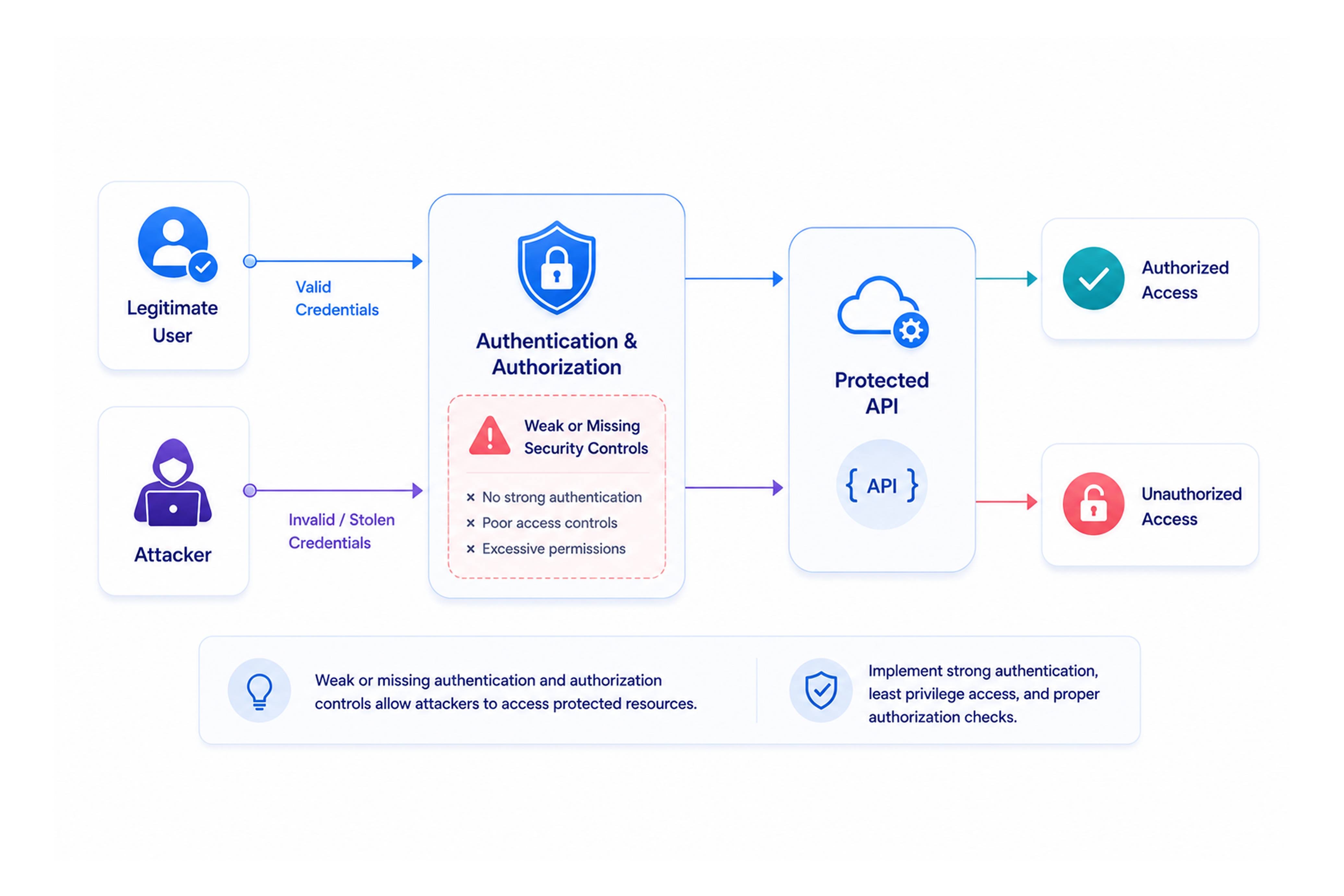 Authentication verifies a user's identity, while authorization determines what that user is allowed to access. Although these concepts appear straightforward, they remain among the leading causes of API breaches. Weak authentication mechanisms, improperly configured JSON Web Tokens (JWTs), insecure session management, and insufficient access controls frequently allow attackers to impersonate legitimate users or gain elevated privileges.
One of the most common vulnerabilities identified by the OWASP API Top 10 is Broken Object Level Authorization (BOLA). This occurs when APIs fail to validate whether a user has permission to access a specific resource. For example, changing an object identifier in a request from /users/1001/orders to /users/1002/orders should never expose another customer's information. If proper authorization checks are missing, attackers can retrieve sensitive records without exploiting complex vulnerabilities.
Similarly, Broken Function Level Authorization (BFLA) occurs when APIs expose administrative functionality without validating user roles. An attacker with standard user privileges may gain access to administrator-only endpoints simply by modifying an HTTP request. These vulnerabilities often arise because developers focus on authentication while overlooking authorization checks at the function level.
To mitigate these risks, organizations should implement robust identity management using OAuth 2.0 or OpenID Connect, validate JWT signatures and expiration, enforce least-privilege access, and perform authorization checks on every API request. Regular penetration testing remains essential because many authorization flaws cannot be detected through automated vulnerability scanners alone.
Excessive Data Exposure and Business Logic Flaws
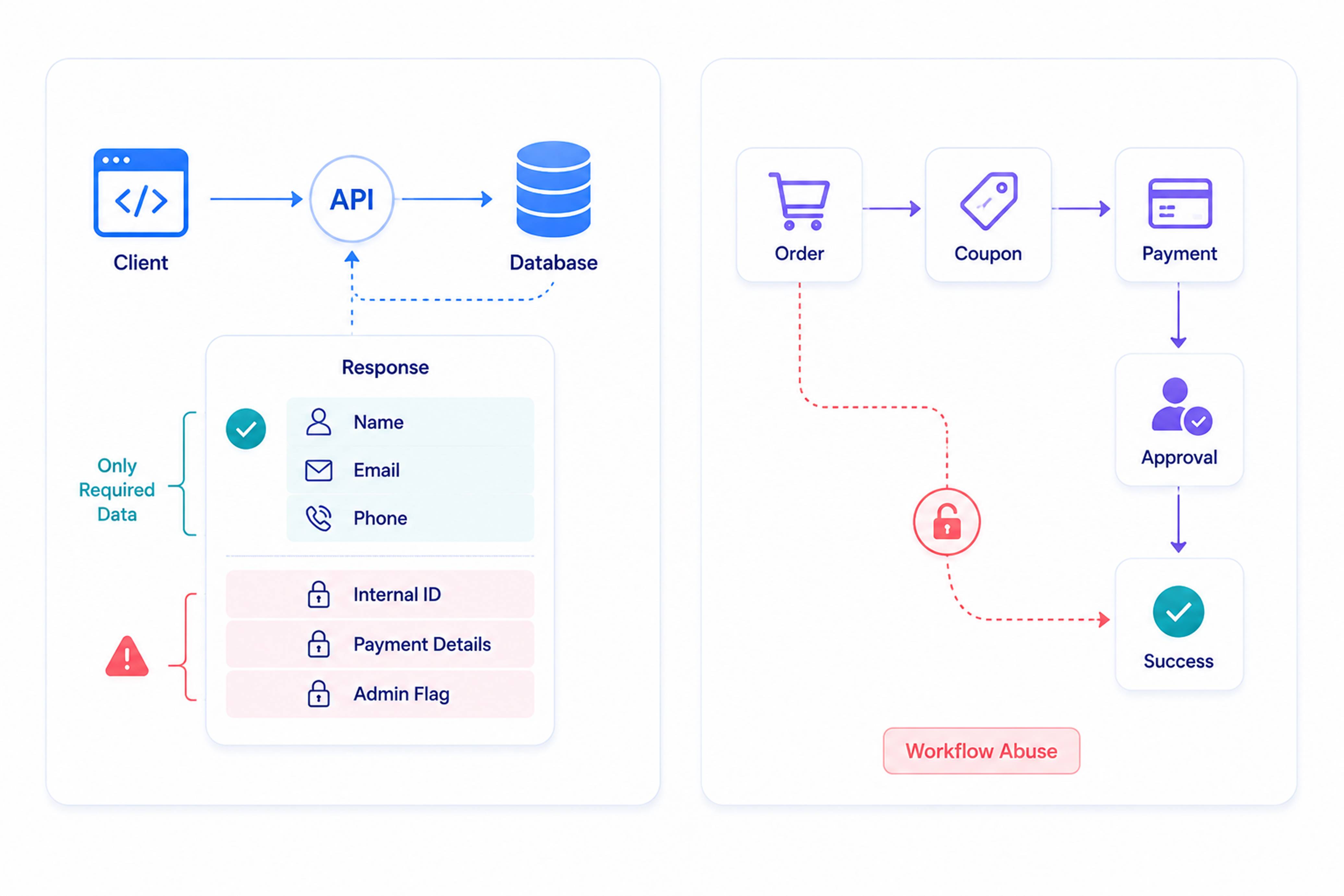 One of the most underestimated API vulnerabilities is excessive data exposure. Developers frequently return complete database objects through APIs and rely on frontend applications to hide sensitive fields. While the user interface may display only the required information, attackers interacting directly with the API can often retrieve confidential attributes such as internal identifiers, financial records, personally identifiable information (PII), or administrative metadata.
For example, an API endpoint designed to retrieve customer details may unintentionally return internal account status, password reset flags, employee identifiers, or payment information. Although the frontend ignores these attributes, an attacker inspecting the raw API response gains access to information that should never have been exposed.
Business logic vulnerabilities present an even greater challenge because they exploit flaws in application workflows rather than technical implementation. Attackers may abuse coupon redemption processes, manipulate payment sequences, bypass approval workflows, or repeatedly invoke sensitive business operations to gain unfair advantages. Since these attacks follow legitimate application behavior, traditional security tools rarely identify them.
Effective API security testing must therefore include detailed response validation, abuse-case testing, and manual business logic assessments. Organizations should adopt a principle of returning only the minimum data required by each API endpoint while validating every workflow against misuse scenarios. These practices significantly reduce critical API security risks while improving compliance with privacy regulations.
API Security Testing Methodologies
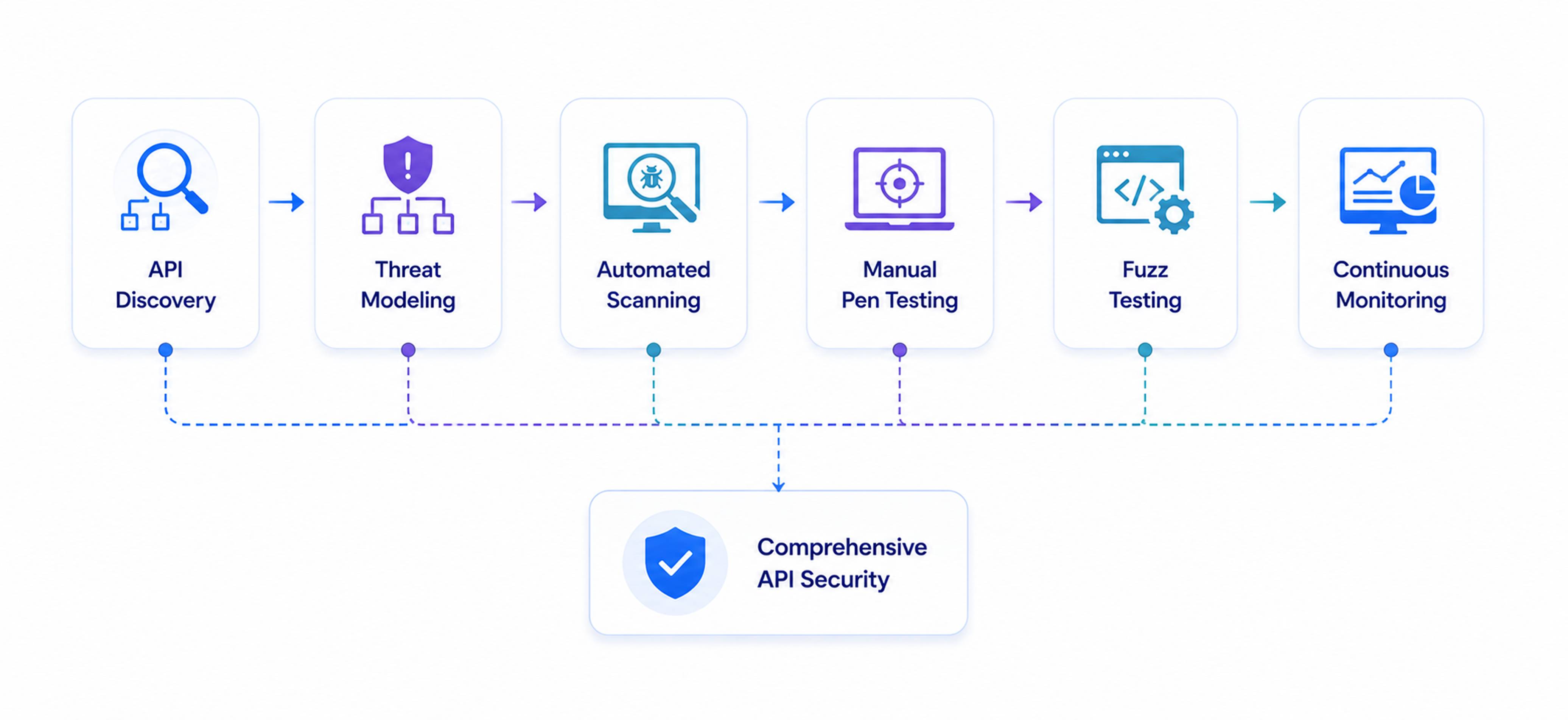 Comprehensive API security cannot rely solely on automated vulnerability scanners. Although automation identifies common weaknesses efficiently, modern API attacks frequently exploit authorization flaws, business logic errors, and complex workflow vulnerabilities that require expert analysis. An effective testing strategy combines automated assessments with manual validation to provide comprehensive coverage across the API lifecycle.
A typical API security assessment begins with API discovery and inventory management. Many organizations maintain hundreds of active APIs, including undocumented or deprecated endpoints known as shadow APIs. Identifying every exposed endpoint ensures that security assessments cover the complete attack surface rather than only documented interfaces.
Threat modeling follows API discovery by identifying potential attack paths based on architecture, trust boundaries, authentication mechanisms, and business processes. Security teams analyze how attackers might abuse APIs, prioritize high-risk endpoints, and determine appropriate testing strategies.
Automated vulnerability scanning is then performed using tools capable of identifying common issues such as injection flaws, security misconfigurations, insecure headers, weak TLS configurations, and known software vulnerabilities. While valuable, these scanners represent only one component of a mature API security program.
Manual penetration testing complements automated assessments by evaluating authorization controls, business logic, authentication workflows, and API sequencing. Experienced security consultants simulate realistic attacker behavior to uncover vulnerabilities that automated tools cannot identify. Combining both approaches provides a significantly higher level of assurance than either method alone.
Continuous API security testing should also include fuzz testing, where unexpected inputs, malformed requests, and boundary conditions are submitted to APIs to identify unhandled exceptions or insecure behavior. Static Application Security Testing (SAST), Dynamic Application Security Testing (DAST), Software Composition Analysis (SCA), and runtime API monitoring further strengthen the organization's security posture throughout the software development lifecycle.
SecNinjaz API Security Testing Playbook
At SecNinjaz, API security assessments extend far beyond traditional vulnerability scanning. Our methodology combines architecture reviews, manual penetration testing, automated validation, and continuous security verification to identify vulnerabilities that directly impact business operations.
The first phase focuses on understanding the application's architecture, identifying exposed APIs, mapping data flows, and classifying sensitive assets. This foundational analysis allows our consultants to prioritize testing efforts based on business impact rather than technical complexity alone.
Next, threat modeling identifies potential attack scenarios by analyzing authentication mechanisms, authorization models, trust relationships, external integrations, and communication between microservices. This proactive approach enables organizations to understand how attackers might target their API ecosystem before vulnerabilities are exploited.
Once the threat model is established, comprehensive OWASP API Top 10 security testing is performed. Authentication mechanisms are evaluated for weaknesses in OAuth implementations, JWT validation, session handling, and multi-factor authentication. Authorization testing focuses on identifying Broken Object Level Authorization, Broken Function Level Authorization, and privilege escalation opportunities.
Input validation testing evaluates injection vulnerabilities, insecure deserialization, server-side request forgery (SSRF), and parameter manipulation. Business logic testing examines transactional workflows, approval processes, payment mechanisms, and API sequencing to identify vulnerabilities unique to the organization's applications.
The final phase involves risk prioritization, detailed reporting, and remediation guidance. Each finding includes technical evidence, business impact, proof-of-concept demonstrations where appropriate, and actionable recommendations aligned with industry best practices. After remediation, validation testing confirms that vulnerabilities have been successfully addressed without introducing new security issues.
Recommended Tools for OWASP API Top 10 Security Testing
Although experienced security professionals remain essential for identifying complex vulnerabilities, specialized security tools significantly improve assessment efficiency. Selecting the right combination of tools enables organizations to automate repetitive tasks while focusing manual efforts on business-critical risks.
OWASP ZAP remains one of the most widely adopted open-source API security testing tools. It supports automated vulnerability scanning, API fuzzing, authentication testing, and integration into CI/CD pipelines.
Burp Suite Professional provides advanced penetration testing capabilities, including request manipulation, authorization testing, vulnerability scanning, and manual API exploration. Its extensibility makes it particularly valuable during comprehensive security assessments.
Postman and Insomnia support functional API testing while allowing security teams to validate authentication flows, authorization controls, request sequencing, and response structures. Although primarily development tools, they are invaluable during security verification.
Organizations seeking enterprise-scale API security should also consider dedicated API protection platforms capable of runtime monitoring, API discovery, anomaly detection, and behavioral analytics. These solutions complement penetration testing by continuously monitoring production environments for suspicious API activity.
Regardless of the tools selected, organizations should remember that technology alone cannot eliminate API risk. Combining automated tools with expert-led assessments, secure development practices, and continuous monitoring provides the strongest defense against evolving API threats.
Secure Microservices Architecture
 Designing secure microservices begins long before deployment. Security should be embedded into the architecture rather than added as a post-deployment control. Since APIs act as the communication layer between services, every interaction must be authenticated, authorized, encrypted, monitored, and validated. A well-designed architecture minimizes the attack surface while ensuring services remain scalable and resilient.
Modern microservices typically communicate through an API Gateway, which serves as a centralized enforcement point for authentication, authorization, rate limiting, request validation, and traffic monitoring. Rather than exposing every service directly to the internet, organizations should expose only the API Gateway while keeping internal services isolated within private networks.
Authentication should be delegated to a centralized Identity Provider (IdP) using OAuth 2.0 or OpenID Connect. Once authenticated, user identities and permissions should propagate securely across microservices using signed JWTs or mutual TLS (mTLS). This eliminates duplicate authentication logic while maintaining a consistent security posture across the environment.
Service-to-service communication should never rely on implicit trust. Every request between microservices must be authenticated and authorized independently using zero-trust principles. Network segmentation, encryption in transit, API gateways, service meshes, and runtime monitoring collectively reduce the likelihood of lateral movement following an initial compromise.
API Security in a Zero Trust Environment
Traditional perimeter security assumes that internal systems are trustworthy. Modern API ecosystems invalidate this assumption because applications communicate across cloud platforms, Kubernetes clusters, partner networks, and hybrid infrastructures. A Zero Trust architecture assumes that every request is potentially malicious until verified.
In a Zero Trust API model, every API request undergoes identity verification, authorization validation, policy enforcement, and continuous monitoring. Access decisions are based on user identity, device posture, application context, and risk rather than network location. This approach significantly reduces opportunities for attackers to exploit stolen credentials or move laterally across services.
Microservices should also implement short-lived access tokens, certificate-based authentication, and service identities using technologies such as SPIFFE or service mesh platforms. Combined with runtime anomaly detection, Zero Trust provides a stronger defense against sophisticated API attacks.
Integrating DevSecOps into API Security
API security should not be treated as a final quality assurance activity. Instead, it should become an integral component of the software development lifecycle through DevSecOps. By integrating security into every development stage, organizations can identify vulnerabilities early, reduce remediation costs, and accelerate secure software delivery.
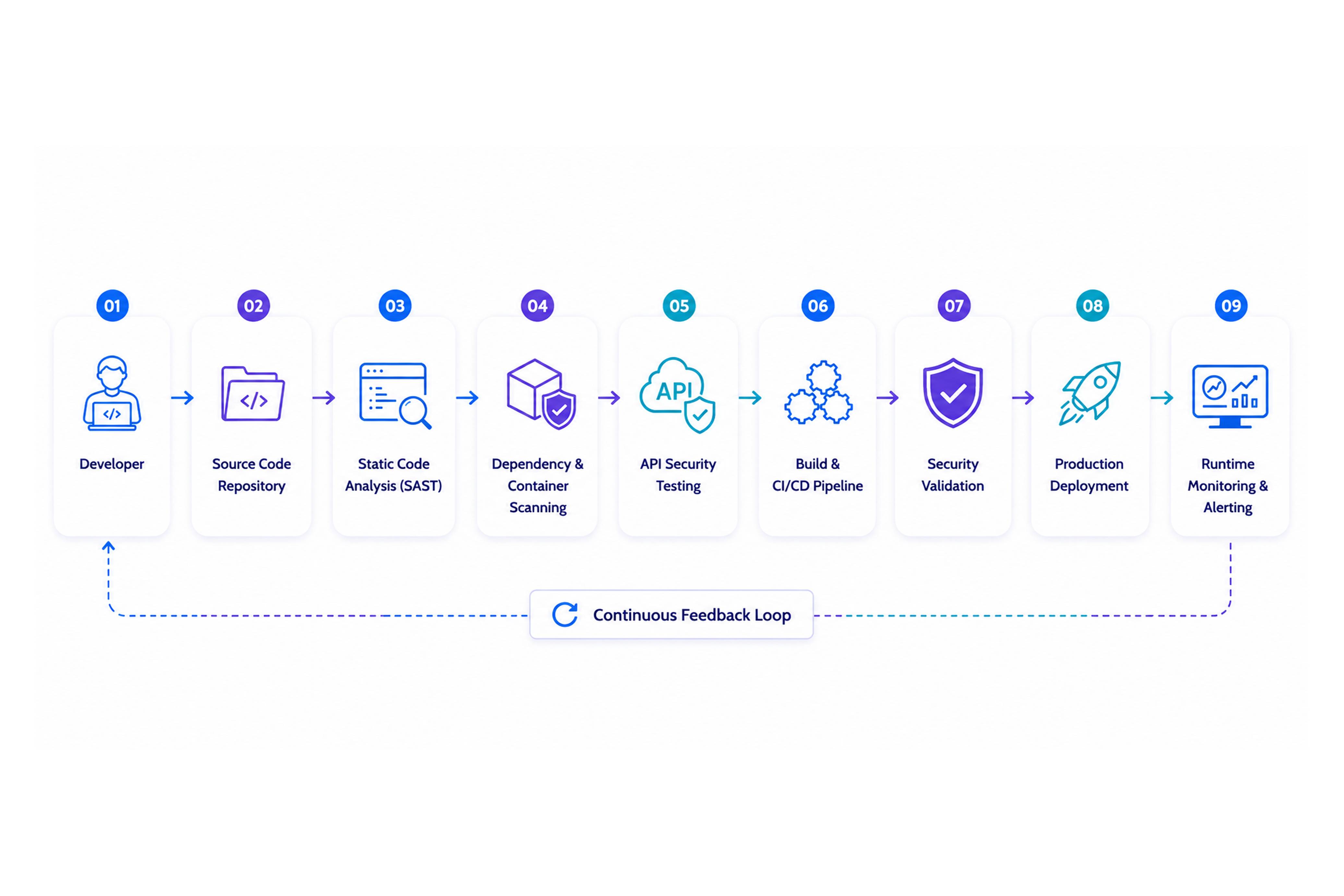
A DevSecOps pipeline begins during application design with threat modeling and secure architecture reviews. During development, secure coding standards, peer reviews, and Static Application Security Testing (SAST) identify vulnerabilities before code reaches production. As applications move through Continuous Integration and Continuous Deployment (CI/CD) pipelines, automated security controls verify API configurations, dependencies, authentication mechanisms, and infrastructure settings.
Dynamic Application Security Testing (DAST), Software Composition Analysis (SCA), container scanning, Infrastructure as Code (IaC) analysis, and API security validation further strengthen the pipeline. Together, these practices ensure vulnerabilities are identified continuously rather than periodically.
DevSecOps API Security Pipeline
Continuous feedback from runtime monitoring should feed directly into development backlogs, enabling rapid remediation of newly discovered vulnerabilities and continuous improvement of API security practices.
 ## Real-World API Security Incidents
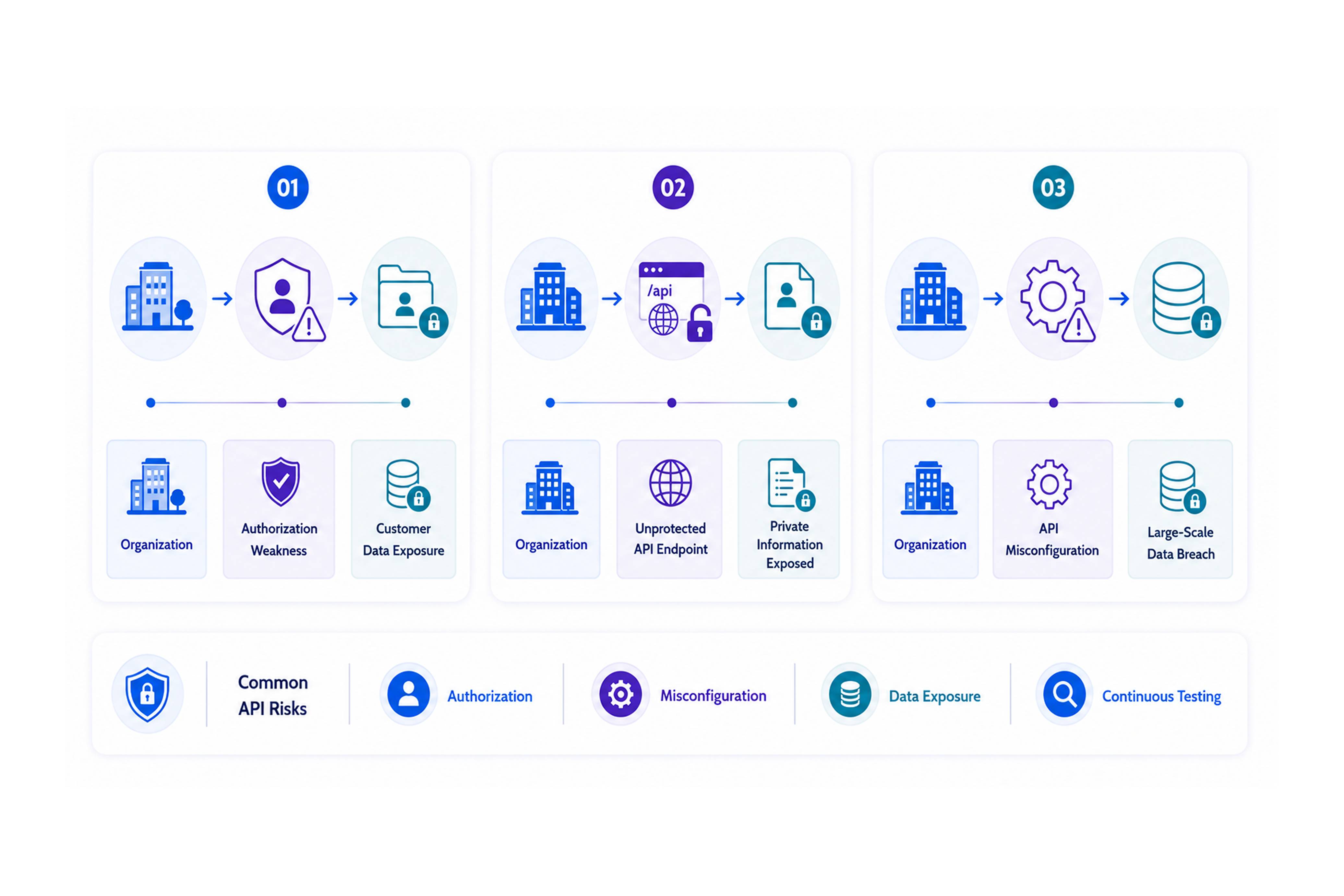 Numerous high-profile breaches demonstrate that API vulnerabilities can have severe financial, operational, and reputational consequences. Examining these incidents helps organizations understand how attackers exploit API weaknesses and why continuous security testing is essential.
One widely publicized example involved T-Mobile, where API vulnerabilities exposed customer account information through insufficient authorization controls. Attackers were able to retrieve sensitive customer data by exploiting weaknesses in API access validation, highlighting the importance of robust object-level authorization testing.
Another notable incident involved Peloton, where unauthenticated API endpoints exposed private user profile information, including age, gender, workout statistics, and location data. Although authentication existed elsewhere in the platform, certain API endpoints lacked proper authorization checks, demonstrating how inconsistent API security controls can undermine otherwise secure applications.
Similarly, the Optus data breach involved exposed APIs that allowed attackers to access customer information affecting millions of individuals. The incident reinforced the importance of API inventory management, secure configuration, and continuous monitoring.
These incidents emphasize that API attacks rarely rely on sophisticated malware. Instead, attackers frequently exploit overlooked authorization flaws, misconfigurations, excessive permissions, and excessive data exposure to compromise sensitive information.
Best Practices for Reducing API Security Risks
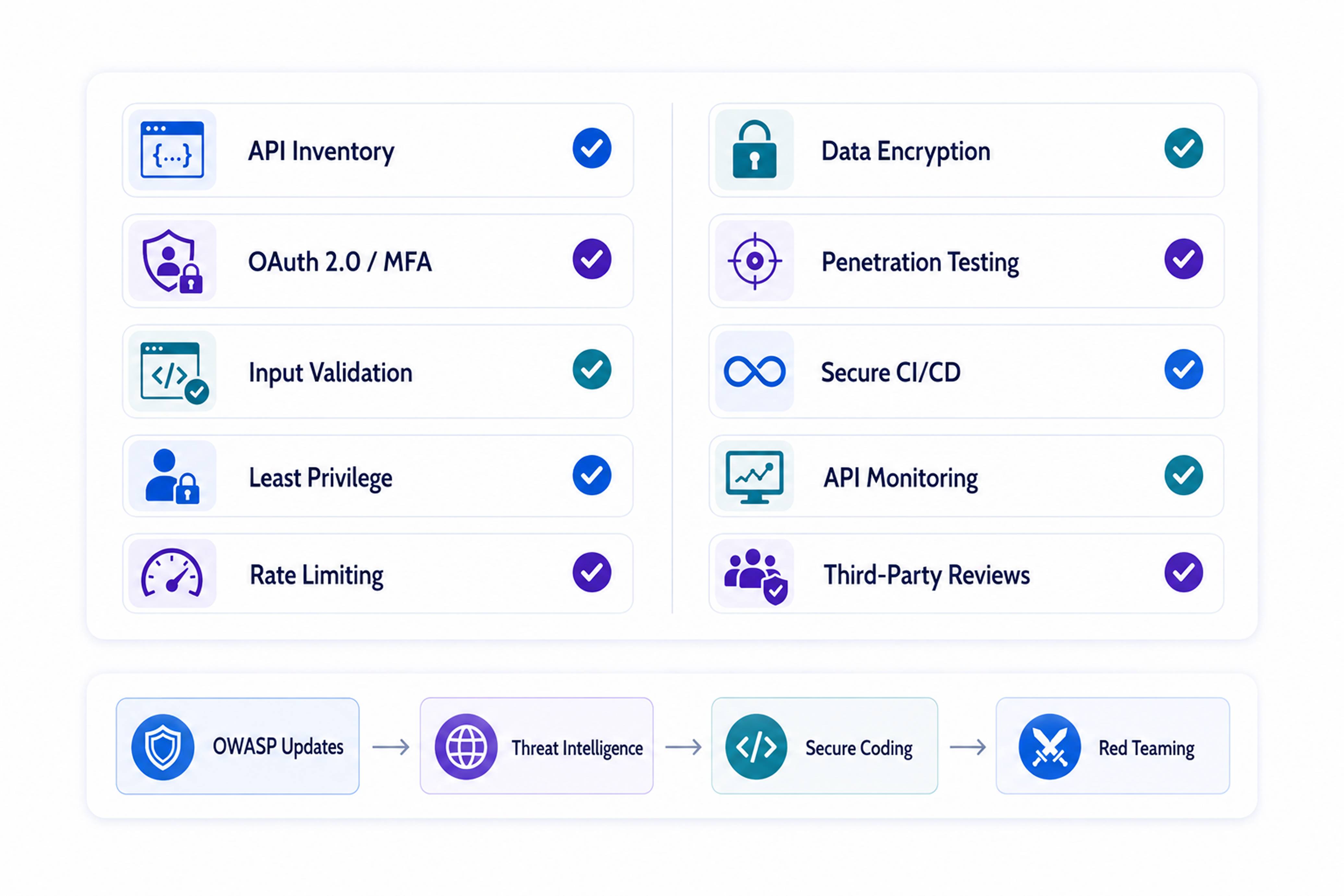 Building secure APIs requires a combination of secure architecture, disciplined development practices, and continuous testing. Organizations should establish an API security program that addresses the complete application lifecycle rather than relying solely on vulnerability assessments performed before deployment.
Authentication mechanisms should implement modern standards such as OAuth 2.0, OpenID Connect, and Multi-Factor Authentication (MFA). Authorization should follow the principle of least privilege, ensuring every API validates object-level, function-level, and property-level access before processing requests.
Developers should validate every input parameter, sanitize user-supplied data, implement schema validation, and reject malformed requests before they reach backend services. APIs should return only the information necessary to complete each transaction, minimizing opportunities for excessive data exposure.
Rate limiting, throttling, and bot detection help protect APIs from brute-force attacks and denial-of-service attempts. Logging every authentication event, authorization failure, and anomalous request enables rapid detection and investigation of suspicious activity.
Organizations should also maintain a complete inventory of APIs, including internal, external, partner, and deprecated endpoints. Shadow APIs frequently become overlooked attack vectors because they remain undocumented or unmanaged.
API Security Best Practices Checklist
| Best Practice | Security Benefit |
|---|---|
| Maintain an API inventory | Eliminates shadow APIs |
| Enforce OAuth 2.0 / OpenID Connect | Strong authentication |
| Validate all inputs | Prevents injection attacks |
| Implement least privilege | Reduces unauthorized access |
| Enable rate limiting | Prevents abuse and DoS attacks |
| Encrypt data in transit | Protects sensitive communications |
| Conduct regular penetration testing | Identifies hidden vulnerabilities |
| Integrate security into CI/CD | Continuous security validation |
| Monitor API activity | Detects anomalous behavior |
| Review third-party integrations | Reduces supply chain risk |
Preparing for Upcoming OWASP Changes
API technologies continue evolving alongside artificial intelligence, serverless computing, GraphQL, Kubernetes, and cloud-native architectures. As new attack techniques emerge, the upcoming OWASP guidance is expected to expand recommendations around API discovery, runtime protection, software supply chain security, AI-enabled APIs, and business logic abuse.
Organizations should avoid treating the OWASP API Top 10 as a static compliance checklist. Instead, it should serve as a living framework that evolves with application architecture and the threat landscape. Regular reviews of updates published by the OWASP API Security Project help organizations align their security strategies with emerging best practices.
Security teams should also invest in continuous learning, threat intelligence, red team exercises, and secure coding education. Building internal awareness enables developers and architects to design APIs that remain resilient as technologies and attacker capabilities evolve.
Preparing for future OWASP recommendations today ensures organizations remain ahead of emerging threats rather than reacting after vulnerabilities have already been exploited.
Why Organizations Choose SecNinjaz for API Security Testing
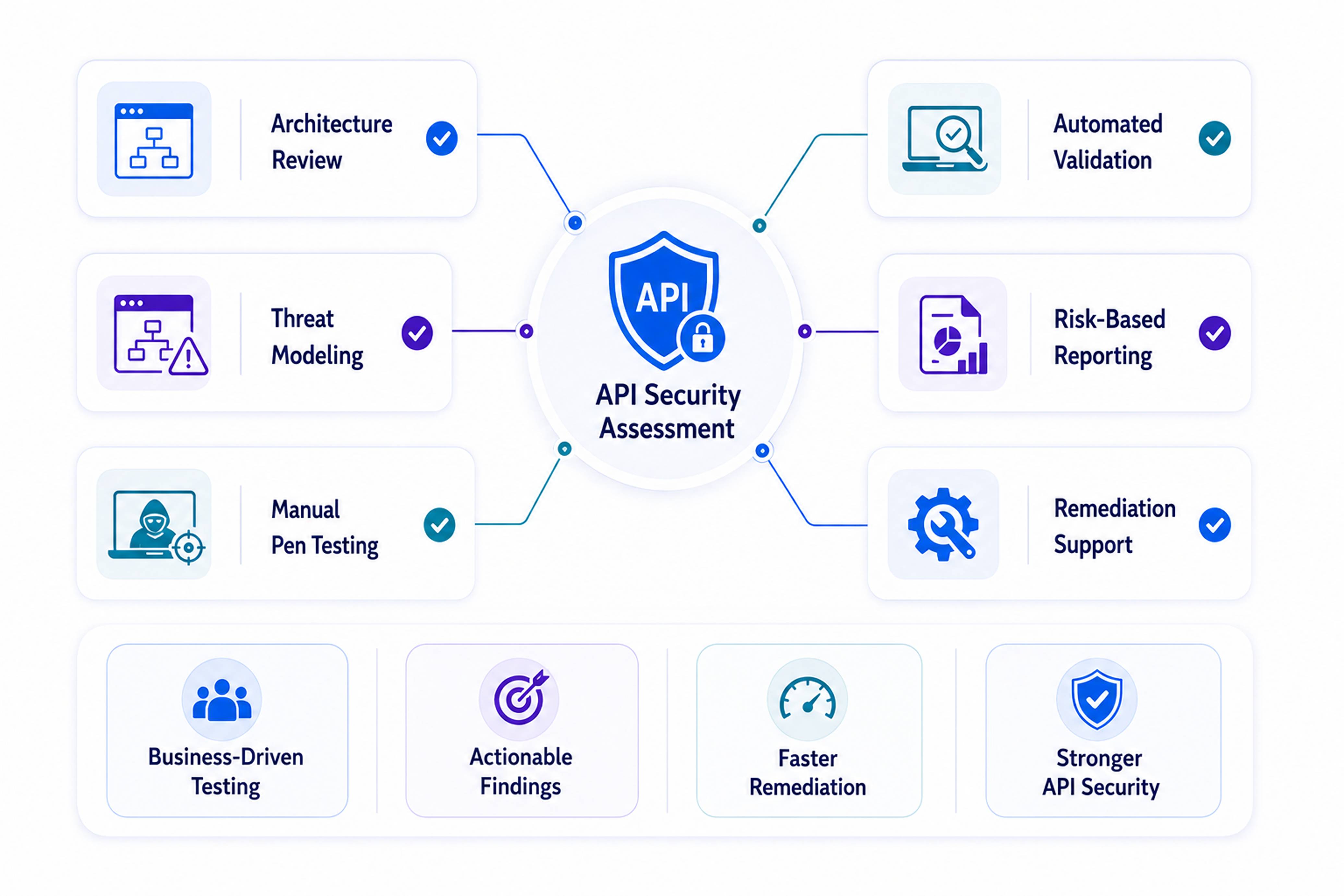
Modern API ecosystems require more than periodic vulnerability assessments. Organizations need a security partner that understands business logic, cloud-native architectures, DevSecOps, and the evolving threat landscape. At SecNinjaz, our API security assessments are designed to identify vulnerabilities that matter most to your business while minimizing disruption to development and operations.
Our methodology combines architecture reviews, manual penetration testing, automated vulnerability scanning, and threat modeling to deliver a comprehensive evaluation of your API ecosystem. Instead of relying solely on automated tools, our security consultants manually validate authentication, authorization, business logic, and data handling workflows to uncover vulnerabilities that scanners often miss.
Every engagement begins with understanding your application's architecture, business processes, API inventory, and threat landscape. This allows us to prioritize security testing based on business impact rather than simply producing a list of technical findings. By focusing on risk-driven assessments, organizations receive actionable recommendations that improve security without slowing innovation.
SecNinjaz also supports organizations throughout the remediation lifecycle. Our consultants work closely with development teams to explain findings, recommend secure implementation approaches, validate fixes, and provide retesting services. This collaborative approach helps organizations build secure APIs while strengthening internal security capabilities.
The SecNinjaz API Security Assessment Process
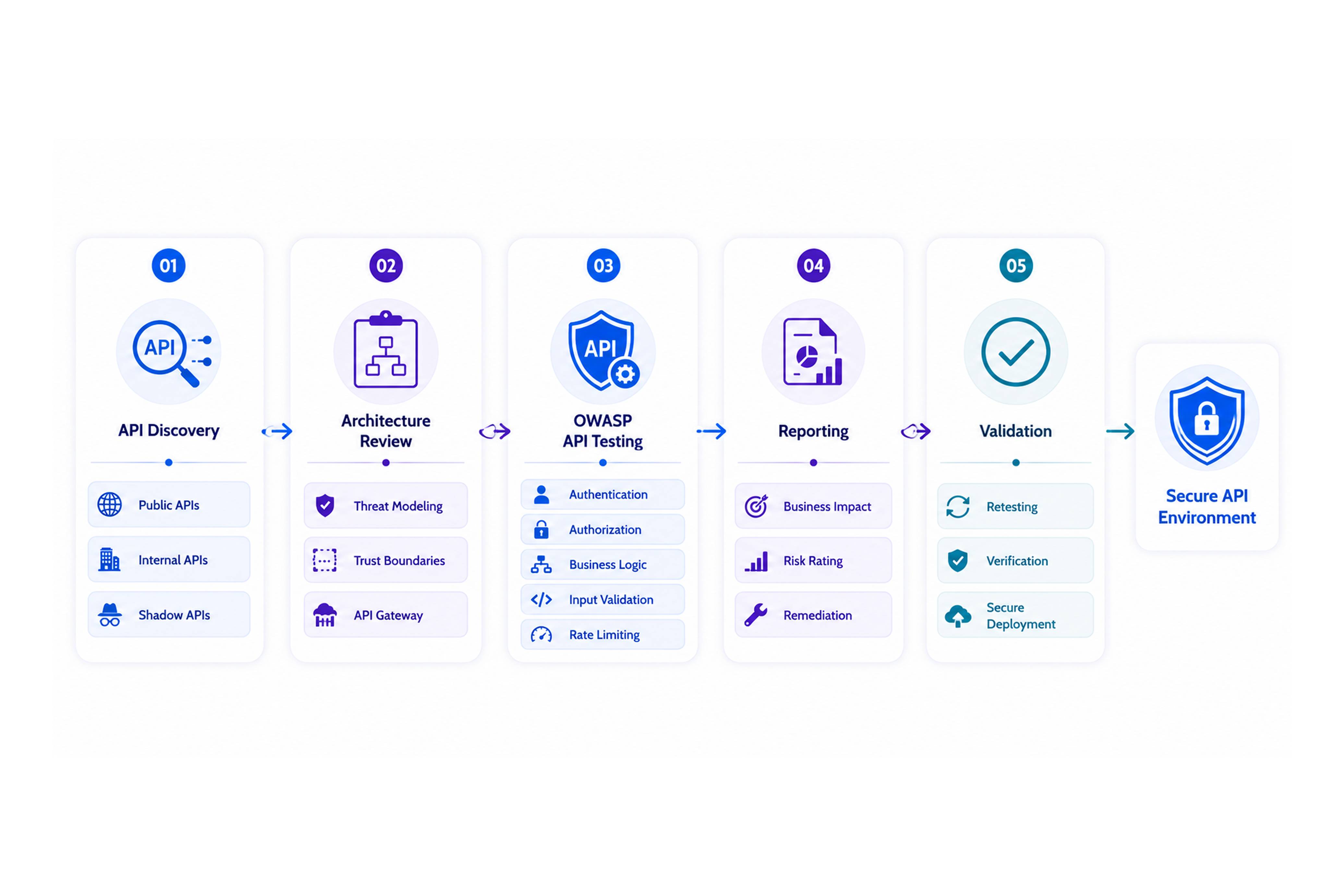 A structured testing methodology ensures consistent coverage across every API assessment. Rather than treating every API equally, SecNinjaz evaluates business context, data sensitivity, trust boundaries, and attacker objectives before beginning technical testing.
Step 1: API Discovery and Inventory
The engagement begins with identifying every exposed API, including public APIs, internal microservices, partner integrations, mobile application endpoints, and undocumented interfaces. Shadow APIs often become the weakest point in an organization's security posture, making comprehensive discovery essential.
Step 2: Architecture Review and Threat Modeling
Our consultants analyze authentication mechanisms, authorization models, API gateways, service communication, cloud infrastructure, and trust boundaries to identify potential attack paths. Threat modeling helps prioritize testing efforts based on real-world attacker behavior.
Step 3: OWASP API Top 10 Security Testing
Each API undergoes comprehensive testing aligned with the OWASP API Security Project. Assessments include:
Authentication testing
Authorization validation
Business logic testing
Rate limiting verification
Input validation
Injection testing
Security misconfiguration assessment
Sensitive data exposure analysis
API inventory validation
Third-party API security assessment
Step 4: Reporting and Risk Prioritization
Every finding includes technical details, business impact, proof-of-concept evidence where appropriate, severity ratings, and practical remediation guidance. Reports are written for both technical teams and executive stakeholders, enabling faster decision-making and remediation planning.
Step 5: Remediation Validation
Once fixes have been implemented, SecNinjaz performs validation testing to verify that vulnerabilities have been resolved successfully without introducing new security weaknesses.
Real-world Examples of Owasp Api Security Risks in Action
Security risks oft transubstantiate from abstract threats into rough real-world realities, as demonstrated by respective incidents. A medium company faced information breach due to insufficient rate limiting, compromising their consumer data and gnaw trust. Similarly, notable trust Api exposure highlighted the dangers of data exposure, making millions individual records vulnerable.
Moreover, an Iot platform was victimized through an introduction attack, capitalising on unchecked input fields to compromise network integrity. These incidents highlight essential for wakeful security practices. The consequences affirm the importance of proactively addressing Owasp Api security risks to safeguard your microservices painting against unintended breaches.
Building a Culture of Continuous API Security
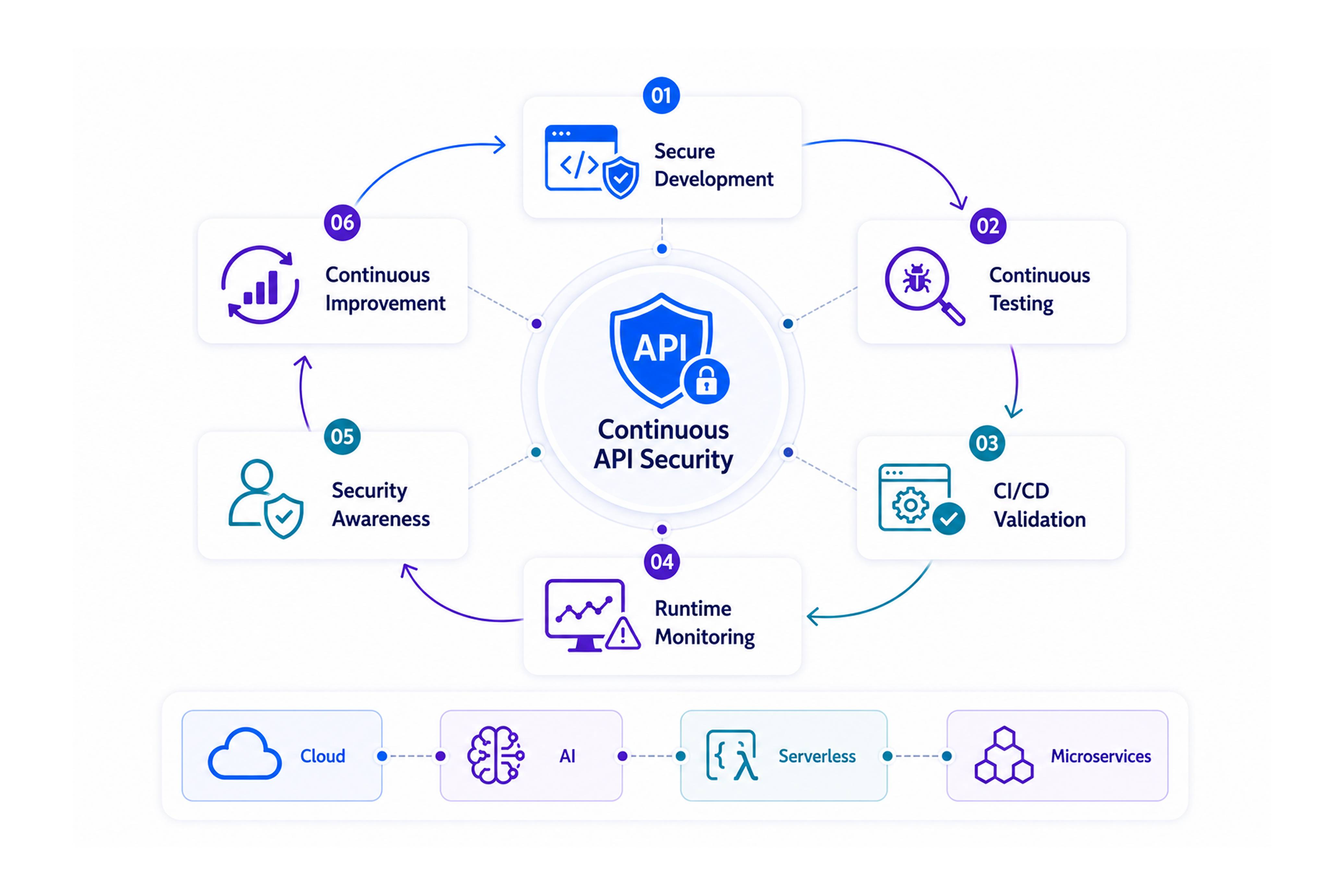 API security should not be viewed as a one-time project completed before production deployment. Applications evolve continuously through feature releases, cloud migrations, third-party integrations, and infrastructure updates. Every change introduces new opportunities for security weaknesses if testing does not keep pace with development.
Organizations adopting continuous API security integrate testing directly into development workflows. Developers receive secure coding guidance, automated testing runs within CI/CD pipelines, and production environments are monitored continuously for abnormal API behavior. This proactive approach enables organizations to identify vulnerabilities earlier, reduce remediation costs, and strengthen overall application resilience.
Security awareness also plays a critical role. Developers, architects, QA engineers, and operations teams should understand common API attack techniques, secure coding practices, and the recommendations published by the Open Web Application Security community. Continuous education helps prevent vulnerabilities from being introduced during development rather than relying solely on post-development testing.
As organizations embrace artificial intelligence, serverless computing, and increasingly distributed architectures, maintaining continuous visibility into API security becomes even more important. Combining secure development, runtime monitoring, penetration testing, and automated validation creates a mature API security program capable of adapting to evolving threats.
Conclusion
APIs have become the foundation of modern digital transformation, enabling organizations to build scalable, cloud-native applications through microservices architecture. However, this increased connectivity has also expanded the attack surface, making APIs one of the most attractive targets for cybercriminals.
The OWASP API Security Project provides organizations with a proven framework for understanding and mitigating today's most significant API vulnerabilities. Implementing OWASP API Top 10 security testing allows security teams to identify weaknesses before attackers exploit them while improving compliance, resilience, and customer trust.
At SecNinjaz, we combine technical expertise, manual penetration testing, automated assessments, and practical remediation guidance to help organizations secure their APIs throughout the software development lifecycle. Whether you're deploying new microservices or strengthening an existing API ecosystem, a proactive security strategy will always be more effective—and less costly—than responding to a data breach.
As API technologies continue evolving and upcoming OWASP recommendations introduce new guidance, organizations that invest in continuous API security today will be best positioned to defend against tomorrow's threats.
Explore Application Security Testing →
Frequently Asked Questions
What is the OWASP API Top 10?
The OWASP API Top 10 is a globally recognized list of the most critical API security risks published by the OWASP API Security Project. It helps organizations identify, prioritize, and remediate common API vulnerabilities such as broken authentication, authorization failures, excessive data exposure, and security misconfigurations.
Why is OWASP API Top 10 security testing important?
OWASP API Top 10 security testing helps organizations proactively identify vulnerabilities before attackers can exploit them. It provides a structured approach to evaluating authentication, authorization, business logic, API configurations, and sensitive data handling, improving the overall security of modern applications.
What are the most critical API security risks?
Common API security risks include Broken Object Level Authorization (BOLA), Broken Authentication, Broken Function Level Authorization (BFLA), excessive data exposure, unrestricted resource consumption, Server-Side Request Forgery (SSRF), security misconfiguration, improper API inventory management, and unsafe consumption of third-party APIs.
How does the OWASP API Security Project help organizations?
The OWASP API Security Project provides best practices, testing methodologies, and security guidance specifically for APIs. It enables developers, architects, and security teams to implement secure API design, development, testing, and ongoing security management throughout the software development lifecycle.
How often should API security testing be performed?
API security testing should be integrated into every major release and CI/CD pipeline. In addition to continuous automated testing, organizations should conduct manual API penetration testing at least annually or whenever significant architectural, business logic, or infrastructure changes occur.
How can organizations reduce excessive data exposure?
Organizations should return only the data required for each API request, enforce the principle of least privilege, review API responses for unnecessary information, and perform regular penetration testing to identify and eliminate excessive data exposure before it leads to a security incident.
How does DevSecOps improve API security?
DevSecOps integrates security throughout the software development lifecycle by embedding automated security testing, code analysis, dependency scanning, and API validation into CI/CD pipelines. This enables teams to identify vulnerabilities earlier, reduce remediation costs, and deliver secure applications faster.
Secure Your APIs with SecNinjaz
 API attacks continue to evolve, making proactive security testing essential for every organization building modern applications. Whether you're developing cloud-native microservices, exposing partner APIs, or modernizing enterprise applications, SecNinjaz helps you identify vulnerabilities before attackers do.
Our comprehensive API security assessments align with the OWASP API Security Project, incorporate OWASP API Top 10 security testing, and evaluate authentication, authorization, business logic, infrastructure, and runtime security. By combining expert-led penetration testing with practical remediation guidance, we help organizations reduce critical API security risks, eliminate excessive data exposure, and build resilient API ecosystems prepared for both today's challenges and upcoming OWASP recommendations.
Ready to strengthen your API security posture? Contact SecNinjaz today to schedule a comprehensive API security assessment and protect your applications before vulnerabilities become business risks.