

The World Economic Forum published its Global Cybersecurity Outlook 2026 in January, in collaboration with Accenture, timed to coincide with the Forum's Annual Meeting in Davos. The headline figure from that report is blunt: 94% of the CISOs, CEOs, and other C-suite leaders surveyed said AI will be the most significant driver of change in cybersecurity this year. The report's own framing is worth sitting with: cybersecurity, in its words, is no longer a backroom technical function. It has become a core strategic concern for governments, businesses, and societies at the same time that the regulatory ground underneath it keeps shifting.
That combination, technical change moving fast and compliance obligations tightening at the same time, is the actual story behind most "trends to watch" lists for 2026. AI is reshaping both sides of the attack-and-defence equation. Zero trust has moved from a differentiator to something closer to a baseline expectation. Cloud and multi-cloud environments have gotten complex enough that manual security review cannot keep up. Ransomware operators are moving faster than most incident response plans were built to handle. And regulatory deadlines, from India's DPDP Rules to the EU AI Act, are landing in the same budget cycle rather than politely taking turns.
Here is the part most year-ahead roundups skip. Treating the technical trends and the compliance trends as two separate conversations, one for the security team and one for legal, is exactly the gap attackers and regulators both exploit. A business that hardens its cloud estate but has no AI governance policy is still exposed. A business with a beautifully documented compliance file but no tested incident response plan is exposed in a different, equally expensive way. The businesses that come out ahead in 2026 are the ones running security and compliance as one programme rather than two.
This guide walks through the five trends actually worth planning around this year, what the data behind each one says, where compliance obligations intersect with the technical work, what falling behind costs, and a readiness playbook a business can start on this quarter. It is written for the people who have to act on it: security leaders, compliance owners, and the executives who sign off on both budgets.
Five Trends Framing How Businesses Should Plan for 2026
| Trend | What is driving it | What it means for planning |
|---|---|---|
| AI on both sides of the fight | Attackers and defenders are adopting the same generative and agentic AI tools | AI governance is now a security control, not a side policy |
| Zero trust as the operating baseline | Perimeter security has failed against hybrid work and multi-cloud sprawl | Identity-first access control, not a single product purchase |
| Cloud and multi-cloud complexity | Workloads spread across environments faster than visibility tools keep up | Unified monitoring matters more than any single cloud's native controls |
| Ransomware getting faster | Automation has compressed the time from intrusion to encryption | Incident response plans built for slower, older timelines are already outdated |
| Regulatory compliance tightening on multiple fronts | DPDP, the EU AI Act, CERT-In, and sectoral regulators are all moving at once | Compliance work has to run continuously, not as an annual review |
Trend 1: AI Cybersecurity, Where Attacker and Defender Use the Same Tools
IBM's 2025 Cost of a Data Breach Report, produced with the Ponemon Institute, is the clearest data point on how AI is reshaping both sides of this fight. One in five breached organizations in the study had been compromised through shadow AI, unsanctioned AI tools employees adopted without security sign-off, and those incidents added roughly $670,000 to the average breach cost. Among organizations that suffered any AI-related security incident, 97% said they lacked proper access controls around the AI tools involved, and 63% had no AI governance policy in place at all.
The attacker side of the same report is just as telling. AI played a role in 16% of breaches studied, most commonly through AI-generated phishing, present in 37% of those cases, and deepfake impersonation, present in 35%. Neither of those attack types requires a sophisticated actor anymore. Generative tools have lowered the skill floor for producing a convincing phishing email or a passable synthetic voice call.
The practical implication is that AI governance now sits alongside endpoint protection and access control as a core security function, not a separate policy exercise run by legal. Mapping AI use against a recognized framework, ISO/IEC 42001 is the relevant management-system standard here, gives a business the same kind of structured, auditable process for AI that ISO 27001 gives for information security generally, rather than a governance gap that shadow AI quietly fills in the meantime.
Trend 2: Zero Trust Security Becomes the Default, Not the Differentiator
Zero trust, as defined in NIST Special Publication 800-207, replaces implicit trust based on network location with continuous verification of every user, device, and access request. NIST SP 800-207A extends the same model to cloud-native and multi-cloud environments, which is the version most businesses are actually implementing against in 2026 given how few estates are still purely on-premise.
What has changed is not the model itself but its status. Sectoral regulators are pushing it from best practice toward expectation. The Reserve Bank of India's Financial Stability Report has pressed banks and financial institutions toward zero trust and continuous assessment-based red teaming to curb rising digital fraud. CERT-In's incident reporting directions, which require notification within six hours of detecting a reportable incident, are considerably easier to meet with the kind of unified identity and monitoring layer zero trust architectures are built around than with a flat network and fragmented logging. The CISA Zero Trust Maturity Model v2.0 gives organizations outside regulated sectors a structured way to benchmark progress even without a specific mandate forcing the move.
Trend 3: Cloud Security and Multi-Cloud Complexity Outpace Manual Review
Cloud adoption did not slow down in 2026, and neither did the number of businesses running workloads across more than one provider without a unified view across them. IBM's breach research has repeatedly flagged data spread across multiple, poorly tracked environments as a disproportionate driver of breach cost and scope, a pattern that shows up again in this year's reporting: incidents involving data stored across several environments consistently cost more and take longer to contain than incidents confined to one.
The failure mode is rarely a single catastrophic cloud misconfiguration anymore. It is smaller, cumulative visibility gaps, an access policy that made sense on one cloud and was never replicated correctly on the second one, a logging format that differs enough between providers that nobody notices a gap until an incident is already underway. A multi-cloud strategy that stops at running two providers, without building a shared identity and monitoring layer on top, tends to multiply this problem rather than solve the vendor-lock-in issue it was adopted to address.
Trend 4: Ransomware Gets Faster, More Automated, and Harder to Negotiate With
The 2026 Verizon Data Breach Investigations Report found ransomware present in 48% of breaches studied, the highest share the report has recorded. The more operationally significant finding sits underneath that headline number: the median time from initial intrusion to ransomware execution has compressed to roughly five days in recent reporting, down sharply from the multi-week dwell times security teams were still planning around only a few years ago.
Ransomware-as-a-service has industrialized alongside that speed increase. Groups such as Qilin, DragonForce, and LockBit 5.0 are among the more active platforms in 2026, filling the gap left after law enforcement action against LockBit's earlier infrastructure and the collapse of ALPHV/BlackCat. Separately, Sophos's ransomware research has found a majority of victim organizations now refuse to pay, a trend regulators in several jurisdictions are actively reinforcing through payment-reporting and negotiation rules.
The planning implication is direct. An incident response plan built around a detection window of weeks is not a plan for 2026's ransomware timeline. Detection, containment, and recovery capability all need to assume an attacker can reach encryption in days, not weeks.
Trend 5: Regulatory Compliance Tightens on Multiple Fronts at Once
India's Digital Personal Data Protection Rules, 2025 were notified in November 2025, starting an eighteen-month compliance runway that runs to roughly May 2027 for organizations to fully operationalize their obligations as data fiduciaries. That runway is not a grace period so much as a fixed amount of preparation time, and a good share of it will be consumed by exactly the technical work described above, access controls, breach detection, AI governance, since the Act's Section 8(5) security-safeguard duty does not distinguish between a compliance failure and a security failure.
Globally, 2 August 2026 was the date most obligations for high-risk AI systems under the EU AI Act became applicable, a milestone relevant to any business building, selling, or using AI that touches the European market, regardless of where it is headquartered. CERT-In's six-hour incident reporting mandate continues to apply domestically, and sector-specific regulators, the RBI foremost among them for financial services, are layering additional expectations, continuous assessment-based red teaming, stronger authentication, on top of the general framework.
How the 2026 Regulatory Calendar Is Shaping Up
| Period | What changed or is changing |
|---|---|
| November 2025 | India's DPDP Rules, 2025 are notified, starting an eighteen-month compliance runway |
| January 2026 | The WEF Global Cybersecurity Outlook 2026 is published, flagging AI as the dominant driver of change |
| 2 August 2026 | Most obligations for high-risk AI systems under the EU AI Act become applicable |
| Ongoing through 2026 | CERT-In's six-hour incident reporting mandate and RBI's zero trust and CART expectations continue to apply and expand |
| Around May 2027 | The DPDP Rules' compliance runway closes for organizations acting as data fiduciaries |
Where Trend-Watching Meets Compliance: Why They Cannot Be Separate Roadmaps
Faster adoption of AI, cloud, and automation does not move the compliance boundaries a business operates inside, and this is where most "trends" content and most "compliance checklist" content talk past each other instead of to each other.
The DPDP Act's Section 8(5) duty to implement reasonable security safeguards is not satisfied by a policy document. It is satisfied by the same technical controls this guide has already covered: access governance tight enough to close the gap that let 97% of AI-related breaches happen without proper controls, monitoring unified enough to meet CERT-In's six-hour reporting window, and an incident response plan built for a five-day ransomware timeline rather than a multi-week one. A security roadmap that ignores this framing produces controls that happen to be compliant by accident. A compliance roadmap that ignores the technical detail produces documentation that will not survive an actual incident.
The AI Act adds a further wrinkle for businesses with any European exposure: Article 15 of that Act requires high-risk AI systems to demonstrate resilience against adversarial manipulation, which means the AI governance work businesses need for their own shadow AI problem and the AI Act's security-testing expectations are, in practice, the same underlying work viewed from two different regulatory angles.
What Falling Behind on These Trends Actually Costs
| Gap | Consequence |
|---|---|
| No AI governance policy | Average of $670,000 in additional breach cost where shadow AI is present, per IBM's research, on top of any DPDP or sectoral exposure |
| Flat network, no zero trust | Faster lateral movement and larger breach scope once any single account or device is compromised |
| Unmanaged multi-cloud sprawl | Data spread across untracked environments, a pattern consistently linked to higher breach cost and longer containment time |
| Incident response built for outdated ransomware timelines | A five-day window to encryption leaves little margin for a response plan designed around multi-week detection |
| Inadequate security safeguards under DPDP Section 8(5) | Up to ₹250 crore penalty, the highest tier in the Act's Schedule |
| Missing EU AI Act Article 15 evidence for high-risk systems with EU exposure | Up to €15 million or 3% of worldwide annual turnover for most high-risk obligation breaches |
A Maturity Model for 2026 Readiness
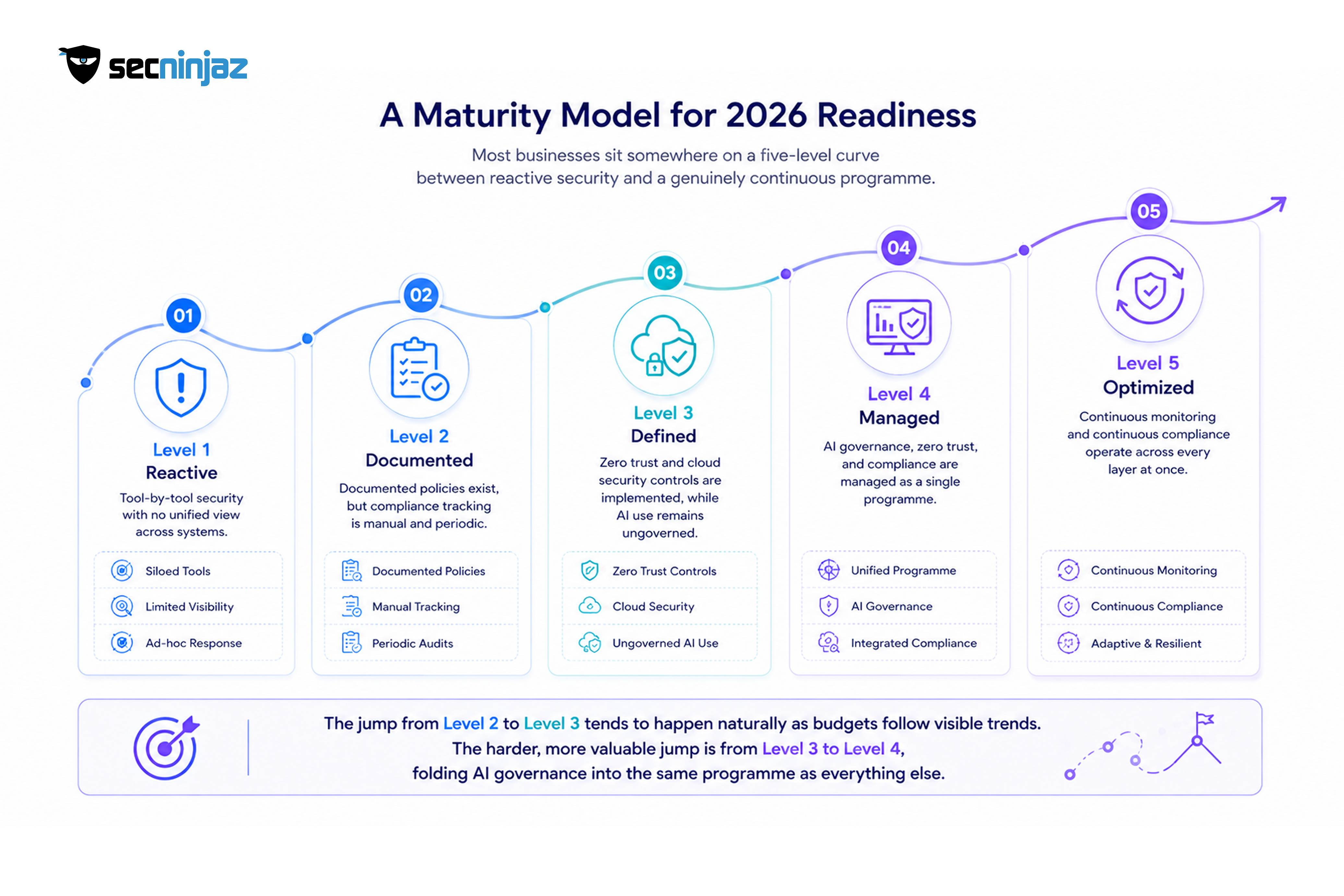 Most businesses sit somewhere on a five-level curve between reactive security and a genuinely continuous programme.
Level 1: Reactive, tool-by-tool security with no unified view across systems ↓ Level 2: Documented policies exist, but compliance tracking is manual and periodic ↓ Level 3: Zero trust and cloud security controls are implemented, while AI use remains ungoverned ↓ Level 4: AI governance, zero trust, and compliance are managed as a single programme ↓ Level 5: Continuous monitoring and continuous compliance operate across every layer at once
The jump from Level 2 to Level 3 tends to happen naturally as budgets follow visible trends. The harder, more valuable jump is from Level 3 to Level 4, folding AI governance into the same programme as everything else, which is exactly the step this year's data suggests most businesses have not made yet.
A Readiness Playbook for 2026
- Inventory AI use across the business, sanctioned and shadow. A governance policy written before this step is a policy for tools nobody has actually mapped yet.
- Set an AI governance policy before expanding AI adoption further. Closing the gap behind an existing rollout is harder than building the policy alongside a new one.
- Move identity and access to a zero trust model, starting with privileged accounts. Identity is the layer everything else in a zero trust design depends on.
- Consolidate visibility across every cloud environment in use. A dashboard per provider is not the same as a unified view during an active incident.
- Rebuild the incident response plan around a five-day ransomware timeline, not the multi-week assumption most existing plans were written against.
- Map obligations against DPDP, CERT-In, and, where relevant, the EU AI Act as a single compliance matrix, rather than three separate filing exercises.
- Run a red team or breach-and-attack simulation exercise against the current architecture, not just the one it looked like a year ago.
- Reassess quarterly, not annually. The trend cycle behind this list is moving faster than an annual review can track.
Common Mistakes and Edge Cases
Treating AI governance as a policy document nobody enforces. A written policy with no access controls or approval workflow behind it does not close the gap that made 97% of AI-related breaches possible in IBM's research.
Assuming zero trust is a single product purchase. Buying an identity provider or a network access tool badged as zero trust does not deliver the architecture on its own without the segmentation and monitoring work behind it.
Mistaking multi-cloud for resilience by default. Running two providers without a shared identity and logging layer between them adds visibility gaps rather than removing single-vendor risk.
Planning incident response around outdated dwell-time assumptions. A plan that assumes weeks of warning before ransomware executes is planning against a threat model that no longer matches the data.
Running security and compliance as separate budgets and separate teams. The DPDP Act's security-safeguard duty and the technical controls a security team would build anyway are largely the same work; splitting the ownership tends to produce duplicated effort and gaps at the seams.
Waiting for final regulatory guidance before starting foundational work. Inventory, governance policy design, and identity-first access control do not depend on the last word of any pending rule or standard, and delaying them on that basis is the most common way a business ends up short of its own compliance runway.
When to Use What: A Few Decision Points
Build AI governance in-house versus bring in a specialist. A business with an existing GRC function that already runs ISO certifications can usually extend that structure to cover AI. A business without that foundation tends to move faster with outside help setting the governance framework up correctly the first time.
A full zero trust rollout versus a phased, identity-first approach. A large legacy estate rarely tolerates a single cutover to zero trust. Starting with identity and privileged access, then extending to network segmentation and monitoring, spreads the cost and the risk without leaving the highest-value target, credentials, unaddressed in the meantime.
An in-house SOC versus AI-driven SOC automation. A smaller alert volume and team can often be handled in-house. Once alert volume outpaces the team's ability to triage manually, automation aimed specifically at SOC workflows tends to close the gap faster than simply hiring further into a shortage of experienced analysts.
Annual compliance review versus continuous compliance monitoring. A business in a lightly regulated sector with low data sensitivity may still manage with an annual cycle. Anything touching DPDP-covered personal data, EU market exposure, or a sectoral regulator like the RBI is better served by continuous monitoring, given how much the underlying rules have moved even within a single year.
How SecNinjaz Fits Into This
The pattern across all five trends is the same one this guide keeps returning to: the technical work and the compliance work are one programme, not two, and most vendors are built to cover only one side of it. SecNinjaz's Cybersecurity practice, Vulnerability Assessment, Penetration Testing, Red Teaming, Purple Teaming, Breach and Attack Simulation, and AI SOC Automation, covers the testing and monitoring side that turns a zero trust or cloud security design into something verified against real attack paths rather than assumed to work.
The compliance side runs through the GRC and DPDP practice, Regulatory Compliance, ISO Certification and Compliance, AI Governance, Risk Management, Audit and Gap Assessment, and vCISO support for businesses that need senior security leadership without a full-time hire. SecNinjaz holds ISO/IEC 27001:2022 for information security, ISO/IEC 27701:2025 for privacy information management, and ISO/IEC 42001:2023 for AI management systems, the specific combination relevant to running AI governance, data protection, and general security compliance as a single programme rather than three separate initiatives. For businesses trying to close the gap between this year's technical trends and this year's regulatory deadlines at the same time, that combination of tested security work and documented governance is the pairing worth looking for, whether the business works with SecNinjaz or anyone else.
Frequently Asked Questions
What is the single biggest cybersecurity trend for 2026?
According to the World Economic Forum's Global Cybersecurity Outlook 2026, 94% of surveyed leaders point to AI as the most significant driver of change in cybersecurity this year, affecting both attacker capability and defensive tooling at the same time.
What is shadow AI and why does it matter for compliance?
Shadow AI refers to AI tools employees adopt without security or IT approval. IBM's 2025 Cost of a Data Breach Report found that breaches involving high levels of shadow AI cost roughly $670,000 more on average, and that 97% of organizations with an AI-related breach lacked proper access controls around the tools involved. It matters for compliance because the same access-control gap that drives up breach cost is also the kind of failure regulators look for under security-safeguard duties like DPDP Section 8(5).
Is zero trust a specific product businesses can buy?
No. Zero trust is an architectural model, defined in NIST SP 800-207 and extended to cloud-native environments in NIST SP 800-207A, built around continuous verification of every user, device, and access request rather than implicit trust based on network location. A single identity or access product can support part of that model, but it does not deliver the full architecture without segmentation, monitoring, and policy work built around it.
How fast do ransomware attacks move in 2026?
The 2026 Verizon Data Breach Investigations Report found ransomware present in 48% of breaches, and separate industry reporting has put the median time from initial intrusion to ransomware execution at roughly five days, down sharply from the multi-week dwell times security teams were planning around only a few years ago. Incident response plans built for a slower timeline are not aligned with the current threat.
What compliance deadlines should businesses track in 2026?
In India, the DPDP Rules, 2025, notified in November 2025, started an eighteen-month runway to roughly May 2027 for full compliance as a data fiduciary. Globally, most obligations for high-risk AI systems under the EU AI Act became applicable from 2 August 2026, relevant to any business building, selling, or using AI that touches the European market regardless of headquarters location.
Why should security and compliance be run as one programme instead of two?
Because the underlying work overlaps almost completely. The technical controls a security team would build anyway, access governance, unified monitoring, tested incident response, are largely what satisfies a duty like DPDP Section 8(5)'s reasonable-security-safeguards requirement. Running them as separate budgets and separate teams tends to produce duplicated effort and gaps at the seams between the two.
What is the most common mistake businesses make when responding to these trends?
Treating AI governance as a policy document with no enforcement behind it. A written policy without access controls or an approval workflow does not close the gap that IBM's research found behind most AI-related breaches, and it does not satisfy a regulator looking for evidence that safeguards were actually implemented rather than asserted.
Where should a business start if it has not addressed any of these trends yet?
Start with an inventory of AI use across the business, sanctioned and shadow, since a governance policy written before that step targets tools nobody has actually mapped. From there, move identity and access to a zero trust model starting with privileged accounts, and rebuild the incident response plan around a five-day ransomware timeline rather than an outdated multi-week assumption.