

2 August 2026 marks one of the most significant implementation milestones of the EU AI Act, when most obligations for high-risk AI systems become applicable.If your organisation builds, sells, or even just uses AI that touches the European market, the EU AI Act 2026 milestone is the point where "we'll deal with it later" stops being a viable plan.
The EU AI Act is more than a regulatory requirement - it establishes a governance framework for trustworthy AI by requiring organizations to implement risk management, transparency, cybersecurity, human oversight, and continuous monitoring throughout the AI lifecycle. Organizations with mature AI governance practices, such as those aligned with ISO/IEC 42001:2023, will have a significant advantage in meeting these obligations.
Here is the part that trips people up. This is not only a legal exercise for the GRC team to sign off in a spreadsheet. A large slice of the Act is about whether your AI actually works safely under pressure: is it accurate, does it hold up against adversarial input, is it secured against tampering. That is a security problem as much as a paperwork problem. Treat it as one or the other and you will fail the audit you weren't expecting.
This guide walks through what the Act requires, what specifically changes in 2026, how the risk tiers map to real obligations, what happens if you get it wrong, and a readiness playbook you can start on this quarter. It is written for the people who have to make it real: engineering leads, security teams, and the compliance owners sitting between them.
What the EU AI Act Actually Is (and Why "2026" Matters)
The EU AI Act is the first broad, horizontal law regulating artificial intelligence anywhere. "Horizontal" matters here. It does not carve out a single sector like finance or health. It applies across the board, then sorts AI systems by how much risk they pose to people's safety and fundamental rights.
It entered into force on 1 August 2024. But the obligations were deliberately staged over several years, which is why the calendar confuses so many teams. Different rules switch on at different dates. Some prohibitions already applied in early 2025. The obligations most businesses actually worry about, the ones covering high-risk systems, land in 2026 and 2027.
Two things about scope catch companies off guard.
First, it is extraterritorial. You do not need an office in Frankfurt or Paris to be caught. If your AI system's output is used in the EU, or you place a system on the EU market, the Act can reach you from Bengaluru, London, or San Francisco. For an India-headquartered business selling into European clients, that is not a hypothetical. It is the default assumption you should plan around.
Second, it splits duties by role. A "provider" (the party that develops an AI system or has it developed and puts it on the market under its own name) carries the heaviest load. A "deployer" (an organisation using an AI system in a professional capacity) carries a lighter but real set of duties. Plenty of companies are both at once: you might deploy a vendor's model for HR screening while also shipping your own AI feature to customers. You wear both hats, and the obligations stack.
The 2026 Timeline: What Applies and When
The staggered dates are the single most misread part of the Act. So here is the sequence in plain terms, with the 2026 milestone in context.
| Date | What becomes applicable |
|---|---|
| 1 August 2024 | The Act entered into force. The clock starts. |
| 2 February 2025 | Bans on prohibited AI practices take effect. AI literacy duties for staff begin. |
| 2 August 2025 | Rules for general-purpose AI (GPAI) models, governance bodies, confidentiality, and most penalty provisions apply. |
| 2 August 2026 | The majority of the Act applies, including obligations for high-risk systems listed in Annex III (things like recruitment, credit scoring, and biometric categorisation). |
| 2 August 2027 | Obligations for high-risk AI embedded in regulated products under Annex I (medical devices, machinery, and similar) apply, with an extended transition. |
So when someone says "the EU AI Act 2026 deadline," they almost always mean 2 August 2026. That is the date Annex III high-risk obligations become enforceable and national authorities are expected to be policing them.
A word of caution on treating 2026 as comfortably far off. It is not. Building a conformity assessment, a working risk management process, technical documentation, and the security testing evidence to back all of it is a multi-quarter effort for most teams. If you are starting from a standing position with no AI inventory, backdating from August 2026 puts your real start line somewhere around now.
> Note: dates and article references here reflect the Act as published. Delegated acts, harmonised standards, and Commission guidance continue to fill in detail, so confirm specifics against the current official text before you make a binding decision.
The Four Risk Tiers, Explained
The Act sorts AI into four buckets by risk, plus a separate track for general-purpose models. Your obligations depend entirely on which bucket you land in, so getting the classification right is step one of everything else.
| Risk tier | What it covers | Core obligation |
|---|---|---|
| Unacceptable | Practices banned outright (Article 5) | Prohibited. Do not build or deploy. |
| High-risk | Annex III use cases and safety components of regulated products | Full compliance programme before market entry |
| Limited (transparency) | Chatbots, emotion recognition, deepfakes/synthetic media | Disclosure duties (Article 50) |
| Minimal | Spam filters, AI in games, most everyday tools | No mandatory obligations |
Unacceptable Risk: The Hard No
Some uses are simply off the table. Social scoring by public authorities, certain untargeted scraping of facial images to build recognition databases, manipulative techniques that exploit vulnerabilities, and some real-time remote biometric identification in public spaces fall here. These bans already applied from February 2025. If any of your roadmap touches this list, the answer is not "add controls." The answer is stop.
High-Risk: Where the Real Work Lives
This is the tier that consumes the compliance budget. Annex III lists use cases considered high-risk because of their impact on people: AI used in recruitment and worker management, access to education, credit and insurance decisions, essential public services, biometric categorisation, critical infrastructure, and law enforcement, among others.
If you are here, you owe a full programme: a risk management system, data governance, technical documentation, logging, human oversight, transparency to deployers, and demonstrated accuracy and security. We break these out in the next section because they are where most of the effort, and most of the failure, happens.
Limited Risk: Tell People It's AI
A chatbot has to make clear it is a machine. Synthetic or manipulated media (deepfakes) has to be labelled as such. Emotion recognition and biometric categorisation systems have to inform the people exposed to them. These transparency duties under Article 50 are lighter than the high-risk regime, but they are not optional, and they apply to a lot of ordinary customer-facing AI.
Minimal Risk: Mostly Left Alone
The spam filter, the recommendation engine on a low-stakes feature, the AI opponent in a mobile game. The Act largely leaves these alone. Voluntary codes of conduct are encouraged, nothing more. Most AI in the wild sits here, which is worth remembering when a vendor tries to sell you a panic-grade compliance package for a tool that filters junk mail.
General-Purpose AI: A Separate Track
Foundation models and other general-purpose AI get their own rules, applicable from August 2025. Providers of GPAI models owe technical documentation, training-data transparency summaries, and copyright compliance. Models judged to carry "systemic risk," typically the largest and most capable, owe more: model evaluations, adversarial testing, incident reporting, and cybersecurity protections. If you fine-tune or heavily modify a GPAI model, check carefully whether you have stepped into provider obligations yourself.
What High-Risk Providers and Deployers Must Actually Do
Once a system is classified high-risk, the Act stops being abstract. It hands you a concrete list of duties, most set out in Articles 9 through 15. Here is what each one means in practice, without the legalese.
Risk management system (Article 9). A continuous, documented process across the whole lifecycle. Not a one-time assessment you file and forget. You identify foreseeable risks, test whether your mitigations work, and revisit the whole thing when the system or its use changes. Auditors will ask to see the loop running, not a single dated PDF.
Data and data governance (Article 10). Training, validation, and testing data must be relevant, representative, and as free of errors as feasible for the purpose. You need to examine datasets for bias that could harm people or produce discriminatory outputs. For a credit-scoring model, that means being able to show what your data looked like and what you did about skew, not just asserting the model is fair.
Technical documentation (Article 11, Annex IV). A detailed dossier: system design, development process, capabilities and limitations, and the evidence behind your compliance claims. This has to exist before the system goes to market and stay current after.
Record-keeping and logging (Article 12). High-risk systems must log events automatically so you can trace what happened. When a decision goes wrong, you should be able to reconstruct why. Retention and traceability are the point.
Transparency to deployers (Article 13). Providers must ship clear instructions for use: what the system does, its accuracy limits, the conditions it was tested under, and the human oversight it expects. Deployers cannot use a system safely if they do not know its boundaries.
Human oversight (Article 14). A person must be able to understand, monitor, and where needed override the system. Oversight has to be real, not a rubber-stamp "human in the loop" who clicks approve on a thousand outputs a day without any genuine ability to intervene.
Accuracy, robustness, and cybersecurity (Article 15). This is the one security teams need to read twice. High-risk systems must reach appropriate levels of accuracy, be resilient against errors and adversarial manipulation, and be protected against attempts to alter their use or performance. The Act explicitly names data poisoning, model poisoning, adversarial examples, and confidentiality attacks as things you are expected to defend against.
That last article is where compliance and security stop being separate conversations.
Provider vs Deployer: Who Owes What
The split matters because most teams assume "the vendor handles it." Often they do not, at least not the part that is yours.
| Duty | Provider | Deployer |
|---|---|---|
| Build the risk management system | Yes | No |
| Produce technical documentation | Yes | No |
| Conformity assessment before market | Yes | No |
| Use the system per instructions | Shared | Yes |
| Assign competent human oversight | Sets requirements | Implements |
| Monitor operation, report serious incidents | Yes | Yes |
| Keep logs generated in use | Provides capability | Retains them |
| Inform affected people where required | Depends on role | Often yes |
If you deploy a third-party high-risk system, you inherit real duties: using it within its stated limits, staffing genuine oversight, monitoring for problems, and keeping the logs. Buying a "compliant" product does not transfer those to the vendor.
Where Security Meets Compliance: The Article 15 Angle
Most EU AI Act coverage online is written by law firms and policy analysts. It is accurate on the legal mechanics and thin on the security engineering. That gap is exactly where organisations get caught, because Article 15 asks a question a lawyer cannot answer on paper: is this AI system actually resilient against attack?
Consider what "robustness and cybersecurity" means for a high-risk model in practice.
Data poisoning is a live threat, not a textbook one. If an attacker can influence your training or fine-tuning data, they can plant behaviour that only triggers under specific conditions. A recruitment model quietly biased against a group. A fraud model with a blind spot the attacker built in. Demonstrating Article 15 compliance means being able to show you tested for this, not just that you hoped it wasn't there.
Adversarial examples are inputs crafted to fool a model while looking normal to a human. A slightly perturbed image that a vision system misclassifies. A prompt injection that makes an LLM ignore its guardrails and leak data or take an action it shouldn't. For any high-risk system with a language interface, prompt injection and jailbreak resistance are now part of your regulatory evidence, not just your bug tracker.
Model theft and confidentiality attacks round it out. Model inversion and membership inference can pull training data back out of a deployed model, which is both a security failure and, if that data was personal, a privacy breach that pulls in the DPDP Act and GDPR at the same time.
The practical implication: you cannot write your way to Article 15 compliance. You have to test the system, adversarially, and keep the evidence. This is where AI red teaming and structured AI and LLM security testing become compliance artefacts, not just security hygiene. A red team that tries to poison, jailbreak, extract from, and mislead your model produces exactly the kind of documented resilience testing the Act expects to see.
This is squarely SecNinjaz territory. The team's work in AI Red Teaming, AI/LLM Security Testing, and AI SOC automation lines up directly with the accuracy, robustness, and cybersecurity duties in Article 15, and the GRC practice (AI Governance, Risk Management, Audit and Gap Assessment, and vCISO support) covers the documentation and process side. It is worth being blunt about why that pairing matters: a governance consultant who cannot break your model cannot prove it is secure, and a red team with no compliance mapping produces findings nobody files. You need both halves talking to each other.
One credibility point worth stating plainly, because it is genuinely relevant here rather than a bolt-on: SecNinjaz holds ISO/IEC 42001:2023, the international management-system standard for AI. That is the standard most directly aligned with building the kind of AI governance system the EU AI Act expects, which we will come back to in the readiness playbook.
Penalties: What Getting It Wrong Costs
The Act has teeth, and they are sized to hurt large companies specifically. Fines are set as the higher of a fixed euro amount or a percentage of worldwide annual turnover, so a global enterprise cannot treat them as a rounding error.
| Violation | Maximum fine |
|---|---|
| Using a prohibited AI practice (Article 5) | Up to €35 million or 7% of total worldwide annual turnover |
| Breaching most other obligations (high-risk duties, transparency, GPAI) | Up to €15 million or 3% of worldwide annual turnover |
| Supplying incorrect, incomplete, or misleading information to authorities | Up to €7.5 million or 1.5% of worldwide annual turnover |
For small and medium enterprises and startups, the fines are capped at the lower of the amount or the percentage, which softens the blow but does not remove it. There are also proportionality provisions, so enforcement is meant to weigh the nature of the breach and the size of the business.
The number that gets attention is 7%. To put it in perspective, that ceiling is higher than the GDPR's headline 4%. The EU set it deliberately high for the prohibited-practices category because those are the uses it considers genuinely unacceptable. The realistic risk for most compliant-but-imperfect companies is the 3% tier, which is where a sloppy high-risk programme or missing documentation would land you.
Fines are not the whole exposure. A finding against you can force a system off the EU market, trigger mandatory corrective action, and hand competitors a very public reason to question your product. For a business selling AI into regulated European buyers, the reputational and commercial cost of an enforcement action can outrun the fine itself.
A Business Readiness Playbook
You cannot boil the ocean, and you should not try to. A workable path is sequential: know what you have, sort it by risk, then go deep only where the law demands it. Here is the order that tends to work.
- Build an AI inventory. You cannot govern what you have not listed. Catalogue every AI system you build, buy, or embed, including the quiet ones: the model inside a SaaS tool, the fine-tuned open-source model a team spun up, the vendor feature nobody registered. Most organisations underestimate this count by a wide margin on the first pass.
- Classify each system by risk tier. For every item, decide: prohibited, high-risk, limited, or minimal. Record why. This single step determines how much work each system needs, and it is the classification an auditor will scrutinise first.
- Confirm your role per system. Provider, deployer, or both. The duties differ, and getting this wrong means preparing the wrong evidence.
- Run a gap assessment on the high-risk set. Against Articles 9 to 15, mark what exists and what is missing: risk management process, data governance records, technical documentation, logging, human oversight design, and security testing evidence. Be honest about the gaps. A gap assessment that flatters you is worse than useless.
- Stand up the governance system. Assign ownership, define your risk management loop, set documentation standards, and decide how oversight actually works in production. This is where an AI management system, and specifically ISO/IEC 42001, gives you a ready-made scaffold instead of inventing one from scratch.
- Do the security testing Article 15 implies. Red team the high-risk models. Test for prompt injection, data and model poisoning, adversarial inputs, and data extraction. Keep the reports. These are compliance evidence now, not just security tickets.
- Fix the AI literacy gap. The Act already expects staff who build and use AI to have appropriate literacy. That means practical training, not a slide deck nobody opens. The people running human oversight in particular need to understand the system's limits.
- Set up ongoing monitoring and incident reporting. Compliance is not a launch-day event. You need continuous monitoring, a route to report serious incidents to authorities, and a cadence to revisit risk classifications as systems and uses change.
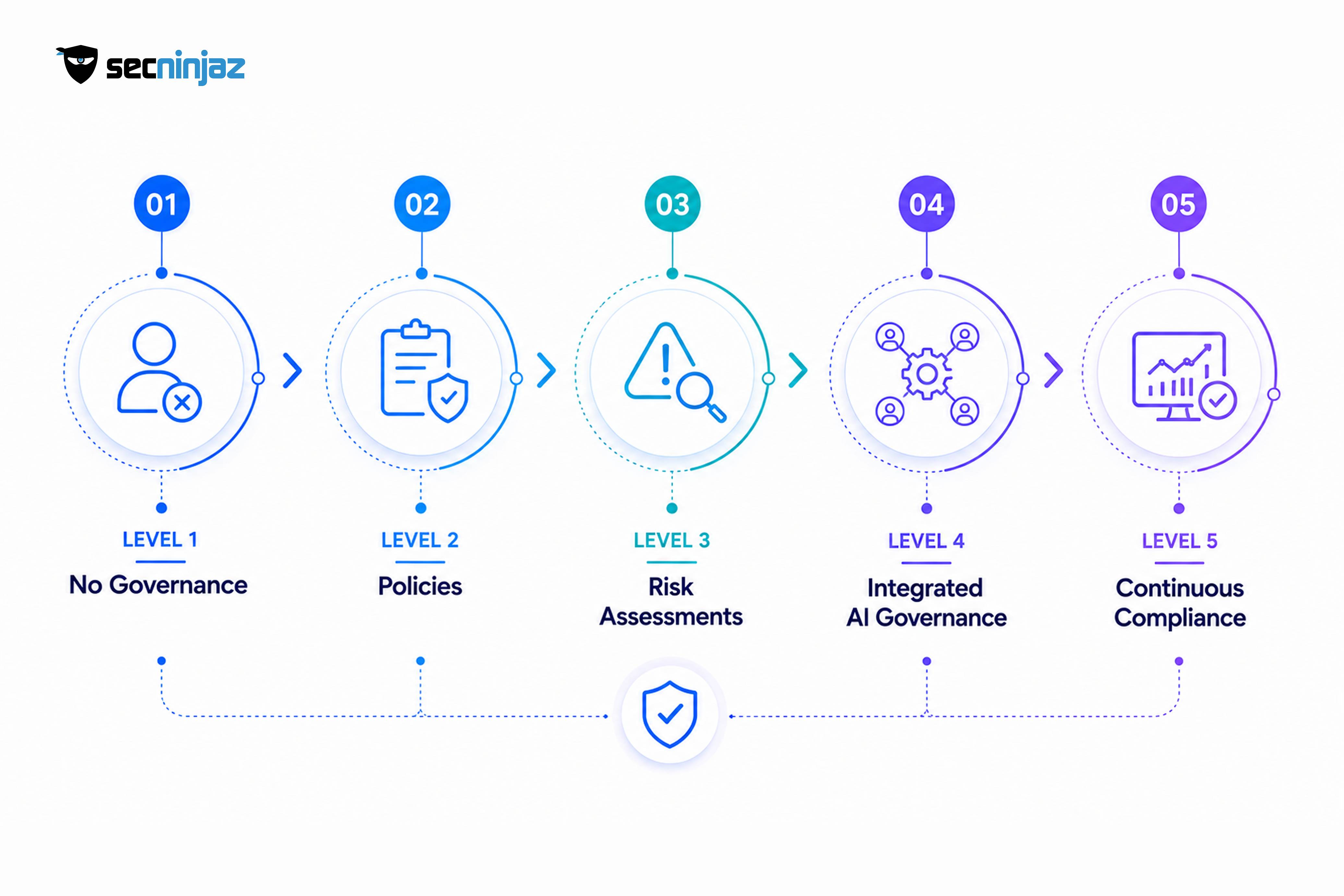 Work this list backward from 2 August 2026 for anything Annex III, and you will see why "later" has quietly become "now" for high-risk systems.
Common Mistakes and Edge Cases
A few patterns show up again and again once teams start the work.
Assuming the vendor's compliance is your compliance. A supplier can hand you a beautifully documented high-risk system and you can still be non-compliant, because deployer duties (oversight, monitoring, logging, informing affected people) are yours to run. Read the instructions for use, then check you are actually meeting the conditions in them.
Missing the shadow AI. The inventory almost always misses something: a marketing team's fine-tuned model, an analyst's script calling an external LLM, a feature a product manager enabled without telling security. Shadow AI is the compliance equivalent of shadow IT, and it is where surprises hide.
Treating classification as permanent. A minimal-risk tool becomes high-risk the moment you point it at recruitment decisions. Risk tier follows use, not the technology. Reclassify when the use case changes.
Confusing GDPR compliance with AI Act compliance. They overlap on personal data, and being good at one helps. But the AI Act adds duties GDPR never contemplated, such as adversarial robustness testing and conformity assessment. Your data protection officer's sign-off does not close the AI Act gap on its own.
Forgetting fine-tuning can make you a provider. Take a general-purpose model, fine-tune it substantially for a high-risk use, put it out under your name, and you may have crossed from deployer into provider, inheriting the heavier obligations. Check the line carefully before you assume you are only a user.
Over-engineering the minimal-risk tools. The opposite failure. Do not burn your budget wrapping a spam filter in a high-risk compliance programme. Spend the effort where the Act actually requires it.
Assuming ChatGPT or Other AI Tools Are Automatically Compliant Using ChatGPT, Microsoft Copilot, Claude, Gemini, or any other AI tool does not automatically make your organisation compliant. Compliance depends on how the AI is used, the risk category, and whether your organisation meets its obligations as a provider or deployer. Always assess AI use cases individually rather than relying on the vendor's compliance claims.
When to Use What: A Few Decision Points
Some choices come up for almost everyone. Here is how to think through them.
ISO/IEC 42001 versus a home-grown governance process. If you have more than a handful of AI systems, or you sell into buyers who will audit you, the standard is usually the better starting point. It gives you an auditable AI management system that maps cleanly onto the Act's governance and risk-management expectations, and a certificate that customers recognise. If you have one low-risk model and no external scrutiny, a lightweight internal process may be enough for now. The tipping point is scale plus external accountability. Once either grows, the ad-hoc approach starts costing more than it saves.
Build the security testing in-house versus bring in a red team. Internal teams know your systems best and should own day-to-day monitoring. But adversarial AI testing is a specialist skill, and there is a real independence argument: a team grading its own model's resilience is not the evidence an auditor trusts most. A practical split is internal monitoring plus periodic independent AI red teaming for the high-risk systems, which is also closer to what Article 15 evidence should look like.
Provider-grade programme versus deployer-grade programme. Do not build provider-level documentation for systems where you are only a deployer. Confirm your role first (step 3 of the playbook), then scope the effort to match. Over-scoping wastes the budget you need for the systems that genuinely carry provider duties.
Start now versus wait for harmonised standards. Some teams are holding off until every harmonised standard and guidance document lands. That is a mistake for the inventory, classification, and gap-assessment work, none of which depends on the final standards. Do the foundational work now. Refine the technical specifics as the detail firms up.
How SecNinjaz Fits Into This
If the pattern in this guide is clear, the Act sits on the seam between governance and security, and most providers cover only one side of it. SecNinjaz works both. On the compliance side, the GRC and DPDP practice covers AI Governance, Regulatory Compliance, Risk Management, and Audit and Gap Assessment, with vCISO support for organisations that need senior security leadership without a full-time hire. On the security side, AI Red Teaming and AI/LLM Security Testing produce the adversarial resilience evidence Article 15 expects.
The ISO/IEC 42001:2023 certification the team holds matters here specifically because it is the recognised framework for building the AI management system the Act's governance duties call for. Paired with the group's ISO 27001 and ISO/IEC 27701:2025 certifications, it covers the security and privacy management ground the Act keeps brushing up against. For businesses outside the EU that still sell into it, and for governments and enterprises building AI they cannot afford to get wrong, that combination of standards-led governance and hands-on offensive testing is the pairing worth looking for, whether you work with SecNinjaz or anyone else.
Frequently Asked Questions
What is the main EU AI Act 2026 deadline?
The key date is 2 August 2026, when the majority of the Act applies, including obligations for high-risk AI systems listed in Annex III such as recruitment, credit scoring, and biometric categorisation. Earlier dates already passed: prohibited practices from February 2025, and general-purpose AI and penalty rules from August 2025. High-risk AI embedded in regulated products under Annex I follows in August 2027.
Does the EU AI Act apply to companies outside the EU?
Yes. The Act is extraterritorial. If you place an AI system on the EU market, or the output of your system is used in the EU, you can be caught regardless of where your business is based. An India-headquartered or US-based company selling AI into European clients should assume it is in scope and plan accordingly.
What counts as a high-risk AI system?
Two groups. First, AI used in the sensitive areas listed in Annex III: recruitment and worker management, credit and insurance decisions, education access, essential public services, biometric categorisation, critical infrastructure, and law enforcement, among others. Second, AI used as a safety component of products already regulated under EU law, such as medical devices and machinery. Risk follows the use case, so the same tool can be minimal-risk in one context and high-risk in another.
What are the penalties for non-compliance?
Fines are the higher of a fixed amount or a percentage of worldwide annual turnover. Using a prohibited practice can cost up to €35 million or 7% of global turnover. Breaching most other obligations can cost up to €15 million or 3%. Supplying incorrect information to authorities can cost up to €7.5 million or 1.5%. Small and medium enterprises face the lower of the two figures. Enforcement can also force a system off the EU market.
How does the EU AI Act relate to security testing?
Article 15 requires high-risk systems to reach appropriate accuracy and to be resilient against errors and adversarial manipulation, naming data poisoning, model poisoning, adversarial examples, and confidentiality attacks. In practice you cannot document that on paper alone. You need adversarial testing, such as AI red teaming and structured LLM security testing, and you need to keep the results as compliance evidence. Security testing becomes part of your regulatory file, not just a separate engineering task.
Is ISO/IEC 42001 enough for EU AI Act compliance?
Not by itself, but it is a strong foundation. ISO/IEC 42001 is the international standard for an AI management system, and it maps closely onto the Act's governance and risk-management expectations, giving you an auditable structure instead of an invented one. You still need to meet the Act's specific duties, including the accuracy and security testing in Article 15 and any conformity assessment for high-risk systems. Think of 42001 as the scaffold, not the whole building.
We only use a vendor's AI. Do we still have obligations?
Yes, if the system is high-risk. As a deployer you must use the system within its stated limits, assign genuine human oversight, monitor operation, retain the logs it generates, report serious incidents, and in some cases inform the people affected. Buying a system the vendor calls compliant does not transfer those duties to the vendor. Read the instructions for use and confirm you are actually meeting them.
Where should we start if we've done nothing yet?
Start with an AI inventory, then classify each system by risk tier and confirm whether you are a provider or deployer for it. That trio tells you where the real work is before you spend a rupee or a euro on deeper compliance. From there, run a gap assessment on the high-risk systems against Articles 9 to 15, stand up your governance process, and begin the security testing. None of this depends on the final harmonised standards, so there is no reason to wait.