

Protecting Digital Personal Data, Building Customer Trust, and Strengthening Privacy Governance
Imagine you get an email from a customer who asks, "What information does your company have about me?" Can your company answer this question with confidence? For a lot of companies the answer is no.
Customer information is usually over the place. It is in HR systems, CRM platforms, cloud applications, marketing tools, emails and spreadsheets. Since companies do not have an idea of where personal data is or how it is used it becomes hard to answer questions about privacy and this increases the risk of not following the rules.
The Digital Personal Data Protection Act that India introduced in 2023 changes things by giving individuals rights and making companies more responsible.
However, following the rules is not about avoiding trouble. Companies that do a job of protecting privacy gain the trust of their customers make better decisions reduce the risk of cyber attacks and support long term digital transformation.
This guide explains the Digital Personal Data Protection Act in terms and gives companies a step by step plan, for creating a program that protects privacy and follows the rules.
Why Privacy Has Become a Business Priority
Digital transformation has really changed how companies collect and use information. Things like signing up customers managing employees doing marketing using cloud computing, artificial intelligence and making online payments all need to be done with personal data in a responsible way.
At the time there are a lot of cyber threats and privacy issues and companies have to follow more rules so privacy is now a big deal for the people in charge. Customers want companies to be open about how they collect, use and protect their information.
Companies that do a job with privacy are better off because they can:
- Build trust with customers.
- Avoid problems, with rules. Running the company.
- Make their cybersecurity stronger.
- Try things in a responsible way.
- Help their business grow over time.
| Global Cost | India Cost | Privacy ROI | Global Adoption |
|---|---|---|---|
| USD 4.88M Average cost of a data breach (2024) |
INR 195M Average cost of a data breach in India (2024) |
96% Organizations report positive ROI from privacy investments |
140+ Countries and jurisdictions with privacy laws |
Key takeaways
By the end of this guide, you will understand:
- What the Digital Personal Data Protection (DPDP) Act, 2023 is and why it matters.
- Which organizations are required to comply with the Act.
- The key stakeholders and their responsibilities under the DPDP framework.
- The rights provided to individuals over their personal data.
- The obligations organizations must fulfill to process personal data responsibly.
- A practical roadmap for implementing DPDP compliance across your organization.
- Common implementation challenges and practical recommendations for overcoming them.
- How strong privacy governance can become a competitive advantage rather than just a compliance requirement.
1. Understanding the DPDP Act, 2023
What is the DPDP Act?
The Digital Personal Data Protection Act of 2023 is the law in India that deals with digital personal data. This law sets rules for companies on how to collect, use, store, share and get remove of information. It also makes sure that people have rights when their data is being used.
The Digital Personal Data Protection Act wants to make a system where companies can keep making new things and providing digital services. At the time it makes sure that personal information is used correctly openly and responsibly.
The Digital Personal Data Protection Act is different from ways of doing things that only thought about keeping information safe. The Digital Personal Data Protection Act cares more about making sure companies are responsible for data and that people have rights when their data is being used.
Companies should not just think of privacy as something they have to do because the law says so. The Digital Personal Data Protection Act says that companies should think of privacy as a way to make their business better. This is because when companies care about privacy they can make their customers trust them more. The Digital Personal Data Protection Act also helps companies be ready for rules and laws, about data. It helps them use data in a good way.
Why Was the DPDP Act Introduced?
The DPDP Act was introduced because India has seen a lot of people using services for banking and healthcare and education and shopping and government services and lots of other things online. As all these services became digital companies started collecting a lot of information about people but they were not always clear about how they were using this information.
The DPDP Act was introduced to do things.
- It was introduced to protect the privacy of people whose personal data is used digitally.
- It was introduced to make sure companies that handle data are responsible for what they do with it.
- The DPDP Act was also introduced to make sure companies are honest and transparent when they use data.
- It was introduced to make people trust Indias economy.
- The DPDP Act was introduced to create rules that work for the world which is changing very fast.
The DPDP Act is also part of a trend around the world where people think privacy is very important just like keeping information safe, from hackers and following rules.
Objectives of the DPDP Act
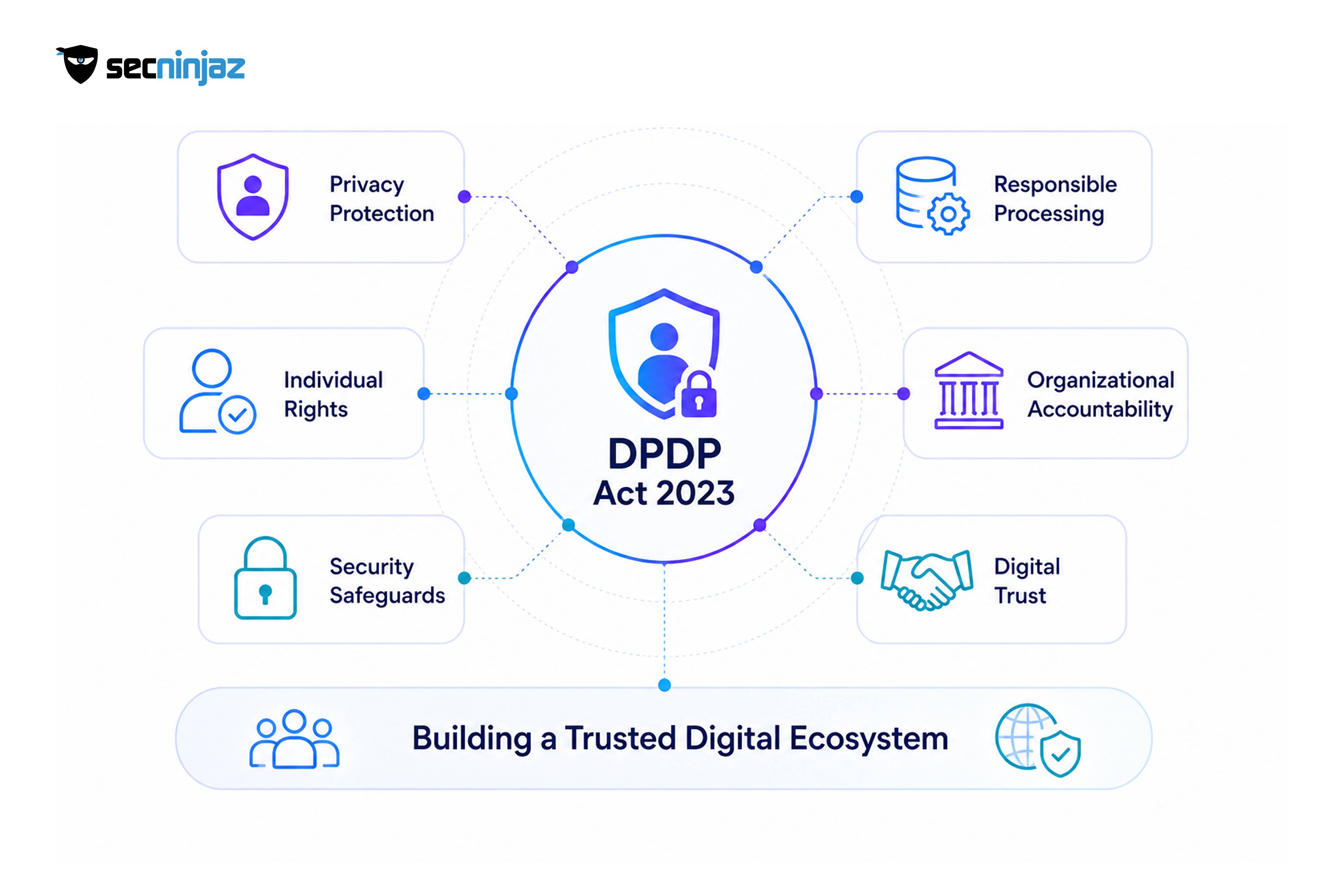
The Act is made to do a very important things.
Protect Individual Privacy People should know more about what happens to the information that's about them and they should be able to control it. This information is Used and shared by others.
Promote Responsible Data Processing Companies should only use information for good reasons and they should keep it safe.
Increase Organizational Accountability Companies that handle information on computers must make sure they are doing things right. They need to have processes and controls in place to show they are responsible.
Strengthen Trust in Digital Services When people think companies are handling their information in a way these companies can build trust with them. This helps companies work with people for a time and it helps them make new digital things.
Encourage Privacy by Design Companies should think about privacy, from the start. They should not just think about it after they have already made something. Privacy should be part of the way they do business and make products and technologies. The Act is designed to help the Digital Services and the people who use them like the Individual Privacy. This way people can trust the Digital Services and the companies that handle their information. The Act is also made to help the companies that handle information to make sure they are doing things right like Responsible Data Processing and Organizational Accountability.
Core Principles of the DPDP Act
The DPDP Act has some rules that organizations need to follow. To do things right you have to understand what the DPDP Act is really about.
Lawful Processing The DPDP Act says that personal data should only be used for reasons and in a legal way.
Purpose Limitation When organizations collect data they should only use it for the reason they collected it for. They should not use it for things without a good reason.
Data Minimization Organizations should only collect the data they really need. They should not collect more than that.
Accuracy Organizations need to make sure the personal information they have is correct and up to date.
Storage Limitation Personal data should not be kept forever. Organizations should have a plan for how they keep it and get rid of it when they do not need it anymore.
Security Safeguards Organizations need to protect data from people who should not see it. They need to have systems in place to keep it safe.
Accountability The DPDP Act says that organizations are always responsible for keeping information safe. This is true even when other people are helping them with the data. The organizations are still, in charge of keeping the data of the DPDP Act safe.
SecNinjaz Insight: Many organizations think that privacy compliance is about making a privacy policy. It is not that simple. Just having a piece of paper with rules on it does not mean you are doing things right. You need to know where the personal data of people is, how it moves around in your business and who can see it. If you do not know these things it is hard for organizations to deal with requests, about privacy manage risks from companies and put in place good security measures. The DPDP Act is really important because it helps you build an lasting program to govern privacy.
 ## 2. Who Needs to Comply with the DPDP Act?
People often ask if the DPDP Act applies to their company. The answer does not depend on how big the company's but on whether it handles digital personal data that the DPDP Act covers.
If your company collects personal data about people stores it uses it shares it transfers it or does anything else with it you need to know about the DPDP Act. This includes companies that get information from websites, mobile apps, systems for employees customer portals, marketing tools, cloud services, HR apps, payment systems, AI tools or digital communication channels.
So the DPDP Act applies to kinds of companies including:
- Technology companies and SaaS providers
- E-commerce platforms
- Financial institutions
- Healthcare providers
- Educational institutions
- Manufacturing organizations
- Consulting firms
- Human resource service providers
- Digital marketing agencies
- AI product and service companies
- New companies that handle customer or employee information
- Government bodies, when the DPDP Act applies to them
So it is not just companies that need to follow the rules. Any company that handles personal data should look at what the DPDP Act says it needs to do and make sure it has good privacy rules in place. The DPDP Act is important, for all companies that handle personal data and these companies should follow the DPDP Act rules.
| Industry | Personal Data Processed |
|---|---|
| Banking | KYC documents, account information, transaction history |
| Healthcare | Patient records, prescriptions, diagnostics |
| SaaS | User accounts, subscription details, usage logs |
| Manufacturing | Employee records, vendor information |
| Education | Student information, examination records |
| E-Commerce | Customer orders, payment information, delivery addresses |
| AI Companies | User prompts, datasets, model feedback |
SecNinjaz Insight: Many medium-sized organizations think that privacy rules are only for big companies. If your organization is dealing with peoples personal information online. Like through a website, a system for employees a customer relationship management platform, a mobile app or a cloud service. Then the DPDP Act is something you should know about. Understanding if the DPDP Act applies to you on is helpful because it means your organization can get ready ahead of time and set up good privacy practices, as the DPDP Act and your organization grow.
3. Key Roles Under the DPDP Framework
The DPDP Act has some jobs that tell us how to handle and protect peoples digital personal data. We need to understand these jobs because each one has its tasks to do when it comes to keeping peoples information private. If you are collecting information from customers or dealing with employee records or using cloud services from companies you need to figure out what role your organization plays. This is the step to making sure you are following the rules.
SecNinjaz Insight: It is very important to know the roles of the Data Principal, the Data Fiduciary, the Data Processor and other people involved. This helps organizations give out tasks make their rules stronger and work better with companies. If we do not know who is in charge the job of keeping peoples information private can get confusing. Spread out across different departments. This can increase the risks of making mistakes and not following the rules.
Data Principal
The Data Principal is the person whose data we are talking about. To put it simply if your organization collects someones information that person is the Data Principal.
Here are some examples:
- A customer who buys things online
- An employee who gives information to the human resources department
- A student who signs up for a school
- A patient who registers with a hospital
- A person who visits a website and creates an account
The DPDP Act gives the Data Principal some rights when it comes to their information. This means they can see what is happening with their data and have control, over how organizations use it. So organizations should make sure they have processes in place that respect the rights of the Data Principal throughout the time they are handling the data.
Data Fiduciary
A Data Fiduciary is someone or a company that decides how and why personal information is used. Most companies that collect information about their customers or employees are Data Fiduciaries.
Examples of Data Fiduciaries include:
- Banks
- Hospitals
- Educational Institutions
- E-commerce Companies
- SaaS Providers
- Insurance Companies
- Manufacturing Organizations
- HR Service Providers
- Government Bodies
- AI Solution Providers
Being a Data Fiduciary is a responsibility. The Data Fiduciary has to make sure that personal information is used correctly kept safe and only used for reasons. The Data Fiduciary is also in charge of putting the privacy rules in place answering peoples questions managing other companies that help with the information and keeping the information safe from the time it is collected until it is no longer needed. Even if another company is helping the Data Fiduciary with the information the Data Fiduciary is still responsible, for making sure everything is done correctly and safely.
Data Processor
A Data Processor handles information for a Data Fiduciary. The Data Processor does not figure out why the information is being used. It just follows the instructions given by the Data Fiduciary.
Some common examples of Data Processors are:
- Cloud Hosting Providers
- Payroll Service Providers
- CRM Platforms
- Email Marketing Platforms
- IT Managed Service Providers
- Outsourced HR Vendors
- Data Analytics Providers
- Customer Support Platforms
- AI Service Providers that process customer information
The Data Fiduciary is still responsible for what happens to the information. The Data Processor is very important when it comes to keeping personal information safe. The Data Processor must have technical and organizational security measures in place. This is why it is necessary to check vendors and have controls in place in the contract, and it is also necessary to keep an eye on the vendors all the time. These things are important, for following the rules of the Data Fiduciary and Data Processor regulations. The Data Processor and the Data Fiduciary must work together to protect information, and the Data Fiduciary and the Data Processor have to make sure they are doing everything they can to keep information safe.
Significant Data Fiduciary (SDF)
The Central Government can pick organizations to be Significant Data Fiduciaries. This is because these organizations work with a lot of data or the data is really sensitive, and the government checks how this data can impact peoples rights and the countrys interests. The organizations that are called Significant Data Fiduciaries have to follow rules. They need to set up management and check their systems all the time, and the government will give them instructions, on what they need to do.
Large companies that handle a lot of information or operate in areas where privacy's a big issue might be called Significant Data Fiduciaries. So these organizations should pay attention to what the government's doing and see if they need to take extra steps. Significant Data Fiduciaries have a responsibility to protect peoples personal data. The Central Government will choose which organizations are Significant Data Fiduciaries based on the rules.
Consent Manager
The DPDP framework also knows about something called a Consent Manager. A Consent Manager is something that helps people say yes or no to things and also helps them look at what they said yes or no to and even take back what they said yes to. It does all this in a way that's easy to use and fair.
Sometimes organizations can handle getting consent from people on their own.. Consent Managers can make it easier for organizations to do this and also make it clearer for people what is going on when they give consent. When organizations do a job of managing consent it helps them show that they are responsible and it also gives people more power over what happens to their own information. The DPDP framework and Consent Managers are important for this. Consent Managers are really helpful, for people because they make it easy to manage consent.
Data Protection Board of India
The DPDP Act establishes the Data Protection Board of India, which has responsibilities under the Act relating to matters such as handling certain complaints, determining non-compliance where applicable, and imposing penalties in accordance with the law. The Board forms an important part of India's data protection ecosystem by supporting the implementation and enforcement framework established under the Act. Organizations should therefore treat privacy compliance as an ongoing governance responsibility rather than a one-time documentation exercise.
Understanding the Relationship Between These Roles
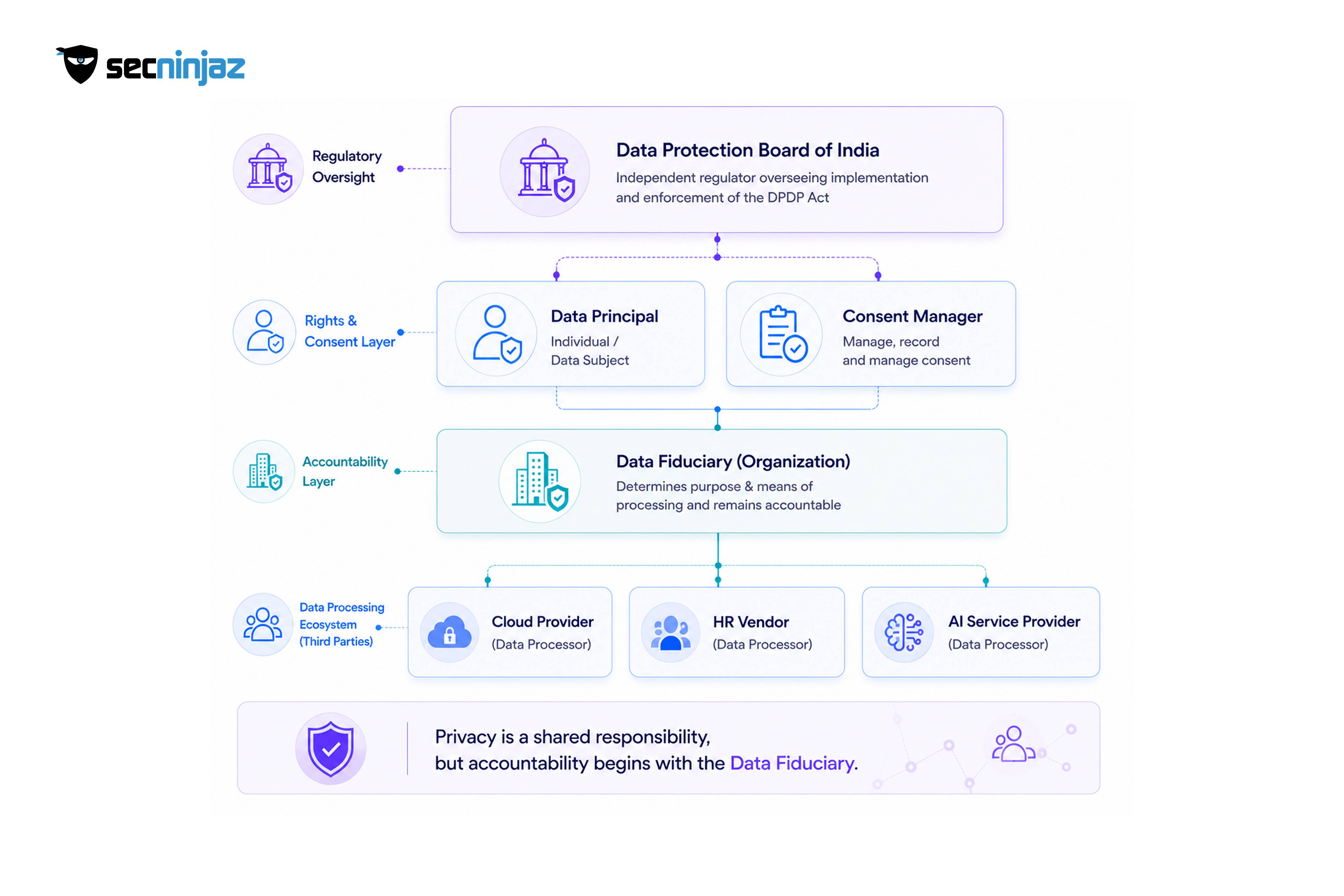
The way that peoples private information is protected is through the interaction of groups of people. A person who is a customer or what we call a Data Principal shares their information with a company, which is called a Data Fiduciary. This company might then work with another company, like a cloud provider or a payroll company, which is called a Data Processor to handle this information. Sometimes people can use something called a Consent Manager to control what happens with their information. There is also a Data Protection Board that makes sure everything is done correctly.
Each person or group has a job to do to keep information safe but the company that is the Data Fiduciary is mostly responsible for making sure that everything is done fairly and correctly. Understanding how all these groups work together is important for companies because it helps them figure out who is responsible, for what set up rules and deal with problems that might come up when working with companies.
 ## 4. Rights of Data Principals
The main goal of the DPDP Act is to give people power over their personal digital data. The DPDP Act is really important for this. Organizations should not just think of these rights as things they have to do because of rules. The DPDP Act and these rights are a chance for organizations to be open and honest to make customers trust them more and to show that they are handling data in a way. To make this work organizations need to have plans inside the company they need to train their staff and they need to have the right technology to handle requests quickly and efficiently. In the part we will look at each of the rights given by the DPDP Act one, by one and explain what organizations need to do to make them work in real life using the DPDP Act as a guide.
Self-Assessment
Can your organization say yes to these questions?
- Do you have a plan for dealing with requests, about customer privacy?
- Where do you store customer information do you know that?
- Can you delete customer information when it is the thing to do?
- Do the people who work for your organization know what to do when someone asks about customer privacy?
- Are you keeping track of all the privacy requests you get?
If your organization says no to three or more of these customer privacy questions then your organization should work on making its customer privacy rules better.
The main goal of the Digital Personal Data Protection Act 2023 is to give people power over their Digital Personal Data. This means people have a say in how their Digital Personal Data's collected, used, stored and shared. The Digital Personal Data Protection Act 2023 calls people who own the data Data Principals. Data Principals have rights that companies must follow. Companies have to put in place governance to support these rights.
These rights make companies be honest take responsibility and be careful, with peoples information. For companies this means they have to make it clear how they will handle requests keep records and make sure they think about privacy every day. It is very important for companies to understand these rights because they affect how companies deal with customers, employees, digital services and their own privacy plans. The Digital Personal Data Protection Act, 2023. Its rules directly influence how companies design things for customers, employees and digital services and how they handle Digital Personal Data.
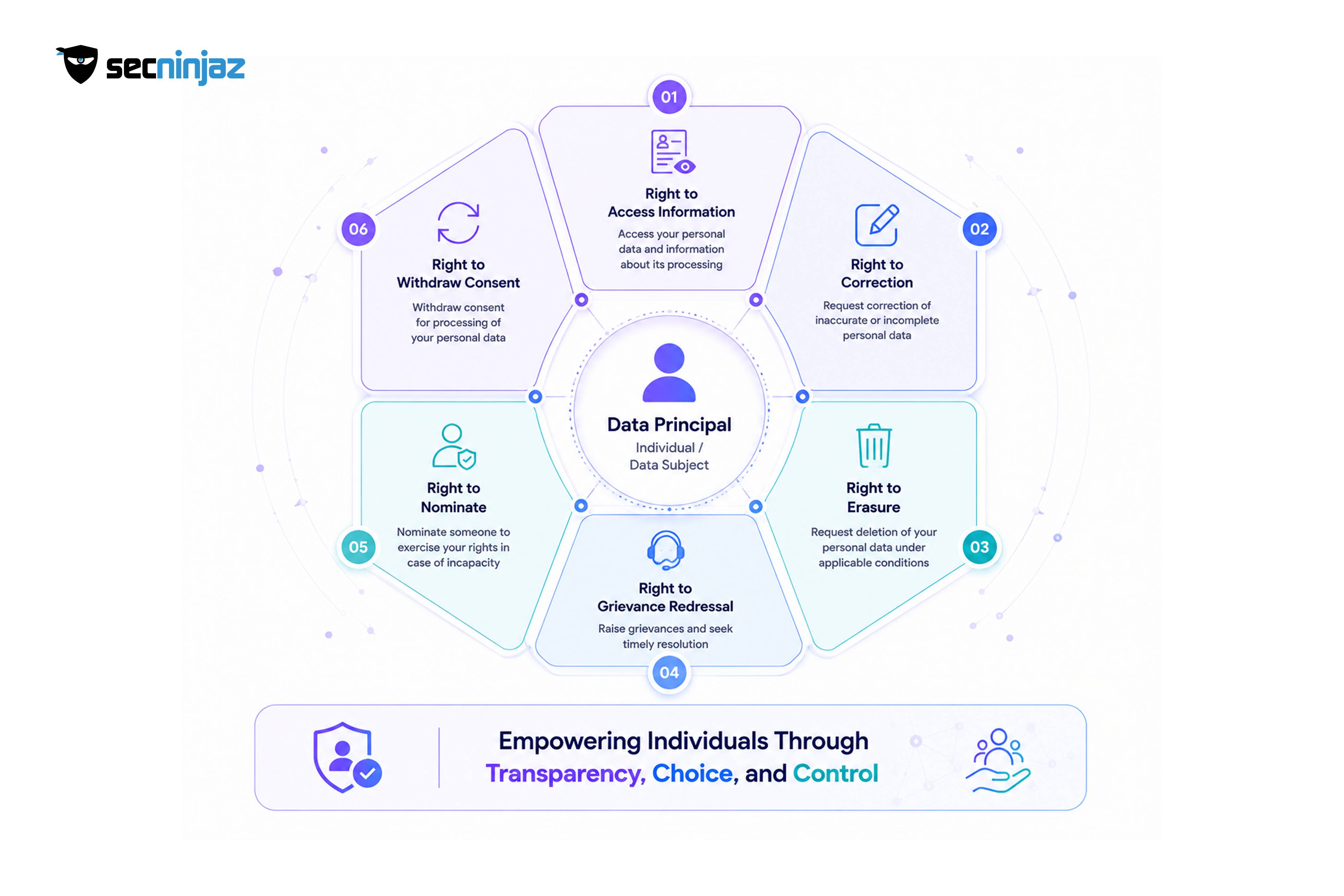
Right to Access Information
A Data Principal has the right to ask for information about the data that an organization is using. This is really helpful because people are curious and they want to know things about their data.
People want to know if their personal data is being used by the organization and what kind of data the organization is collecting about the Data Principal. They want to know why the Data Principals data is being used by the organization. They also want to know if the Data Principals data has been shared with someone. They want to know how the organization is using the Data Principals information.
For organizations this means they have to keep records of where all the Data Principals personal data is so they can answer questions about it quickly. If organizations do not have a system to keep track of the Data Principals data it can be very hard and take a long time to answer these questions about the Data Principals data.
For example let us say a customer contacts an e-commerce company and asks for details about all the information that is associated with their account. The organization should be able to find the customers information in all their systems and give an answer about what kind of data they have, about the Data Principal and how they are using the Data Principals data. The organization should be able to tell the customer what data they have about the Data Principal and why they are using the Data Principals data. The e-commerce company should be able to say how they are using the Data Principals information.
Right to Correction and Erasure
People have the right to ask for personal information to be corrected if it is wrong or not complete. They can also ask for their personal data to be erased when it is not needed anymore for the reason it was collected long as this does not go against any laws or rules that apply.
Organizations should have a system in place for:
- Reviewing requests to correct information
- Updating records that're wrong
- Checking someones identity before making any changes
- Figuring out if there are any contractual rules that require them to keep the data before they delete it
A good policy for keeping and getting rid of data is very important, for making sure peoples rights are respected.
Practical Example An employee notices that their emergency contact information is incorrect in the HR system and requests an update. The HR department should verify the request, update the record, and ensure that the corrected information is reflected across relevant systems where appropriate.
Right to Grievance Redressal
If a Data Principal thinks that an organization is not doing a job of handling their privacy concerns they have the right to complain about it. Organizations should have an fair way to deal with complaints so individuals can:
- Submit complaints
- Talk about their privacy concerns
- Check what is happening with their complaint
- Get answers on time
Having a complaint process helps organizations follow the rules and also makes Data Principals trust them more and see that they are being honest and open, about what they are doing with Data Principals privacy concerns.
Practical Example A customer believes that promotional emails continue to be sent even after opting out. The organization should have a documented process to receive the complaint, investigate the issue, resolve it promptly, and communicate the outcome to the customer.
Right to Nominate
The DPDP Act allows a Data Principal to nominate another individual who can exercise certain rights on their behalf under circumstances specified by the Act. Organizations should consider how nomination requests will be verified and managed within their internal privacy procedures. This may require updates to customer management systems, identity verification processes, and privacy workflows.
Right to Withdraw Consent
When people give permission for their personal data to be used they have the right to take that permission back. People should be able to take their personal data permission easily. If someone wants to take their permission it should be easy to do so, and the process should be simple. People should be able to find out how to take back their personal data permission, and it should be clear what is happening when they do. There should not be a lot of steps to take when people want to take their personal data permission.
Companies should make it just as easy to take back data permission as it is to give personal data permission in the first place. Once someone takes back their data permission the company should look at the rules to see if they are still allowed to use the personal data. If companies are not allowed to use the data they should stop using it and make sure they follow the rules from now on. The company should make sure to update what they are doing with the data so they are doing what is right, with the personal data. Companies should always follow the rules when it comes to data permission and personal data.
Practical Example A user subscribes to a company's marketing newsletter but later decides to unsubscribe. The organization should provide an easy opt-out mechanism and ensure that marketing communications stop once consent has been withdrawn, unless another lawful basis permits the processing.
Supporting Data Principal Rights in Practice
So companies have to do more than just give people these rights. They also have to set up systems to handle things quickly and in the way every time.
A good privacy plan should have these things:
- A clear way to handle requests from Data Principal
- A way to check someones identity
- A timeline for when things need to be done
- A way to keep track of requests
- A plan for what to do when things get complicated
- Teaching staff about privacy
- Checking and reporting on how thingsre going
Companies that put time and money into these things will be better at handling privacy requests and will show that they are responsible and honest. This is important for privacy governance program and Data Principal requests. Companies that do this will be better, at handling Data Principal requests.
 Download the DPDP Compliance Toolkit
SecNinjaz Insight: Supporting Data Principal rights requires more than responding to requests. Organizations need well-defined processes, trained employees, accurate data inventories, and supporting technologies to ensure privacy requests can be handled consistently, efficiently, and transparently. Organizations that invest in these capabilities not only strengthen compliance but also improve customer trust and service quality.
5. Organizational Obligations Under the DPDP Act
The DPDP Act gives individuals some rights but it also gives organizations that handle digital personal data a lot of work to do. Organizations have to do more than just post a notice about privacy or get people to agree to something by checking a box. They have to put in place rules and steps to follow and security measures to make sure personal data is handled properly from start to finish. To make a privacy program that really works you need people, from teams to work together like the leaders, the legal team, the compliance team, the IT team the information security team, the HR team, the procurement team and the business teams. The DPDP Act and DPDP compliance program have some things that organizations have to do which are listed below.
Common Mistakes Organizations Make
Organizations make a lot of mistakes. Here are some of them:
- They copy privacy policies from the internet.
- They collect information from people.
- They keep this data forever.
- They think that cloud providers will take care of compliance for them.
- They ignore the data of their employees.
- They do not check if the companies they work with are doing things correctly.
- They never test what they would do in case of a problem.
- They think that privacy is about following rules.
If organizations can avoid making these mistakes they will be better at handling privacy, and will have less risk of something going wrong.
How To Handle Personal Data
Organizations should only use data for good reasons. They should only use it for their business, and it has to be legal. Before they collect any data they need to know:
- Why they need this data.
- If they have told the person why they need it.
- If they still need this data.
If they collect data in case they might need it or if they keep data they do not need this can cause problems, with privacy and make it harder to follow the rules.
Provide Clear and Transparent Privacy Notices
People need to know what information about them is being gathered and why it is being collected. This is a right that people have the right to know what is happening with their information. A good privacy notice is one that's easy to understand it should not be full of complicated legal words that people do not understand.
A good privacy notice usually tells you what information about you the information about you is being collected and this is very important for your privacy for the information about you. It also tells you why the information about you is being collected, which is something that people should know about their information, the information about them. Then it tells you what they are going to do with the information about you and this is crucial for people to know about their privacy and the information about them. The notice also says if they are going to share the information about you with someone and people should be aware of this it is about the information about them. It tells you how they are going to keep the information about you, which's important for people to know about the information about them.
You also get to know what you can do if you want to use your rights and this is a part of privacy notices it is about the information about you. Lastly it tells you who to contact if you have questions about privacy and thiss very helpful for people who want to know more about the information about them. When people are honest and open about what they do with the information about you you are more likely to trust them. This is what privacy notices are all about the information about you.
There will be confusion about what is happening with the information about you and this is a good thing for people who care about their privacy and the information about them. People will understand what is going on with their data the information about them. This is important for privacy notices to be clear because privacy notices and personal data the information about you are very important. People should know what is happening with their data the information about them. This is something that privacy notices can help with by being clear and easy to understand which is what people need to know about the information, about them.
Obtain and Manage Consent
When it comes to getting consent from people organizations need to make sure they do it in a way that's clear and easy to understand. The organization should get consent that's:
- Specific
- Informed
- Unambiguous
- Given
- Easy to withdraw
Organizations should keep good records that show when and how they got consent and if someone took it back later.
Implement Appropriate Security Safeguards
Protecting data is a big responsibility for every organization that deals with digital personal data. The DPDP Act says that organizations must have security measures in place to prevent access, accidental sharing, changes, loss or damage to personal information. People often think that security is an IT task but that is not true. It requires a team effort across technology, people and business processes to get it right. A good privacy program needs an information security program to back it up. This program should have organizational controls in place. The type of controls needed depend on the size of the organization the type of processing and the risks involved in data protection.
Organizations should consider putting the following safeguards in place:
- Identity and Access Management (IAM)
- Multi-Factor Authentication (MFA)
- Encryption of data
- Network Security Controls
- Secure Backup and Recovery
- Endpoint Protection
- Vulnerability Management
- Security Monitoring and Logging
- Risk Assessments
- Employee Security Awareness Training
- Incident Response Procedures
- Data Loss Prevention (DLP) when it is necessary, for data protection.
Security measures need to be checked to make sure they are still working properly as technology, business activities and threats are constantly changing for data protection.
Ensure Accuracy of Personal Data
Personal information needs to be correct and complete so it can be used for the purpose. If the information is not correct it can cause problems with the way a company makes decisions and how customers are treated, and it can also cause trouble with following rules and getting work done.
Organizations should make sure they have a system in place to:
- Verify information when they collect it
- Update records when someone tells them something has changed
- Check information from time to time
- Get rid of old records
- Let people ask for corrections to be made
Information that is accurate helps companies follow rules and do better. Keeping information accurate is very important, for companies. Personal information that is helps with following rules and it also helps companies do better.
Define Data Retention and Secure Disposal
One of the common privacy risks is keeping personal information for longer than needed. Many companies keep customer and employee records forever because there is no plan for how to keep them.
A good plan for keeping data should say:
- What personal data is gathered.
- Why it is gathered.
- How long it should stay.
- Legal or contract rules about keeping it.
- How to get rid of it safely.
- Who is in charge of checking the data that is kept.
When personal data is not needed anymore it should be deleted completely made unrecognizable or handled in a way that follows the company rules and the law. Keeping data also means fewer risks, for the company.
Manage Third-Party Data Processors
Modern organizations do not usually handle all data by themselves. They often get help from companies like cloud providers and payroll vendors and CRM platforms and marketing agencies and AI service providers and managed service providers and outsourced support teams to process personal information. These companies do this work on behalf of the organizations. Even though organizations outsource some of their work they are still responsible for keeping data safe, and the Data Fiduciary is the one who has to make sure this happens.
So organizations should have a system in place to manage risks that come with working with companies. This system should include things like:
- Checking vendors carefully before working with them
- Making sure vendors can keep information private and secure
- Putting rules in place to protect data in contracts
- Keeping information secret
- Having expectations, for how vendors should keep data safe
- Reviewing vendors regularly
- Telling organizations when something goes wrong with data
- Getting rid of data when a contract ends
Managing third-party companies should be a part of what an organization does to keep data private and manage risks. It should not be something they only do when they are buying something from another company.
Establish a Data Breach Response Process
Security incidents can still happen even when we take steps to prevent them. Companies need to be ready to deal with data breaches in a smart and fast way. They should be able to find the problem figure out what is going on stop it from getting worse look into what happened and respond to it.
A good plan for dealing with breaches should have these things:
- Incident identification
- Procedures for reporting incidents
- Looking at how bad the problem's at first
- Stopping the problem from getting worse
- Looking into what happened
- Figuring out what caused the problem
- Taking steps to fix the problem
- Keeping records of what happened
- Notifying people who need to know when necessary
- Learning from what happened and trying to do next time
Having a good plan, for dealing with security incidents helps companies keep running smoothly and makes them stronger. Personal data breaches are a deal and companies need to be ready to respond to them quickly and effectively which is why personal data breaches need to be taken seriously and companies need to have a plan to deal with personal data breaches.
Protect Children's Personal Data
Companies that make things for kids or handle childrens personal information should follow the rules. Keep kids safe. The rules are in the DPDP framework. These companies need to get permission to use childrens information. They have to handle it in a way. They have to make sure they do everything right so kids are safe.
When companies are making things for childrens they should think about them. They should ask themselves some questions, like:
- Will childrens probably use what they make for themselves?
- Should they check how old someone is before they let them use their service.
- Do they need to add checks to get permission from childrens or their parents.
- Is the information they give people about privacy easy for kids to understand.
Protecting childrens privacy is very important. Companies should think about this when they are designing and building things for childrens. They have to remember that childrens privacy is very important. Companies that deal with childrens information have to be very careful. They have to follow the rules, in the DPDP framework to keep childrens safe. Companies that make things for childrens should always think about childrens. Keep childrens safe.
Build Organizational Accountability
Privacy compliance cannot be achieved through documentation alone. To really make sure we are taking care of peoples information we need to do more than just have the right papers. Companies should set up a system that clearly says who is in charge of taking care of data from start to finish.
A good privacy program at a company should have these things:
- Defined roles for people who handle information
- Bosses who keep an eye on things
- Rules and steps to follow for privacy
- Teaching employees about privacy
- Regular checks to make sure we are following the rules
- Looking at what might go wrong
- Checking ourselves to make sure we are doing things right
- Always watching to make sure we are doing things correctly
- Telling managers what is going on
- Fixing things that go wrong
When everyone in the company's responsible, for taking care of private information it becomes a normal part of what we do every day rather than just something we do to follow the rules sometimes.
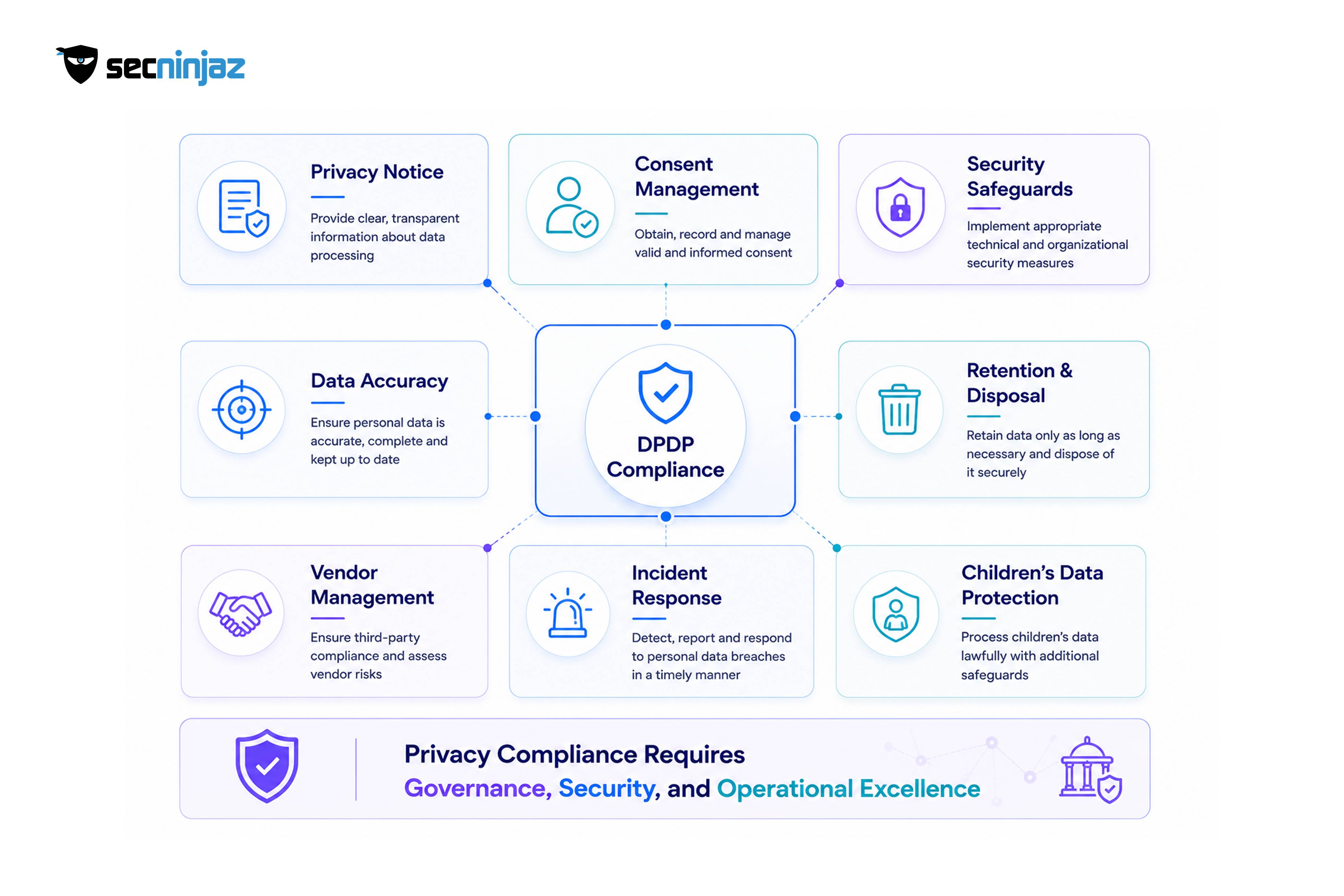 > SecNinjaz Insight: Privacy obligations extend beyond legal documentation. Organizations must integrate governance, security, operational processes, employee awareness, and third-party oversight into their everyday business activities. A mature privacy program balances compliance requirements with practical business operations, reducing both regulatory and operational risks.
6. Building a Practical DPDP Compliance Program
Understanding what the law says is the start. The hard part for companies is turning these rules into things that people can actually do every day in each department. A lot of companies already have some things in place to help with privacy. They may have security measures, rules for employees agreements with customers or contracts, with vendors.. Often each department does its own thing without a plan that ties everything together for privacy. Companies should not just focus on filling out paperwork to follow the rules. They should make a plan that puts privacy into everything they do including how they run the business use technology and make decisions. The following plan is a way for companies to start or improve their DPDP compliance journey.
Step 1: Identify the Personal Data You Process
To follow the rules you need to understand what kind of information your company is collecting and using. Lots of companies do not know the answers to questions like:
- What kind of information do we collect?
- Where do we keep it?
- Who can see it?
- Why do we need it?
- How long do we keep it?
- Which other companies use it?
If you do not know these things it is much harder to make sure you are protecting peoples privacy. You should start by making a list of all the personal information your company is using including everything from the human resources department to the marketing team and from customer lists to cloud services and other companies you work with. This list is the starting point for everything you will do to protect peoples privacy. The personal data your company is collecting and using is very important so you need to understand what data your organization is collecting and processing and make sure you have a good handle, on the personal data you are working with.
Step 2: Conduct Data Mapping
When we find out what data we have we should know how it moves around the company. Personal data is a deal so we need to think about things like:
- Where do we get data from?
- Which computers and systems use data?
- Which teams in the company look at data?
- Do we share data with people outside the company?
- Do we move data to other countries?
- When do we put data away or get rid of it?
If we write down how personal data flows we can see what we do not need to do with it. This helps us to be safer with data and follow the rules. Personal data is important so we need to be careful, with it.
Step 3: Classify Personal Data
Not all information is equally important. Organizations need to figure out what kind of information they have and how much it matters. They should make a system to classify information based on how sensitive it's how much it affects the business.
Some common types of information are:
- Public Information
- Internal Information
- Confidential Information
- Personal Data
- Business Sensitive Data
When organizations classify their information they can put the security measures in place and focus on managing the biggest risks to Business Sensitive Data and Personal Data and Confidential Information.
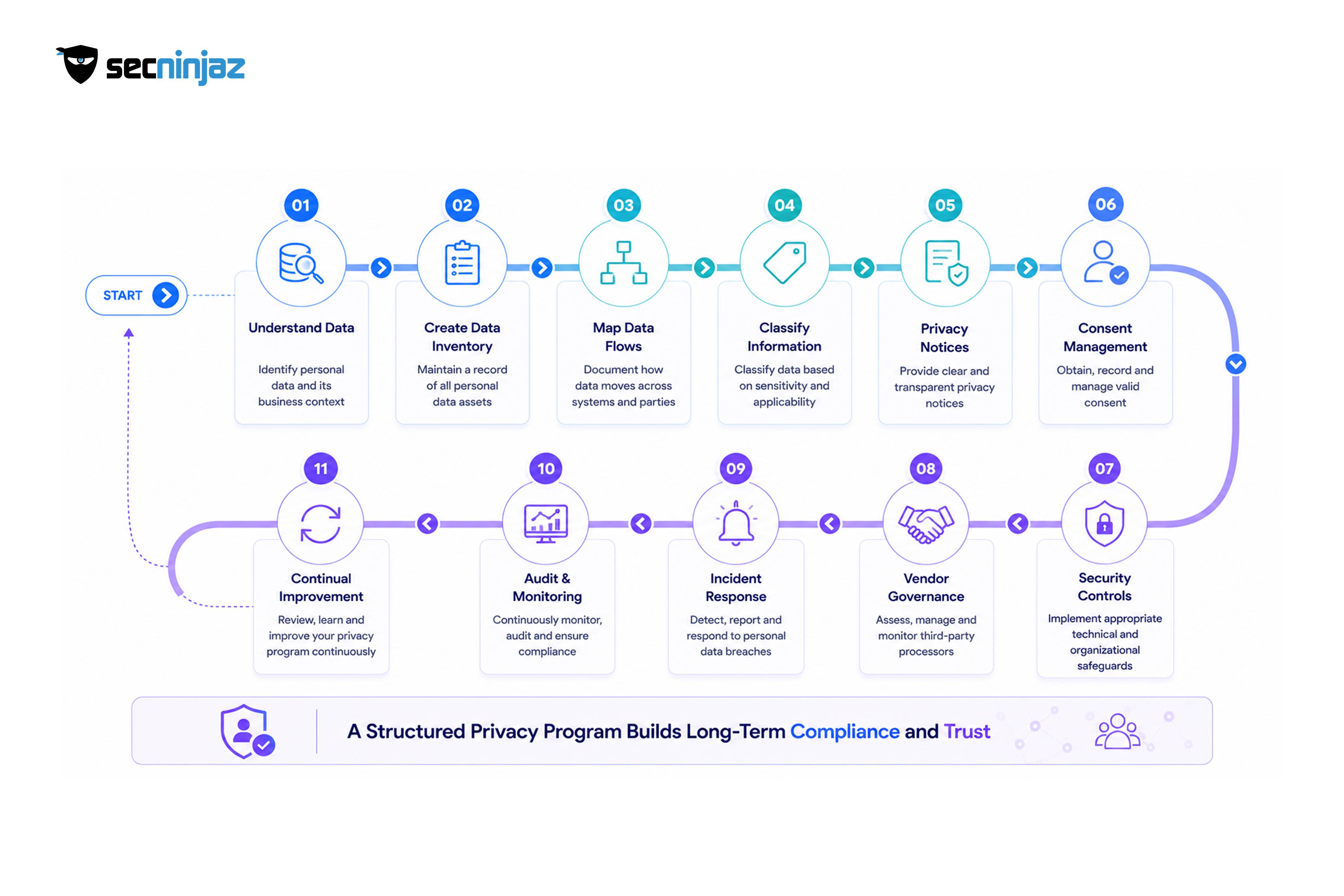 ### Step 4: Review and Update Privacy Notices
Privacy notices are usually the way people learn about how an organization handles their personal information. These notices need to say what personal data is gathered why it is gathered how it is used if it is given to other companies how long it is kept and how people can manage their information. Many companies use privacy notices that're the same for everyone or use complicated legal words. These types of notices might not help the company achieve its goals or meet what people want.
A good privacy notice should be:
- Written in plain and easy to understand words.
- Easy to find when personal data is collected.
- Tailored to what the organization does.
- Checked often to make sure it matches any changes, in how the company works or what the law says.
Different parts of a business might need privacy notices. For example:
- Customer Privacy Notice
- Employee Privacy Notice
- Recruitment Privacy Notice
- Website Privacy Notice
- Mobile Application Privacy Notice
Privacy notices need to show what the organization does — not what a template says it does.
Step 5: Implement Effective Consent Management
Consent is one of the aspects of privacy compliance. It is relied upon for processing. Organizations should make sure that consent mechanisms are designed to give individuals choice and clear information. A good consent management process should let organizations do the following. Record the time when consent was given. Record the reason why consent was given. Keep proof of consent. Watch for any changes to consent. Record when consent is taken back. Stop processing when needed after consent is removed. Consent management should not depend on pictures or paper records. When possible organizations should put consent records into customer relationship management systems, other applications or special consent management tools. Consent should be checked now. Then to make sure it still fits with how data is being used.
Step 6: Strengthen Technical and Organizational Security Controls
Privacy does not work without security. The best plans for privacy are useless if someone can get to information when they are not supposed to or if security is not good enough. Companies need to make sure their privacy plans match the way they manage security, for information. To be secure companies should do things like:
Identity & Access Management They have to make sure employees can only see the information that they need to do their jobs. Companies have to make sure that security is good so that privacy can really exist for data.
Multi-Factor Authentication Keep accounts and remote access safe by using extra ways to check who is trying to log in.
Encryption Keep information safe when it is stored and when it is sent by using strong encryption tools.
Vulnerability Management Find problems that could let personal data be seen by others and fix them quickly.
Backup & Recovery Make sure personal data can be brought back after a cyber attack or a system crash.
Logging & Monitoring Keep records of what's happening so that any strange activity involving personal data can be noticed.
Employee Awareness People make mistakes. That is one of the main reasons why privacy problems happen. Regular training should teach employees about:
- Privacy responsibilities
- How to handle data safely
- How to spot phishing attempts
- How to use strong passwords
- How to report problems
- How to use AI tools properly
- How to avoid social engineering tricks
Privacy awareness should be part of the way the company works every day not just something that happens once a year, as a rule.
Step 7: Strengthen Vendor Privacy Management
Most companies do not handle all information by themselves. They usually get help to manage things like customer information and employee records and payroll and cloud infrastructure and marketing platforms and payment gateways and AI services and CRM solutions and support platforms. Every time you work with someone outside your company to handle information you are taking a bigger risk with peoples privacy. So companies should have a system in place to manage how they work with these outside parties when it comes to privacy.
Before you start working with a vendor you should ask yourself some questions.
- What kind of information will this vendor be able to see?
- Why do they need to see this information?
- Does the vendor have security measures in place?
- Have they had any security problems in the past?
- Do they work with companies to handle information?
- Are there rules about how they will handle privacy issues?
- How will you make sure they are following the rules?
You should keep an eye on the vendors you work with all the time not when you first sign a contract with them. You should check in with them regularly to make sure they are still handling privacy risks in a way. This helps make sure that personal information is safe. You need to keep working with the vendor to make sure they are doing things right. That means Third-Party Privacy Management is an ongoing process for companies and Third-Party Privacy Management is very important, for companies. Companies should always be thinking about Third-Party Privacy Management. How it affects their personal data and Third-Party Privacy Management is a key part of how companies handle personal data.
Step 8: Prepare for Personal Data Breaches
No organization can completely stop the chance of a security incident happening. What makes strong organizations different is how well they get ready for deal with and fix things after these events.
A plan for responding to a breach of data should explain:
- Detection — How will problems be found?
- Reporting — Who should workers tell?
- Assessment — What details were affected?
- Containment — How will more damage be stopped?
- Investigation — What led to the problem?
- Recovery — How will the business go back, to normal?
- Lessons Learned — How will the same problem be avoided time?
Frequent practice sessions and fake incident tests can help organizations get better prepared.
Step 9: Monitor Compliance Continuously
Privacy compliance is not something you do once. Then forget about. Organizations are always making changes like introducing products hiring new employees working with vendors using artificial intelligence solutions and trying out new technologies. Each of these changes can bring up things to think about when it comes to privacy.
So a good privacy program needs to keep an eye on things all the time through things like:
- Internal privacy reviews
- Compliance assessments
- Risk assessments
- Vendor reviews
- Policy reviews
- Security monitoring
- Audits
- Corrective action tracking
- Management reporting
Privacy compliance programs that keep a close eye, on things can help organizations see potential problems before they become big issues. This way organizations can deal with privacy compliance all the time not once. Privacy compliance is a process that needs constant attention and this is what a mature privacy program does it keeps track of privacy compliance.
Step 10: Continually Improve Your Privacy Program
Privacy expectations, technologies, customer behaviors and regulatory requirements keep changing all the time. Companies need to check from time to time if their privacy rules are still working well.
Leadership should ask themselves these questions regularly:
- Are we handling types of personal information?
- Have we started using online services?
- Are our privacy statements still correct?
- Have we added suppliers?
- Are workers following the privacy rules they are supposed to follow?
- Have there been privacy problems?
- Are we doing a job when people ask for their data?
- Are our security measures still right?
Ongoing improvements make sure that the privacy plan grows with the company of getting left behind.
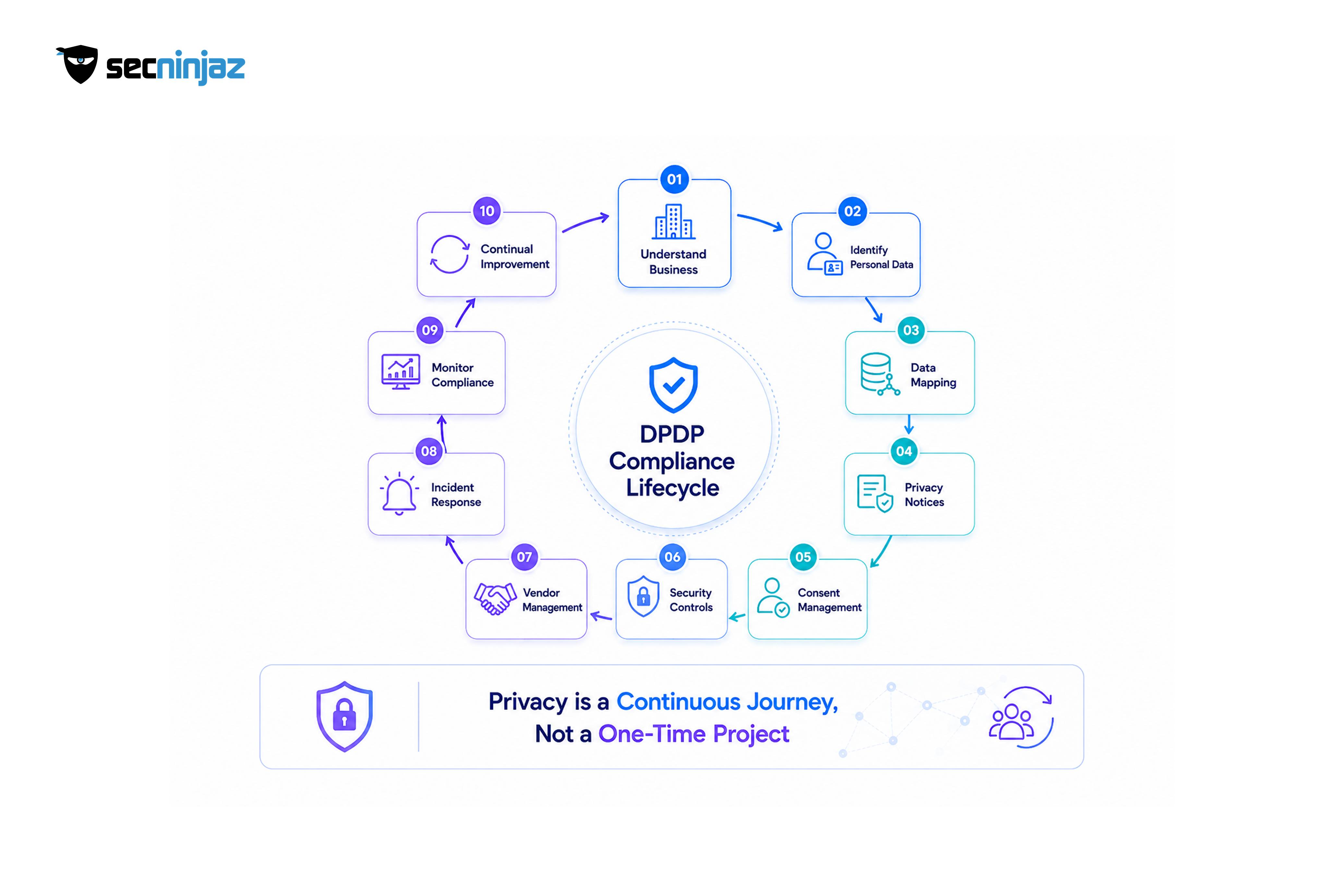 > SecNinjaz Insight: Many organizations understand what needs to be done but struggle with where to begin. Following a structured implementation roadmap helps prioritize activities, allocate resources effectively, and build a scalable privacy program that grows alongside the organization.
7. Common DPDP Compliance Challenges
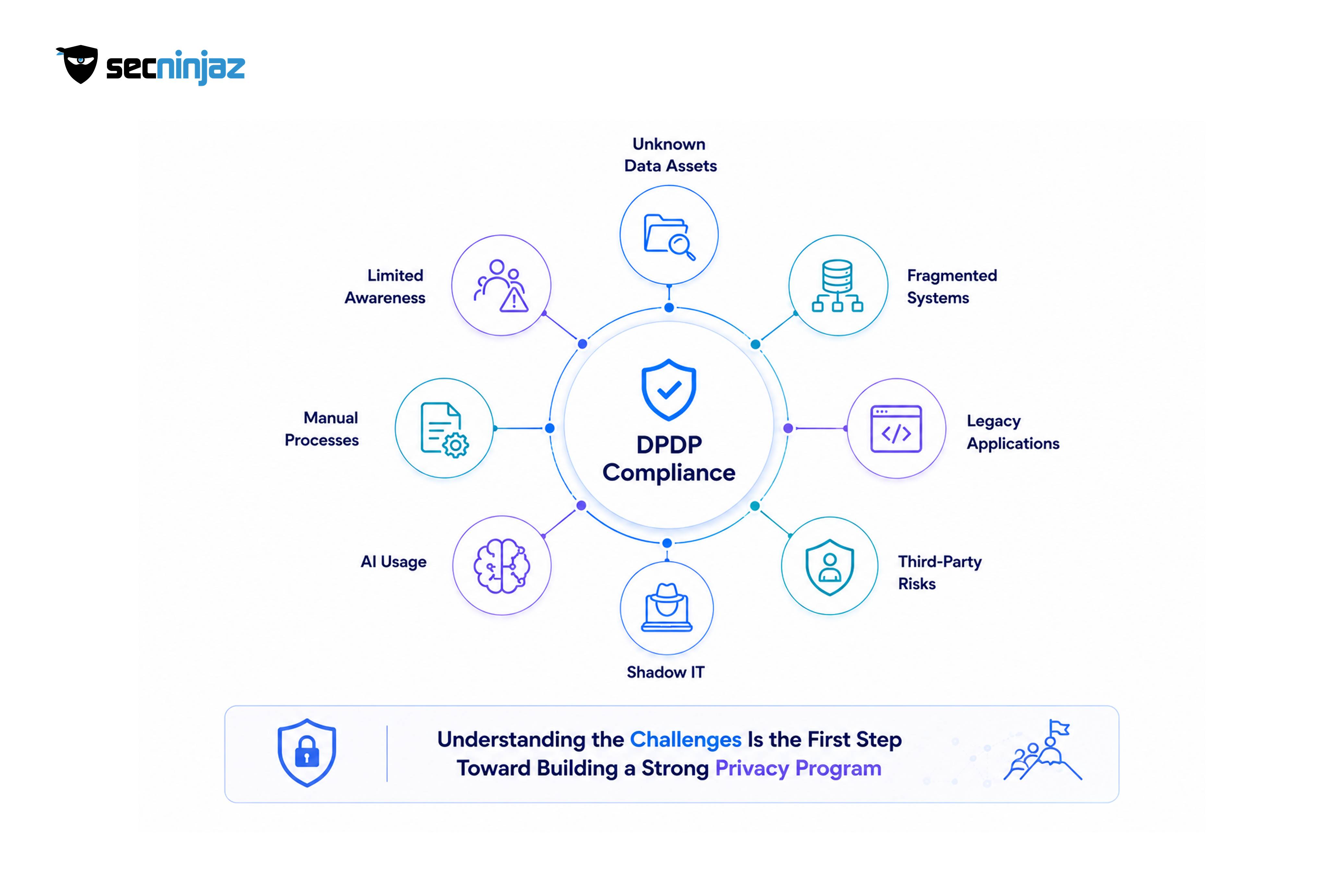
Many organizations know that privacy is important. It is hard to make a plan that really works for DPDP compliance. If organizations understand the problems they might face they can make a plan that's realistic and decide what to improve first.
One problem is that organizations do not know what data they have. They cannot answer questions like:
- What kind of personal data do we collect?
- Where is this data stored?
- Who can look at it?
- Why do we keep it?
If organizations do not know what data they have it is hard to make sure that this data is safe. Organizations also have different systems that store personal data, such as HR platforms, CRM applications, ERP solutions, marketing tools, cloud storage, collaboration platforms, spreadsheets and AI applications. This makes it hard to manage requests related to data and to keep security controls consistent. Old systems may not be able to do things that are required for privacy, such as managing consent automatically deleting data logging who looks at data or handling requests from people whose data is being stored. Organizations should look at their systems and find ways to improve them.
Many organizations also work with companies, such as cloud providers, software vendors, payroll providers, marketing agencies and AI platforms that handle personal data. If organizations do not have a way to manage these other companies they may not know how their personal data is being protected. Some employees use SaaS applications and AI tools without asking the IT or compliance teams. These tools can help employees be more productive. They can also create problems with privacy, security and following rules if personal data is shared without the right controls. Organizations should make rules about how to use AI services and cloud applications.
If organizations try to follow DPDP compliance rules by hand using spreadsheets to keep track of things it can become very hard as the organization grows. Using workflows, automation and governance tools can make things more efficient and reduce the risk of mistakes. The DPDP compliance is not about technology it is also about people. Employees handle data every day and if they are not trained to be careful they can make mistakes that put this data at risk. So it is very important to teach employees about privacy and how to handle data safely. This is just as important, as using technology to protect data. Organizations should make sure that employees know how to handle data and that they follow the rules. This way organizations can really protect data and follow DPDP compliance rules.
 | Level | Description | | --- | --- | | Level 1 | Ad Hoc | | Level 2 | Basic Documentation | | Level 3 | Defined Processes | | Level 4 | Integrated Privacy Governance | | Level 5 | Continuous Privacy Optimization |
SecNinjaz Insight: Recognizing privacy challenges early allows organizations to take proactive steps before they become significant compliance or business risks. Addressing issues such as poor data visibility, fragmented systems, and limited employee awareness creates a stronger foundation for sustainable privacy governance.
8. Best Practices for Sustainable DPDP Compliance
Achieving compliance with the DPDP Act is not a one-time milestone. Organizations continually introduce new technologies, onboard vendors, expand into new markets, and process additional categories of personal data. As business operations evolve, privacy risks evolve as well. Organizations that treat privacy as an ongoing governance function are better positioned to maintain compliance, strengthen customer trust, and respond to future regulatory developments. The following best practices can help organizations establish a sustainable privacy program.
1. Build Privacy into Business Processes
Privacy should be considered during the design of products, services, applications, and business processes — not after implementation. When privacy is integrated from the beginning, organizations can reduce implementation costs, minimize compliance gaps, and improve customer confidence.
2. Know What Personal Data You Process
Organizations cannot protect information they do not know exists. Maintain an up-to-date inventory of:
- Customer Data
- Employee Data
- Vendor Data
- Website Data
- Marketing Data
- AI Training Data (where applicable)
- Application Logs containing personal information
Review the inventory regularly as new systems and services are introduced.
3. Adopt Risk-Based Privacy Governance
Not every processing activity presents the same level of privacy risk. Organizations should identify:
- High-risk business processes
- Critical applications
- Sensitive information
- Third-party dependencies
- AI-enabled processing activities
Resources can then be prioritized toward the areas presenting the greatest business and privacy risks.
4. Strengthen Information Security
Privacy and cybersecurity should work together. Organizations should establish security controls that support confidentiality, integrity, and availability of personal data. Examples include:
- Access Control
- Encryption
- Multi-Factor Authentication
- Secure Configuration
- Vulnerability Management
- Logging & Monitoring
- Secure Backup
- Endpoint Protection
Security should be reviewed regularly as threats evolve.
5. Establish Strong Third-Party Governance
Every vendor processing personal data becomes part of your privacy ecosystem. Organizations should:
- Assess vendors before onboarding.
- Define privacy requirements in contracts.
- Periodically review vendor performance.
- Monitor security incidents.
- Reassess high-risk vendors.
- Ensure secure offboarding.
Vendor governance should continue throughout the relationship — not just during procurement.
6. Train Employees Regularly
Employees interact with personal information every day. Regular awareness programs should cover:
- Privacy Principles
- Secure Data Handling
- Password Security
- Phishing Awareness
- Incident Reporting
- Acceptable Use of AI Tools
- Clean Desk Practices
- Remote Working Security
An informed workforce is one of the most effective safeguards against privacy incidents.
7. Review Policies and Procedures Periodically
Business processes change, technology changes, and regulatory expectations change, so privacy documentation should evolve accordingly. Organizations should periodically review:
- Privacy Policy
- Data Retention Policy
- Information Security Policy
- Incident Response Plan
- Vendor Management Procedure
- Acceptable Use Policy
- AI Governance Policy (where applicable)
Regular reviews help ensure that documented practices continue to reflect actual business operations.
8. Perform Regular Privacy Audits
Periodic assessments help organizations identify weaknesses before they become compliance issues. Privacy audits should evaluate:
- Policy Implementation
- Data Inventory Accuracy
- Consent Management
- Third-Party Compliance
- Security Controls
- Privacy Requests
- Data Retention
- Incident Management
Audit findings should feed into continual improvement activities.
9. Monitor Regulatory Developments
Privacy regulation continues to evolve. Organizations should remain informed about:
- Updates to the DPDP framework
- Sector-specific regulatory requirements
- International privacy regulations
- Emerging AI governance requirements
- Cybersecurity regulations
Staying informed enables organizations to prepare proactively rather than reacting after changes occur.
10. Build a Culture of Privacy
The most successful privacy programs extend beyond legal and compliance teams. Privacy should become part of everyday decision-making across:
- Leadership
- Human Resources
- IT
- Procurement
- Marketing
- Sales
- Product Development
- Customer Support
- Operations
When employees understand that protecting personal information is everyone's responsibility, organizations become more resilient and trustworthy.
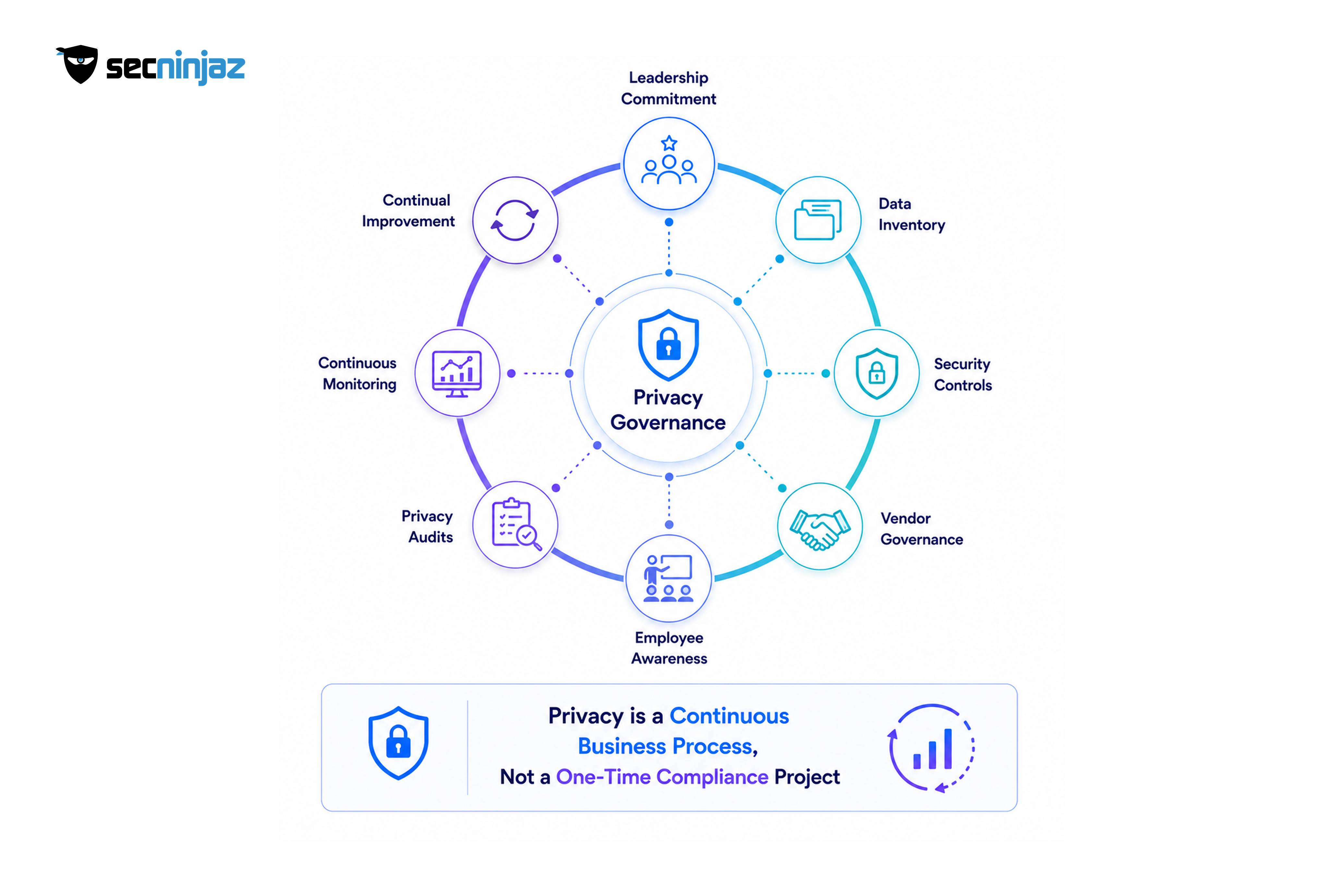 > SecNinjaz Insight: Privacy is not achieved through individual projects or annual compliance exercises. Organizations that embed privacy into governance, technology, culture, and decision-making create resilient businesses capable of adapting to changing regulations, customer expectations, and emerging technologies.
Privacy Compliance Is About Building Trust, Not Just Meeting Regulations
Many organizations begin their DPDP journey by updating privacy notices or creating documentation. While these activities are important, they represent only a small part of an effective privacy program. True compliance requires organizations to understand what personal data they process, identify associated risks, implement appropriate governance, strengthen security controls, manage third-party relationships, and continuously monitor the effectiveness of their privacy practices. Organizations that integrate privacy into everyday business operations are better positioned to:
- Build customer confidence.
- Reduce operational risks.
- Respond to regulatory changes.
- Support responsible innovation.
- Enable secure digital transformation.
At SecNinjaz, we believe privacy should become a business capability rather than a periodic compliance exercise.
9. How SecNinjaz Helps Organizations Achieve DPDP Compliance
Every organization has a unique privacy journey. Some organizations are beginning their first privacy assessment, while others need to strengthen existing governance frameworks, integrate privacy into business operations, or prepare for customer and regulatory expectations. SecNinjaz works with organizations to establish practical, risk-based privacy programs aligned with business objectives and regulatory requirements. Our approach focuses on building sustainable privacy capabilities rather than producing documentation alone.
Our DPDP compliance services include:
- DPDP Gap Assessment — Evaluate current privacy practices, identify compliance gaps, and develop a prioritized improvement roadmap.
- Personal Data Inventory & Data Mapping — Identify personal data across business processes, applications, cloud platforms, and third-party services.
- Privacy Governance Framework — Develop governance structures, define roles and responsibilities, and establish privacy management processes.
- Policy & Procedure Development — Create practical documentation tailored to your organization's operations, including privacy notices, data retention procedures, breach response plans, and vendor management processes.
- Privacy Risk Assessment — Identify privacy risks, assess business impact, and define appropriate mitigation strategies.
- Third-Party Privacy Assessments — Evaluate vendors that process personal data and strengthen third-party governance.
- Privacy Awareness & Training — Deliver organization-wide awareness programs to build a culture of privacy and responsible data handling.
- Internal Privacy Assessments — Review the effectiveness of privacy controls and support continual improvement initiatives.
Our objective is to help organizations move from fragmented privacy activities to a structured, scalable, and sustainable privacy management program.
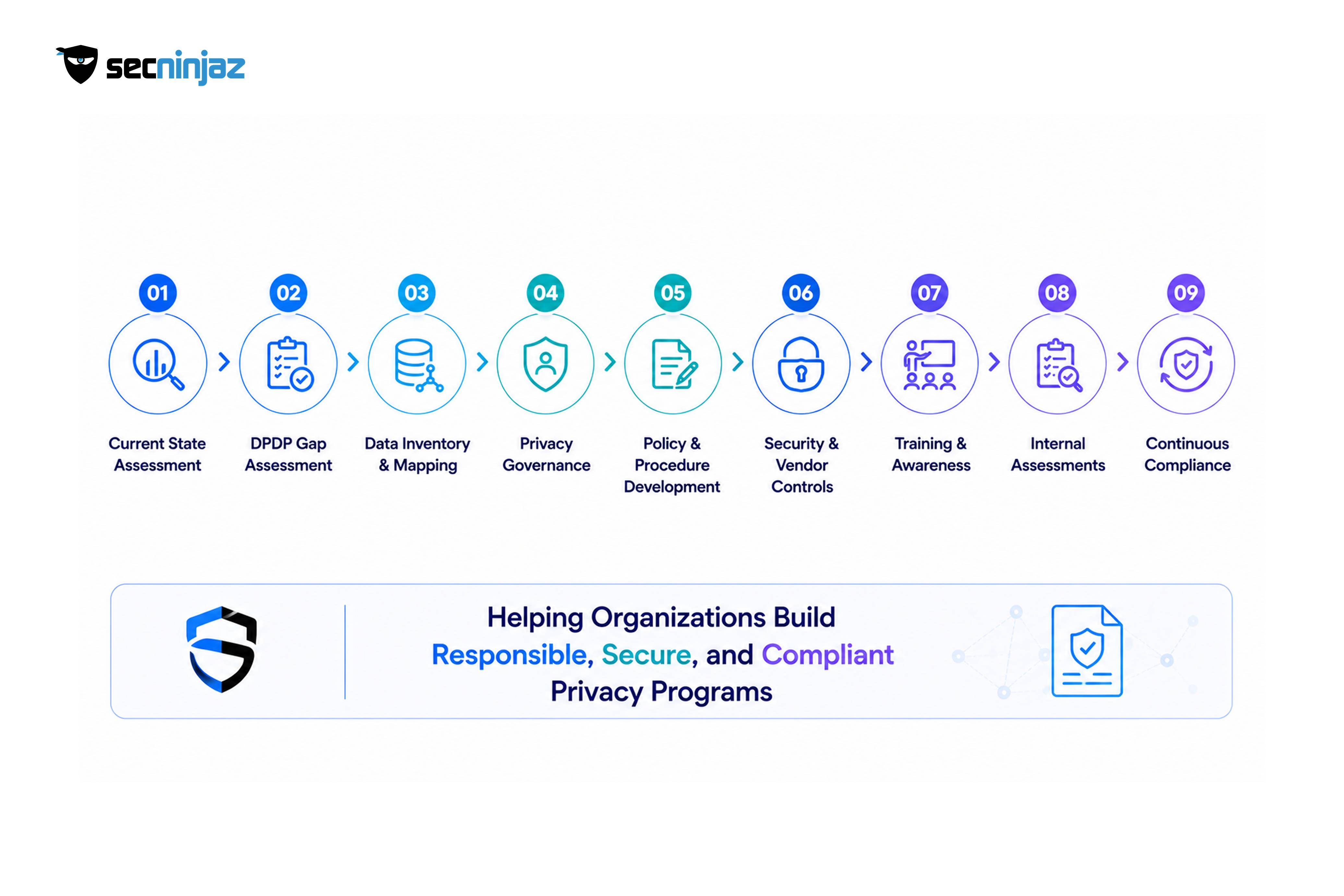 Helping Organizations Build Responsible, Secure, and Compliant Privacy Programs
Frequently Asked Questions
What is the DPDP Act, 2023?
The Digital Personal Data Protection (DPDP) Act, 2023 is India's primary legislation governing the processing of digital personal data. It establishes rights for individuals and responsibilities for organizations handling such data.
Who needs to comply with the DPDP Act?
Any organization that processes digital personal data within the scope of the Act should assess its obligations and implement appropriate privacy governance measures.
Does the DPDP Act apply to startups?
Yes. Applicability depends on the nature of personal data processing rather than the size of the organization.
What is a Data Fiduciary?
A Data Fiduciary is an organization or person that determines the purpose and means of processing personal data.
What is a Data Processor?
A Data Processor processes personal data on behalf of a Data Fiduciary according to its instructions.
What rights do individuals have under the DPDP Act?
The Act provides rights relating to access to information, correction and erasure where applicable, grievance redressal, nomination, and withdrawal of consent where consent is the basis for processing.
What are the key obligations for organizations?
Organizations should establish appropriate privacy governance, implement security safeguards, provide transparent privacy notices, manage consent where required, oversee third-party processors, maintain appropriate data practices, and prepare to respond to personal data breaches.
Does the DPDP Act require organizations to appoint a Data Protection Officer?
Certain additional obligations may apply to organizations notified as Significant Data Fiduciaries under the Act and related rules. Organizations should assess the latest regulatory requirements applicable to their circumstances.
How long does DPDP compliance take?
The timeline varies depending on the organization's size, complexity, existing governance maturity, technology landscape, and the volume of personal data processed.
How can organizations begin their DPDP compliance journey?
A practical starting point is to perform a privacy gap assessment, build a personal data inventory, map data flows, identify applicable obligations, and develop a prioritized implementation roadmap.
Conclusion
The Digital Personal Data Protection Act, 2023 marks an important step in strengthening privacy governance in India's digital economy. For organizations, compliance should not be viewed as a standalone legal obligation or a documentation exercise. It is an opportunity to establish stronger governance, improve information security, enhance customer trust, and support responsible digital transformation. Organizations that understand their personal data, implement appropriate governance, manage privacy risks, and continuously improve their controls will be better prepared for evolving regulatory expectations and changing business environments. Building an effective privacy program requires collaboration across leadership, legal, compliance, information security, technology, human resources, procurement, and business teams. The earlier organizations begin this journey, the easier it becomes to embed privacy into everyday operations rather than treating it as a reactive compliance activity.
Ready to Start Your DPDP Compliance Journey?
Whether you are beginning your privacy program or strengthening an existing framework, SecNinjaz can help you build a practical, risk-based approach to DPDP compliance.
Our experts support organizations with:
- DPDP Gap Assessments
- Privacy Governance Frameworks
- Data Inventory & Data Mapping
- Privacy Risk Assessments
- Vendor Privacy Management
- Policy & Procedure Development
- Privacy Awareness Training
- Internal Privacy Reviews
- Continuous Compliance Support
Privacy is no longer simply a legal obligation — it has become a competitive differentiator. Organizations that understand their personal data, establish effective governance, strengthen security controls, and embrace transparency are better positioned to earn customer trust, reduce operational risk, and support sustainable digital transformation. The DPDP Act provides organizations with an opportunity to move beyond compliance and build a culture of responsible data stewardship. Whether your organization is just beginning its privacy journey or looking to mature an existing program, the right governance framework today can become tomorrow's competitive advantage.
SecNinjaz Technologies - Where Cybersecurity Meets Intelligence.
Talk to us: +91-9289962965 · sales@secninjaz.com · www.secninjaz.com